 Add to Chrome
 Add to Firefox
 Add to Edge
Few-Shot and Pseudo-Label Guided Speech Quality Evaluation with Large Language Models
Apr 15, 2026
In this paper, we introduce GatherMOS, a novel framework that leverages large language models (LLM) as meta-evaluators to aggregate diverse signals into quality predictions. GatherMOS integrates lightweight acoustic descriptors with pseudo-labels from DNSMOS and VQScore, enabling the LLM to reason over heterogeneous inputs and infer perceptual mean opinion scores (MOS). We further explore both zero-shot and few-shot in-context learning setups, showing that zero-shot GatherMOS maintains stable performance across diverse conditions, while few-shot guidance yields large gains when support samples match the test conditions. Experiments on the VoiceBank-DEMAND dataset demonstrate that GatherMOS consistently outperforms DNSMOS, VQScore, naive score averaging, and even learning-based models such as CNN-BLSTM and MOS-SSL when trained under limited labeled-data conditions. These results highlight the potential of LLM-based aggregation as a practical strategy for non-intrusive speech quality evaluation.

Improving Perceptual Audio Aesthetic Assessment via Triplet Loss and Self-Supervised Embeddings
Sep 03, 2025We present a system for automatic multi-axis perceptual quality prediction of generative audio, developed for Track 2 of the AudioMOS Challenge 2025. The task is to predict four Audio Aesthetic Scores--Production Quality, Production Complexity, Content Enjoyment, and Content Usefulness--for audio generated by text-to-speech (TTS), text-to-audio (TTA), and text-to-music (TTM) systems. A main challenge is the domain shift between natural training data and synthetic evaluation data. To address this, we combine BEATs, a pretrained transformer-based audio representation model, with a multi-branch long short-term memory (LSTM) predictor and use a triplet loss with buffer-based sampling to structure the embedding space by perceptual similarity. Our results show that this improves embedding discriminability and generalization, enabling domain-robust audio quality assessment without synthetic training data.
HAAQI-Net: A non-intrusive neural music quality assessment model for hearing aids
Jan 02, 2024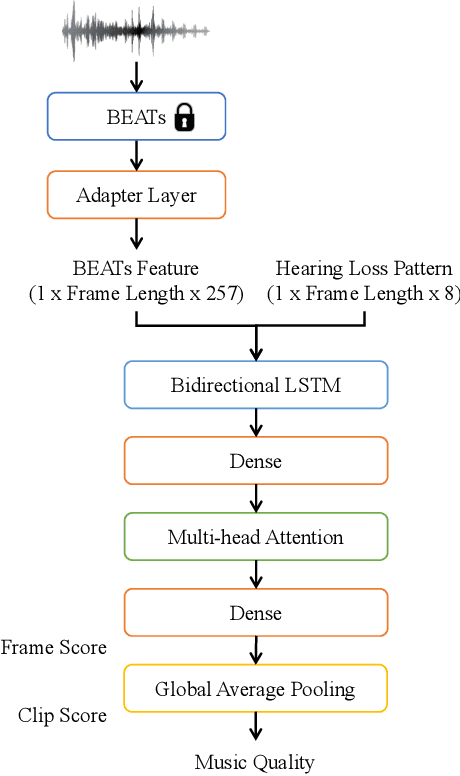
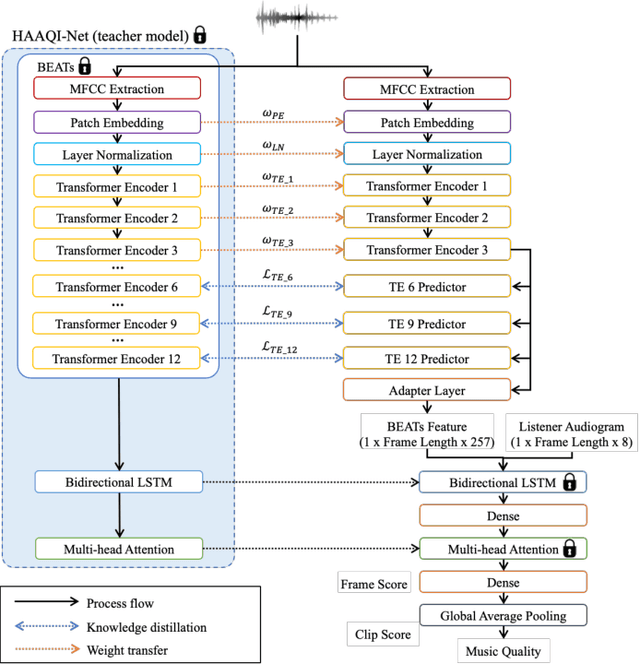
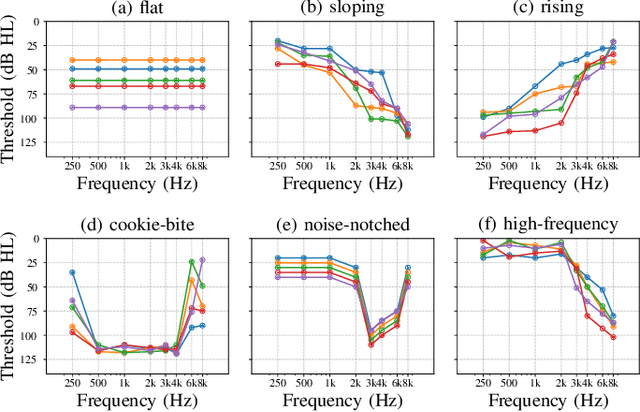
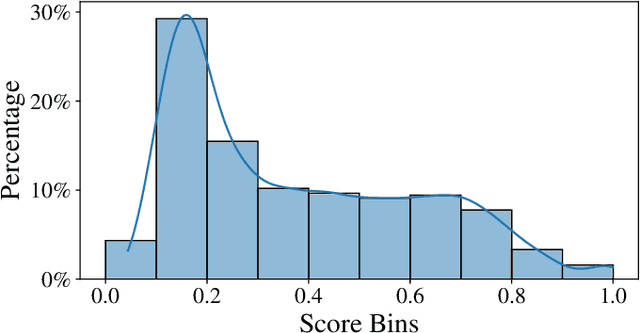
This paper introduces HAAQI-Net, a non-intrusive deep learning model for music quality assessment tailored to hearing aid users. In contrast to traditional methods like the Hearing Aid Audio Quality Index (HAAQI), HAAQI-Net utilizes a Bidirectional Long Short-Term Memory (BLSTM) with attention. It takes an assessed music sample and a hearing loss pattern as input, generating a predicted HAAQI score. The model employs the pre-trained Bidirectional Encoder representation from Audio Transformers (BEATs) for acoustic feature extraction. Comparing predicted scores with ground truth, HAAQI-Net achieves a Longitudinal Concordance Correlation (LCC) of 0.9257, Spearman's Rank Correlation Coefficient (SRCC) of 0.9394, and Mean Squared Error (MSE) of 0.0080. Notably, this high performance comes with a substantial reduction in inference time: from 62.52 seconds (by HAAQI) to 2.71 seconds (by HAAQI-Net), serving as an efficient music quality assessment model for hearing aid users.