 Add to Chrome
 Add to Firefox
 Add to Edge
NARRAS: Edge-Triggered Distributed Inference for CSI-Based Localization in Vehicular IoT Networks
Jun 10, 2026
CSI-based localization with spatially distributed antenna arrays exposes a basic resource trade-off. Each array can provide a rich view of the channel, but forwarding observations from all arrays to a fusion center is wasteful when only a few carry useful information, and the shared uplink supports only a limited number of simultaneous transmissions. We let each array decide locally whether its current observation is worth reporting, subject to a budget on the average number of active transmitters. We refer to this abstraction as Edge-Triggered Distributed Inference (ETDI). It captures a broader class of task-oriented communication problems where resource-constrained devices share an access channel for a common inference task. We instantiate ETDI for CSI-based localization, a common scenario in vehicular IoT networks. Spatially distributed remote antenna arrays (RAAs) encode local channel state information (CSI) from user equipment (UE) transmissions into latent features, and the fusion center estimates the UE position from the subset of reported features. We propose NARRAS, a decentralized reporting policy in which each RAA combines a recurrent summary of its recent observations with a memory of the last latent it transmitted. Training controls an explicit activity budget through differentiable activity penalties and validation-calibrated deterministic thresholds, and uses channel-chart regularization to shape the latent geometry. Experiments show that, at comparable uplink activity, NARRAS improves localization accuracy over learned and heuristic sparse-reporting strategies, while dense full-report models remain useful budget-free references. In low-activity regimes, chart regularization further reduces high-percentile localization errors, suggesting that geometry-aware latent representations are more robust under sparse reporting.

JGRA: Jacobian Geometry Robustness Assessment in NISQ Noise-Aware Quantum Neural Networks
Jun 08, 2026The NISQ era places stringent constraints on quantum computation, where noise and decoherence fundamentally limit performance. In classical deep learning, model robustness and resilience to perturbations are well studied: deep neural networks (DNNs) maintain high performance despite pruning, noise injection, and structural perturbations due to inherent redundancy in their representations. A central challenge in quantum machine learning is to transfer this notion of robustness to quantum neural networks (QNNs) under realistic NISQ noise. While classical deep learning exhibits robustness through structural redundancy, analogous principles for QNNs remain underdeveloped. We propose JGRA: a framework for assessing robustness in noise-aware QNNs via Jacobian geometry, capturing model sensitivity to parameter perturbations induced by noise. Our method includes entropy-matched noise calibration, noise-aware training, and noise-conditioned Jacobian extraction, yielding geometric descriptors that link clean-regime structure to noisy inference behaviour. We also empirically demonstrate that these descriptors encode predictive information about robustness under unseen noise.
Improving Perceptual Audio Aesthetic Assessment via Triplet Loss and Self-Supervised Embeddings
Sep 03, 2025We present a system for automatic multi-axis perceptual quality prediction of generative audio, developed for Track 2 of the AudioMOS Challenge 2025. The task is to predict four Audio Aesthetic Scores--Production Quality, Production Complexity, Content Enjoyment, and Content Usefulness--for audio generated by text-to-speech (TTS), text-to-audio (TTA), and text-to-music (TTM) systems. A main challenge is the domain shift between natural training data and synthetic evaluation data. To address this, we combine BEATs, a pretrained transformer-based audio representation model, with a multi-branch long short-term memory (LSTM) predictor and use a triplet loss with buffer-based sampling to structure the embedding space by perceptual similarity. Our results show that this improves embedding discriminability and generalization, enabling domain-robust audio quality assessment without synthetic training data.
PAUSE: Low-Latency and Privacy-Aware Active User Selection for Federated Learning
Mar 17, 2025Federated learning (FL) enables multiple edge devices to collaboratively train a machine learning model without the need to share potentially private data. Federated learning proceeds through iterative exchanges of model updates, which pose two key challenges: First, the accumulation of privacy leakage over time, and second, communication latency. These two limitations are typically addressed separately: The former via perturbed updates to enhance privacy and the latter using user selection to mitigate latency - both at the expense of accuracy. In this work, we propose a method that jointly addresses the accumulation of privacy leakage and communication latency via active user selection, aiming to improve the trade-off among privacy, latency, and model performance. To achieve this, we construct a reward function that accounts for these three objectives. Building on this reward, we propose a multi-armed bandit (MAB)-based algorithm, termed Privacy-aware Active User SElection (PAUSE) which dynamically selects a subset of users each round while ensuring bounded overall privacy leakage. We establish a theoretical analysis, systematically showing that the reward growth rate of PAUSE follows that of the best-known rate in MAB literature. To address the complexity overhead of active user selection, we propose a simulated annealing-based relaxation of PAUSE and analyze its ability to approximate the reward-maximizing policy under reduced complexity. We numerically validate the privacy leakage, associated improved latency, and accuracy gains of our methods for the federated training in various scenarios.
Age-of-Gradient Updates for Federated Learning over Random Access Channels
Oct 15, 2024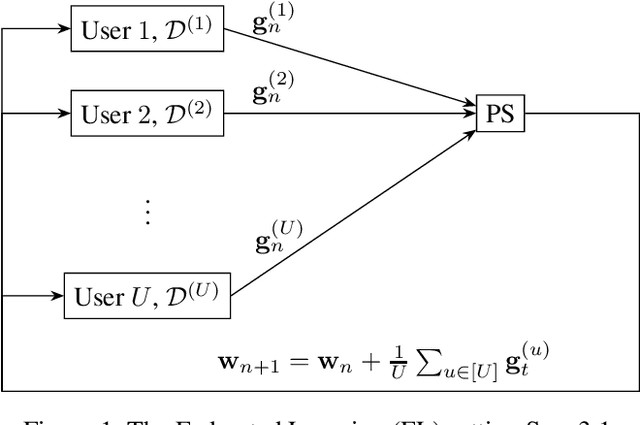
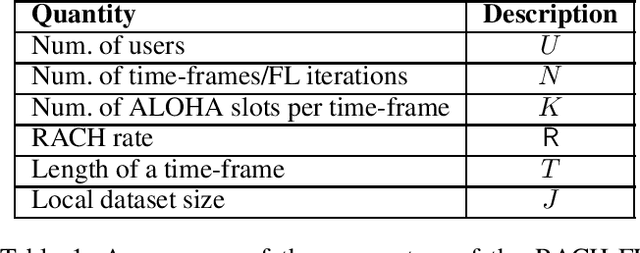

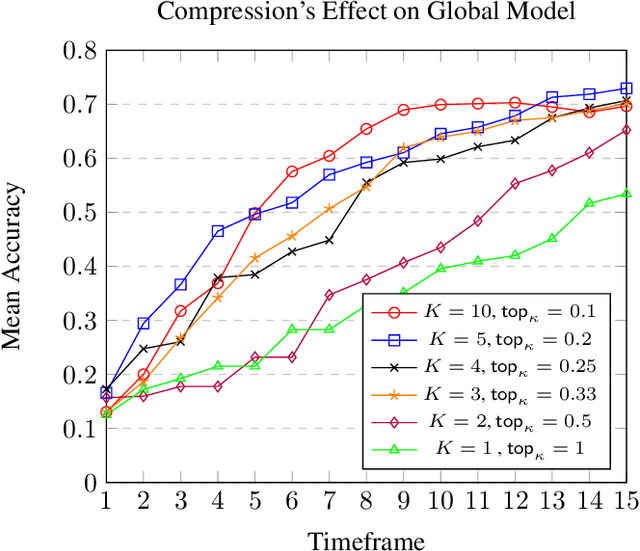
This paper studies the problem of federated training of a deep neural network (DNN) over a random access channel (RACH) such as in computer networks, wireless networks, and cellular systems. More precisely, a set of remote users participate in training a centralized DNN model using SGD under the coordination of a parameter server (PS). The local model updates are transmitted from the remote users to the PS over a RACH using a slotted ALOHA protocol. The PS collects the updates from the remote users, accumulates them, and sends central model updates to the users at regular time intervals. We refer to this setting as the RACH-FL setting. The RACH-FL setting crucially addresses the problem of jointly designing a (i) client selection and (ii) gradient compression strategy which addresses the communication constraints between the remote users and the PS when transmission occurs over a RACH. For the RACH-FL setting, we propose a policy, which we term the ''age-of-gradient'' (AoG) policy in which (i) gradient sparsification is performed using top-K sparsification, (ii) the error correction is performed using memory accumulation, and (iii) the slot transmission probability is obtained by comparing the current local memory magnitude minus the magnitude of the gradient update to a threshold. Intuitively, the AoG measure of ''freshness'' of the memory state is reminiscent of the concept of age-of-information (AoI) in the context of communication theory and provides a rather natural interpretation of this policy. Numerical simulations show the superior performance of the AoG policy as compared to other RACH-FL policies.
HAAQI-Net: A non-intrusive neural music quality assessment model for hearing aids
Jan 02, 2024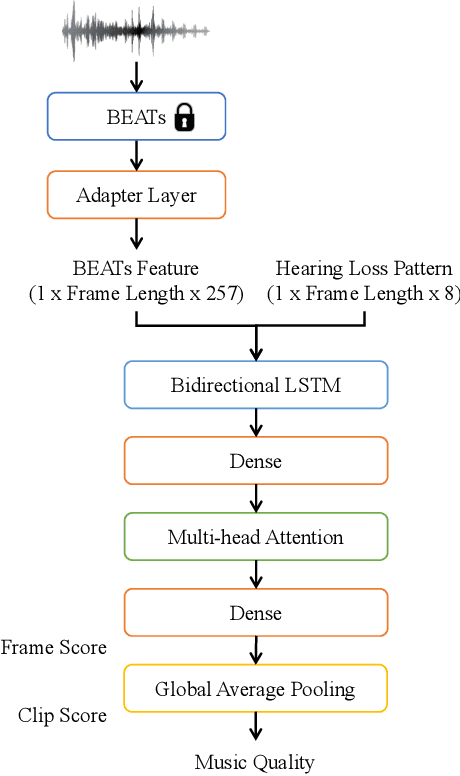
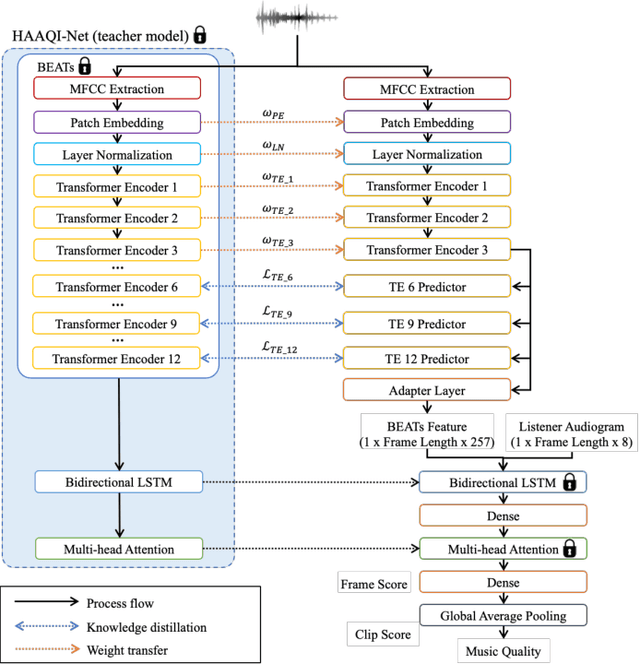
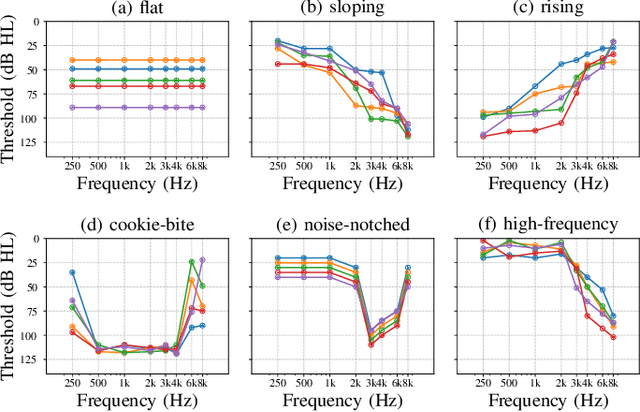
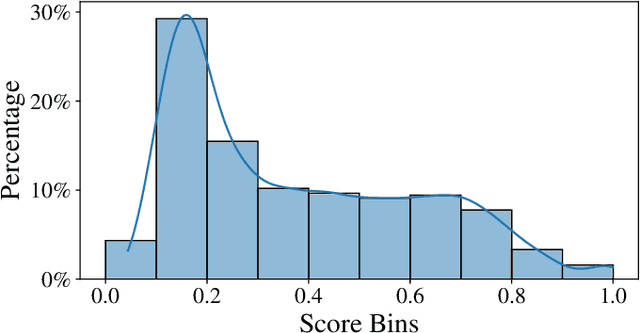
This paper introduces HAAQI-Net, a non-intrusive deep learning model for music quality assessment tailored to hearing aid users. In contrast to traditional methods like the Hearing Aid Audio Quality Index (HAAQI), HAAQI-Net utilizes a Bidirectional Long Short-Term Memory (BLSTM) with attention. It takes an assessed music sample and a hearing loss pattern as input, generating a predicted HAAQI score. The model employs the pre-trained Bidirectional Encoder representation from Audio Transformers (BEATs) for acoustic feature extraction. Comparing predicted scores with ground truth, HAAQI-Net achieves a Longitudinal Concordance Correlation (LCC) of 0.9257, Spearman's Rank Correlation Coefficient (SRCC) of 0.9394, and Mean Squared Error (MSE) of 0.0080. Notably, this high performance comes with a substantial reduction in inference time: from 62.52 seconds (by HAAQI) to 2.71 seconds (by HAAQI-Net), serving as an efficient music quality assessment model for hearing aid users.
Harmonic Retrieval Using Weighted Lifted-Structure Low-Rank Matrix Completion
Nov 08, 2023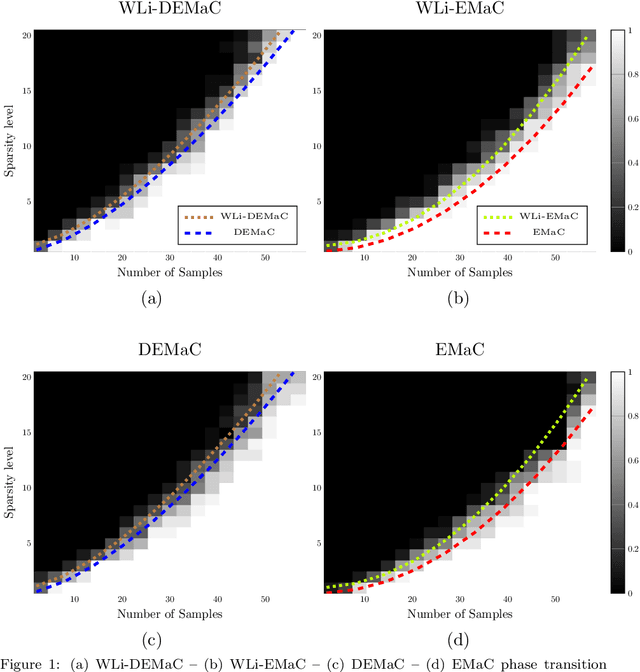
In this paper, we investigate the problem of recovering the frequency components of a mixture of $K$ complex sinusoids from a random subset of $N$ equally-spaced time-domain samples. Because of the random subset, the samples are effectively non-uniform. Besides, the frequency values of each of the $K$ complex sinusoids are assumed to vary continuously within a given range. For this problem, we propose a two-step strategy: (i) we first lift the incomplete set of uniform samples (unavailable samples are treated as missing data) into a structured matrix with missing entries, which is potentially low-rank; then (ii) we complete the matrix using a weighted nuclear minimization problem. We call the method a \emph{ weighted lifted-structured (WLi) low-rank matrix recovery}. Our approach can be applied to a range of matrix structures such as Hankel and double-Hankel, among others, and provides improvement over the unweighted existing schemes such as EMaC and DEMaC. We provide theoretical guarantees for the proposed method, as well as numerical simulations in both noiseless and noisy settings. Both the theoretical and the numerical results confirm the superiority of the proposed approach.
M22: A Communication-Efficient Algorithm for Federated Learning Inspired by Rate-Distortion
Jan 23, 2023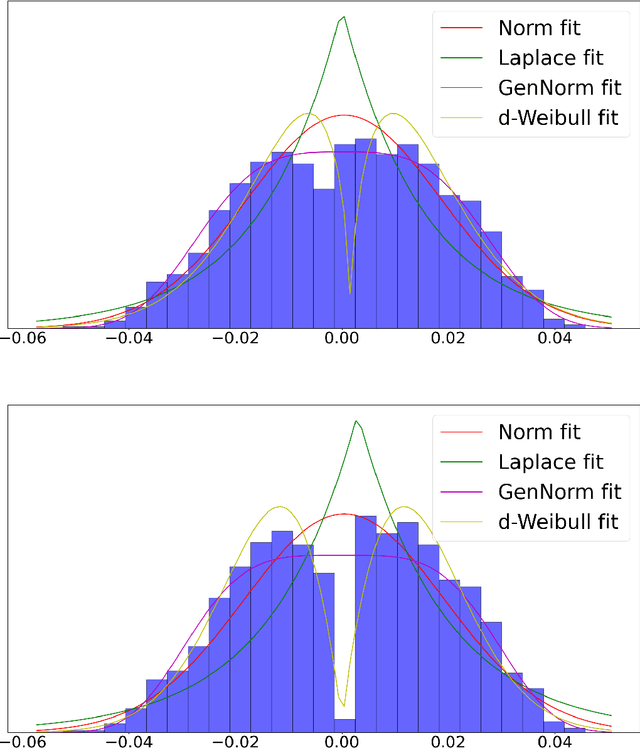
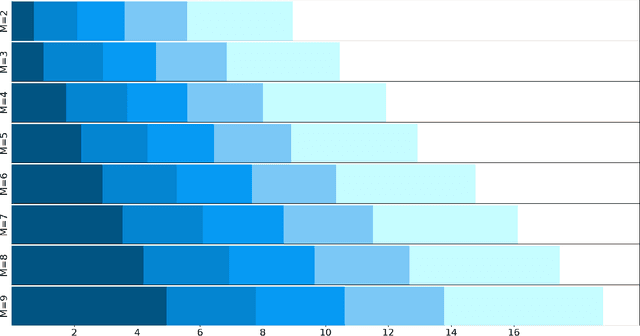
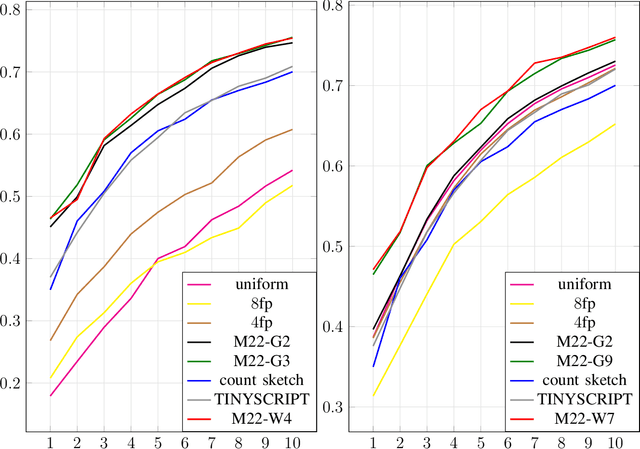
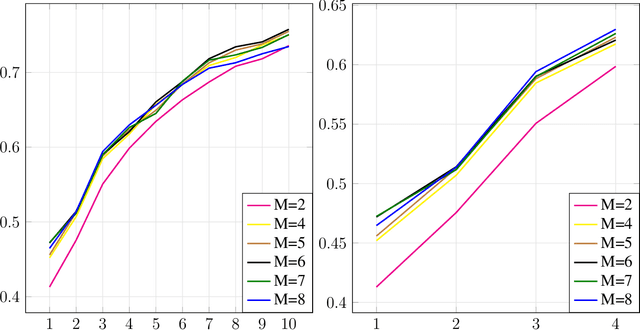
In federated learning (FL), the communication constraint between the remote learners and the Parameter Server (PS) is a crucial bottleneck. For this reason, model updates must be compressed so as to minimize the loss in accuracy resulting from the communication constraint. This paper proposes ``\emph{${\bf M}$-magnitude weighted $L_{\bf 2}$ distortion + $\bf 2$ degrees of freedom''} (M22) algorithm, a rate-distortion inspired approach to gradient compression for federated training of deep neural networks (DNNs). In particular, we propose a family of distortion measures between the original gradient and the reconstruction we referred to as ``$M$-magnitude weighted $L_2$'' distortion, and we assume that gradient updates follow an i.i.d. distribution -- generalized normal or Weibull, which have two degrees of freedom. In both the distortion measure and the gradient, there is one free parameter for each that can be fitted as a function of the iteration number. Given a choice of gradient distribution and distortion measure, we design the quantizer minimizing the expected distortion in gradient reconstruction. To measure the gradient compression performance under a communication constraint, we define the \emph{per-bit accuracy} as the optimal improvement in accuracy that one bit of communication brings to the centralized model over the training period. Using this performance measure, we systematically benchmark the choice of gradient distribution and distortion measure. We provide substantial insights on the role of these choices and argue that significant performance improvements can be attained using such a rate-distortion inspired compressor.
Empirical Risk Minimization with Generalized Relative Entropy Regularization
Nov 12, 2022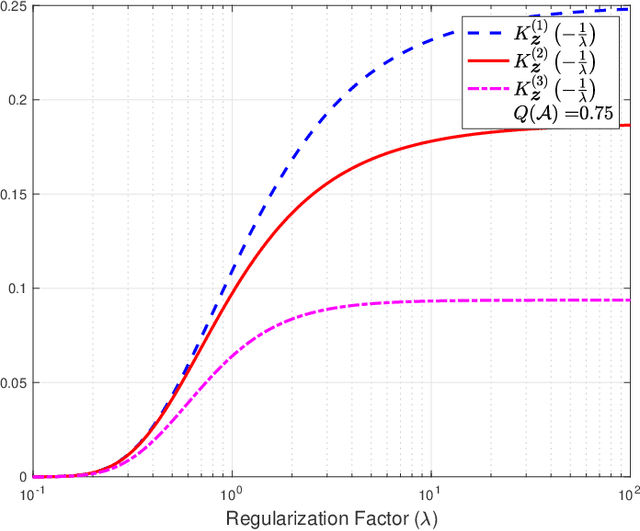
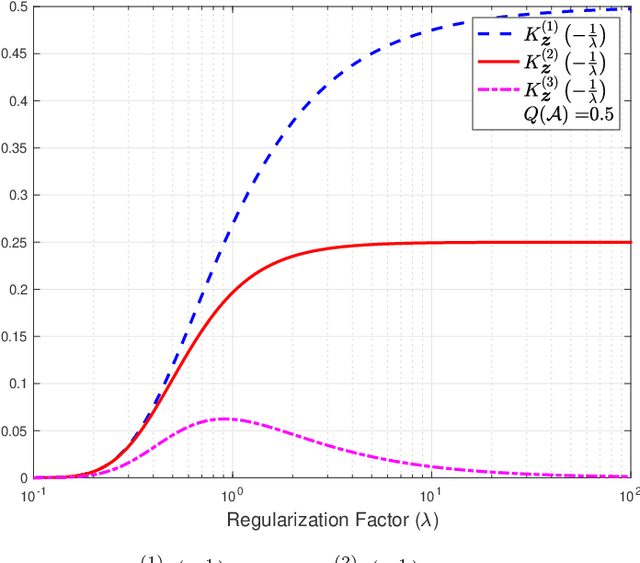
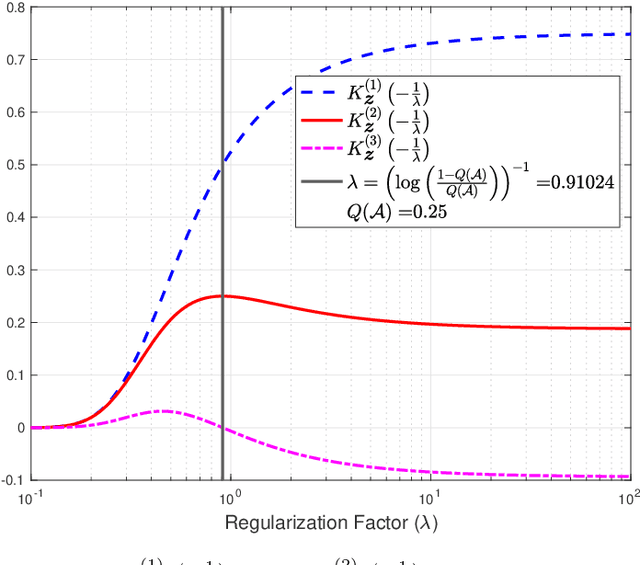
The empirical risk minimization (ERM) problem with relative entropy regularization (ERM-RER) is investigated under the assumption that the reference measure is a~$\sigma$-finite measure instead of a probability measure. This assumption leads to a generalization of the ERM-RER (g-ERM-RER) problem that allows for a larger degree of flexibility in the incorporation of prior knowledge over the set of models. The solution of the g-ERM-RER problem is shown to be a unique probability measure mutually absolutely continuous with the reference measure and to exhibit a probably-approximately-correct (PAC) guarantee for the ERM problem. For a given dataset, the empirical risk is shown to be a sub-Gaussian random variable when the models are sampled from the solution to the g-ERM-RER problem. Finally, the sensitivity of the expected empirical risk to deviations from the solution of the g-ERM-RER problem is studied. In particular, the expectation of the absolute value of sensitivity is shown to be upper bounded, up to a constant factor, by the square root of the lautum information between the models and the datasets.
Sharp asymptotics on the compression of two-layer neural networks
May 18, 2022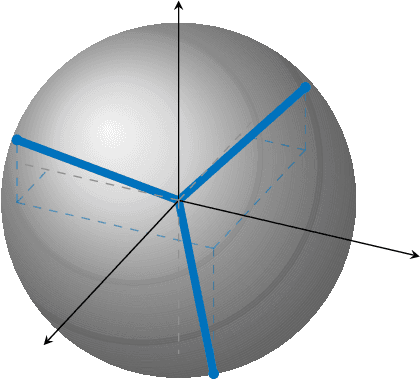
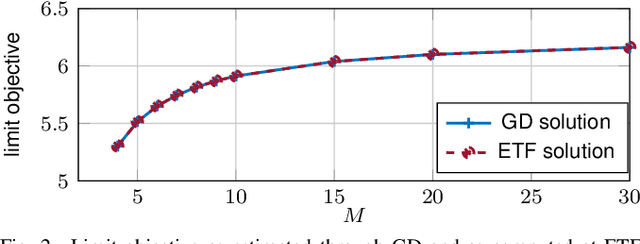
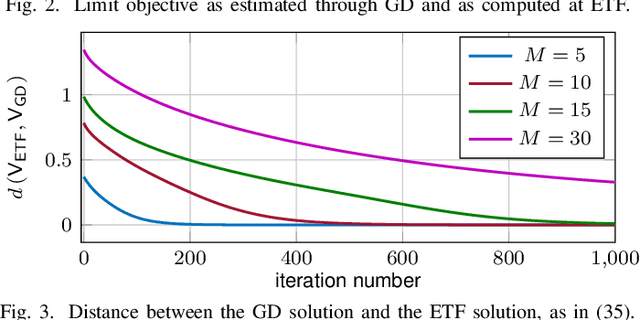

In this paper, we study the compression of a target two-layer neural network with N nodes into a compressed network with M < N nodes. More precisely, we consider the setting in which the weights of the target network are i.i.d. sub-Gaussian, and we minimize the population L2 loss between the outputs of the target and of the compressed network, under the assumption of Gaussian inputs. By using tools from high-dimensional probability, we show that this non-convex problem can be simplified when the target network is sufficiently over-parameterized, and provide the error rate of this approximation as a function of the input dimension and N . For a ReLU activation function, we conjecture that the optimum of the simplified optimization problem is achieved by taking weights on the Equiangular Tight Frame (ETF), while the scaling of the weights and the orientation of the ETF depend on the parameters of the target network. Numerical evidence is provided to support this conjecture.