 Add to Chrome
 Add to Firefox
 Add to Edge
Personalized Keyword Spotting for User-Defined Keywords Leveraging Text-Independent Speaker Verification
Jun 18, 2026
User-defined keyword spotting (UD-KWS) enables zero-shot wake-word detection from text, but existing systems learn speaker-invariant representations that cannot reject impostors uttering the correct keyword. We address this dual zero-shot setting -- unseen keywords and unseen speakers -- with ZP-KWS, a lightweight framework combining a phoneme-supervised audio encoder with a GE2E-pretrained compact speaker encoder (about 0.9M parameters). Multiplicative late fusion at inference grants each branch independent veto power, supporting modes from conventional detection to strict speaker-gated activation without retraining. On LibriPhrase, Google Speech Commands, and Qualcomm datasets, ZP-KWS reduces target-only FRR at 1% FAR by up to 60% relative to the strongest baseline while maintaining competitive keyword detection, all within a 1.55M parameter budget for edge deployment.

DeRA-MOS: Optimizing Text-to-Music Evaluation via Decoupled Listwise Ranking and Modality Alignment
Jun 08, 2026Evaluating text-to-music (TTM) systems remains expensive because music impression (MI) and text alignment (TA) scores rely on human mean opinion scores (MOS). Most automatic MOS estimators are trained with point-wise regression or distributional classification. These objectives do not directly optimize rank-based metrics and provide weak geometric constraints for cross-modal coherence. To address these gaps, we propose DeRA-MOS, a decoupled optimization framework for TTM evaluation. For MI, we introduce a batch-aware listwise ranking loss that models relative order within each mini-batch and better aligns with evaluation based on Spearman's rank correlation coefficient (SRCC). For TA, we introduce a score-anchored modality alignment loss that maps human scores to target audio-text similarity and regularizes the latent space before fusion. By effectively mitigating the point-wise training mismatch and modality drift, experiments on MusicEval demonstrate that our decoupled framework yields substantial improvements in both MI and TA ranking metrics, establishing a robust paradigm for large-scale TTM evaluation.
Robust Generative Audio Quality Assessment: Disentangling Quality from Spurious Correlations
Mar 17, 2026The rapid proliferation of AI-Generated Content (AIGC) has necessitated robust metrics for perceptual quality assessment. However, automatic Mean Opinion Score (MOS) prediction models are often compromised by data scarcity, predisposing them to learn spurious correlations-- such as dataset-specific acoustic signatures-- rather than generalized quality features. To address this, we leverage domain adversarial training (DAT) to disentangle true quality perception from these nuisance factors. Unlike prior works that rely on static domain priors, we systematically investigate domain definition strategies ranging from explicit metadata-driven labels to implicit data-driven clusters. Our findings reveal that there is no "one-size-fits-all" domain definition; instead, the optimal strategy is highly dependent on the specific MOS aspect being evaluated. Experimental results demonstrate that our aspect-specific domain strategy effectively mitigates acoustic biases, significantly improving correlation with human ratings and achieving superior generalization on unseen generative scenarios.
Efficient Dialect-Aware Modeling and Conditioning for Low-Resource Taiwanese Hakka Speech Processing
Feb 26, 2026Taiwanese Hakka is a low-resource, endangered language that poses significant challenges for automatic speech recognition (ASR), including high dialectal variability and the presence of two distinct writing systems (Hanzi and Pinyin). Traditional ASR models often encounter difficulties in this context, as they tend to conflate essential linguistic content with dialect-specific variations across both phonological and lexical dimensions. To address these challenges, we propose a unified framework grounded in the Recurrent Neural Network Transducers (RNN-T). Central to our approach is the introduction of dialect-aware modeling strategies designed to disentangle dialectal "style" from linguistic "content", which enhances the model's capacity to learn robust and generalized representations. Additionally, the framework employs parameter-efficient prediction networks to concurrently model ASR (Hanzi and Pinyin). We demonstrate that these tasks create a powerful synergy, wherein the cross-script objective serves as a mutual regularizer to improve the primary ASR tasks. Experiments conducted on the HAT corpus reveal that our model achieves 57.00% and 40.41% relative error rate reduction on Hanzi and Pinyin ASR, respectively. To our knowledge, this is the first systematic investigation into the impact of Hakka dialectal variations on ASR and the first single model capable of jointly addressing these tasks.
TG-ASR: Translation-Guided Learning with Parallel Gated Cross Attention for Low-Resource Automatic Speech Recognition
Feb 25, 2026Low-resource automatic speech recognition (ASR) continues to pose significant challenges, primarily due to the limited availability of transcribed data for numerous languages. While a wealth of spoken content is accessible in television dramas and online videos, Taiwanese Hokkien exemplifies this issue, with transcriptions often being scarce and the majority of available subtitles provided only in Mandarin. To address this deficiency, we introduce TG-ASR for Taiwanese Hokkien drama speech recognition, a translation-guided ASR framework that utilizes multilingual translation embeddings to enhance recognition performance in low-resource environments. The framework is centered around the parallel gated cross-attention (PGCA) mechanism, which adaptively integrates embeddings from various auxiliary languages into the ASR decoder. This mechanism facilitates robust cross-linguistic semantic guidance while ensuring stable optimization and minimizing interference between languages. To support ongoing research initiatives, we present YT-THDC, a 30-hour corpus of Taiwanese Hokkien drama speech with aligned Mandarin subtitles and manually verified Taiwanese Hokkien transcriptions. Comprehensive experiments and analyses identify the auxiliary languages that most effectively enhance ASR performance, achieving a 14.77% relative reduction in character error rate and demonstrating the efficacy of translation-guided learning for underrepresented languages in practical applications.
Universal Robust Speech Adaptation for Cross-Domain Speech Recognition and Enhancement
Feb 04, 2026Pre-trained models for automatic speech recognition (ASR) and speech enhancement (SE) have exhibited remarkable capabilities under matched noise and channel conditions. However, these models often suffer from severe performance degradation when confronted with domain shifts, particularly in the presence of unseen noise and channel distortions. In view of this, we in this paper present URSA-GAN, a unified and domain-aware generative framework specifically designed to mitigate mismatches in both noise and channel conditions. URSA-GAN leverages a dual-embedding architecture that consists of a noise encoder and a channel encoder, each pre-trained with limited in-domain data to capture domain-relevant representations. These embeddings condition a GAN-based speech generator, facilitating the synthesis of speech that is acoustically aligned with the target domain while preserving phonetic content. To enhance generalization further, we propose dynamic stochastic perturbation, a novel regularization technique that introduces controlled variability into the embeddings during generation, promoting robustness to unseen domains. Empirical results demonstrate that URSA-GAN effectively reduces character error rates in ASR and improves perceptual metrics in SE across diverse noisy and mismatched channel scenarios. Notably, evaluations on compound test conditions with both channel and noise degradations confirm the generalization ability of URSA-GAN, yielding relative improvements of 16.16% in ASR performance and 15.58% in SE metrics.
SCENE: Semantic-aware Codec Enhancement with Neural Embeddings
Jan 29, 2026Compression artifacts from standard video codecs often degrade perceptual quality. We propose a lightweight, semantic-aware pre-processing framework that enhances perceptual fidelity by selectively addressing these distortions. Our method integrates semantic embeddings from a vision-language model into an efficient convolutional architecture, prioritizing the preservation of perceptually significant structures. The model is trained end-to-end with a differentiable codec proxy, enabling it to mitigate artifacts from various standard codecs without modifying the existing video pipeline. During inference, the codec proxy is discarded, and SCENE operates as a standalone pre-processor, enabling real-time performance. Experiments on high-resolution benchmarks show improved performance over baselines in both objective (MS-SSIM) and perceptual (VMAF) metrics, with notable gains in preserving detailed textures within salient regions. Our results show that semantic-guided, codec-aware pre-processing is an effective approach for enhancing compressed video streams.
Revealing the Role of Audio Channels in ASR Performance Degradation
Aug 12, 2025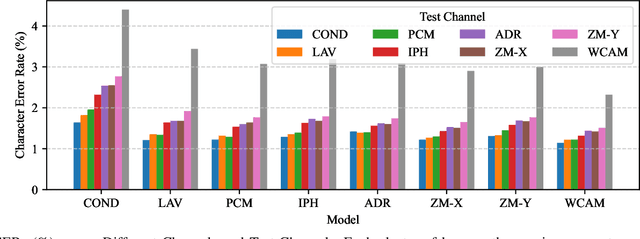
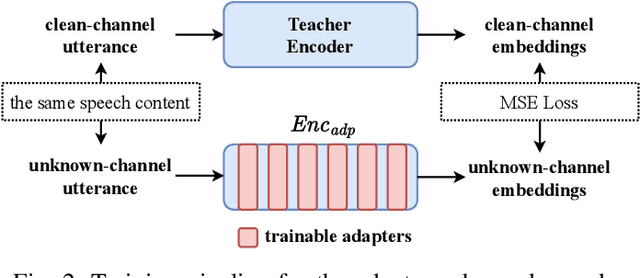
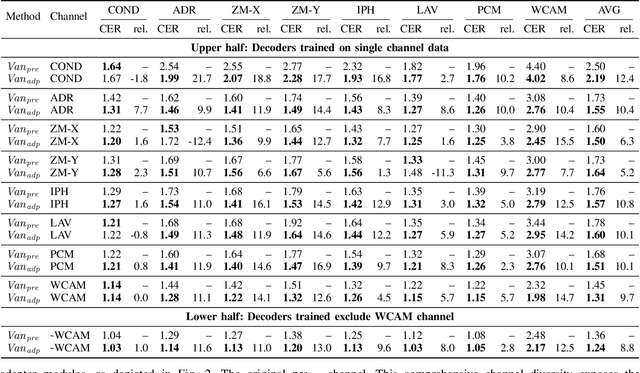
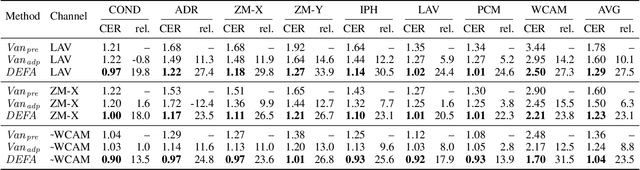
Pre-trained automatic speech recognition (ASR) models have demonstrated strong performance on a variety of tasks. However, their performance can degrade substantially when the input audio comes from different recording channels. While previous studies have demonstrated this phenomenon, it is often attributed to the mismatch between training and testing corpora. This study argues that variations in speech characteristics caused by different recording channels can fundamentally harm ASR performance. To address this limitation, we propose a normalization technique designed to mitigate the impact of channel variation by aligning internal feature representations in the ASR model with those derived from a clean reference channel. This approach significantly improves ASR performance on previously unseen channels and languages, highlighting its ability to generalize across channel and language differences.
QAMRO: Quality-aware Adaptive Margin Ranking Optimization for Human-aligned Assessment of Audio Generation Systems
Aug 12, 2025Evaluating audio generation systems, including text-to-music (TTM), text-to-speech (TTS), and text-to-audio (TTA), remains challenging due to the subjective and multi-dimensional nature of human perception. Existing methods treat mean opinion score (MOS) prediction as a regression problem, but standard regression losses overlook the relativity of perceptual judgments. To address this limitation, we introduce QAMRO, a novel Quality-aware Adaptive Margin Ranking Optimization framework that seamlessly integrates regression objectives from different perspectives, aiming to highlight perceptual differences and prioritize accurate ratings. Our framework leverages pre-trained audio-text models such as CLAP and Audiobox-Aesthetics, and is trained exclusively on the official AudioMOS Challenge 2025 dataset. It demonstrates superior alignment with human evaluations across all dimensions, significantly outperforming robust baseline models.
Enhancing Low-Resource Minority Language Translation with LLMs and Retrieval-Augmented Generation for Cultural Nuances
May 16, 2025This study investigates the challenges of translating low-resource languages by integrating Large Language Models (LLMs) with Retrieval-Augmented Generation (RAG). Various model configurations were tested on Hakka translations, with BLEU scores ranging from 12% (dictionary-only) to 31% (RAG with Gemini 2.0). The best-performing model (Model 4) combined retrieval and advanced language modeling, improving lexical coverage, particularly for specialized or culturally nuanced terms, and enhancing grammatical coherence. A two-stage method (Model 3) using dictionary outputs refined by Gemini 2.0 achieved a BLEU score of 26%, highlighting iterative correction's value and the challenges of domain-specific expressions. Static dictionary-based approaches struggled with context-sensitive content, demonstrating the limitations of relying solely on predefined resources. These results emphasize the need for curated resources, domain knowledge, and ethical collaboration with local communities, offering a framework that improves translation accuracy and fluency while supporting cultural preservation.