 Add to Chrome
 Add to Firefox
 Add to Edge
Few-shot Open Set Object Detection
Papers and Code
FSP-DETR: Few-Shot Prototypical Parasitic Ova Detection
Oct 10, 2025
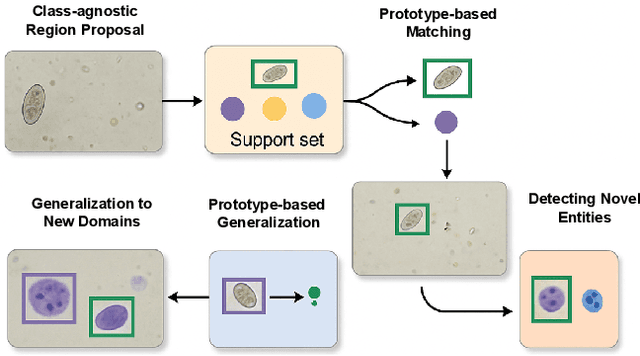
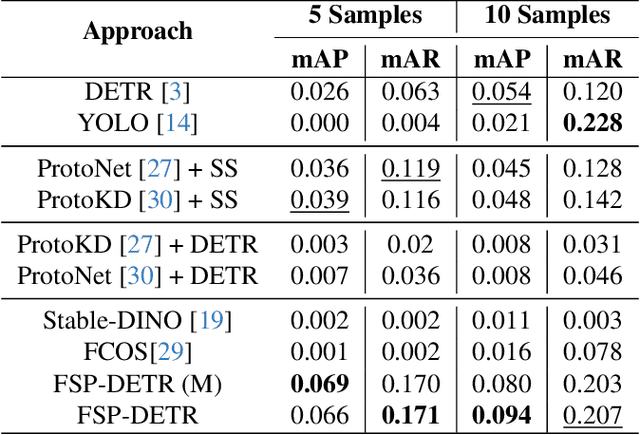
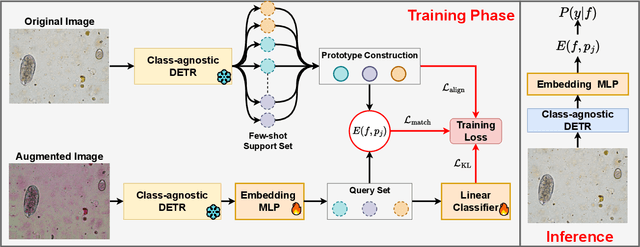
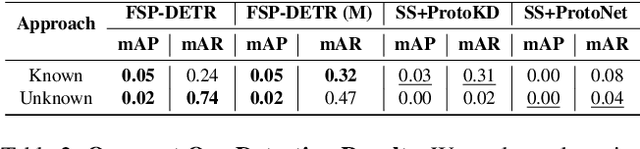
Object detection in biomedical settings is fundamentally constrained by the scarcity of labeled data and the frequent emergence of novel or rare categories. We present FSP-DETR, a unified detection framework that enables robust few-shot detection, open-set recognition, and generalization to unseen biomedical tasks within a single model. Built upon a class-agnostic DETR backbone, our approach constructs class prototypes from original support images and learns an embedding space using augmented views and a lightweight transformer decoder. Training jointly optimizes a prototype matching loss, an alignment-based separation loss, and a KL divergence regularization to improve discriminative feature learning and calibration under scarce supervision. Unlike prior work that tackles these tasks in isolation, FSP-DETR enables inference-time flexibility to support unseen class recognition, background rejection, and cross-task adaptation without retraining. We also introduce a new ova species detection benchmark with 20 parasite classes and establish standardized evaluation protocols. Extensive experiments across ova, blood cell, and malaria detection tasks demonstrate that FSP-DETR significantly outperforms prior few-shot and prototype-based detectors, especially in low-shot and open-set scenarios.

Hallucinate, Ground, Repeat: A Framework for Generalized Visual Relationship Detection
Jun 06, 2025Understanding relationships between objects is central to visual intelligence, with applications in embodied AI, assistive systems, and scene understanding. Yet, most visual relationship detection (VRD) models rely on a fixed predicate set, limiting their generalization to novel interactions. A key challenge is the inability to visually ground semantically plausible, but unannotated, relationships hypothesized from external knowledge. This work introduces an iterative visual grounding framework that leverages large language models (LLMs) as structured relational priors. Inspired by expectation-maximization (EM), our method alternates between generating candidate scene graphs from detected objects using an LLM (expectation) and training a visual model to align these hypotheses with perceptual evidence (maximization). This process bootstraps relational understanding beyond annotated data and enables generalization to unseen predicates. Additionally, we introduce a new benchmark for open-world VRD on Visual Genome with 21 held-out predicates and evaluate under three settings: seen, unseen, and mixed. Our model outperforms LLM-only, few-shot, and debiased baselines, achieving mean recall (mR@50) of 15.9, 13.1, and 11.7 on predicate classification on these three sets. These results highlight the promise of grounded LLM priors for scalable open-world visual understanding.
Vision-Language Model for Object Detection and Segmentation: A Review and Evaluation
Apr 13, 2025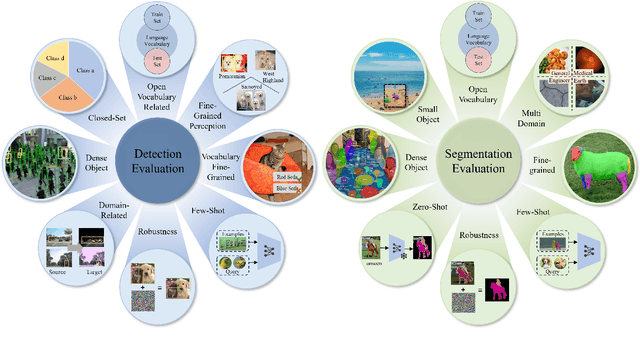
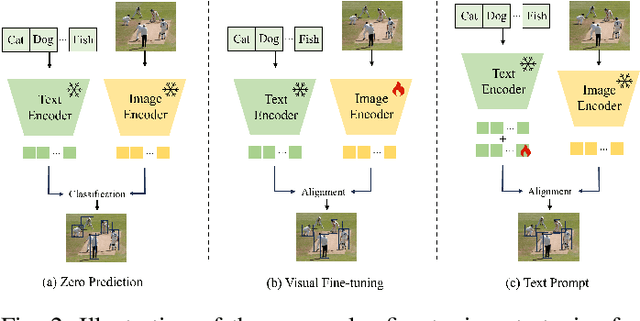
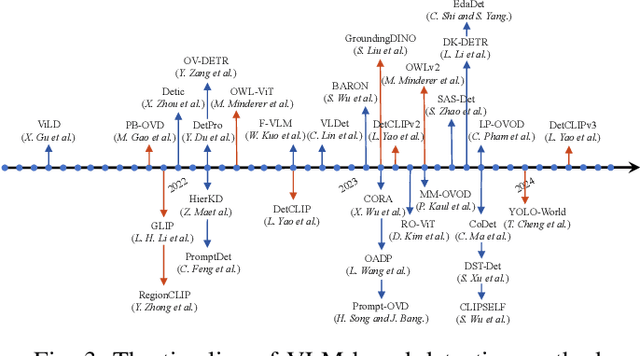
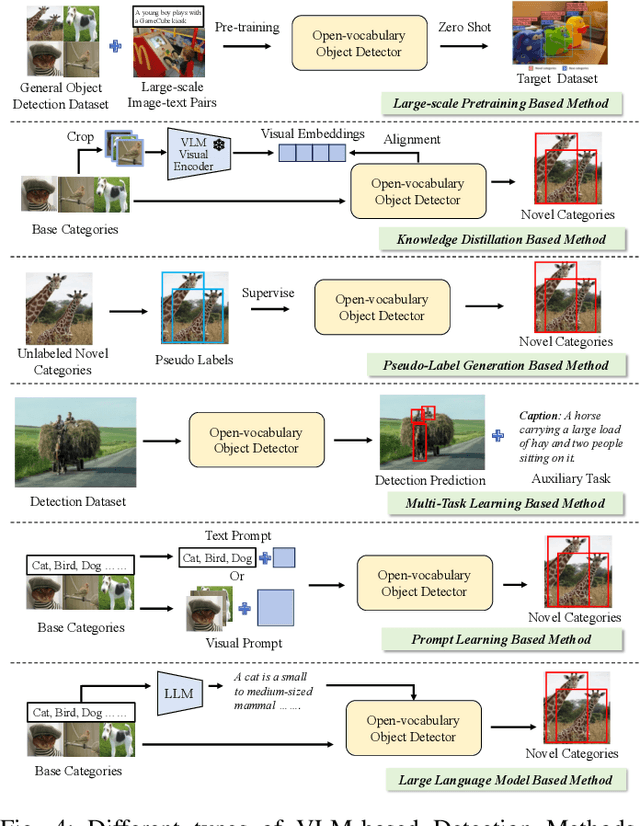
Vision-Language Model (VLM) have gained widespread adoption in Open-Vocabulary (OV) object detection and segmentation tasks. Despite they have shown promise on OV-related tasks, their effectiveness in conventional vision tasks has thus far been unevaluated. In this work, we present the systematic review of VLM-based detection and segmentation, view VLM as the foundational model and conduct comprehensive evaluations across multiple downstream tasks for the first time: 1) The evaluation spans eight detection scenarios (closed-set detection, domain adaptation, crowded objects, etc.) and eight segmentation scenarios (few-shot, open-world, small object, etc.), revealing distinct performance advantages and limitations of various VLM architectures across tasks. 2) As for detection tasks, we evaluate VLMs under three finetuning granularities: \textit{zero prediction}, \textit{visual fine-tuning}, and \textit{text prompt}, and further analyze how different finetuning strategies impact performance under varied task. 3) Based on empirical findings, we provide in-depth analysis of the correlations between task characteristics, model architectures, and training methodologies, offering insights for future VLM design. 4) We believe that this work shall be valuable to the pattern recognition experts working in the fields of computer vision, multimodal learning, and vision foundation models by introducing them to the problem, and familiarizing them with the current status of the progress while providing promising directions for future research. A project associated with this review and evaluation has been created at https://github.com/better-chao/perceptual_abilities_evaluation.
Few-Shot Adaptation of Grounding DINO for Agricultural Domain
Apr 09, 2025Deep learning models are transforming agricultural applications by enabling automated phenotyping, monitoring, and yield estimation. However, their effectiveness heavily depends on large amounts of annotated training data, which can be labor and time intensive. Recent advances in open-set object detection, particularly with models like Grounding-DINO, offer a potential solution to detect regions of interests based on text prompt input. Initial zero-shot experiments revealed challenges in crafting effective text prompts, especially for complex objects like individual leaves and visually similar classes. To address these limitations, we propose an efficient few-shot adaptation method that simplifies the Grounding-DINO architecture by removing the text encoder module (BERT) and introducing a randomly initialized trainable text embedding. This method achieves superior performance across multiple agricultural datasets, including plant-weed detection, plant counting, insect identification, fruit counting, and remote sensing tasks. Specifically, it demonstrates up to a $\sim24\%$ higher mAP than fully fine-tuned YOLO models on agricultural datasets and outperforms previous state-of-the-art methods by $\sim10\%$ in remote sensing, under few-shot learning conditions. Our method offers a promising solution for automating annotation and accelerating the development of specialized agricultural AI solutions.
NTIRE 2025 Challenge on Cross-Domain Few-Shot Object Detection: Methods and Results
Apr 14, 2025Cross-Domain Few-Shot Object Detection (CD-FSOD) poses significant challenges to existing object detection and few-shot detection models when applied across domains. In conjunction with NTIRE 2025, we organized the 1st CD-FSOD Challenge, aiming to advance the performance of current object detectors on entirely novel target domains with only limited labeled data. The challenge attracted 152 registered participants, received submissions from 42 teams, and concluded with 13 teams making valid final submissions. Participants approached the task from diverse perspectives, proposing novel models that achieved new state-of-the-art (SOTA) results under both open-source and closed-source settings. In this report, we present an overview of the 1st NTIRE 2025 CD-FSOD Challenge, highlighting the proposed solutions and summarizing the results submitted by the participants.
From Dataset to Real-world: General 3D Object Detection via Generalized Cross-domain Few-shot Learning
Mar 08, 2025LiDAR-based 3D object detection datasets have been pivotal for autonomous driving, yet they cover a limited range of objects, restricting the model's generalization across diverse deployment environments. To address this, we introduce the first generalized cross-domain few-shot (GCFS) task in 3D object detection, which focuses on adapting a source-pretrained model for high performance on both common and novel classes in a target domain with few-shot samples. Our solution integrates multi-modal fusion and contrastive-enhanced prototype learning within one framework, holistically overcoming challenges related to data scarcity and domain adaptation in the GCFS setting. The multi-modal fusion module utilizes 2D vision-language models to extract rich, open-set semantic knowledge. To address biases in point distributions across varying structural complexities, we particularly introduce a physically-aware box searching strategy that leverages laser imaging principles to generate high-quality 3D box proposals from 2D insights, enhancing object recall. To effectively capture domain-specific representations for each class from limited target data, we further propose a contrastive-enhanced prototype learning, which strengthens the model's adaptability. We evaluate our approach with three GCFS benchmark settings, and extensive experiments demonstrate the effectiveness of our solution for GCFS tasks. The code will be publicly available.
Visual-RFT: Visual Reinforcement Fine-Tuning
Mar 03, 2025Reinforcement Fine-Tuning (RFT) in Large Reasoning Models like OpenAI o1 learns from feedback on its answers, which is especially useful in applications when fine-tuning data is scarce. Recent open-source work like DeepSeek-R1 demonstrates that reinforcement learning with verifiable reward is one key direction in reproducing o1. While the R1-style model has demonstrated success in language models, its application in multi-modal domains remains under-explored. This work introduces Visual Reinforcement Fine-Tuning (Visual-RFT), which further extends the application areas of RFT on visual tasks. Specifically, Visual-RFT first uses Large Vision-Language Models (LVLMs) to generate multiple responses containing reasoning tokens and final answers for each input, and then uses our proposed visual perception verifiable reward functions to update the model via the policy optimization algorithm such as Group Relative Policy Optimization (GRPO). We design different verifiable reward functions for different perception tasks, such as the Intersection over Union (IoU) reward for object detection. Experimental results on fine-grained image classification, few-shot object detection, reasoning grounding, as well as open-vocabulary object detection benchmarks show the competitive performance and advanced generalization ability of Visual-RFT compared with Supervised Fine-tuning (SFT). For example, Visual-RFT improves accuracy by $24.3\%$ over the baseline in one-shot fine-grained image classification with around 100 samples. In few-shot object detection, Visual-RFT also exceeds the baseline by $21.9$ on COCO's two-shot setting and $15.4$ on LVIS. Our Visual-RFT represents a paradigm shift in fine-tuning LVLMs, offering a data-efficient, reward-driven approach that enhances reasoning and adaptability for domain-specific tasks.
Open-vocabulary vs. Closed-set: Best Practice for Few-shot Object Detection Considering Text Describability
Oct 20, 2024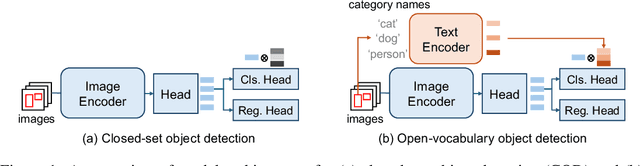
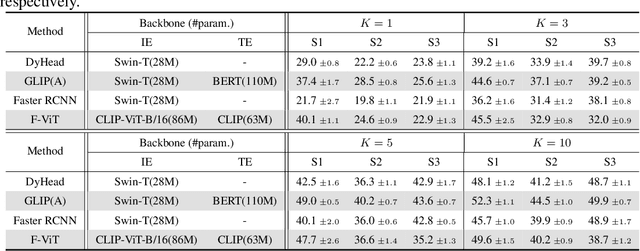
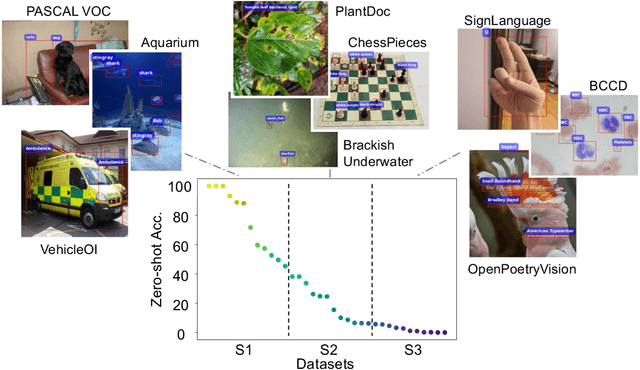
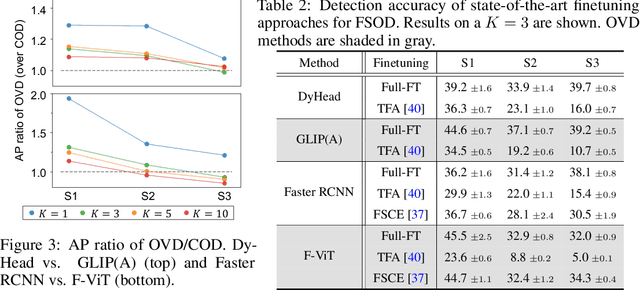
Open-vocabulary object detection (OVD), detecting specific classes of objects using only their linguistic descriptions (e.g., class names) without any image samples, has garnered significant attention. However, in real-world applications, the target class concepts is often hard to describe in text and the only way to specify target objects is to provide their image examples, yet it is often challenging to obtain a good number of samples. Thus, there is a high demand from practitioners for few-shot object detection (FSOD). A natural question arises: Can the benefits of OVD extend to FSOD for object classes that are difficult to describe in text? Compared to traditional methods that learn only predefined classes (referred to in this paper as closed-set object detection, COD), can the extra cost of OVD be justified? To answer these questions, we propose a method to quantify the ``text-describability'' of object detection datasets using the zero-shot image classification accuracy with CLIP. This allows us to categorize various OD datasets with different text-describability and emprically evaluate the FSOD performance of OVD and COD methods within each category. Our findings reveal that: i) there is little difference between OVD and COD for object classes with low text-describability under equal conditions in OD pretraining; and ii) although OVD can learn from more diverse data than OD-specific data, thereby increasing the volume of training data, it can be counterproductive for classes with low-text-describability. These findings provide practitioners with valuable guidance amidst the recent advancements of OVD methods.
DeepCRCEval: Revisiting the Evaluation of Code Review Comment Generation
Dec 24, 2024Code review is a vital but demanding aspect of software development, generating significant interest in automating review comments. Traditional evaluation methods for these comments, primarily based on text similarity, face two major challenges: inconsistent reliability of human-authored comments in open-source projects and the weak correlation of text similarity with objectives like enhancing code quality and detecting defects. This study empirically analyzes benchmark comments using a novel set of criteria informed by prior research and developer interviews. We then similarly revisit the evaluation of existing methodologies. Our evaluation framework, DeepCRCEval, integrates human evaluators and Large Language Models (LLMs) for a comprehensive reassessment of current techniques based on the criteria set. Besides, we also introduce an innovative and efficient baseline, LLM-Reviewer, leveraging the few-shot learning capabilities of LLMs for a target-oriented comparison. Our research highlights the limitations of text similarity metrics, finding that less than 10% of benchmark comments are high quality for automation. In contrast, DeepCRCEval effectively distinguishes between high and low-quality comments, proving to be a more reliable evaluation mechanism. Incorporating LLM evaluators into DeepCRCEval significantly boosts efficiency, reducing time and cost by 88.78% and 90.32%, respectively. Furthermore, LLM-Reviewer demonstrates significant potential of focusing task real targets in comment generation.
LEARN: A Unified Framework for Multi-Task Domain Adapt Few-Shot Learning
Dec 20, 2024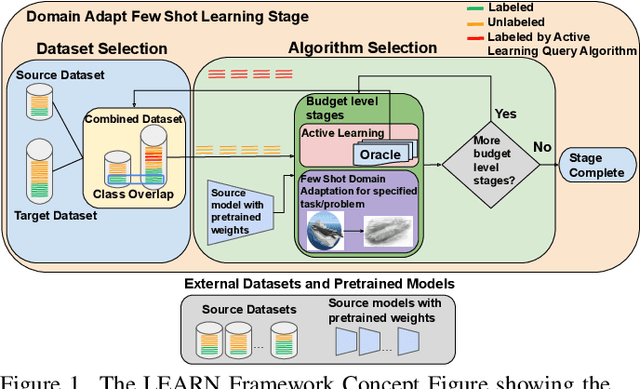
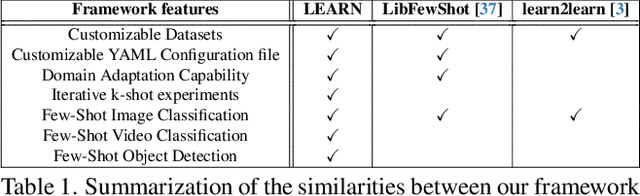
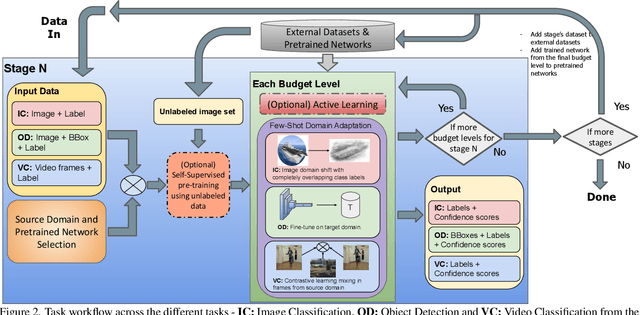
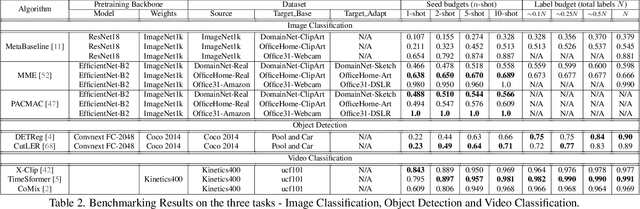
Both few-shot learning and domain adaptation sub-fields in Computer Vision have seen significant recent progress in terms of the availability of state-of-the-art algorithms and datasets. Frameworks have been developed for each sub-field; however, building a common system or framework that combines both is something that has not been explored. As part of our research, we present the first unified framework that combines domain adaptation for the few-shot learning setting across 3 different tasks - image classification, object detection and video classification. Our framework is highly modular with the capability to support few-shot learning with/without the inclusion of domain adaptation depending on the algorithm. Furthermore, the most important configurable feature of our framework is the on-the-fly setup for incremental $n$-shot tasks with the optional capability to configure the system to scale to a traditional many-shot task. With more focus on Self-Supervised Learning (SSL) for current few-shot learning approaches, our system also supports multiple SSL pre-training configurations. To test our framework's capabilities, we provide benchmarks on a wide range of algorithms and datasets across different task and problem settings. The code is open source has been made publicly available here: https://gitlab.kitware.com/darpa_learn/learn