 Add to Chrome
 Add to Firefox
 Add to Edge
Gated-BEPO: Confidence-Gated Bellman Credit Assignment for Large Language Model Agents
Aug 07, 2026
Training large language model agents in long-horizon environments requires assigning credit from sparse terminal outcomes to individual actions. Existing critic-free methods propagate trajectory-level rewards uniformly across steps, while recent approaches construct step-level groups by matching repeated states and compare actions within each group. The former cannot distinguish useful actions in failed trajectories from ineffective actions in successful ones. The latter rely on step credit derived directly from individual trajectory outcomes and fixed-weight fusion with episode-level credit. We propose Gated-BEPO, which derives step-level credit from empirical rollout graphs. For each rollout group, Gated-BEPO constructs an empirical graph and estimates node values through a mean-backup Bellman fixed point that reflects the empirical action distribution of the current policy. We then accumulate these temporal-difference residuals along each sampled trajectory using generalized advantage estimation, yielding step-level Bellman advantages that capture both immediate and downstream effects. To adaptively fuse episode- and step-level credit, a confidence gate incorporates Bellman credit only at states with multiple observed successors and otherwise uses episode-level credit. Experiments on WebShop, ALFWorld, and visual Sokoban show consistent improvements across language and vision-language models, while diagnostic ablations support the effectiveness of Bellman fixed-point value estimation and show that step-level credit should be incorporated selectively rather than uniformly into the final advantage.

Towards Precision Therapy in Hepatocellular Carcinoma: A Clinical-Reasoning LLM for Risk Stratification and Treatment Guidance
Jul 09, 2026Hepatocellular carcinoma (HCC) is a common malignancy and a leading cause of cancer-related mortality. Current guidelines and staging systems provide coarse categories, but often miss within-stage heterogeneity and the clinical context in electronic medical records (EMRs). We present HCC-STAR (Hepatocellular Carcinoma Staging, Treatment And pRognosis), a clinically aligned large language model that reads routine EMR narratives and jointly outputs risk score-based staging, ranked guideline-consistent treatments with evidence-based rationales, and individualized survival estimates. We curated about 30,000 HCC cases from SEER and expanded them into EMR-style narrative training data using a clinician-validated, prompt-based augmentation workflow. On this corpus, we developed a knowledge-aligned reasoning framework optimized with a step-verifiable composite reward, moving beyond text-level memorization of clinical guidelines. In a multi-center cohort of 6,668 patients from 12 hospitals in China, HCC-STAR achieved state-of-the-art performance in treatment recommendation and risk stratification compared with clinical guidelines and competitive models, including GPT-5 and Gemini-2.5 Pro. Hypothetical overall-survival analysis showed a median survival of 51 months under adherence to HCC-STAR recommendations, compared with 29 and 32 months under BCLC and CNLC. In clinician-centric evaluations, blinded hepatobiliary specialists rated HCC-STAR's reasoning and evidence-based justifications as trustworthy. The model surpassed resident and attending physicians in treatment accuracy and helped physicians make more accurate decisions faster when used as an assistant. These findings support HCC-STAR as a reliable and verifiable decision-support system for risk stratification and precision therapy in HCC.
veScale-FSDP: Flexible and High-Performance FSDP at Scale
Feb 25, 2026Fully Sharded Data Parallel (FSDP), also known as ZeRO, is widely used for training large-scale models, featuring its flexibility and minimal intrusion on model code. However, current FSDP systems struggle with structure-aware training methods (e.g., block-wise quantized training) and with non-element-wise optimizers (e.g., Shampoo and Muon) used in cutting-edge models (e.g., Gemini, Kimi K2). FSDP's fixed element- or row-wise sharding formats conflict with the block-structured computations. In addition, today's implementations fall short in communication and memory efficiency, limiting scaling to tens of thousands of GPUs. We introduce veScale-FSDP, a redesigned FSDP system that couples a flexible sharding format, RaggedShard, with a structure-aware planning algorithm to deliver both flexibility and performance at scale. veScale-FSDP natively supports efficient data placement required by FSDP, empowering block-wise quantization and non-element-wise optimizers. As a result, veScale-FSDP achieves 5~66% higher throughput and 16~30% lower memory usage than existing FSDP systems, while scaling efficiently to tens of thousands of GPUs.
Beyond Open Vocabulary: Multimodal Prompting for Object Detection in Remote Sensing Images
Feb 02, 2026Open-vocabulary object detection in remote sensing commonly relies on text-only prompting to specify target categories, implicitly assuming that inference-time category queries can be reliably grounded through pretraining-induced text-visual alignment. In practice, this assumption often breaks down in remote sensing scenarios due to task- and application-specific category semantics, resulting in unstable category specification under open-vocabulary settings. To address this limitation, we propose RS-MPOD, a multimodal open-vocabulary detection framework that reformulates category specification beyond text-only prompting by incorporating instance-grounded visual prompts, textual prompts, and their multimodal integration. RS-MPOD introduces a visual prompt encoder to extract appearance-based category cues from exemplar instances, enabling text-free category specification, and a multimodal fusion module to integrate visual and textual information when both modalities are available. Extensive experiments on standard, cross-dataset, and fine-grained remote sensing benchmarks show that visual prompting yields more reliable category specification under semantic ambiguity and distribution shifts, while multimodal prompting provides a flexible alternative that remains competitive when textual semantics are well aligned.
Vision-Language Model for Object Detection and Segmentation: A Review and Evaluation
Apr 13, 2025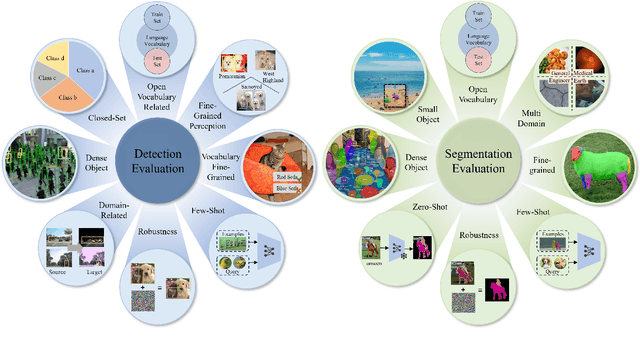
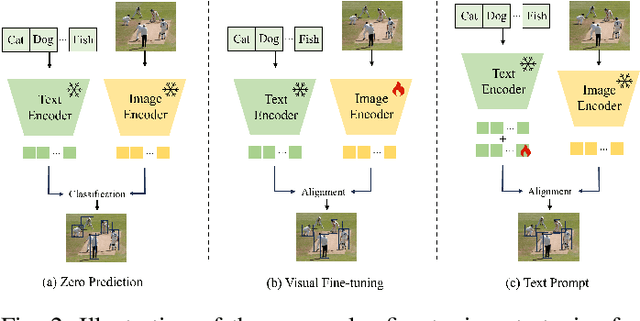
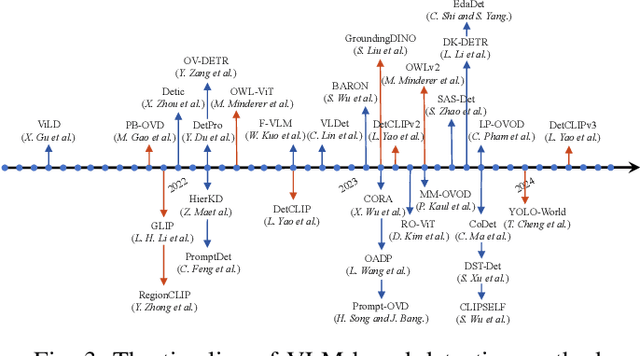
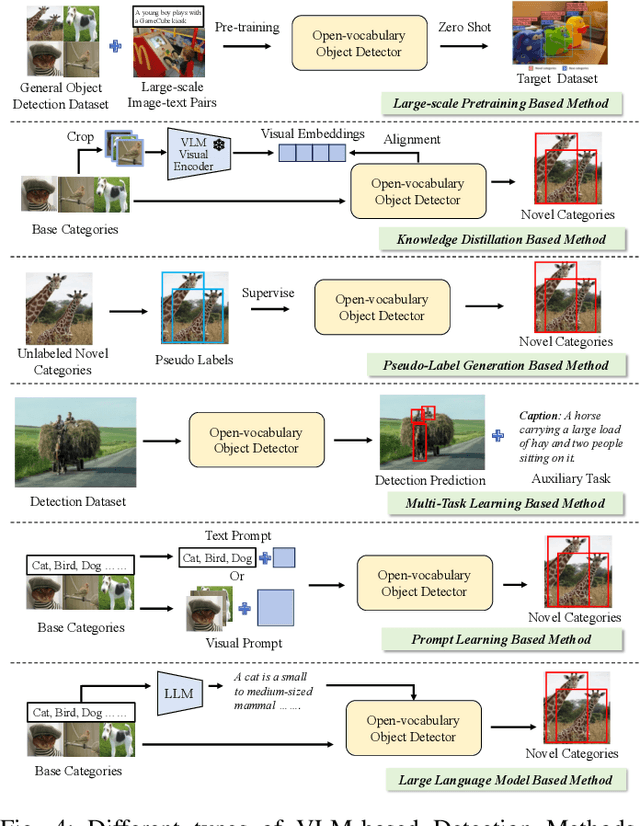
Vision-Language Model (VLM) have gained widespread adoption in Open-Vocabulary (OV) object detection and segmentation tasks. Despite they have shown promise on OV-related tasks, their effectiveness in conventional vision tasks has thus far been unevaluated. In this work, we present the systematic review of VLM-based detection and segmentation, view VLM as the foundational model and conduct comprehensive evaluations across multiple downstream tasks for the first time: 1) The evaluation spans eight detection scenarios (closed-set detection, domain adaptation, crowded objects, etc.) and eight segmentation scenarios (few-shot, open-world, small object, etc.), revealing distinct performance advantages and limitations of various VLM architectures across tasks. 2) As for detection tasks, we evaluate VLMs under three finetuning granularities: \textit{zero prediction}, \textit{visual fine-tuning}, and \textit{text prompt}, and further analyze how different finetuning strategies impact performance under varied task. 3) Based on empirical findings, we provide in-depth analysis of the correlations between task characteristics, model architectures, and training methodologies, offering insights for future VLM design. 4) We believe that this work shall be valuable to the pattern recognition experts working in the fields of computer vision, multimodal learning, and vision foundation models by introducing them to the problem, and familiarizing them with the current status of the progress while providing promising directions for future research. A project associated with this review and evaluation has been created at https://github.com/better-chao/perceptual_abilities_evaluation.
A Survey on Remote Sensing Foundation Models: From Vision to Multimodality
Mar 28, 2025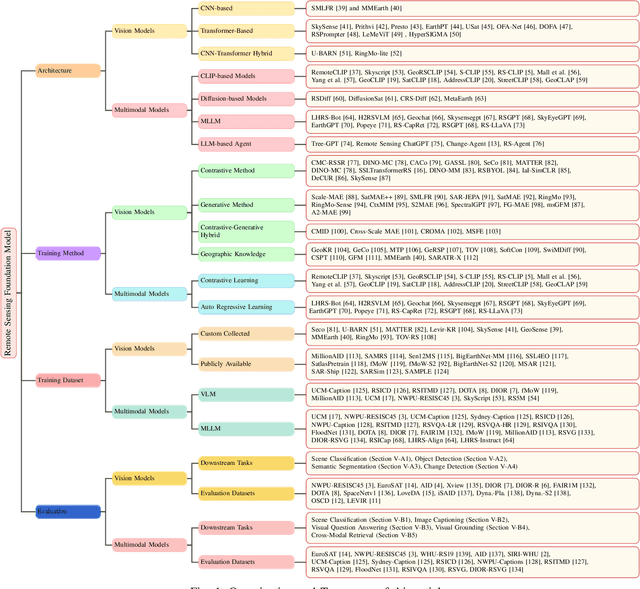
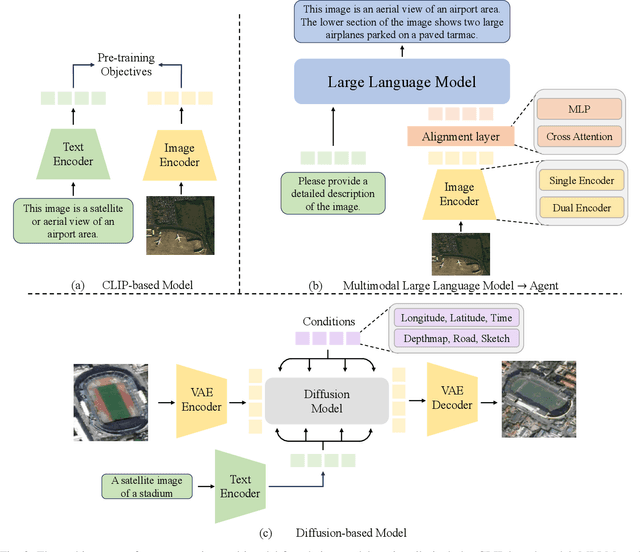
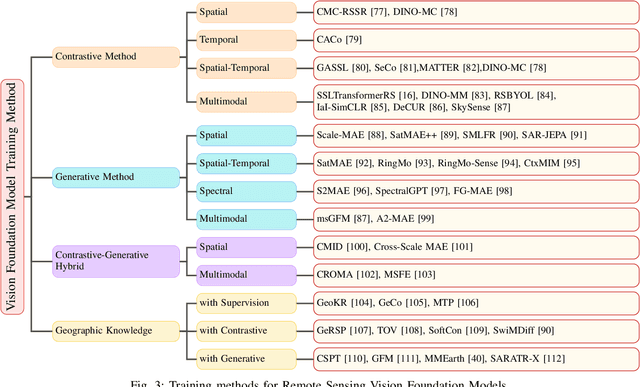
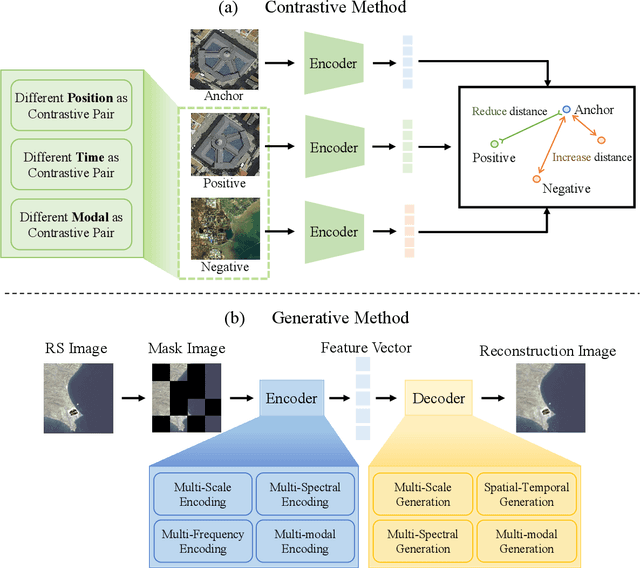
The rapid advancement of remote sensing foundation models, particularly vision and multimodal models, has significantly enhanced the capabilities of intelligent geospatial data interpretation. These models combine various data modalities, such as optical, radar, and LiDAR imagery, with textual and geographic information, enabling more comprehensive analysis and understanding of remote sensing data. The integration of multiple modalities allows for improved performance in tasks like object detection, land cover classification, and change detection, which are often challenged by the complex and heterogeneous nature of remote sensing data. However, despite these advancements, several challenges remain. The diversity in data types, the need for large-scale annotated datasets, and the complexity of multimodal fusion techniques pose significant obstacles to the effective deployment of these models. Moreover, the computational demands of training and fine-tuning multimodal models require significant resources, further complicating their practical application in remote sensing image interpretation tasks. This paper provides a comprehensive review of the state-of-the-art in vision and multimodal foundation models for remote sensing, focusing on their architecture, training methods, datasets and application scenarios. We discuss the key challenges these models face, such as data alignment, cross-modal transfer learning, and scalability, while also identifying emerging research directions aimed at overcoming these limitations. Our goal is to provide a clear understanding of the current landscape of remote sensing foundation models and inspire future research that can push the boundaries of what these models can achieve in real-world applications. The list of resources collected by the paper can be found in the https://github.com/IRIP-BUAA/A-Review-for-remote-sensing-vision-language-models.
OpenRSD: Towards Open-prompts for Object Detection in Remote Sensing Images
Mar 08, 2025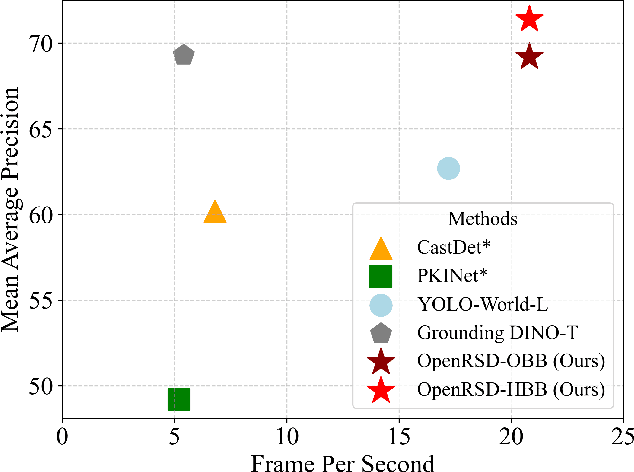
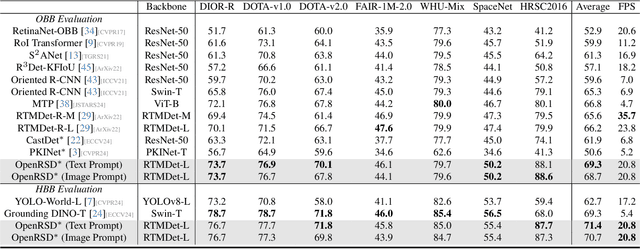
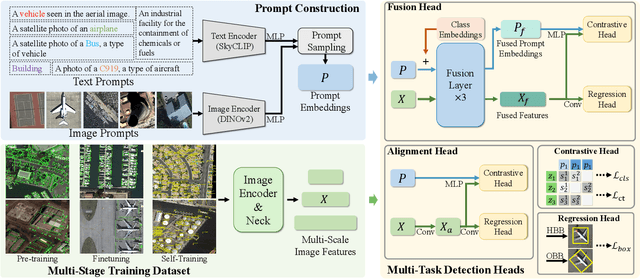
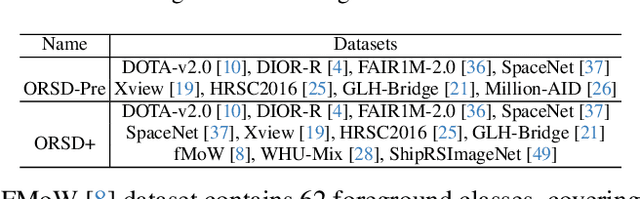
Remote sensing object detection has made significant progress, but most studies still focus on closed-set detection, limiting generalization across diverse datasets. Open-vocabulary object detection (OVD) provides a solution by leveraging multimodal associations between text prompts and visual features. However, existing OVD methods for remote sensing (RS) images are constrained by small-scale datasets and fail to address the unique challenges of remote sensing interpretation, include oriented object detection and the need for both high precision and real-time performance in diverse scenarios. To tackle these challenges, we propose OpenRSD, a universal open-prompt RS object detection framework. OpenRSD supports multimodal prompts and integrates multi-task detection heads to balance accuracy and real-time requirements. Additionally, we design a multi-stage training pipeline to enhance the generalization of model. Evaluated on seven public datasets, OpenRSD demonstrates superior performance in oriented and horizontal bounding box detection, with real-time inference capabilities suitable for large-scale RS image analysis. Compared to YOLO-World, OpenRSD exhibits an 8.7\% higher average precision and achieves an inference speed of 20.8 FPS. Codes and models will be released.
Training on Fake Labels: Mitigating Label Leakage in Split Learning via Secure Dimension Transformation
Oct 11, 2024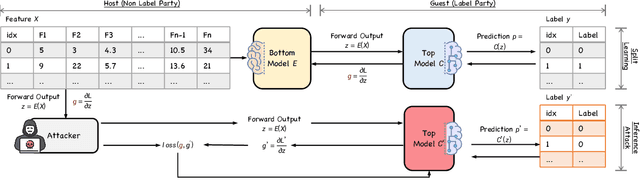
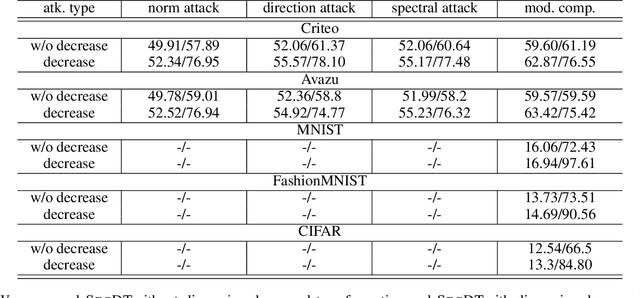
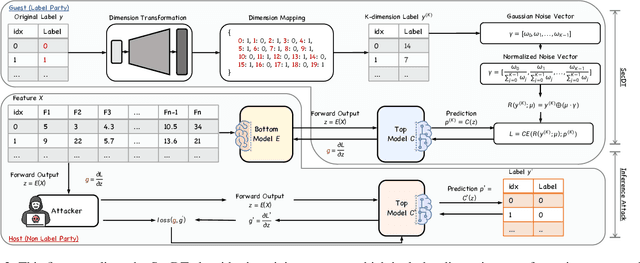
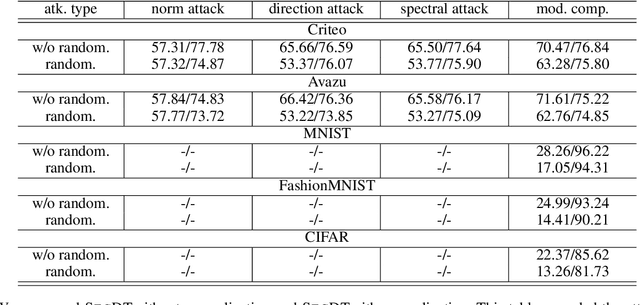
Two-party split learning has emerged as a popular paradigm for vertical federated learning. To preserve the privacy of the label owner, split learning utilizes a split model, which only requires the exchange of intermediate representations (IRs) based on the inputs and gradients for each IR between two parties during the learning process. However, split learning has recently been proven to survive label inference attacks. Though several defense methods could be adopted, they either have limited defensive performance or significantly negatively impact the original mission. In this paper, we propose a novel two-party split learning method to defend against existing label inference attacks while maintaining the high utility of the learned models. Specifically, we first craft a dimension transformation module, SecDT, which could achieve bidirectional mapping between original labels and increased K-class labels to mitigate label leakage from the directional perspective. Then, a gradient normalization algorithm is designed to remove the magnitude divergence of gradients from different classes. We propose a softmax-normalized Gaussian noise to mitigate privacy leakage and make our K unknowable to adversaries. We conducted experiments on real-world datasets, including two binary-classification datasets (Avazu and Criteo) and three multi-classification datasets (MNIST, FashionMNIST, CIFAR-10); we also considered current attack schemes, including direction, norm, spectral, and model completion attacks. The detailed experiments demonstrate our proposed method's effectiveness and superiority over existing approaches. For instance, on the Avazu dataset, the attack AUC of evaluated four prominent attacks could be reduced by 0.4532+-0.0127.
PS-TTL: Prototype-based Soft-labels and Test-Time Learning for Few-shot Object Detection
Aug 11, 2024In recent years, Few-Shot Object Detection (FSOD) has gained widespread attention and made significant progress due to its ability to build models with a good generalization power using extremely limited annotated data. The fine-tuning based paradigm is currently dominating this field, where detectors are initially pre-trained on base classes with sufficient samples and then fine-tuned on novel ones with few samples, but the scarcity of labeled samples of novel classes greatly interferes precisely fitting their data distribution, thus hampering the performance. To address this issue, we propose a new framework for FSOD, namely Prototype-based Soft-labels and Test-Time Learning (PS-TTL). Specifically, we design a Test-Time Learning (TTL) module that employs a mean-teacher network for self-training to discover novel instances from test data, allowing detectors to learn better representations and classifiers for novel classes. Furthermore, we notice that even though relatively low-confidence pseudo-labels exhibit classification confusion, they still tend to recall foreground. We thus develop a Prototype-based Soft-labels (PS) strategy through assessing similarities between low-confidence pseudo-labels and category prototypes as soft-labels to unleash their potential, which substantially mitigates the constraints posed by few-shot samples. Extensive experiments on both the VOC and COCO benchmarks show that PS-TTL achieves the state-of-the-art, highlighting its effectiveness. The code and model are available at https://github.com/gaoyingjay/PS-TTL.
MutDet: Mutually Optimizing Pre-training for Remote Sensing Object Detection
Jul 13, 2024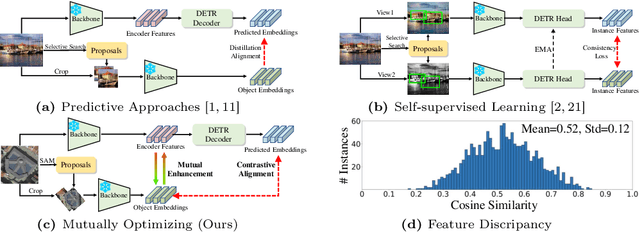
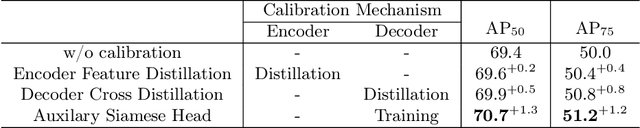
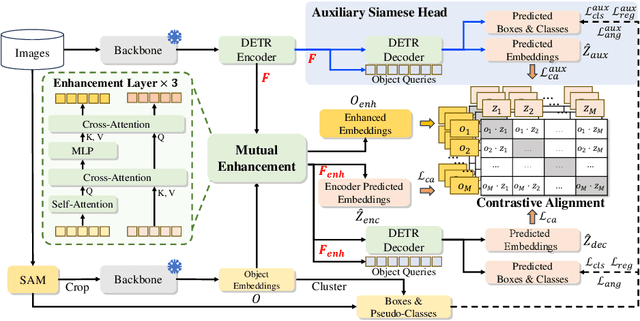

Detection pre-training methods for the DETR series detector have been extensively studied in natural scenes, e.g., DETReg. However, the detection pre-training remains unexplored in remote sensing scenes. In existing pre-training methods, alignment between object embeddings extracted from a pre-trained backbone and detector features is significant. However, due to differences in feature extraction methods, a pronounced feature discrepancy still exists and hinders the pre-training performance. The remote sensing images with complex environments and more densely distributed objects exacerbate the discrepancy. In this work, we propose a novel Mutually optimizing pre-training framework for remote sensing object Detection, dubbed as MutDet. In MutDet, we propose a systemic solution against this challenge. Firstly, we propose a mutual enhancement module, which fuses the object embeddings and detector features bidirectionally in the last encoder layer, enhancing their information interaction.Secondly, contrastive alignment loss is employed to guide this alignment process softly and simultaneously enhances detector features' discriminativity. Finally, we design an auxiliary siamese head to mitigate the task gap arising from the introduction of enhancement module. Comprehensive experiments on various settings show new state-of-the-art transfer performance. The improvement is particularly pronounced when data quantity is limited. When using 10% of the DIOR-R data, MutDet improves DetReg by 6.1% in AP50. Codes and models are available at: https://github.com/floatingstarZ/MutDet.