 Add to Chrome
 Add to Firefox
 Add to Edge
Class Geometry as Supervision for Sample-Efficient Open-World Detection
Aug 13, 2026
Open-world object detection requires models to recognize known categories, reject unfamiliar objects, and incorporate new classes over time. This is especially challenging in scarce-data settings such as biomedical and scientific imaging, where rare categories may have only a few annotated examples and fine-grained classes differ by subtle morphology. Prototype-based detectors are natural for this regime, but they typically learn class prototypes as independent anchors, ignoring relational structure among classes. We propose class-geometry supervision (CGS), a general framework that constrains learned prototype or class-representation spaces to preserve visual or semantic class dissimilarities estimated from training data. CGS introduces a dissimilarity-preserving objective that aligns pairwise distances among learned class representations with a target class-geometry matrix while retaining the standard task loss. We instantiate the same objective across prototype recognition, few-shot biomedical object detection, open-set detection, novel-class insertion, and OWOD adaptation on COCO. Experiments show that CGS improves sample efficiency in recognition and ova detection, substantially strengthens novel-class insertion, and improves unknown recall on COCO while retaining much of the known-class detection performance. Ablations show that meaningful visual geometry provides the most reliable gains, while random geometry can help novel separation but is less consistent for few-shot detection. These results suggest that relational class geometry is an effective supervisory signal for building calibrated and extensible open-world detectors under limited supervision.

FSP-DETR: Few-Shot Prototypical Parasitic Ova Detection
Oct 10, 2025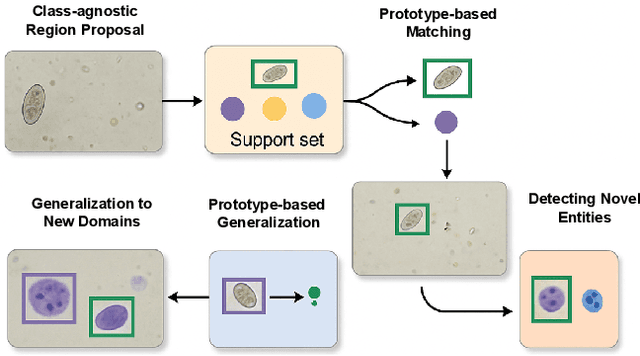
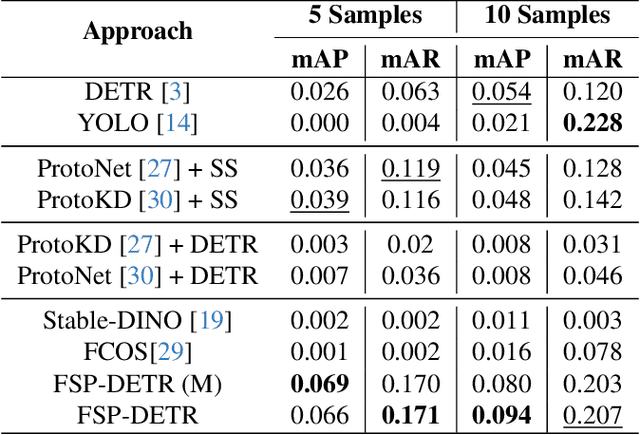
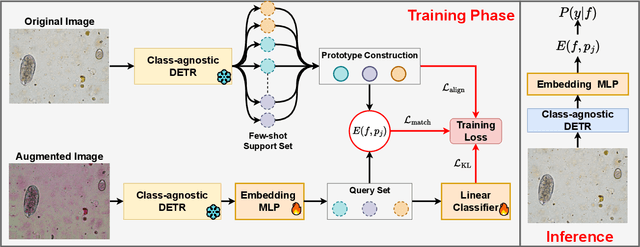
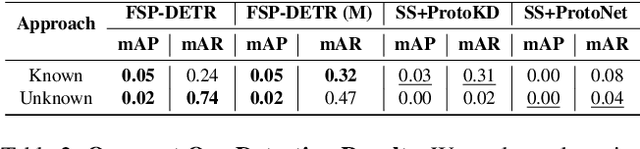
Object detection in biomedical settings is fundamentally constrained by the scarcity of labeled data and the frequent emergence of novel or rare categories. We present FSP-DETR, a unified detection framework that enables robust few-shot detection, open-set recognition, and generalization to unseen biomedical tasks within a single model. Built upon a class-agnostic DETR backbone, our approach constructs class prototypes from original support images and learns an embedding space using augmented views and a lightweight transformer decoder. Training jointly optimizes a prototype matching loss, an alignment-based separation loss, and a KL divergence regularization to improve discriminative feature learning and calibration under scarce supervision. Unlike prior work that tackles these tasks in isolation, FSP-DETR enables inference-time flexibility to support unseen class recognition, background rejection, and cross-task adaptation without retraining. We also introduce a new ova species detection benchmark with 20 parasite classes and establish standardized evaluation protocols. Extensive experiments across ova, blood cell, and malaria detection tasks demonstrate that FSP-DETR significantly outperforms prior few-shot and prototype-based detectors, especially in low-shot and open-set scenarios.
ProtoKD: Learning from Extremely Scarce Data for Parasite Ova Recognition
Sep 18, 2023


Developing reliable computational frameworks for early parasite detection, particularly at the ova (or egg) stage is crucial for advancing healthcare and effectively managing potential public health crises. While deep learning has significantly assisted human workers in various tasks, its application and diagnostics has been constrained by the need for extensive datasets. The ability to learn from an extremely scarce training dataset, i.e., when fewer than 5 examples per class are present, is essential for scaling deep learning models in biomedical applications where large-scale data collection and annotation can be expensive or not possible (in case of novel or unknown infectious agents). In this study, we introduce ProtoKD, one of the first approaches to tackle the problem of multi-class parasitic ova recognition using extremely scarce data. Combining the principles of prototypical networks and self-distillation, we can learn robust representations from only one sample per class. Furthermore, we establish a new benchmark to drive research in this critical direction and validate that the proposed ProtoKD framework achieves state-of-the-art performance. Additionally, we evaluate the framework's generalizability to other downstream tasks by assessing its performance on a large-scale taxonomic profiling task based on metagenomes sequenced from real-world clinical data.