 Add to Chrome
 Add to Firefox
 Add to Edge
Automatic Sleep Stage Classification
Papers and Code
Using Legacy Polysomnography Data to Train a Radar System to Quantify Sleep in Older Adults and People living with Dementia
Jan 07, 2026
Objective: Ultra-wideband radar technology offers a promising solution for unobtrusive and cost-effective in-home sleep monitoring. However, the limited availability of radar sleep data poses challenges in building robust models that generalize across diverse cohorts and environments. This study proposes a novel deep transfer learning framework to enhance sleep stage classification using radar data. Methods: An end-to-end neural network was developed to classify sleep stages based on nocturnal respiratory and motion signals. The network was trained using a combination of large-scale polysomnography (PSG) datasets and radar data. A domain adaptation approach employing adversarial learning was utilized to bridge the knowledge gap between PSG and radar signals. Validation was performed on a radar dataset of 47 older adults (mean age: 71.2), including 18 participants with prodromal or mild Alzheimer disease. Results: The proposed network structure achieves an accuracy of 79.5% with a Kappa value of 0.65 when classifying wakefulness, rapid eye movement, light sleep and deep sleep. Experimental results confirm that our deep transfer learning approach significantly enhances automatic sleep staging performance in the target domain. Conclusion: This method effectively addresses challenges associated with data variability and limited sample size, substantially improving the reliability of automatic sleep staging models, especially in contexts where radar data is limited. Significance: The findings underscore the viability of UWB radar as a nonintrusive, forward-looking sleep assessment tool that could significantly benefit care for older people and people with neurodegenerative disorders.

Resource Efficient Sleep Staging via Multi-Level Masking and Prompt Learning
Nov 18, 2025Automatic sleep staging plays a vital role in assessing sleep quality and diagnosing sleep disorders. Most existing methods rely heavily on long and continuous EEG recordings, which poses significant challenges for data acquisition in resource-constrained systems, such as wearable or home-based monitoring systems. In this paper, we propose the task of resource-efficient sleep staging, which aims to reduce the amount of signal collected per sleep epoch while maintaining reliable classification performance. To solve this task, we adopt the masking and prompt learning strategy and propose a novel framework called Mask-Aware Sleep Staging (MASS). Specifically, we design a multi-level masking strategy to promote effective feature modeling under partial and irregular observations. To mitigate the loss of contextual information introduced by masking, we further propose a hierarchical prompt learning mechanism that aggregates unmasked data into a global prompt, serving as a semantic anchor for guiding both patch-level and epoch-level feature modeling. MASS is evaluated on four datasets, demonstrating state-of-the-art performance, especially when the amount of data is very limited. This result highlights its potential for efficient and scalable deployment in real-world low-resource sleep monitoring environments.
eegFloss: A Python package for refining sleep EEG recordings using machine learning models
Jul 08, 2025Electroencephalography (EEG) allows monitoring of brain activity, providing insights into the functional dynamics of various brain regions and their roles in cognitive processes. EEG is a cornerstone in sleep research, serving as the primary modality of polysomnography, the gold standard in the field. However, EEG signals are prone to artifacts caused by both internal (device-specific) factors and external (environmental) interferences. As sleep studies are becoming larger, most rely on automatic sleep staging, a process highly susceptible to artifacts, leading to erroneous sleep scores. This paper addresses this challenge by introducing eegFloss, an open-source Python package to utilize eegUsability, a novel machine learning (ML) model designed to detect segments with artifacts in sleep EEG recordings. eegUsability has been trained and evaluated on manually artifact-labeled EEG data collected from 15 participants over 127 nights using the Zmax headband. It demonstrates solid overall classification performance (F1-score is approximately 0.85, Cohens kappa is 0.78), achieving a high recall rate of approximately 94% in identifying channel-wise usable EEG data, and extends beyond Zmax. Additionally, eegFloss offers features such as automatic time-in-bed detection using another ML model named eegMobility, filtering out certain artifacts, and generating hypnograms and sleep statistics. By addressing a fundamental challenge faced by most sleep studies, eegFloss can enhance the precision and rigor of their analysis as well as the accuracy and reliability of their outcomes.
MetaSTH-Sleep: Towards Effective Few-Shot Sleep Stage Classification with Spatial-Temporal Hypergraph Enhanced Meta-Learning
May 22, 2025Accurate classification of sleep stages based on bio-signals is fundamental for automatic sleep stage annotation. Traditionally, this task relies on experienced clinicians to manually annotate data, a process that is both time-consuming and labor-intensive. In recent years, deep learning methods have shown promise in automating this task. However, three major challenges remain: (1) deep learning models typically require large-scale labeled datasets, making them less effective in real-world settings where annotated data is limited; (2) significant inter-individual variability in bio-signals often results in inconsistent model performance when applied to new subjects, limiting generalization; and (3) existing approaches often overlook the high-order relationships among bio-signals, failing to simultaneously capture signal heterogeneity and spatial-temporal dependencies. To address these issues, we propose MetaSTH-Sleep, a few-shot sleep stage classification framework based on spatial-temporal hypergraph enhanced meta-learning. Our approach enables rapid adaptation to new subjects using only a few labeled samples, while the hypergraph structure effectively models complex spatial interconnections and temporal dynamics simultaneously in EEG signals. Experimental results demonstrate that MetaSTH-Sleep achieves substantial performance improvements across diverse subjects, offering valuable insights to support clinicians in sleep stage annotation.
MSA-CNN: A Lightweight Multi-Scale CNN with Attention for Sleep Stage Classification
Jan 06, 2025
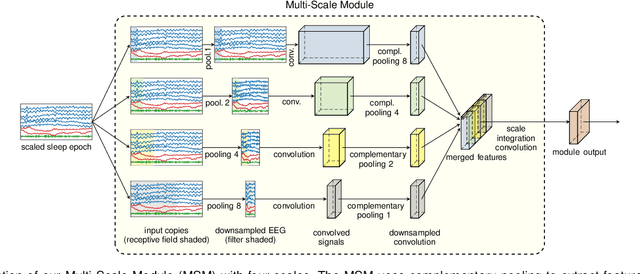
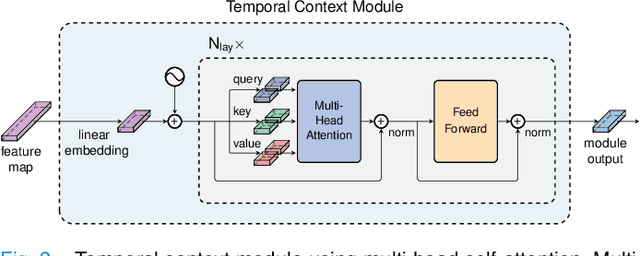
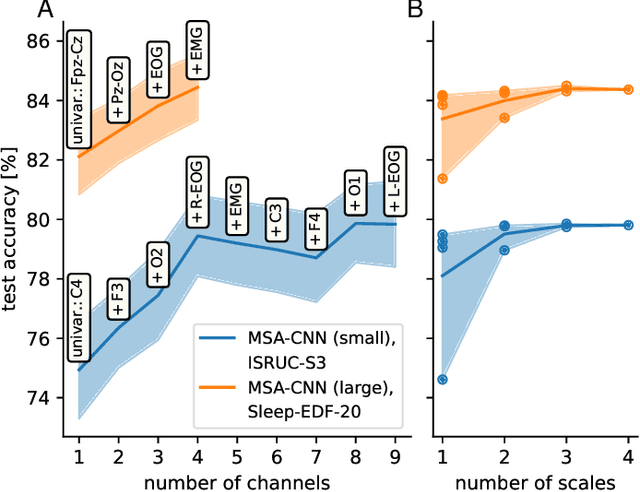
Recent advancements in machine learning-based signal analysis, coupled with open data initiatives, have fuelled efforts in automatic sleep stage classification. Despite the proliferation of classification models, few have prioritised reducing model complexity, which is a crucial factor for practical applications. In this work, we introduce Multi-Scale and Attention Convolutional Neural Network (MSA-CNN), a lightweight architecture featuring as few as ~10,000 parameters. MSA-CNN leverages a novel multi-scale module employing complementary pooling to eliminate redundant filter parameters and dense convolutions. Model complexity is further reduced by separating temporal and spatial feature extraction and using cost-effective global spatial convolutions. This separation of tasks not only reduces model complexity but also mirrors the approach used by human experts in sleep stage scoring. We evaluated both small and large configurations of MSA-CNN against nine state-of-the-art baseline models across three public datasets, treating univariate and multivariate models separately. Our evaluation, based on repeated cross-validation and re-evaluation of all baseline models, demonstrated that the large MSA-CNN outperformed all baseline models on all three datasets in terms of accuracy and Cohen's kappa, despite its significantly reduced parameter count. Lastly, we explored various model variants and conducted an in-depth analysis of the key modules and techniques, providing deeper insights into the underlying mechanisms. The code for our models, baselines, and evaluation procedures is available at https://github.com/sgoerttler/MSA-CNN.
Retrieving Filter Spectra in CNN for Explainable Sleep Stage Classification
Feb 10, 2025Despite significant advances in deep learning-based sleep stage classification, the clinical adoption of automatic classification models remains slow. One key challenge is the lack of explainability, as many models function as black boxes with millions of parameters. In response, recent work has increasingly focussed on enhancing model explainability. This study contributes to these efforts by globally explaining spectral processing of individual EEG channels. Specifically, we introduce a method to retrieve the filter spectrum of low-level convolutional feature extraction and compare it with the classification-relevant spectral information in the data. We evaluate our approach on the MSA-CNN model using the ISRUC-S3 and Sleep-EDF-20 datasets. Our findings show that spectral processing plays a significant role in the lower frequency bands. In addition, comparing the correlation between filter spectrum and data-based spectral information with univariate performance indicates that the model naturally prioritises the most informative channels in a multimodal setting. We specify how these insights can be leveraged to enhance model performance. The code for the filter spectrum retrieval and its analysis is available at https://github.com/sgoerttler/MSA-CNN.
Vision Transformer Accelerator ASIC for Real-Time, Low-Power Sleep Staging
Feb 22, 2025This paper introduces a lightweight vision transformer aimed at automatic sleep staging in a wearable device. The model is trained on the MASS SS3 dataset and achieves an accuracy of 82.9% on a 4-stage classification task with only 31.6k weights. The model is implemented in hardware and synthesized in 65nm CMOS. The accelerator consumes 6.54mW of dynamic power and 11.0mW of leakage power over 45.6ms. Using aggressive power gating while the accelerator is idle, it is calculated that the effective power consumption is 0.56mW. The accelerator uses only 0.754mm2 of silicon and has a clock frequency of 379MHz. These metrics are possible thanks to a layer-dependent fixed-point format and data width and a window average filter on the final softmax layer of the vision transformer.
BiT-MamSleep: Bidirectional Temporal Mamba for EEG Sleep Staging
Nov 03, 2024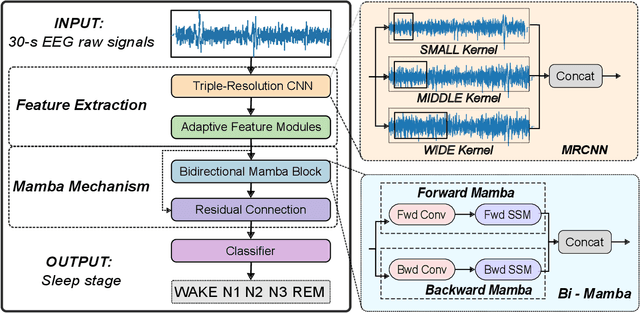
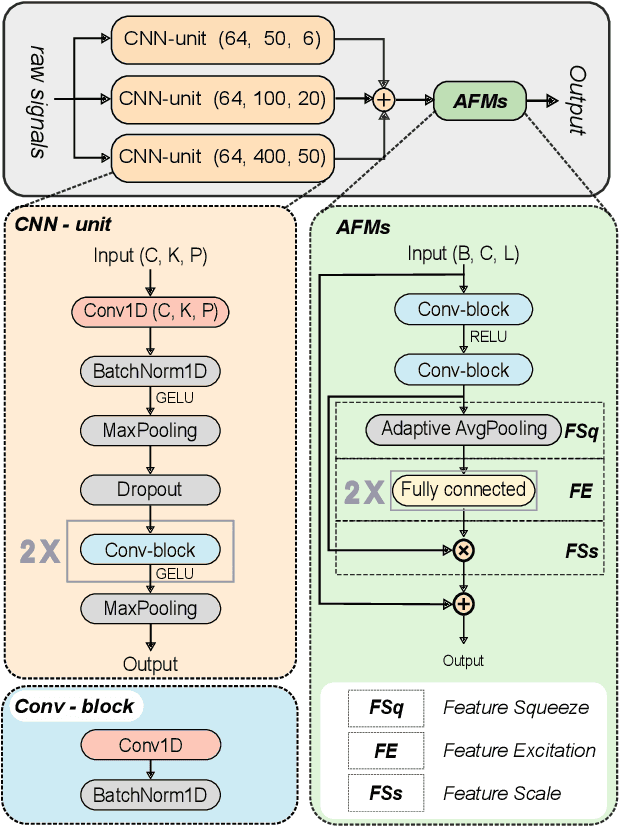
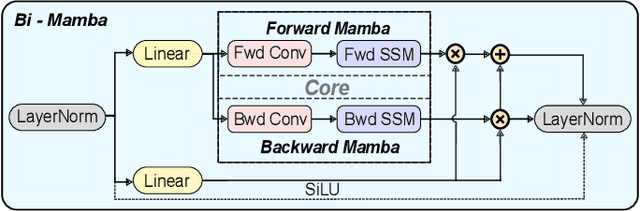
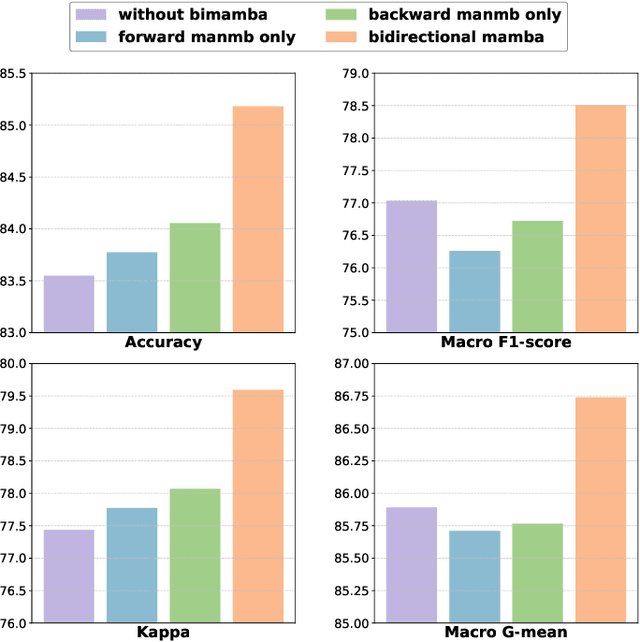
In this paper, we address the challenges in automatic sleep stage classification, particularly the high computational cost, inadequate modeling of bidirectional temporal dependencies, and class imbalance issues faced by Transformer-based models. To address these limitations, we propose BiT-MamSleep, a novel architecture that integrates the Triple-Resolution CNN (TRCNN) for efficient multi-scale feature extraction with the Bidirectional Mamba (BiMamba) mechanism, which models both short- and long-term temporal dependencies through bidirectional processing of EEG data. Additionally, BiT-MamSleep incorporates an Adaptive Feature Recalibration (AFR) module and a temporal enhancement block to dynamically refine feature importance, optimizing classification accuracy without increasing computational complexity. To further improve robustness, we apply optimization techniques such as Focal Loss and SMOTE to mitigate class imbalance. Extensive experiments on four public datasets demonstrate that BiT-MamSleep significantly outperforms state-of-the-art methods, particularly in handling long EEG sequences and addressing class imbalance, leading to more accurate and scalable sleep stage classification.
sDREAMER: Self-distilled Mixture-of-Modality-Experts Transformer for Automatic Sleep Staging
Jan 27, 2025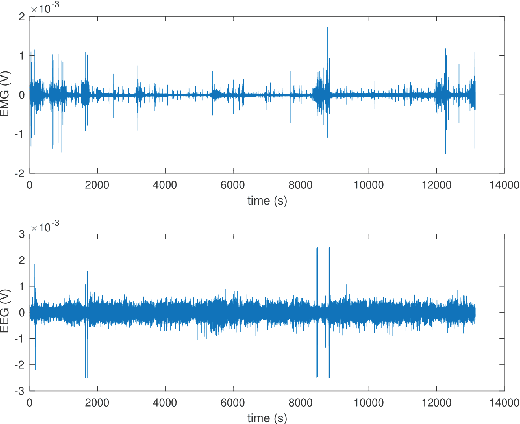
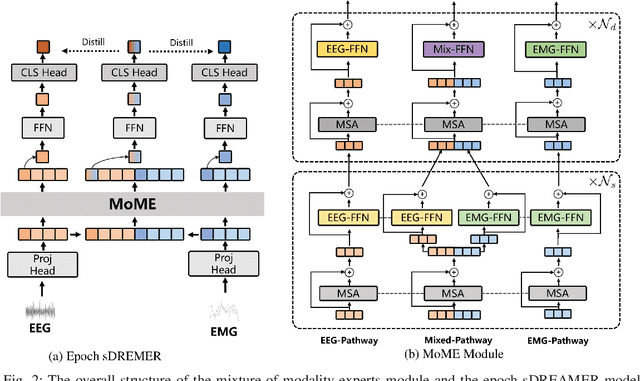
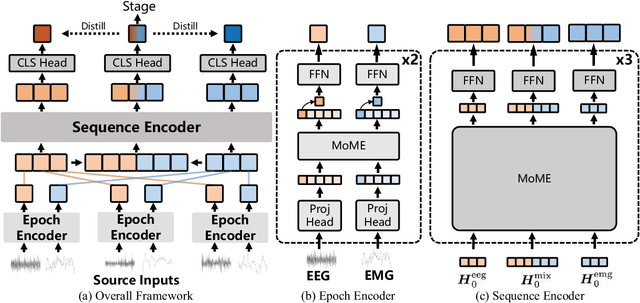
Automatic sleep staging based on electroencephalography (EEG) and electromyography (EMG) signals is an important aspect of sleep-related research. Current sleep staging methods suffer from two major drawbacks. First, there are limited information interactions between modalities in the existing methods. Second, current methods do not develop unified models that can handle different sources of input. To address these issues, we propose a novel sleep stage scoring model sDREAMER, which emphasizes cross-modality interaction and per-channel performance. Specifically, we develop a mixture-of-modality-expert (MoME) model with three pathways for EEG, EMG, and mixed signals with partially shared weights. We further propose a self-distillation training scheme for further information interaction across modalities. Our model is trained with multi-channel inputs and can make classifications on either single-channel or multi-channel inputs. Experiments demonstrate that our model outperforms the existing transformer-based sleep scoring methods for multi-channel inference. For single-channel inference, our model also outperforms the transformer-based models trained with single-channel signals.
Deep Learning-based Automated Diagnosis of Obstructive Sleep Apnea and Sleep Stage Classification in Children Using Millimeter-wave Radar and Pulse Oximeter
Sep 28, 2024
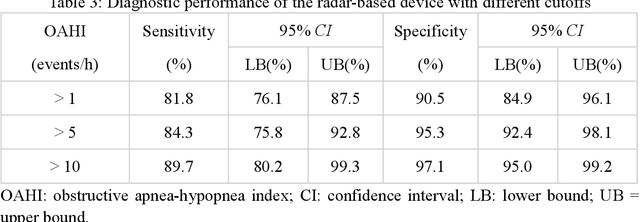
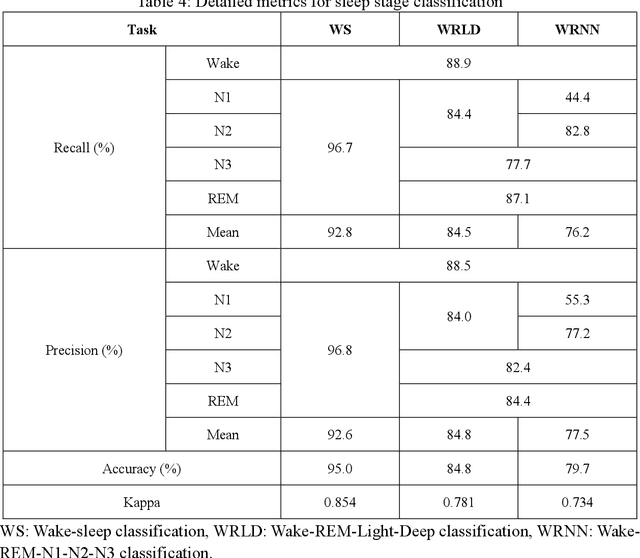
Study Objectives: To evaluate the agreement between the millimeter-wave radar-based device and polysomnography (PSG) in diagnosis of obstructive sleep apnea (OSA) and classification of sleep stage in children. Methods: 281 children, aged 1 to 18 years, who underwent sleep monitoring between September and November 2023 at the Sleep Center of Beijing Children's Hospital, Capital Medical University, were recruited in the study. All enrolled children underwent sleep monitoring by PSG and the millimeter-wave radar-based device, QSA600, simultaneously. QSA600 recordings were automatically analyzed using a deep learning model meanwhile the PSG data was manually scored. Results: The Obstructive Apnea-Hypopnea Index (OAHI) obtained from QSA600 and PSG demonstrates a high level of agreement with an intraclass correlation coefficient of 0.945 (95% CI: 0.93 to 0.96). Bland-Altman analysis indicates that the mean difference of OAHI between QSA600 and PSG is -0.10 events/h (95% CI: -11.15 to 10.96). The deep learning model evaluated through cross-validation showed good sensitivity (81.8%, 84.3% and 89.7%) and specificity (90.5%, 95.3% and 97.1%) values for diagnosing children with OAHI>1, OAHI>5 and OAHI>10. The area under the receiver operating characteristic curve is 0.923, 0.955 and 0.988, respectively. For sleep stage classification, the model achieved Kappa coefficients of 0.854, 0.781, and 0.734, with corresponding overall accuracies of 95.0%, 84.8%, and 79.7% for Wake-sleep classification, Wake-REM-Light-Deep classification, and Wake-REM-N1-N2 N3 classification, respectively. Conclusions: QSA600 has demonstrated high agreement with PSG in diagnosing OSA and performing sleep staging in children. The device is portable, low-load and suitable for follow up and long-term pediatric sleep assessment.