 Add to Chrome
 Add to Firefox
 Add to Edge
A Dynamical Systems and System Identification Framework for Phase Amplitude Coupling Analysis
Mar 09, 2026
Phase-amplitude coupling (PAC), a form of cross-frequency interaction, has been implicated in various cognitive functions and, by extension, in neural communication and information integration. Accurately detecting and characterising PAC is essential for understanding its role in processes such as memory and attention. However, this remains a significant challenge. Most existing methods rely on variations in the temporal profile to detect PAC, but they often suffer from key limitations, most notably, their sensitivity to filter bandwidth selection and their susceptibility to detecting spurious couplings. Previous studies have suggested that approaches grounded in the actual generative dynamics of PAC may offer improved accuracy. In this study, we adopt a dynamical systems perspective and propose a novel method for PAC detection and characterisation based on nonlinear system identification. This approach involves identifying a nonlinear dynamical model that captures the temporal dynamics underlying PAC. The resulting generative model enables noise-free simulation of estimated PAC signals, facilitating detailed analysis of modulation strength and the low-frequency phase at which the high-frequency bursts occur. The proposed method accounts for harmonic-induced spurious couplings through empirically derived criteria and remains robust to high noise levels and variations in slow-frequency power, offering an accurate and interpretable framework for PAC analysis. The performance of the proposed approach is illustrated using several simulated examples and a real case using local field potentials (LFP) data. The results are compared with several popular methods.

Dr.Occ: Depth- and Region-Guided 3D Occupancy from Surround-View Cameras for Autonomous Driving
Mar 05, 20263D semantic occupancy prediction is crucial for autonomous driving perception, offering comprehensive geometric scene understanding and semantic recognition. However, existing methods struggle with geometric misalignment in view transformation due to the lack of pixel-level accurate depth estimation, and severe spatial class imbalance where semantic categories exhibit strong spatial anisotropy. To address these challenges, we propose Dr. Occ, a depth- and region-guided occupancy prediction framework. Specifically, we introduce a depth-guided 2D-to-3D View Transformer (D$^2$-VFormer) that effectively leverages high-quality dense depth cues from MoGe-2 to construct reliable geometric priors, thereby enabling precise geometric alignment of voxel features. Moreover, inspired by the Mixture-of-Experts (MoE) framework, we propose a region-guided Expert Transformer (R/R$^2$-EFormer) that adaptively allocates region-specific experts to focus on different spatial regions, effectively addressing spatial semantic variations. Thus, the two components make complementary contributions: depth guidance ensures geometric alignment, while region experts enhance semantic learning. Experiments on the Occ3D--nuScenes benchmark demonstrate that Dr. Occ improves the strong baseline BEVDet4D by 7.43% mIoU and 3.09% IoU under the full vision-only setting.
SegRap2025: A Benchmark of Gross Tumor Volume and Lymph Node Clinical Target Volume Segmentation for Radiotherapy Planning of Nasopharyngeal Carcinoma
Jan 28, 2026Accurate delineation of Gross Tumor Volume (GTV), Lymph Node Clinical Target Volume (LN CTV), and Organ-at-Risk (OAR) from Computed Tomography (CT) scans is essential for precise radiotherapy planning in Nasopharyngeal Carcinoma (NPC). Building upon SegRap2023, which focused on OAR and GTV segmentation using single-center paired non-contrast CT (ncCT) and contrast-enhanced CT (ceCT) scans, the SegRap2025 challenge aims to enhance the generalizability and robustness of segmentation models across imaging centers and modalities. SegRap2025 comprises two tasks: Task01 addresses GTV segmentation using paired CT from the SegRap2023 dataset, with an additional external testing set to evaluate cross-center generalization, and Task02 focuses on LN CTV segmentation using multi-center training data and an unseen external testing set, where each case contains paired CT scans or a single modality, emphasizing both cross-center and cross-modality robustness. This paper presents the challenge setup and provides a comprehensive analysis of the solutions submitted by ten participating teams. For GTV segmentation task, the top-performing models achieved average Dice Similarity Coefficient (DSC) of 74.61% and 56.79% on the internal and external testing cohorts, respectively. For LN CTV segmentation task, the highest average DSC values reached 60.24%, 60.50%, and 57.23% on paired CT, ceCT-only, and ncCT-only subsets, respectively. SegRap2025 establishes a large-scale multi-center, multi-modality benchmark for evaluating the generalization and robustness in radiotherapy target segmentation, providing valuable insights toward clinically applicable automated radiotherapy planning systems. The benchmark is available at: https://hilab-git.github.io/SegRap2025_Challenge.
AlignDrive: Aligned Lateral-Longitudinal Planning for End-to-End Autonomous Driving
Jan 05, 2026End-to-end autonomous driving has rapidly progressed, enabling joint perception and planning in complex environments. In the planning stage, state-of-the-art (SOTA) end-to-end autonomous driving models decouple planning into parallel lateral and longitudinal predictions. While effective, this parallel design can lead to i) coordination failures between the planned path and speed, and ii) underutilization of the drive path as a prior for longitudinal planning, thus redundantly encoding static information. To address this, we propose a novel cascaded framework that explicitly conditions longitudinal planning on the drive path, enabling coordinated and collision-aware lateral and longitudinal planning. Specifically, we introduce a path-conditioned formulation that explicitly incorporates the drive path into longitudinal planning. Building on this, the model predicts longitudinal displacements along the drive path rather than full 2D trajectory waypoints. This design simplifies longitudinal reasoning and more tightly couples it with lateral planning. Additionally, we introduce a planning-oriented data augmentation strategy that simulates rare safety-critical events, such as vehicle cut-ins, by adding agents and relabeling longitudinal targets to avoid collision. Evaluated on the challenging Bench2Drive benchmark, our method sets a new SOTA, achieving a driving score of 89.07 and a success rate of 73.18%, demonstrating significantly improved coordination and safety
Retrieving Filter Spectra in CNN for Explainable Sleep Stage Classification
Feb 10, 2025Despite significant advances in deep learning-based sleep stage classification, the clinical adoption of automatic classification models remains slow. One key challenge is the lack of explainability, as many models function as black boxes with millions of parameters. In response, recent work has increasingly focussed on enhancing model explainability. This study contributes to these efforts by globally explaining spectral processing of individual EEG channels. Specifically, we introduce a method to retrieve the filter spectrum of low-level convolutional feature extraction and compare it with the classification-relevant spectral information in the data. We evaluate our approach on the MSA-CNN model using the ISRUC-S3 and Sleep-EDF-20 datasets. Our findings show that spectral processing plays a significant role in the lower frequency bands. In addition, comparing the correlation between filter spectrum and data-based spectral information with univariate performance indicates that the model naturally prioritises the most informative channels in a multimodal setting. We specify how these insights can be leveraged to enhance model performance. The code for the filter spectrum retrieval and its analysis is available at https://github.com/sgoerttler/MSA-CNN.
MSA-CNN: A Lightweight Multi-Scale CNN with Attention for Sleep Stage Classification
Jan 06, 2025
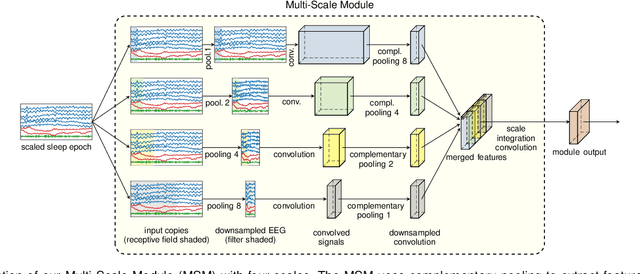
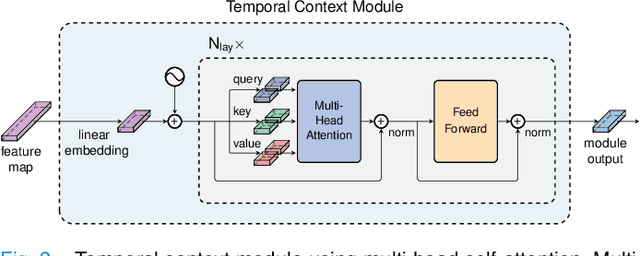
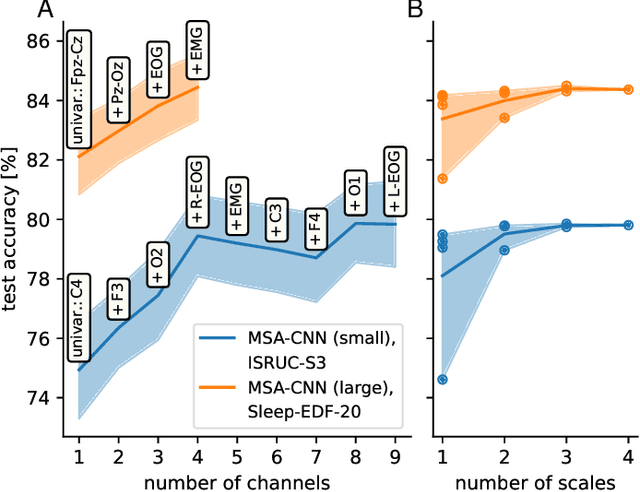
Recent advancements in machine learning-based signal analysis, coupled with open data initiatives, have fuelled efforts in automatic sleep stage classification. Despite the proliferation of classification models, few have prioritised reducing model complexity, which is a crucial factor for practical applications. In this work, we introduce Multi-Scale and Attention Convolutional Neural Network (MSA-CNN), a lightweight architecture featuring as few as ~10,000 parameters. MSA-CNN leverages a novel multi-scale module employing complementary pooling to eliminate redundant filter parameters and dense convolutions. Model complexity is further reduced by separating temporal and spatial feature extraction and using cost-effective global spatial convolutions. This separation of tasks not only reduces model complexity but also mirrors the approach used by human experts in sleep stage scoring. We evaluated both small and large configurations of MSA-CNN against nine state-of-the-art baseline models across three public datasets, treating univariate and multivariate models separately. Our evaluation, based on repeated cross-validation and re-evaluation of all baseline models, demonstrated that the large MSA-CNN outperformed all baseline models on all three datasets in terms of accuracy and Cohen's kappa, despite its significantly reduced parameter count. Lastly, we explored various model variants and conducted an in-depth analysis of the key modules and techniques, providing deeper insights into the underlying mechanisms. The code for our models, baselines, and evaluation procedures is available at https://github.com/sgoerttler/MSA-CNN.
EEG-GMACN: Interpretable EEG Graph Mutual Attention Convolutional Network
Dec 15, 2024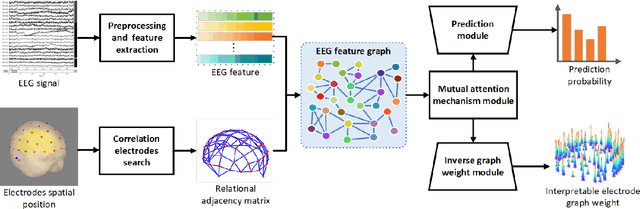
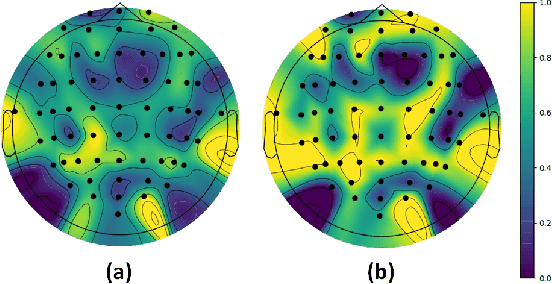
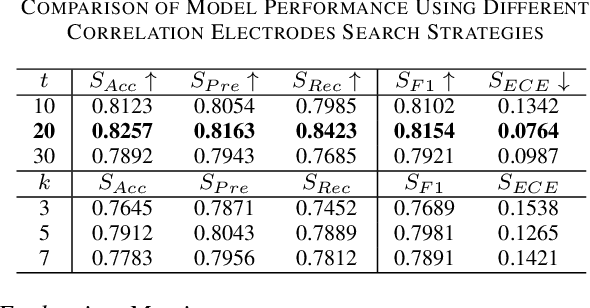
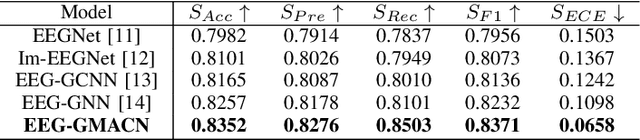
Electroencephalogram (EEG) is a valuable technique to record brain electrical activity through electrodes placed on the scalp. Analyzing EEG signals contributes to the understanding of neurological conditions and developing brain-computer interface. Graph Signal Processing (GSP) has emerged as a promising method for EEG spatial-temporal analysis, by further considering the topological relationships between electrodes. However, existing GSP studies lack interpretability of electrode importance and the credibility of prediction confidence. This work proposes an EEG Graph Mutual Attention Convolutional Network (EEG-GMACN), by introducing an 'Inverse Graph Weight Module' to output interpretable electrode graph weights, enhancing the clinical credibility and interpretability of EEG classification results. Additionally, we incorporate a mutual attention mechanism module into the model to improve its capability to distinguish critical electrodes and introduce credibility calibration to assess the uncertainty of prediction results. This study enhances the transparency and effectiveness of EEG analysis, paving the way for its widespread use in clinical and neuroscience research.
NonSysId: A nonlinear system identification package with improved model term selection for NARMAX models
Nov 25, 2024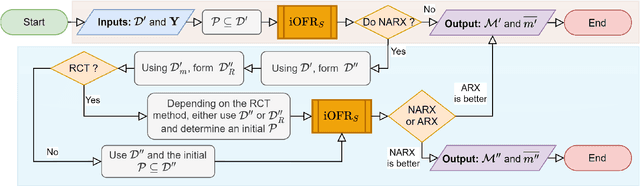
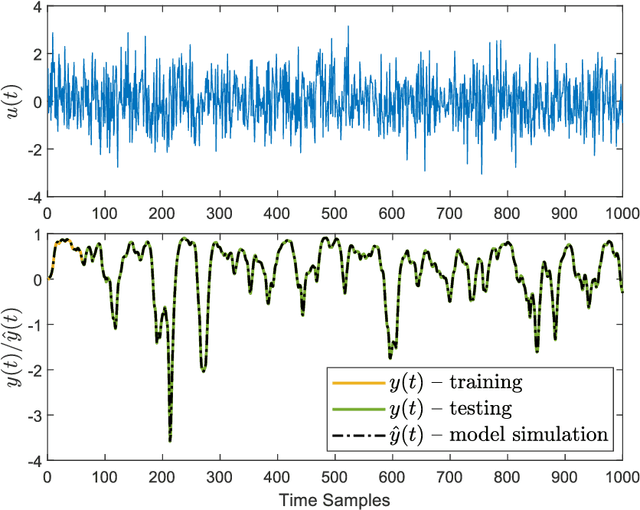
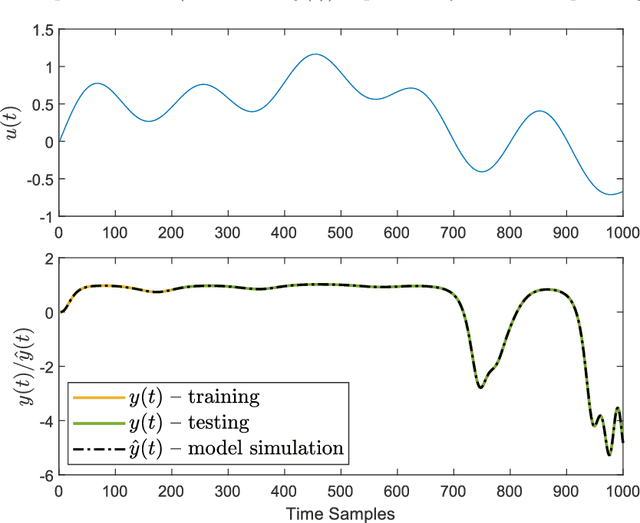
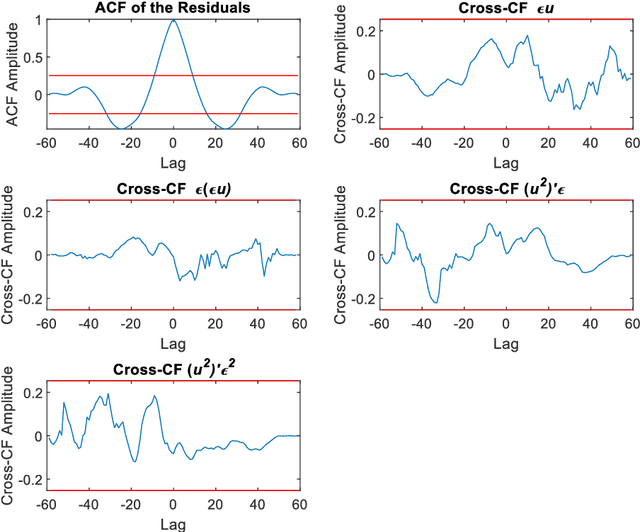
System identification involves constructing mathematical models of dynamic systems using input-output data, enabling analysis and prediction of system behaviour in both time and frequency domains. This approach can model the entire system or capture specific dynamics within it. For meaningful analysis, it is essential for the model to accurately reflect the underlying system's behaviour. This paper introduces NonSysId, an open-sourced MATLAB software package designed for nonlinear system identification, specifically focusing on NARMAX models. The software incorporates an advanced term selection methodology that prioritises on simulation (free-run) accuracy while preserving model parsimony. A key feature is the integration of iterative Orthogonal Forward Regression (iOFR) with Predicted Residual Sum of Squares (PRESS) statistic-based term selection, facilitating robust model generalisation without the need for a separate validation dataset. Furthermore, techniques for reducing computational overheads are implemented. These features make NonSysId particularly suitable for real-time applications such as structural health monitoring, fault diagnosis, and biomedical signal processing, where it is a challenge to capture the signals under consistent conditions, resulting in limited or no validation data.
Balancing Spectral, Temporal and Spatial Information for EEG-based Alzheimer's Disease Classification
Feb 21, 2024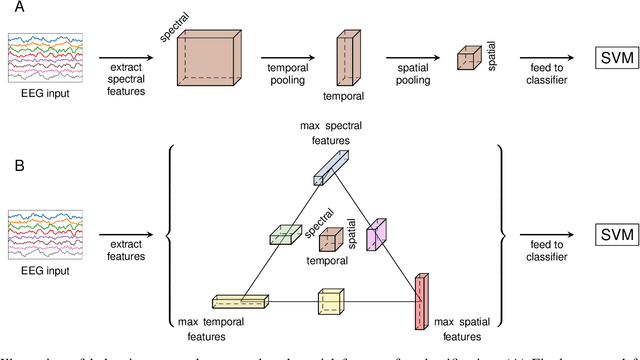
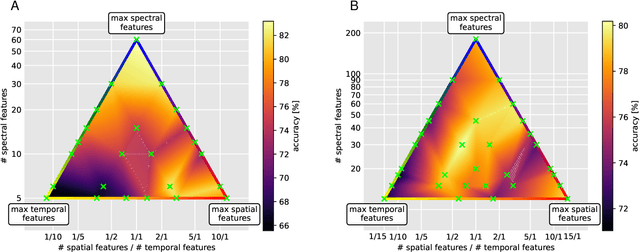
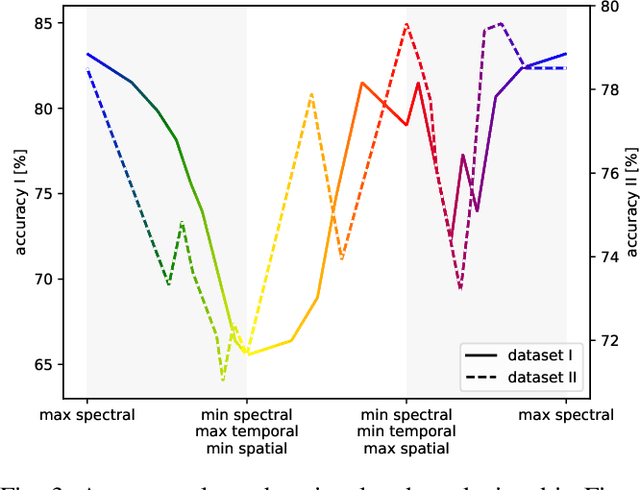
The prospect of future treatment warrants the development of cost-effective screening for Alzheimer's disease (AD). A promising candidate in this regard is electroencephalography (EEG), as it is one of the most economic imaging modalities. Recent efforts in EEG analysis have shifted towards leveraging spatial information, employing novel frameworks such as graph signal processing or graph neural networks. Here, we systematically investigate the importance of spatial information relative to spectral or temporal information by varying the proportion of each dimension for AD classification. To do so, we test various dimension resolution configurations on two routine EEG datasets. We find that spatial information is consistently more relevant than temporal information and equally relevant as spectral information. These results emphasise the necessity to consider spatial information for EEG-based AD classification. On our second dataset, we further find that well-balanced feature resolutions boost classification accuracy by up to 1.6%. Our resolution-based feature extraction has the potential to improve AD classification specifically, and multivariate signal classification generally.
Stochastic Graph Heat Modelling for Diffusion-based Connectivity Retrieval
Feb 20, 2024Heat diffusion describes the process by which heat flows from areas with higher temperatures to ones with lower temperatures. This concept was previously adapted to graph structures, whereby heat flows between nodes of a graph depending on the graph topology. Here, we combine the graph heat equation with the stochastic heat equation, which ultimately yields a model for multivariate time signals on a graph. We show theoretically how the model can be used to directly compute the diffusion-based connectivity structure from multivariate signals. Unlike other connectivity measures, our heat model-based approach is inherently multivariate and yields an absolute scaling factor, namely the graph thermal diffusivity, which captures the extent of heat-like graph propagation in the data. On two datasets, we show how the graph thermal diffusivity can be used to characterise Alzheimer's disease. We find that the graph thermal diffusivity is lower for Alzheimer's patients than healthy controls and correlates with dementia scores, suggesting structural impairment in patients in line with previous findings.