 Add to Chrome
 Add to Firefox
 Add to Edge
Free Process Rewards without Process Labels
Dec 02, 2024


Different from its counterpart outcome reward models (ORMs), which evaluate the entire responses, a process reward model (PRM) scores a reasoning trajectory step by step, providing denser and more fine grained rewards. However, training a PRM requires labels annotated at every intermediate step, presenting significant challenges for both manual and automatic data collection. This paper aims to address this challenge. Both theoretically and empirically, we show that an \textit{implicit PRM} can be obtained at no additional cost, by simply training an ORM on the cheaper response-level labels. The only assumption is to parameterize the outcome reward as the log-likelihood ratios of the policy and reference models, which can be optimized regardless of the specific choice of loss objectives. In experiments, we instantiate our implicit PRMs with various objectives and evaluate their performance on MATH. We show that our implicit PRM outperforms a strong MCTS-based baseline \textit{\'a la} Math-Shepherd using less than $1/38$ of the training data. Its performance can be further improved with majority voting. We further find that scaling up instructions and responses benefits our implicit PRM, and the latter brings a larger gain. Particularly, we find that our implicit PRM, when instantiated with the cross-entropy (CE) loss, is more data-efficient and can keep improving generation models even when trained with only one response per instruction, the setup that suffers from extreme data scarcity and imbalance. Further, instructions should be relevant to downstream tasks while the diversity of responses does not bring gains. Surprisingly, training on extra Math-Shepherd step labels brings no further improvements to our implicit PRM trained on only outcome data. We hope that our work will encourage a rethinking of PRM training approaches and contribute to making training PRMs more accessible.

KBAlign: Efficient Self Adaptation on Specific Knowledge Bases
Nov 25, 2024


Humans can utilize techniques to quickly acquire knowledge from specific materials in advance, such as creating self-assessment questions, enabling us to achieving related tasks more efficiently. In contrast, large language models (LLMs) usually relies on retrieval-augmented generation to exploit knowledge materials in an instant manner, or requires external signals such as human preference data and stronger LLM annotations to conduct knowledge adaptation. To unleash the self-learning potential of LLMs, we propose KBAlign, an approach designed for efficient adaptation to downstream tasks involving knowledge bases. Our method utilizes iterative training with self-annotated data such as Q&A pairs and revision suggestions, enabling the model to grasp the knowledge content efficiently. Experimental results on multiple datasets demonstrate the effectiveness of our approach, significantly boosting model performance in downstream tasks that require specific knowledge at a low cost. Notably, our approach achieves over 90% of the performance improvement that can be obtained by using GPT-4-turbo annotation, while relying entirely on self-supervision. We release our experimental data, models, and process analyses to the community for further exploration (https://github.com/thunlp/KBAlign).
ENAT: Rethinking Spatial-temporal Interactions in Token-based Image Synthesis
Nov 11, 2024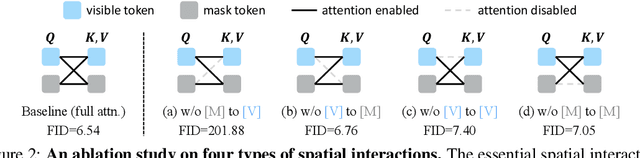
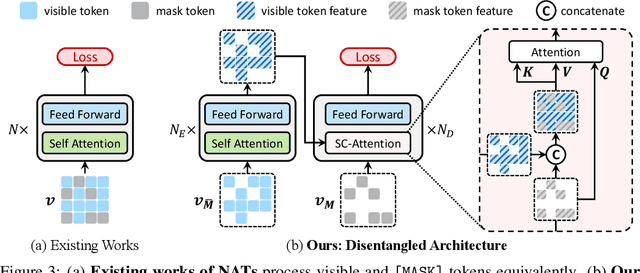
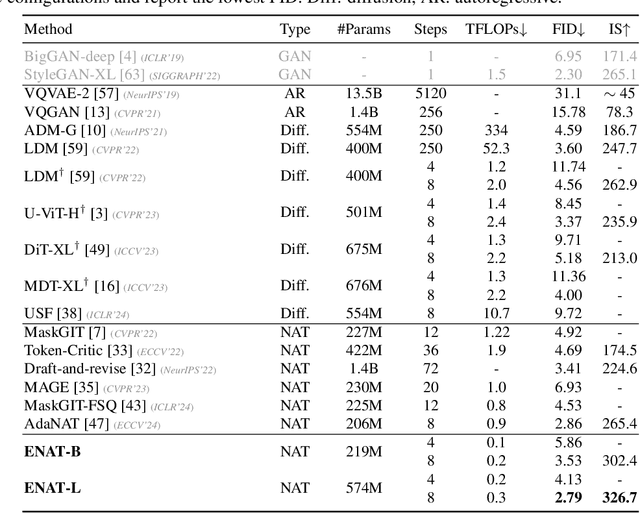
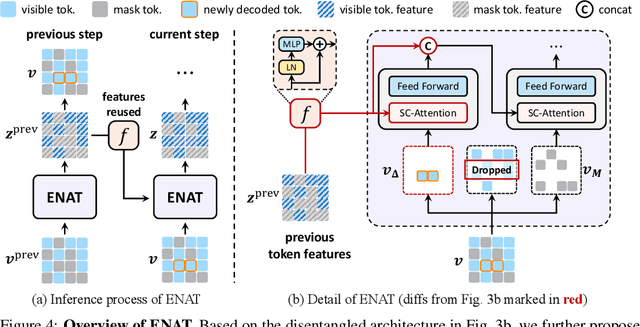
Recently, token-based generation have demonstrated their effectiveness in image synthesis. As a representative example, non-autoregressive Transformers (NATs) can generate decent-quality images in a few steps. NATs perform generation in a progressive manner, where the latent tokens of a resulting image are incrementally revealed. At each step, the unrevealed image regions are padded with mask tokens and inferred by NAT. In this paper, we delve into the mechanisms behind the effectiveness of NATs and uncover two important patterns that naturally emerge from NATs: Spatially (within a step), although mask and visible tokens are processed uniformly by NATs, the interactions between them are highly asymmetric. In specific, mask tokens mainly gather information for decoding, while visible tokens tend to primarily provide information, and their deep representations can be built only upon themselves. Temporally (across steps), the interactions between adjacent generation steps mostly concentrate on updating the representations of a few critical tokens, while the computation for the majority of tokens is generally repetitive. Driven by these findings, we propose EfficientNAT (ENAT), a NAT model that explicitly encourages these critical interactions inherent in NATs. At the spatial level, we disentangle the computations of visible and mask tokens by encoding visible tokens independently, while decoding mask tokens conditioned on the fully encoded visible tokens. At the temporal level, we prioritize the computation of the critical tokens at each step, while maximally reusing previously computed token representations to supplement necessary information. ENAT improves the performance of NATs notably with significantly reduced computational cost. Experiments on ImageNet-256, ImageNet-512 and MS-COCO validate the effectiveness of ENAT. Code is available at https://github.com/LeapLabTHU/ENAT.
WorkflowLLM: Enhancing Workflow Orchestration Capability of Large Language Models
Nov 08, 2024Recent advancements in large language models (LLMs) have driven a revolutionary paradigm shift in process automation from Robotic Process Automation to Agentic Process Automation by automating the workflow orchestration procedure based on LLMs. However, existing LLMs (even the advanced OpenAI GPT-4o) are confined to achieving satisfactory capability in workflow orchestration. To address this limitation, we present WorkflowLLM, a data-centric framework elaborately designed to enhance the capability of LLMs in workflow orchestration. It first constructs a large-scale fine-tuning dataset WorkflowBench with 106,763 samples, covering 1,503 APIs from 83 applications across 28 categories. Specifically, the construction process can be divided into three phases: (1) Data Collection: we collect real-world workflow data from Apple Shortcuts and RoutineHub, transcribing them into Python-style code. We further equip them with generated hierarchical thought via ChatGPT. (2) Query Expansion: we prompt ChatGPT to generate more task queries to enrich the diversity and complexity of workflows. (3) Workflow Generation: we leverage an annotator model trained on collected data to generate workflows for synthesized queries. Finally, we merge the synthetic samples that pass quality confirmation with the collected samples to obtain the WorkflowBench. Based on WorkflowBench, we fine-tune Llama-3.1-8B to obtain WorkflowLlama. Our experiments show that WorkflowLlama demonstrates a strong capacity to orchestrate complex workflows, while also achieving notable generalization performance on previously unseen APIs. Additionally, WorkflowBench exhibits robust zero-shot generalization capabilities on an out-of-distribution task planning dataset, T-Eval. Our data and code are available at https://github.com/OpenBMB/WorkflowLLM.
Sparsing Law: Towards Large Language Models with Greater Activation Sparsity
Nov 04, 2024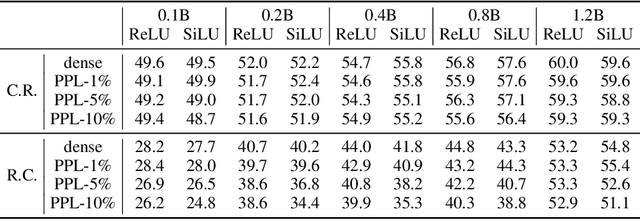
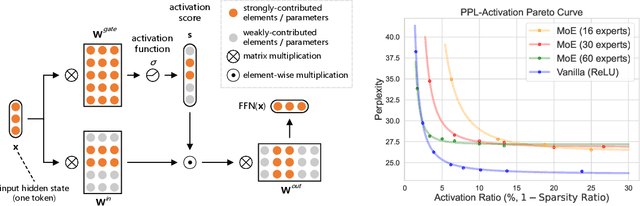
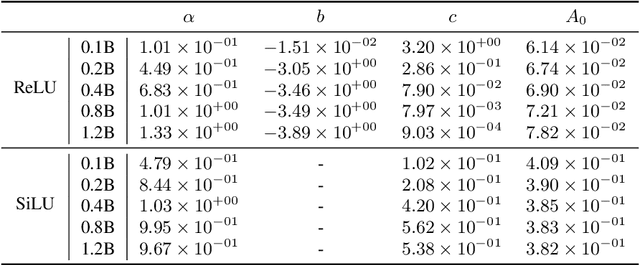

Activation sparsity denotes the existence of substantial weakly-contributed elements within activation outputs that can be eliminated, benefiting many important applications concerned with large language models (LLMs). Although promoting greater activation sparsity within LLMs deserves deep studies, existing works lack comprehensive and quantitative research on the correlation between activation sparsity and potentially influential factors. In this paper, we present a comprehensive study on the quantitative scaling properties and influential factors of the activation sparsity within decoder-only Transformer-based LLMs. Specifically, we propose PPL-$p\%$ sparsity, a precise and performance-aware activation sparsity metric that is applicable to any activation function. Through extensive experiments, we find several important phenomena. Firstly, different activation functions exhibit comparable performance but opposite training-time sparsity trends. The activation ratio (i.e., $1-\mathrm{sparsity\ ratio}$) evolves as a convergent increasing power-law and decreasing logspace power-law with the amount of training data for SiLU-activated and ReLU-activated LLMs, respectively. These demonstrate that ReLU is more efficient as the activation function than SiLU and can leverage more training data to improve activation sparsity. Secondly, the activation ratio linearly increases with the width-depth ratio below a certain bottleneck point, indicating the potential advantage of a deeper architecture at a fixed parameter scale. Finally, at similar width-depth ratios, we surprisingly find that the limit value of activation sparsity varies weakly with the parameter scale, i.e., the activation patterns within LLMs are insensitive to the parameter scale. These empirical laws towards LLMs with greater activation sparsity have important implications for making LLMs more efficient and interpretable.
MALoRA: Mixture of Asymmetric Low-Rank Adaptation for Enhanced Multi-Task Learning
Oct 30, 2024
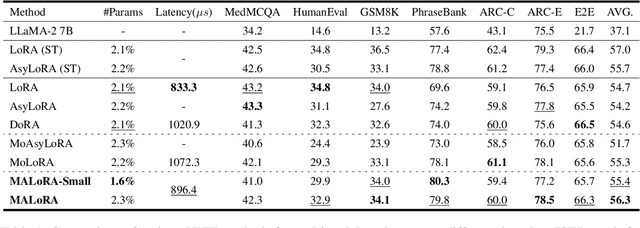


Parameter-Efficient Fine-Tuning (PEFT) methods like LoRA have significantly improved the adaptation of LLMs to downstream tasks in a resource-efficient manner. However, in multi-task scenarios, challenges such as training imbalance and the seesaw effect frequently emerge. Mixture-of-LoRA (MoLoRA), which combines LoRA with sparse Mixture-of-Experts, mitigates some of these issues by promoting task-specific learning across experts. Despite this, MoLoRA remains inefficient in terms of training speed, parameter utilization, and overall multi-task performance. In this paper, we propose Mixture of Asymmetric Low-Rank Adaptaion (MALoRA), a flexible fine-tuning framework that leverages asymmetric optimization across LoRA experts. MALoRA reduces the number of trainable parameters by 30% to 48%, increases training speed by 1.2x, and matches the computational efficiency of single-task LoRA models. Additionally, MALoRA addresses overfitting issues commonly seen in high-rank configurations, enhancing performance stability. Extensive experiments across diverse multi-task learning scenarios demonstrate that MALoRA consistently outperforms all baseline methods in both inter-domain and intra-domain tasks.
RAG-DDR: Optimizing Retrieval-Augmented Generation Using Differentiable Data Rewards
Oct 17, 2024
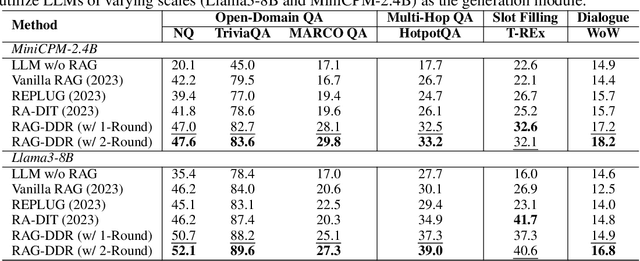


Retrieval-Augmented Generation (RAG) has proven its effectiveness in mitigating hallucinations in Large Language Models (LLMs) by retrieving knowledge from external resources. To adapt LLMs for RAG pipelines, current approaches use instruction tuning to optimize LLMs, improving their ability to utilize retrieved knowledge. This supervised fine-tuning (SFT) approach focuses on equipping LLMs to handle diverse RAG tasks using different instructions. However, it trains RAG modules to overfit training signals and overlooks the varying data preferences among agents within the RAG system. In this paper, we propose a Differentiable Data Rewards (DDR) method, which end-to-end trains RAG systems by aligning data preferences between different RAG modules. DDR works by collecting the rewards to optimize each agent with a rollout method. This method prompts agents to sample some potential responses as perturbations, evaluates the impact of these perturbations on the whole RAG system, and subsequently optimizes the agent to produce outputs that improve the performance of the RAG system. Our experiments on various knowledge-intensive tasks demonstrate that DDR significantly outperforms the SFT method, particularly for LLMs with smaller-scale parameters that depend more on the retrieved knowledge. Additionally, DDR exhibits a stronger capability to align the data preference between RAG modules. The DDR method makes generation module more effective in extracting key information from documents and mitigating conflicts between parametric memory and external knowledge. All codes are available at https://github.com/OpenMatch/RAG-DDR.
Proactive Agent: Shifting LLM Agents from Reactive Responses to Active Assistance
Oct 16, 2024
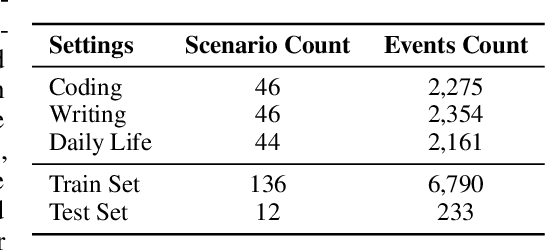

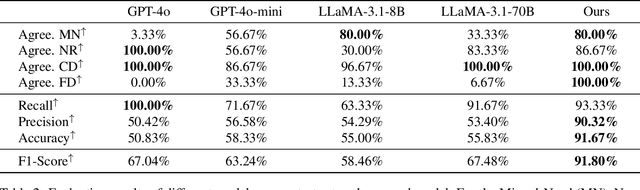
Agents powered by large language models have shown remarkable abilities in solving complex tasks. However, most agent systems remain reactive, limiting their effectiveness in scenarios requiring foresight and autonomous decision-making. In this paper, we tackle the challenge of developing proactive agents capable of anticipating and initiating tasks without explicit human instructions. We propose a novel data-driven approach for this problem. Firstly, we collect real-world human activities to generate proactive task predictions. These predictions are then labeled by human annotators as either accepted or rejected. The labeled data is used to train a reward model that simulates human judgment and serves as an automatic evaluator of the proactiveness of LLM agents. Building on this, we develop a comprehensive data generation pipeline to create a diverse dataset, ProactiveBench, containing 6,790 events. Finally, we demonstrate that fine-tuning models with the proposed ProactiveBench can significantly elicit the proactiveness of LLM agents. Experimental results show that our fine-tuned model achieves an F1-Score of 66.47% in proactively offering assistance, outperforming all open-source and close-source models. These results highlight the potential of our method in creating more proactive and effective agent systems, paving the way for future advancements in human-agent collaboration.
VisRAG: Vision-based Retrieval-augmented Generation on Multi-modality Documents
Oct 14, 2024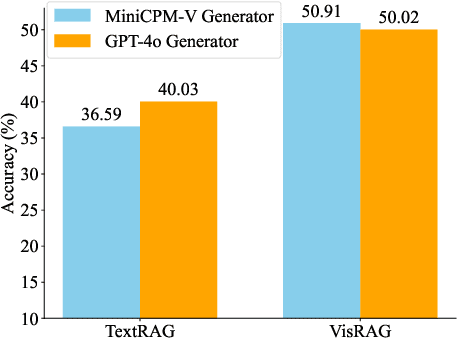
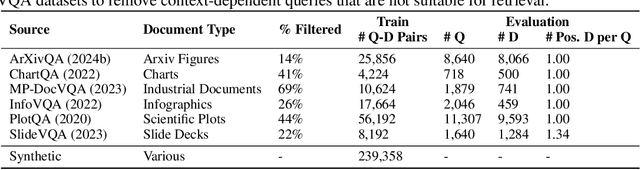
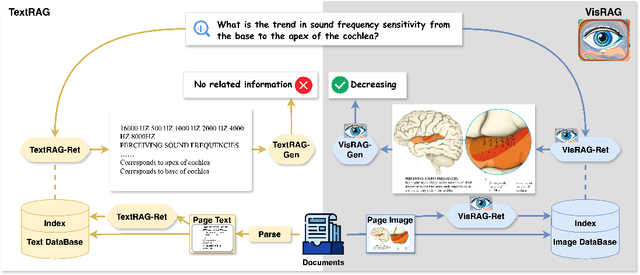
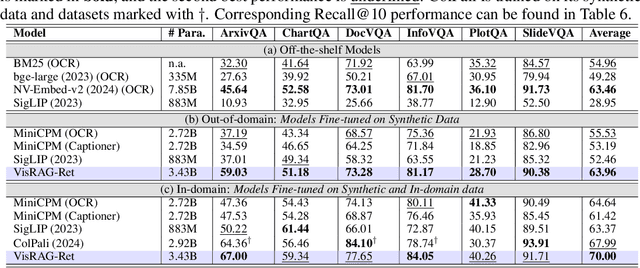
Retrieval-augmented generation (RAG) is an effective technique that enables large language models (LLMs) to utilize external knowledge sources for generation. However, current RAG systems are solely based on text, rendering it impossible to utilize vision information like layout and images that play crucial roles in real-world multi-modality documents. In this paper, we introduce VisRAG, which tackles this issue by establishing a vision-language model (VLM)-based RAG pipeline. In this pipeline, instead of first parsing the document to obtain text, the document is directly embedded using a VLM as an image and then retrieved to enhance the generation of a VLM. Compared to traditional text-based RAG, VisRAG maximizes the retention and utilization of the data information in the original documents, eliminating the information loss introduced during the parsing process. We collect both open-source and synthetic data to train the retriever in VisRAG and explore a variety of generation methods. Experiments demonstrate that VisRAG outperforms traditional RAG in both the retrieval and generation stages, achieving a 25--39\% end-to-end performance gain over traditional text-based RAG pipeline. Further analysis reveals that VisRAG is effective in utilizing training data and demonstrates strong generalization capability, positioning it as a promising solution for RAG on multi-modality documents. Our code and data are available at https://github.com/openbmb/visrag .
LLM$\times$MapReduce: Simplified Long-Sequence Processing using Large Language Models
Oct 12, 2024


Enlarging the context window of large language models (LLMs) has become a crucial research area, particularly for applications involving extremely long texts. In this work, we propose a novel training-free framework for processing long texts, utilizing a divide-and-conquer strategy to achieve comprehensive document understanding. The proposed LLM$\times$MapReduce framework splits the entire document into several chunks for LLMs to read and then aggregates the intermediate answers to produce the final output. The main challenge for divide-and-conquer long text processing frameworks lies in the risk of losing essential long-range information when splitting the document, which can lead the model to produce incomplete or incorrect answers based on the segmented texts. Disrupted long-range information can be classified into two categories: inter-chunk dependency and inter-chunk conflict. We design a structured information protocol to better cope with inter-chunk dependency and an in-context confidence calibration mechanism to resolve inter-chunk conflicts. Experimental results demonstrate that LLM$\times$MapReduce can outperform representative open-source and commercial long-context LLMs, and is applicable to several different models.