 Add to Chrome
 Add to Firefox
 Add to Edge
EvolveNet: Collaborative Harness Evolution for Agent Self-Improvement
Aug 05, 2026
The capabilities of an LLM agent depend not only on its model but on the harness: the executable program that constructs context, invokes tools, verifies results, and recovers from failure. Recent work shows that evolving the harness yields persistent improvements without updating model weights. Existing approaches, however, assume that all execution experience can be routed to a single optimizer, which evolves one harness along a sequential trajectory. Real agent ecosystems violate that assumption: users, organizations, and environments generate isolated streams of experience that cannot be pooled, so the experience most worth learning from is exactly the experience that cannot be directly centralized. We introduce EvolveNet, a paradigm of collaborative harness evolution that moves experience extraction to the data. A shared harness is broadcast to data-local agent deployments, each of which evolves it on its own workload. Only the resulting program adaptations are composed into an updated shared harness and redistributed, so that every participating agent inherits operational experience discovered by the others. By shifting the aggregation boundary from raw workloads to learned adaptations, EvolveNet keeps workloads local and allows multiple evolutionary searches to proceed concurrently with reduced serial depth. Because independently modified programs cannot be averaged like model parameters and may conflict when composed, EvolveNet introduces scope-typed, evidence-guided program aggregation. Across five settings spanning text-to-SQL, data-science coding, competitive programming, software engineering, and agentic workflows, EvolveNet improves the shared harness in all five, with the largest gains under heterogeneous workloads, and ablations attribute the improvement to composition of adaptations from different agents rather than to selecting among them.

Generated Images Are Easier to Forget: A Machine Unlearning Perspective for Synthetic Image Detection
Aug 01, 2026Robust detection of generated images is critical to counter the misuse of generative models. Existing methods primarily depend on learning from human-annotated training datasets, limiting their generalization to unseen distributions. In contrast, large-scale vision models (LVMs) pre-trained on web-scale datasets exhibit exceptional generalization power through exposure to diverse distributions, offering a transformative paradigm for this task. However, our experimental results reveal that LVMs pre-trained on natural-image-dominated data can effectively capture the features of both natural and generated images, yielding comparably low losses and thus limited discriminative capacity between them. This prompts a key question: When and how do LVMs exhibit different behaviors when capturing features of natural and generated images? This investigation reveals an insight: during unlearning, LVMs exhibit disparate forgetting dynamics with feature degradation for generated images escalating faster than natural ones. Inspired by the disparate dynamics, we introduce two detection methods: 1) data-free detection, which prunes model parameters to induce unlearning without data access, and 2) data-driven detection, which optimizes LVMs to unlearn knowledge tied to generated images. Extensive experiments conducted on various benchmarks demonstrate that our unlearning-based approach outperforms conventional detection methods. By recasting the detection task as a problem of machine unlearning, our work establishes a new paradigm for generated image detection.
DRNOISE: Benchmarking Deep Research Agents in Misleading Evidence Environments
Jul 19, 2026Deep research agents increasingly operate over the open web, where relevant records coexist with redundant summaries, outdated reports, and misleading documents. Existing evaluations offer limited insight into whether agents preserve sound evidential standards when an ordinary-looking false document is deliberately seeded into a searchable environment and offers a direct shortcut to a conflicting answer. We introduce DRNOISE, a 100-task benchmark for answer recovery under misleading evidence. Each task has a unique gold answer supported by two corroborating indirect record chains; the paired noisy condition adds one plausible document that states a conflicting answer directly. The benchmark spans ten families of evidence operations. Across agents with strong clean-task performance, this single intervention causes 66-88 percentage-point accuracy drops. Trace analyses identify verification inertia as the dominant failure mode: agents often retrieve truthful records but stop before completing and reconciling the evidence chain, instead deferring to the answer-like document. Generic verification prompts reduce but do not close this gap. The setting is especially relevant to open-web deployment, where plausible falsehoods arrive through ordinary-looking pages rather than explicit attacks. Reliable deep research therefore requires more than retrieval and citation; it requires active reconciliation of direct claims with record-level evidence.
TTHE: Test-Time Harness Evolution
Jul 09, 2026The behavior of an LLM agent is determined not only by the underlying model, but also by its harness: the executable program that constructs context, invokes tools, verifies intermediate results, and recovers from failures. Existing approaches optimize such harnesses before deployment, searching training or development data for a fixed agent workflow that is then frozen at test time. This limits adaptation when the test distribution, failure modes, or tool interactions differ from those seen during development. We ask whether the harness can instead be optimized during evaluation itself, using only the unlabeled execution traces the agent produces on the test inputs. We introduce Test-Time Harness Evolution (TTHE), which treats the executable harness as the state of test-time adaptation. During evaluation, TTHE maintains a population of candidate harnesses and refines them through an agentic proposer that reasons over their execution traces, without gold labels or task-specific supervision; a judge then commits an improved harness from execution-derived proxy signals, and the selected program persists to govern subsequent inputs. Crucially, TTHE does not update model weights, require gold labels, or train a separate adaptation model: solver, proposers, and judge are different roles and harnesses around the same frozen LLM, so all adaptation occurs through changes to the surrounding program. Across text-to-SQL, competitive programming, software engineering, data-science coding, and agentic tool-use tasks, TTHE improves fixed ReAct-style baseline harnesses, yielding persistent, inspectable improvements rather than a pre-searched workflow or per-query retries. These results recast test-time adaptation for LLM agents as evolution over executable control programs and identify execution-derived proxy reliability as a central challenge for robust unsupervised agent improvement.
Detecting Discrepancies Between AI-Generated and Natural Images Using Uncertainty
Dec 08, 2024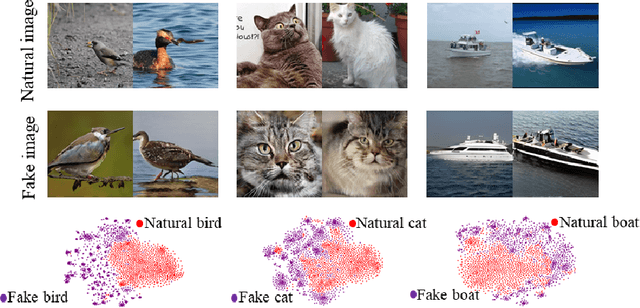
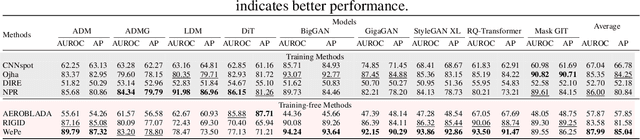
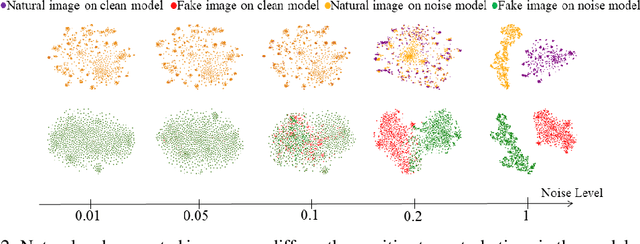
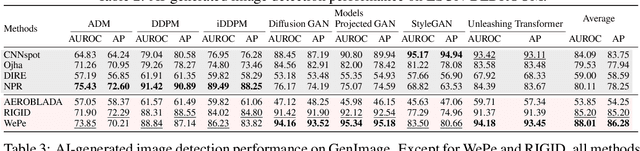
In this work, we propose a novel approach for detecting AI-generated images by leveraging predictive uncertainty to mitigate misuse and associated risks. The motivation arises from the fundamental assumption regarding the distributional discrepancy between natural and AI-generated images. The feasibility of distinguishing natural images from AI-generated ones is grounded in the distribution discrepancy between them. Predictive uncertainty offers an effective approach for capturing distribution shifts, thereby providing insights into detecting AI-generated images. Namely, as the distribution shift between training and testing data increases, model performance typically degrades, often accompanied by increased predictive uncertainty. Therefore, we propose to employ predictive uncertainty to reflect the discrepancies between AI-generated and natural images. In this context, the challenge lies in ensuring that the model has been trained over sufficient natural images to avoid the risk of determining the distribution of natural images as that of generated images. We propose to leverage large-scale pre-trained models to calculate the uncertainty as the score for detecting AI-generated images. This leads to a simple yet effective method for detecting AI-generated images using large-scale vision models: images that induce high uncertainty are identified as AI-generated. Comprehensive experiments across multiple benchmarks demonstrate the effectiveness of our method.
FedCME: Client Matching and Classifier Exchanging to Handle Data Heterogeneity in Federated Learning
Jul 17, 2023

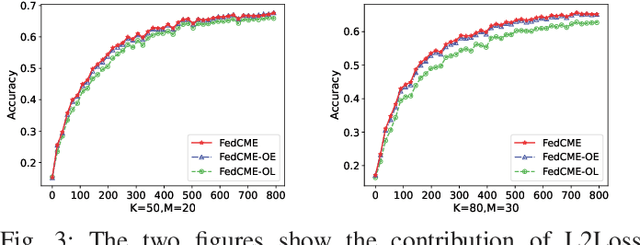

Data heterogeneity across clients is one of the key challenges in Federated Learning (FL), which may slow down the global model convergence and even weaken global model performance. Most existing approaches tackle the heterogeneity by constraining local model updates through reference to global information provided by the server. This can alleviate the performance degradation on the aggregated global model. Different from existing methods, we focus the information exchange between clients, which could also enhance the effectiveness of local training and lead to generate a high-performance global model. Concretely, we propose a novel FL framework named FedCME by client matching and classifier exchanging. In FedCME, clients with large differences in data distribution will be matched in pairs, and then the corresponding pair of clients will exchange their classifiers at the stage of local training in an intermediate moment. Since the local data determines the local model training direction, our method can correct update direction of classifiers and effectively alleviate local update divergence. Besides, we propose feature alignment to enhance the training of the feature extractor. Experimental results demonstrate that FedCME performs better than FedAvg, FedProx, MOON and FedRS on popular federated learning benchmarks including FMNIST and CIFAR10, in the case where data are heterogeneous.