 Add to Chrome
 Add to Firefox
 Add to Edge
Zero2Skill: Bootstrapping Robot Skills through Autonomous Data Collection, Training, and Deployment
Jul 16, 2026
Autonomous data collection governs the volume and quality of real-world trajectories for manipulation policy learning. Existing pipelines reduce human effort via self-resetting, VLM verification, or language-guided correction, yet episode-scoped fixes must be reissued whenever the same failure recurs, so oversight cost grows with session length rather than with the number of distinct problems. We present Zero2Skill, a human-robot symbiotic agentic system in which corrections are retained and reused across rounds. The collection loop collects, verifies, and resets autonomously, pausing for a remote operator only when a phase exhausts an explicit retry budget. An LLM parser maps each natural-language utterance to a structured adjustment stored in Corrective Memory, so addressed failure modes typically need not be corrected again under the same conditions. On a real-robot desktop-clearing testbed, Zero2Skill matches teleoperation episode success while reducing human working time to 16%. Language corrections improve verifier-human agreement in all four evaluated settings and raise average single-attempt success from 12.5% to 47.5% (arm-selection: 20.0% to 50.0%). Policies fine-tuned on Zero2Skill data match teleoperation-trained policy success at a fraction of collection human cost.

Empowering Feed-Forward Reconstruction Models with Metric Scale via Satellite Images
Jun 06, 2026Feed-forward 3D reconstruction models have recently shown strong generalization across diverse scenes, yet most of them recover geometry only up to an unknown global scale. This scale ambiguity limits their use in applications that require metric understanding of the environment. Existing metric reconstruction methods commonly rely on large-scale metric annotations or accurate camera calibration, both of which are costly or unreliable in many real-world settings. We propose a satellite-guided framework for resolving scale ambiguity in feed-forward 3D reconstruction. The key idea is to use readily available satellite imagery as a global metric reference. Given a coarse camera pose, our method retrieves a local satellite patch and integrates it with a feed-forward reconstruction backbone through bidirectional cross-view interaction. By enforcing consistency between the reconstructed scene and the satellite reference, the model infers absolute scale, refines scene geometry, and estimates camera pose in a metric coordinate frame. Experiments on KITTI, nuScenes, and Oxford RobotCar show consistent improvements in metric depth estimation, multi-view point-cloud reconstruction, and cross-view camera localization, while preserving strong generalization across datasets and geographic regions.
Controllable Satellite-to-Street-View Synthesis with Precise Pose Alignment and Zero-Shot Environmental Control
Feb 05, 2025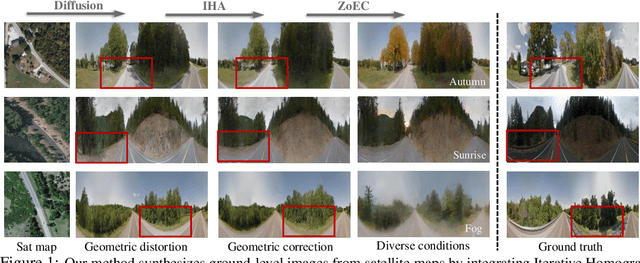
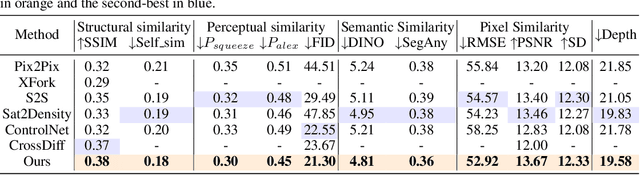
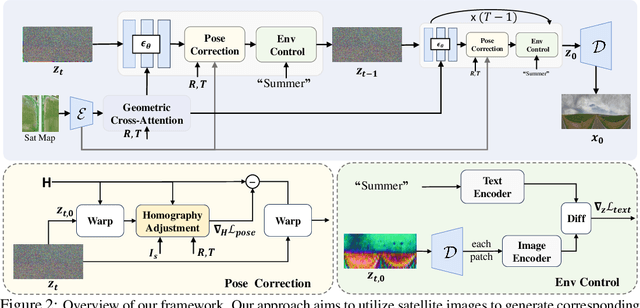
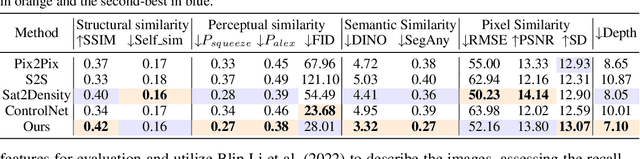
Generating street-view images from satellite imagery is a challenging task, particularly in maintaining accurate pose alignment and incorporating diverse environmental conditions. While diffusion models have shown promise in generative tasks, their ability to maintain strict pose alignment throughout the diffusion process is limited. In this paper, we propose a novel Iterative Homography Adjustment (IHA) scheme applied during the denoising process, which effectively addresses pose misalignment and ensures spatial consistency in the generated street-view images. Additionally, currently, available datasets for satellite-to-street-view generation are limited in their diversity of illumination and weather conditions, thereby restricting the generalizability of the generated outputs. To mitigate this, we introduce a text-guided illumination and weather-controlled sampling strategy that enables fine-grained control over the environmental factors. Extensive quantitative and qualitative evaluations demonstrate that our approach significantly improves pose accuracy and enhances the diversity and realism of generated street-view images, setting a new benchmark for satellite-to-street-view generation tasks.
Learning Dense Flow Field for Highly-accurate Cross-view Camera Localization
Sep 27, 2023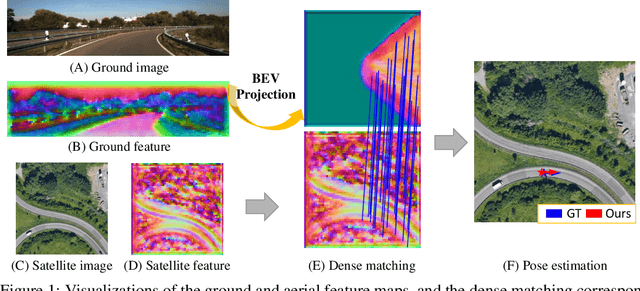
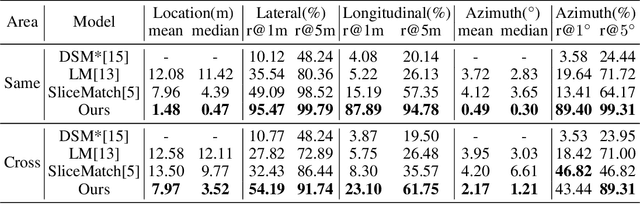
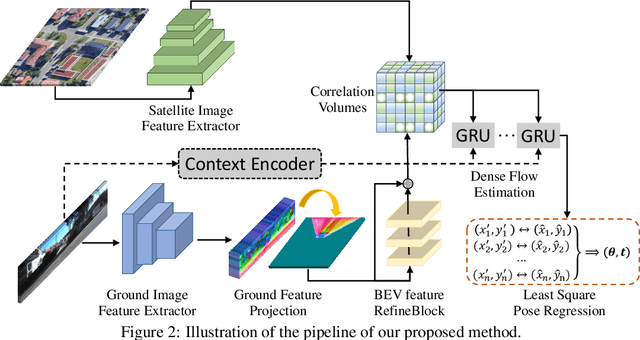
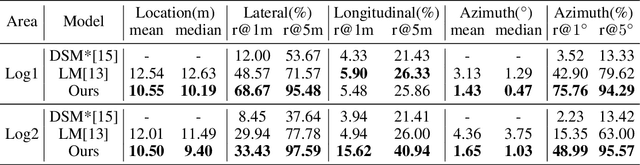
This paper addresses the problem of estimating the 3-DoF camera pose for a ground-level image with respect to a satellite image that encompasses the local surroundings. We propose a novel end-to-end approach that leverages the learning of dense pixel-wise flow fields in pairs of ground and satellite images to calculate the camera pose. Our approach differs from existing methods by constructing the feature metric at the pixel level, enabling full-image supervision for learning distinctive geometric configurations and visual appearances across views. Specifically, our method employs two distinct convolution networks for ground and satellite feature extraction. Then, we project the ground feature map to the bird's eye view (BEV) using a fixed camera height assumption to achieve preliminary geometric alignment. To further establish content association between the BEV and satellite features, we introduce a residual convolution block to refine the projected BEV feature. Optical flow estimation is performed on the refined BEV feature map and the satellite feature map using flow decoder networks based on RAFT. After obtaining dense flow correspondences, we apply the least square method to filter matching inliers and regress the ground camera pose. Extensive experiments demonstrate significant improvements compared to state-of-the-art methods. Notably, our approach reduces the median localization error by 89%, 19%, 80% and 35% on the KITTI, Ford multi-AV, VIGOR and Oxford RobotCar datasets, respectively.