 Add to Chrome
 Add to Firefox
 Add to Edge
JarvisHub: An Open Harness for Canvas-Native Multimodal Creative Agents
Jul 26, 2026
Creative AI is moving from single-step asset generation toward long-horizon multimodal production. Although recent generative models can synthesize high-quality images, videos, audio clips, UI elements, storyboards, slides, and other creative assets, real-world creative work requires more than isolated prompt-output interactions. It involves references, drafts, alternatives, edits, failed attempts, version relations, tool actions, evaluation signals, and human feedback, which together form an evolving project state. Existing prompt-based, chat-based, and node-based generation systems only partially support this state, as they often discard intermediate context, rely on linear conversations, or require manually specified workflows. Recent commercial systems indicate a shift toward agent-assisted creative production, but their closed architectures make it difficult to study how agents represent context, choose tools, revise artifacts, recover from failures, and maintain consistency over time. To address this gap, we introduce JarvisHub, a canvas-native creative agent harness for long-horizon multimodal creation. JarvisHub treats an editable canvas as the user workspace, the agent's external memory, action space, and shared project state, representing multimodal artifacts, dependencies, versions, and feedback as typed canvas nodes and links. Through a three-layer architecture of canvas state, protocol bridge, and agent runtime, JarvisHub enables agents to act within an inspectable and editable creative state. This design moves creative agents beyond isolated tool use toward sustained, human-steerable creative automation, where agents can progressively plan, generate, revise, and organize multimodal projects while users remain able to inspect, guide, and intervene throughout the process.

Deeper vs Wider: A Revisit of Transformer Configuration
May 24, 2022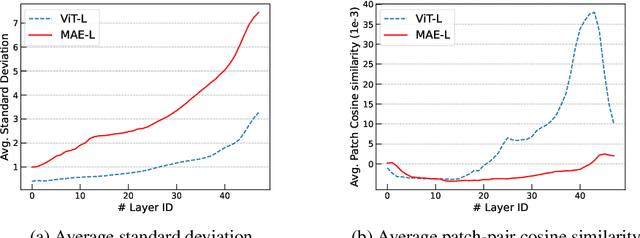
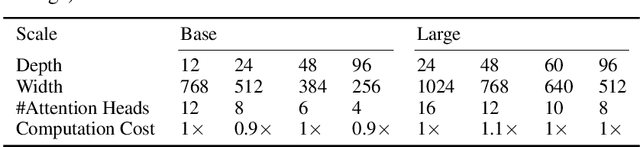
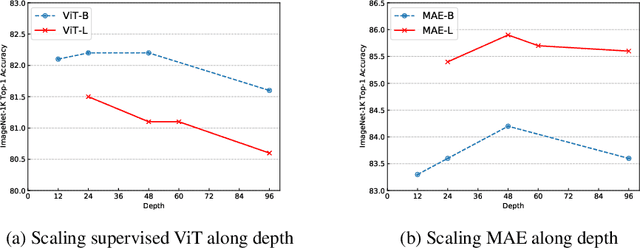
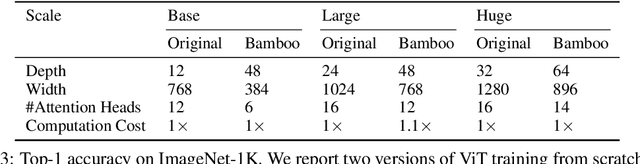
Transformer-based models have delivered impressive results on many tasks, particularly vision and language tasks. In many model training situations, conventional configurations are typically adopted. For example, we often set the base model with hidden dimensions (i.e. model width) to be 768 and the number of transformer layers (i.e. model depth) to be 12. In this paper, we revisit these conventional configurations. Through theoretical analysis and experimental evaluation, we show that the masked autoencoder is effective in alleviating the over-smoothing issue in deep transformer training. Based on this finding, we propose Bamboo, an idea of using deeper and narrower transformer configurations, for masked autoencoder training. On ImageNet, with such a simple change in configuration, re-designed model achieves 87.1% top-1 accuracy and outperforms SoTA models like MAE and BEiT. On language tasks, re-designed model outperforms BERT with default setting by 1.1 points on average, on GLUE datasets.