 Add to Chrome
 Add to Firefox
 Add to Edge
CFALR: Collaborative Filtering-Augmented Large Language Model for Personalized Fashion Outfit Recommendation
Jun 11, 2026
Personalized outfit recommendation poses a significant challenge in e-commerce and social media platforms, requiring systems that balance user preferences with aesthetic compatibility. Collaborative filtering (CF) provides a traditional solution for this, but it struggles with data-sparse scenarios and complex user-item-outfit relationships. Meanwhile, existing template-based approaches are constrained by rigid pre-designed structures. To bridge these research gaps, we introduce CFALR (Collaborative Filtering-Augmented Large Language Model for Recommendation), a novel framework that synergizes collaborative filtering with large language models for personalized outfit recommendation. Specifically, CFALR describes user-outfit interactions in natural language and leverages LLMs to capture fashion semantics while employing CF-enhanced embeddings to bridge the semantic space and the collaborative interaction spaces. Our technical contributions include: (1) the first LLM-based architecture specifically designed for personalized outfit recommendation, (2) a CF-augmented generative mechanism that efficiently navigates the extensive combination space of outfit items, and (3) trainable projection layers that optimally integrate relational and content features. Experiments on Polyvore and IQON benchmarks demonstrate CFALR's superior performance over both traditional CF-based and LLM-based methods in personalized fill-in-the-blank and personalized outfit generation tasks.

Inference Cost Attacks for Retrieval-Augmented Large Language Models
May 31, 2026Retrieval-Augmented Generation (RAG)-enhanced LLM systems, while powerful, introduce substantial inference costs due to the inclusion of an extra multi-stage pipeline that dynamically retrieves and synthesizes information from external knowledge sources. This high operational cost exposes a critical vulnerability to Inference Cost Attacks (ICAs). However, existing ICAs often rely on the impractical assumption of direct prompt manipulation. We argue that a more feasible and potent threat to RAG-enhanced LLM systems arises from poisoning external knowledge bases (e.g., web knowledge from the Internet). In this work, we introduce the Retrieval-Augmented Inference Cost Attack (RA-ICA), a novel attacking paradigm that targets the computational cost of RAG-enhanced LLM systems by injecting malicious documents into external knowledge corpus. To operationalize this attack, we propose Computational Resource Exhaustion via External Poisoning (CREEP), a novel framework that leverages LLM agents to automatically craft malicious documents that are both semantically relevant for retrieval and potent for inducing an abnormal increase in token consumption during the inference phase. To enhance the attack's effectiveness, we introduce Memory-Augmented Group Relative Policy Optimization (MA-GRPO), a novel reinforcement learning algorithm that fine-tunes the agents by learning from a dynamic memory of historical best adversarial documents. Extensive experiments across three real-world datasets demonstrate that RA-ICA increases token consumption by up to 13.12 times with an over 90% success rate, without degrading the integrity of the generated answer.
* Accepted at The ACM Web Conference 2026 (WWW '26)
Mixture-of-Experts Knowledge Graph Retrieval-Augmented Generation for Multi-Agent LLM-based Recommendation
May 27, 2026Large language models (LLMs) have recently been adopted for recommendations due to their ability to understand user intent and item semantics. However, LLM-based recommender systems often rely on parametric knowledge and suffer from outdated knowledge, motivating knowledge graph retrieval-augmented generation (KG-RAG) to ground recommendations on structured, up-to-date KGs. Despite this promise, effective KG-RAG in recommendations faces great challenges. First, users' queries vary in complexity and require KG knowledge at different granularities, whereas existing methods adopt a one-size-fits-all retrieval strategy, leading to over-retrieval for simple queries and under-retrieval for complex ones. In addition, augmenting LLMs with KG knowledge requires translating graph-structured data into linear text, which may introduce noise and cause structural information loss. Moreover, the selection of retrieval granularity lacks direct supervision and must be inferred from the final recommendation after alignment and downstream utilization, making query-aware retrieval hard to learn end-to-end. To address these issues, we propose MixRAGRec, a cooperative multi-agent framework for KG-RAG recommendations. MixRAGRec integrates a Mixture-of-Experts Retrieval Agent that routes each query to a KG retrieval expert with different granularities, a Knowledge Preference Alignment Agent that converts structured knowledge into LLM-friendly natural language, and a Contrastive Learning-reinforced Recommendation Agent trained with contrastive preference feedback. Notably, we introduce Mixture-of-Experts Multi-Agent Policy Optimization (MMAPO) to train three agents under a unified objective. Extensive experiments on real-world datasets demonstrate the effectiveness of our framework.
OVS-DINO: Open-Vocabulary Segmentation via Structure-Aligned SAM-DINO with Language Guidance
Apr 09, 2026Open-Vocabulary Segmentation (OVS) aims to segment image regions beyond predefined category sets by leveraging semantic descriptions. While CLIP based approaches excel in semantic generalization, they frequently lack the fine-grained spatial awareness required for dense prediction. Recent efforts have incorporated Vision Foundation Models (VFMs) like DINO to alleviate these limitations. However, these methods still struggle with the precise edge perception necessary for high fidelity segmentation. In this paper, we analyze internal representations of DINO and discover that its inherent boundary awareness is not absent but rather undergoes progressive attenuation as features transition into deeper transformer blocks. To address this, we propose OVS-DINO, a novel framework that revitalizes latent edge-sensitivity of DINO through structural alignment with the Segment Anything Model (SAM). Specifically, we introduce a Structure-Aware Encoder (SAE) and a Structure-Modulated Decoder (SMD) to effectively activate boundary features of DINO using SAM's structural priors, complemented by a supervision strategy utilizing SAM generated pseudo-masks. Extensive experiments demonstrate that our method achieves state-of-the-art performance across multiple weakly-supervised OVS benchmarks, improving the average score by 2.1% (from 44.8% to 46.9%). Notably, our approach significantly enhances segmentation accuracy in complex, cluttered scenarios, with a gain of 6.3% on Cityscapes (from 36.6% to 42.9%).
HV-Attack: Hierarchical Visual Attack for Multimodal Retrieval Augmented Generation
Nov 19, 2025Advanced multimodal Retrieval-Augmented Generation (MRAG) techniques have been widely applied to enhance the capabilities of Large Multimodal Models (LMMs), but they also bring along novel safety issues. Existing adversarial research has revealed the vulnerability of MRAG systems to knowledge poisoning attacks, which fool the retriever into recalling injected poisoned contents. However, our work considers a different setting: visual attack of MRAG by solely adding imperceptible perturbations at the image inputs of users, without manipulating any other components. This is challenging due to the robustness of fine-tuned retrievers and large-scale generators, and the effect of visual perturbation may be further weakened by propagation through the RAG chain. We propose a novel Hierarchical Visual Attack that misaligns and disrupts the two inputs (the multimodal query and the augmented knowledge) of MRAG's generator to confuse its generation. We further design a hierarchical two-stage strategy to obtain misaligned augmented knowledge. We disrupt the image input of the retriever to make it recall irrelevant knowledge from the original database, by optimizing the perturbation which first breaks the cross-modal alignment and then disrupts the multimodal semantic alignment. We conduct extensive experiments on two widely-used MRAG datasets: OK-VQA and InfoSeek. We use CLIP-based retrievers and two LMMs BLIP-2 and LLaVA as generators. Results demonstrate the effectiveness of our visual attack on MRAG through the significant decrease in both retrieval and generation performance.
WebRec: Enhancing LLM-based Recommendations with Attention-guided RAG from Web
Nov 18, 2025Recommender systems play a vital role in alleviating information overload and enriching users' online experience. In the era of large language models (LLMs), LLM-based recommender systems have emerged as a prevalent paradigm for advancing personalized recommendations. Recently, retrieval-augmented generation (RAG) has drawn growing interest to facilitate the recommendation capability of LLMs, incorporating useful information retrieved from external knowledge bases. However, as a rich source of up-to-date information, the web remains under-explored by existing RAG-based recommendations. In particular, unique challenges are posed from two perspectives: one is to generate effective queries for web retrieval, considering the inherent knowledge gap between web search and recommendations; another challenge lies in harnessing online websites that contain substantial noisy content. To tackle these limitations, we propose WebRec, a novel web-based RAG framework, which takes advantage of the reasoning capability of LLMs to interpret recommendation tasks into queries of user preferences that cater to web retrieval. Moreover, given noisy web-retrieved information, where relevant pieces of evidence are scattered far apart, an insightful MP-Head is designed to enhance LLM attentions between distant tokens of relevant information via message passing. Extensive experiments have been conducted to demonstrate the effectiveness of our proposed web-based RAG methods in recommendation scenarios.
More Than One Teacher: Adaptive Multi-Guidance Policy Optimization for Diverse Exploration
Oct 02, 2025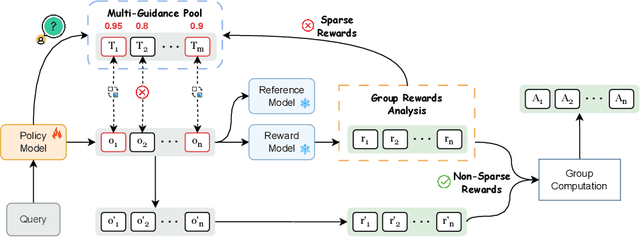
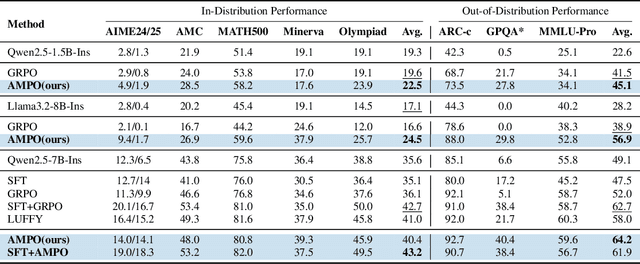
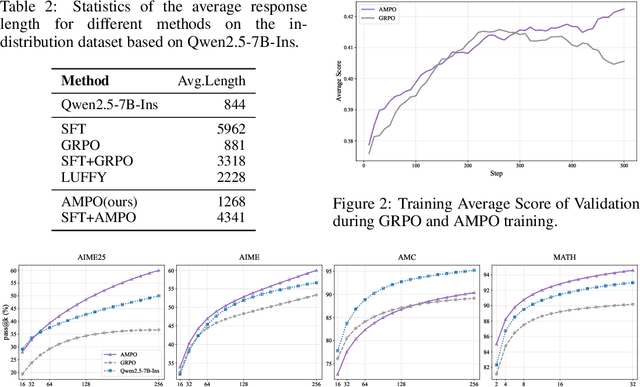
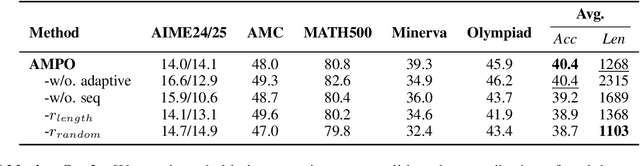
Reinforcement Learning with Verifiable Rewards (RLVR) is a promising paradigm for enhancing the reasoning ability in Large Language Models (LLMs). However, prevailing methods primarily rely on self-exploration or a single off-policy teacher to elicit long chain-of-thought (LongCoT) reasoning, which may introduce intrinsic model biases and restrict exploration, ultimately limiting reasoning diversity and performance. Drawing inspiration from multi-teacher strategies in knowledge distillation, we introduce Adaptive Multi-Guidance Policy Optimization (AMPO), a novel framework that adaptively leverages guidance from multiple proficient teacher models, but only when the on-policy model fails to generate correct solutions. This "guidance-on-demand" approach expands exploration while preserving the value of self-discovery. Moreover, AMPO incorporates a comprehension-based selection mechanism, prompting the student to learn from the reasoning paths that it is most likely to comprehend, thus balancing broad exploration with effective exploitation. Extensive experiments show AMPO substantially outperforms a strong baseline (GRPO), with a 4.3% improvement on mathematical reasoning tasks and 12.2% on out-of-distribution tasks, while significantly boosting Pass@k performance and enabling more diverse exploration. Notably, using four peer-sized teachers, our method achieves comparable results to approaches that leverage a single, more powerful teacher (e.g., DeepSeek-R1) with more data. These results demonstrate a more efficient and scalable path to superior reasoning and generalizability. Our code is available at https://github.com/SII-Enigma/AMPO.
Explore Briefly, Then Decide: Mitigating LLM Overthinking via Cumulative Entropy Regulation
Oct 02, 2025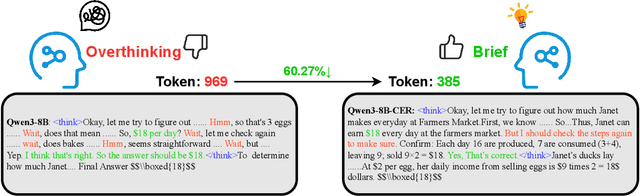
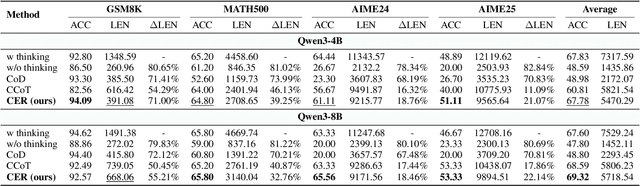
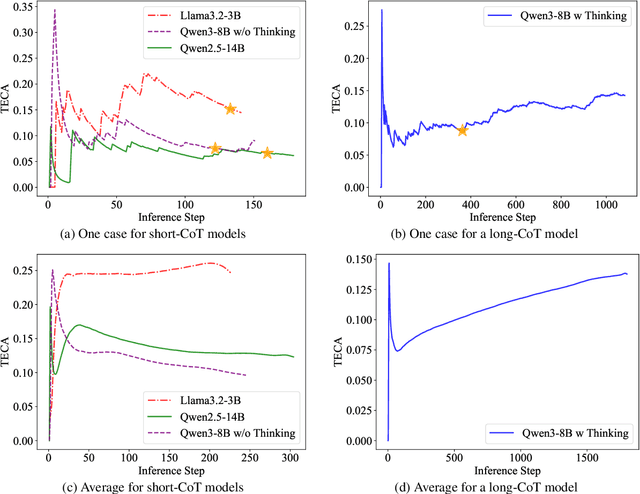
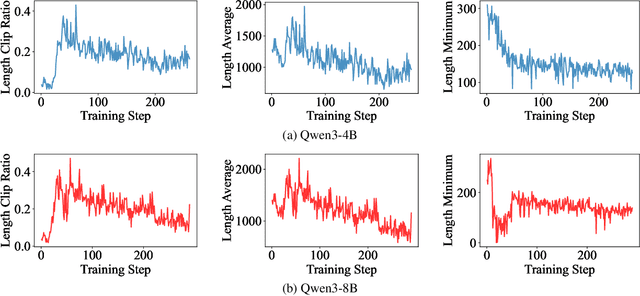
Large Language Models (LLMs) have demonstrated remarkable reasoning abilities on complex problems using long Chain-of-Thought (CoT) reasoning. However, they often suffer from overthinking, meaning generating unnecessarily lengthy reasoning steps for simpler problems. This issue may degrade the efficiency of the models and make them difficult to adapt the reasoning depth to the complexity of problems. To address this, we introduce a novel metric Token Entropy Cumulative Average (TECA), which measures the extent of exploration throughout the reasoning process. We further propose a novel reasoning paradigm -- Explore Briefly, Then Decide -- with an associated Cumulative Entropy Regulation (CER) mechanism. This paradigm leverages TECA to help the model dynamically determine the optimal point to conclude its thought process and provide a final answer, thus achieving efficient reasoning. Experimental results across diverse mathematical benchmarks show that our approach substantially mitigates overthinking without sacrificing problem-solving ability. With our thinking paradigm, the average response length decreases by up to 71% on simpler datasets, demonstrating the effectiveness of our method in creating a more efficient and adaptive reasoning process.
A Survey of WebAgents: Towards Next-Generation AI Agents for Web Automation with Large Foundation Models
Mar 30, 2025With the advancement of web techniques, they have significantly revolutionized various aspects of people's lives. Despite the importance of the web, many tasks performed on it are repetitive and time-consuming, negatively impacting overall quality of life. To efficiently handle these tedious daily tasks, one of the most promising approaches is to advance autonomous agents based on Artificial Intelligence (AI) techniques, referred to as AI Agents, as they can operate continuously without fatigue or performance degradation. In the context of the web, leveraging AI Agents -- termed WebAgents -- to automatically assist people in handling tedious daily tasks can dramatically enhance productivity and efficiency. Recently, Large Foundation Models (LFMs) containing billions of parameters have exhibited human-like language understanding and reasoning capabilities, showing proficiency in performing various complex tasks. This naturally raises the question: `Can LFMs be utilized to develop powerful AI Agents that automatically handle web tasks, providing significant convenience to users?' To fully explore the potential of LFMs, extensive research has emerged on WebAgents designed to complete daily web tasks according to user instructions, significantly enhancing the convenience of daily human life. In this survey, we comprehensively review existing research studies on WebAgents across three key aspects: architectures, training, and trustworthiness. Additionally, several promising directions for future research are explored to provide deeper insights.
ChartAdapter: Large Vision-Language Model for Chart Summarization
Dec 30, 2024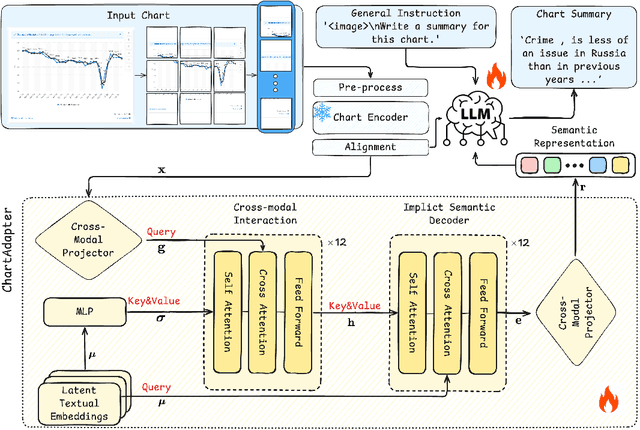
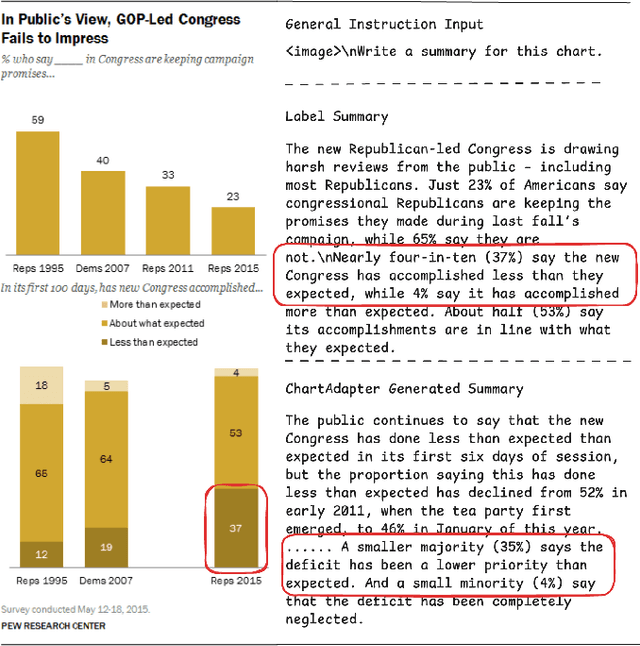
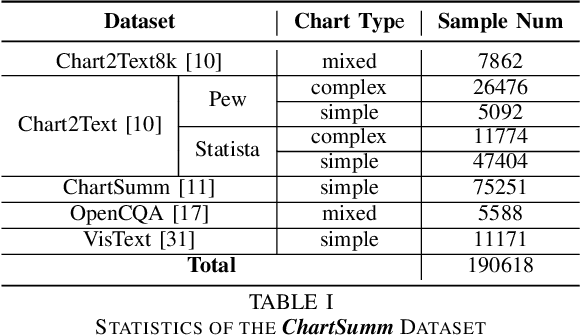
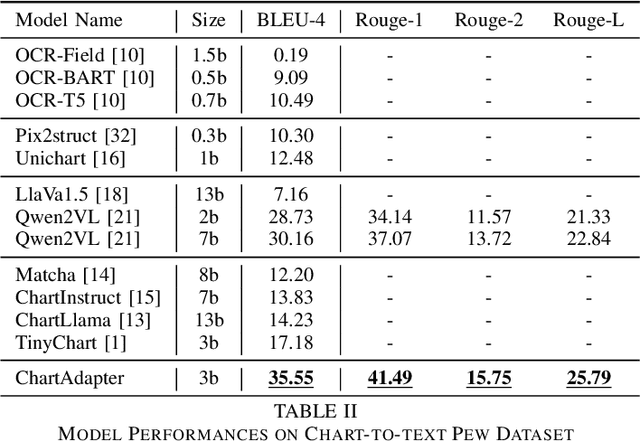
Chart summarization, which focuses on extracting key information from charts and interpreting it in natural language, is crucial for generating and delivering insights through effective and accessible data analysis. Traditional methods for chart understanding and summarization often rely on multi-stage pipelines, which may produce suboptimal semantic alignment between visual and textual information. In comparison, recently developed LLM-based methods are more dependent on the capability of foundation images or languages, while ignoring the characteristics of chart data and its relevant challenges. To address these limitations, we propose ChartAdapter, a novel lightweight transformer module designed to bridge the gap between charts and textual summaries. ChartAdapter employs learnable query vectors to extract implicit semantics from chart data and incorporates a cross-modal alignment projector to enhance vision-to-language generative learning. By integrating ChartAdapter with an LLM, we enable end-to-end training and efficient chart summarization. To further enhance the training, we introduce a three-stage hierarchical training procedure and develop a large-scale dataset specifically curated for chart summarization, comprising 190,618 samples. Experimental results on the standard Chart-to-Text testing set demonstrate that our approach significantly outperforms existing methods, including state-of-the-art models, in generating high-quality chart summaries. Ablation studies further validate the effectiveness of key components in ChartAdapter. This work highlights the potential of tailored LLM-based approaches to advance chart understanding and sets a strong foundation for future research in this area.