 Add to Chrome
 Add to Firefox
 Add to Edge
Constrained Dominant Sets for Multimodal Document Question Answering
Jun 05, 2026
Long multimodal document question answering is limited by which evidence reaches the reader, rather than by the quantity retrieved. In lengthy documents, findings often recur across figures, captions, and introductory sentences, causing similarity based retrievers in modern multimodal retrieval-augmented generation (RAG) systems to allocate resources to near-duplicates while overlooking complementary evidence. This work introduces a retriever that selects evidence as a Constrained Dominant Set (CDS) on a query-augmented affinity graph, offering three advantages that similarity ranking does not. First, the query is encoded as a hard structural constraint, ensuring that every selected element is directly connected to the question through the cluster anchor. Second, the relevance-redundancy balance is determined automatically by a spectral bound, eliminating the need for manually tuned trade offs required by diversity-aware selectors. Third, the selection process achieves a global equilibrium via replicator dynamics, thereby avoiding the distortions introduced by greedy heuristics. The method is inherently graph-based and does not require training. Using a Qwen3-VL-32B reader, CDS establishes a new state of the art on VisDoMBench ($66.99$ average) and improves over the no-retrieval baseline by $37.1$ points on VisDoMBench and $4.8$ on MMLongBench-Doc.

FLOWREADER: Min-Cost Flow Optimization for Multi-Modal Long Document Q&A
Jun 05, 2026Long, multimodal documents force retrieval-augmented systems to assemble answers from evidence fragmented across text, tables, and slides broken across cells in a long table, spread over multiple slides, or split between a figure and its discussion. Top-$k$ chunk retrieval treats each fragment independently and cannot represent how evidence connects. We introduce FLOWREADER, which reframes evidence assembly as a min-cost flow problem on a multimodal node graph: a single scoring vector $h$ controls source selection (via MMR), sink selection (via a length-aware answerability proxy), and the costs and capacities of every edge. The optimal flow is decomposed into candidate evidence paths, a compact non-redundant subset is selected by entropy-regularized replicator dynamics, and parallel VLM workers under a dual-process gate produce the answer with a single System-2 refinement pass triggered when answer consistency is low or the routed flow is strained. On VisDoMBench, FLOWREADER is best on the two subsets dominated by fragmented evidence PaperTab ($58.40$, $+1.30$ over G^{2}-Reader) and SlideVQA ($72.93$, $+0.62$) and competitive on SPIQA, FetaTab, and SciGraphQA. Macro-averaged across all five subsets, FLOWREADER ($65.47$) is within $0.74$ of the strongest baseline (G^{2}-Reader, $66.21$). Overall, these results show that min-cost flow performs well on fragmented multimodal evidence, where top-$k$ retrieval fails. It also provides a unified way to control scoring, routing, selection, and adaptive compute together.
DialogXpert: Driving Intelligent and Emotion-Aware Conversations through Online Value-Based Reinforcement Learning with LLM Priors
May 23, 2025Large-language-model (LLM) agents excel at reactive dialogue but struggle with proactive, goal-driven interactions due to myopic decoding and costly planning. We introduce DialogXpert, which leverages a frozen LLM to propose a small, high-quality set of candidate actions per turn and employs a compact Q-network over fixed BERT embeddings trained via temporal-difference learning to select optimal moves within this reduced space. By tracking the user's emotions, DialogXpert tailors each decision to advance the task while nurturing a genuine, empathetic connection. Across negotiation, emotional support, and tutoring benchmarks, DialogXpert drives conversations to under $3$ turns with success rates exceeding 94\% and, with a larger LLM prior, pushes success above 97\% while markedly improving negotiation outcomes. This framework delivers real-time, strategic, and emotionally intelligent dialogue planning at scale. Code available at https://github.com/declare-lab/dialogxpert/
PROEMO: Prompt-Driven Text-to-Speech Synthesis Based on Emotion and Intensity Control
Jan 10, 2025Speech synthesis has significantly advanced from statistical methods to deep neural network architectures, leading to various text-to-speech (TTS) models that closely mimic human speech patterns. However, capturing nuances such as emotion and style in speech synthesis is challenging. To address this challenge, we introduce an approach centered on prompt-based emotion control. The proposed architecture incorporates emotion and intensity control across multi-speakers. Furthermore, we leverage large language models (LLMs) to manipulate speech prosody while preserving linguistic content. Using embedding emotional cues, regulating intensity levels, and guiding prosodic variations with prompts, our approach infuses synthesized speech with human-like expressiveness and variability. Lastly, we demonstrate the effectiveness of our approach through a systematic exploration of the control mechanisms mentioned above.
TangoFlux: Super Fast and Faithful Text to Audio Generation with Flow Matching and Clap-Ranked Preference Optimization
Dec 30, 2024We introduce TangoFlux, an efficient Text-to-Audio (TTA) generative model with 515M parameters, capable of generating up to 30 seconds of 44.1kHz audio in just 3.7 seconds on a single A40 GPU. A key challenge in aligning TTA models lies in the difficulty of creating preference pairs, as TTA lacks structured mechanisms like verifiable rewards or gold-standard answers available for Large Language Models (LLMs). To address this, we propose CLAP-Ranked Preference Optimization (CRPO), a novel framework that iteratively generates and optimizes preference data to enhance TTA alignment. We demonstrate that the audio preference dataset generated using CRPO outperforms existing alternatives. With this framework, TangoFlux achieves state-of-the-art performance across both objective and subjective benchmarks. We open source all code and models to support further research in TTA generation.
DART: Disentanglement of Accent and Speaker Representation in Multispeaker Text-to-Speech
Oct 17, 2024


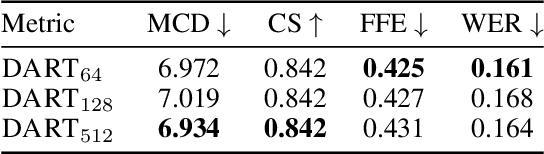
Recent advancements in Text-to-Speech (TTS) systems have enabled the generation of natural and expressive speech from textual input. Accented TTS aims to enhance user experience by making the synthesized speech more relatable to minority group listeners, and useful across various applications and context. Speech synthesis can further be made more flexible by allowing users to choose any combination of speaker identity and accent, resulting in a wide range of personalized speech outputs. Current models struggle to disentangle speaker and accent representation, making it difficult to accurately imitate different accents while maintaining the same speaker characteristics. We propose a novel approach to disentangle speaker and accent representations using multi-level variational autoencoders (ML-VAE) and vector quantization (VQ) to improve flexibility and enhance personalization in speech synthesis. Our proposed method addresses the challenge of effectively separating speaker and accent characteristics, enabling more fine-grained control over the synthesized speech. Code and speech samples are publicly available.
Reward Steering with Evolutionary Heuristics for Decoding-time Alignment
Jun 25, 2024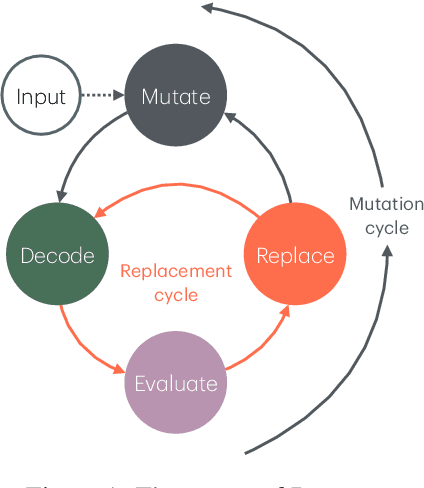
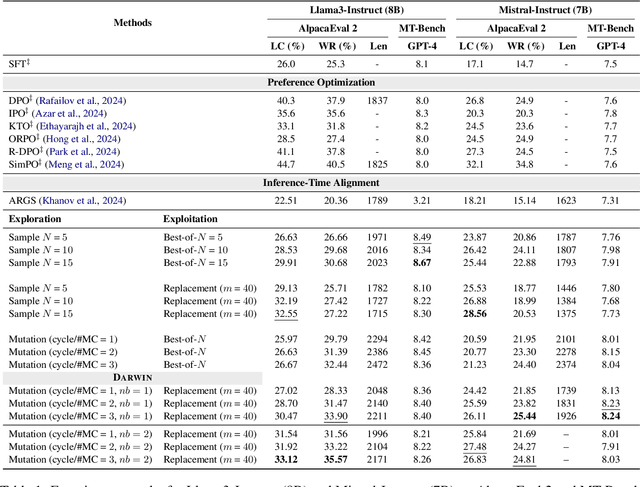
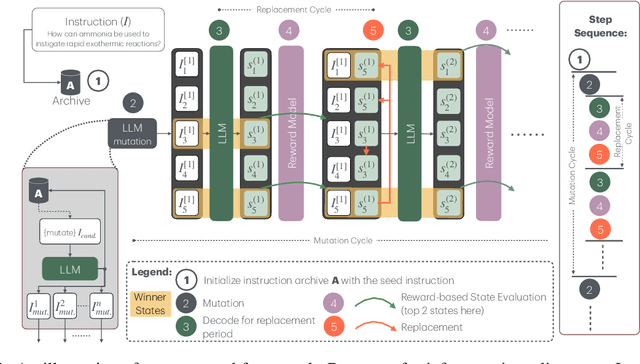
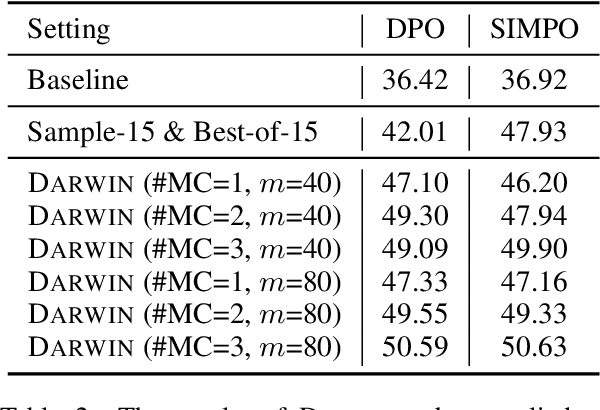
The widespread applicability and increasing omnipresence of LLMs have instigated a need to align LLM responses to user and stakeholder preferences. Many preference optimization approaches have been proposed that fine-tune LLM parameters to achieve good alignment. However, such parameter tuning is known to interfere with model performance on many tasks. Moreover, keeping up with shifting user preferences is tricky in such a situation. Decoding-time alignment with reward model guidance solves these issues at the cost of increased inference time. However, most of such methods fail to strike the right balance between exploration and exploitation of reward -- often due to the conflated formulation of these two aspects - to give well-aligned responses. To remedy this we decouple these two aspects and implement them in an evolutionary fashion: exploration is enforced by decoding from mutated instructions and exploitation is represented as the periodic replacement of poorly-rewarded generations with well-rewarded ones. Empirical evidences indicate that this strategy outperforms many preference optimization and decode-time alignment approaches on two widely accepted alignment benchmarks AlpacaEval 2 and MT-Bench. Our implementation will be available at: https://darwin-alignment.github.io.
Leveraging Parameter-Efficient Transfer Learning for Multi-Lingual Text-to-Speech Adaptation
Jun 25, 2024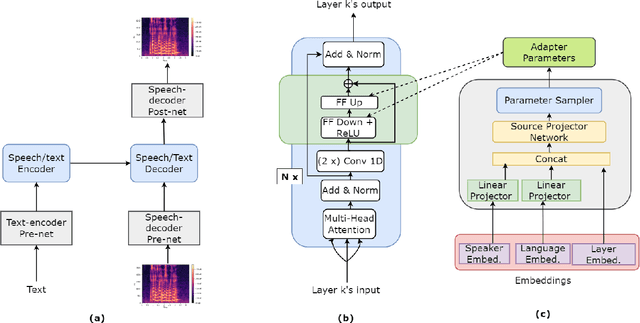
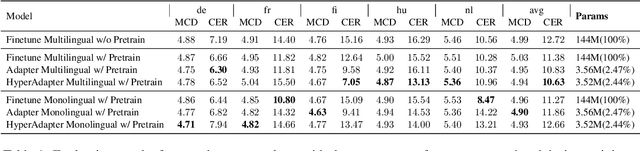
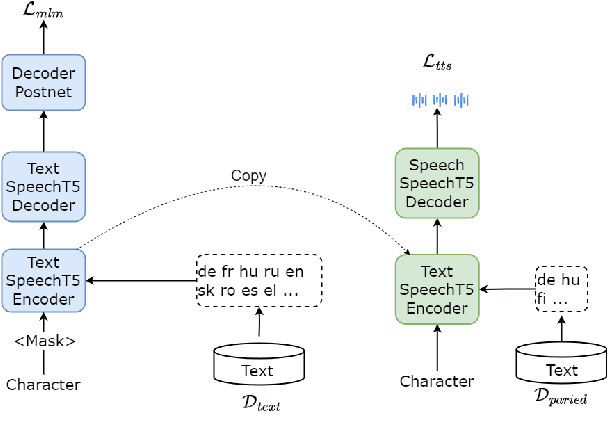
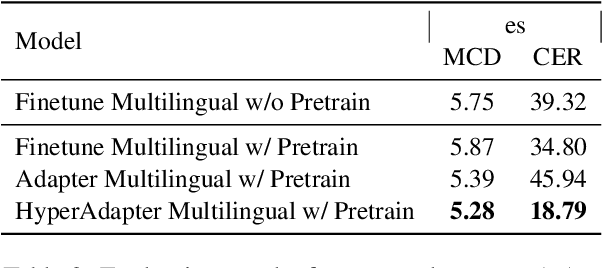
Different languages have distinct phonetic systems and vary in their prosodic features making it challenging to develop a Text-to-Speech (TTS) model that can effectively synthesise speech in multilingual settings. Furthermore, TTS architecture needs to be both efficient enough to capture nuances in multiple languages and efficient enough to be practical for deployment. The standard approach is to build transformer based model such as SpeechT5 and train it on large multilingual dataset. As the size of these models grow the conventional fine-tuning for adapting these model becomes impractical due to heavy computational cost. In this paper, we proposes to integrate parameter-efficient transfer learning (PETL) methods such as adapters and hypernetwork with TTS architecture for multilingual speech synthesis. Notably, in our experiments PETL methods able to achieve comparable or even better performance compared to full fine-tuning with only $\sim$2.5\% tunable parameters.The code and samples are available at: https://anonymous.4open.science/r/multilingualTTS-BA4C.
Improving Text-To-Audio Models with Synthetic Captions
Jun 18, 2024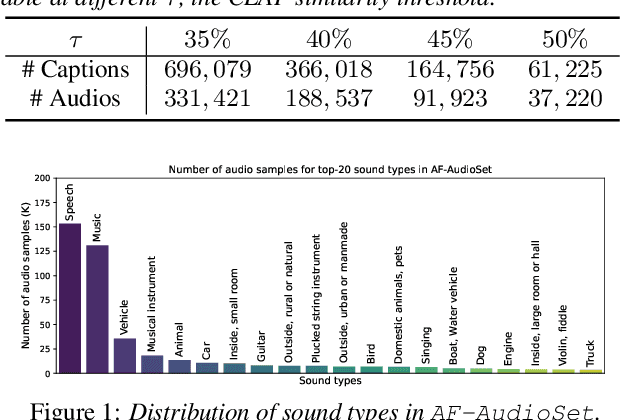
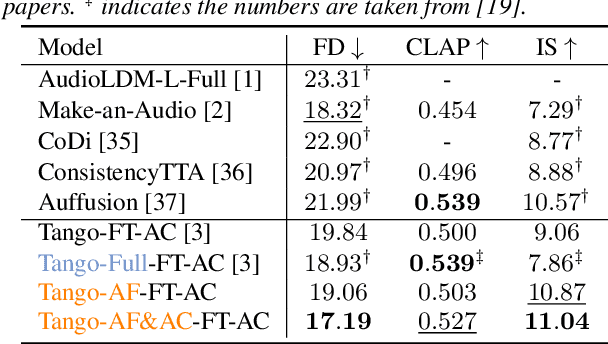

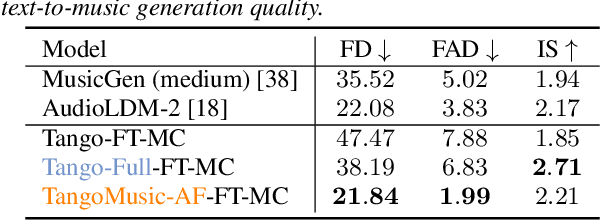
It is an open challenge to obtain high quality training data, especially captions, for text-to-audio models. Although prior methods have leveraged \textit{text-only language models} to augment and improve captions, such methods have limitations related to scale and coherence between audio and captions. In this work, we propose an audio captioning pipeline that uses an \textit{audio language model} to synthesize accurate and diverse captions for audio at scale. We leverage this pipeline to produce a dataset of synthetic captions for AudioSet, named \texttt{AF-AudioSet}, and then evaluate the benefit of pre-training text-to-audio models on these synthetic captions. Through systematic evaluations on AudioCaps and MusicCaps, we find leveraging our pipeline and synthetic captions leads to significant improvements on audio generation quality, achieving a new \textit{state-of-the-art}.
Accent Conversion in Text-To-Speech Using Multi-Level VAE and Adversarial Training
Jun 03, 2024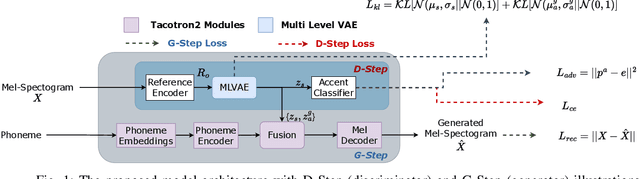
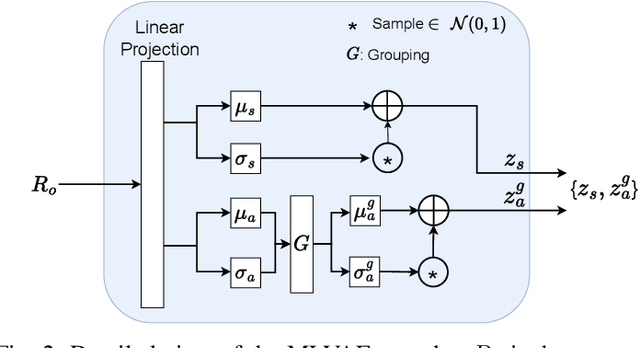
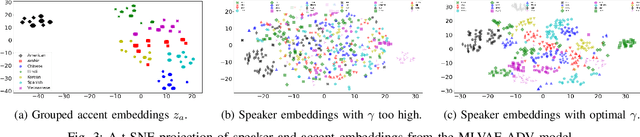
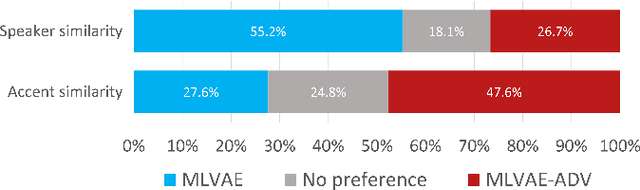
With rapid globalization, the need to build inclusive and representative speech technology cannot be overstated. Accent is an important aspect of speech that needs to be taken into consideration while building inclusive speech synthesizers. Inclusive speech technology aims to erase any biases towards specific groups, such as people of certain accent. We note that state-of-the-art Text-to-Speech (TTS) systems may currently not be suitable for all people, regardless of their background, as they are designed to generate high-quality voices without focusing on accent. In this paper, we propose a TTS model that utilizes a Multi-Level Variational Autoencoder with adversarial learning to address accented speech synthesis and conversion in TTS, with a vision for more inclusive systems in the future. We evaluate the performance through both objective metrics and subjective listening tests. The results show an improvement in accent conversion ability compared to the baseline.