 Add to Chrome
 Add to Firefox
 Add to Edge
Audio-Visual Flamingo: Open Audio-Visual Intelligence for Long and Complex Videos
Jul 17, 2026
We present Audio-Visual Flamingo (AV-Flamingo), a fully open state-of-the-art audio-visual large language model (AV-LLM) for joint understanding and reasoning over audio, images, and long-form videos. Unlike prior AV-LLMs that primarily focus on short clips, AV-Flamingo is designed for understanding and reasoning over long and complex real-world (audio-visual) videos. To support this, we make three key contributions: (i) Audio-Visual-Skills, a large-scale collection of real-world videos with ~7M caption and question-answer training instances designed to emphasize temporal, compositional, and cross-modal audio-visual reasoning; (ii) a novel three-stage curriculum that progressively trains the model from short-range perception to long-horizon multi-event reasoning; and (iii) Temporal Audio-Visual Interleaved Chain-of-Thought, a reasoning framework that explicitly grounds intermediate reasoning steps to timestamps in long audio-visual streams, improving temporal alignment and interpretability. Extensive experiments across 15+ audio-visual, omni-modal, audio, and vision benchmarks show that AV-Flamingo outperforms similarly sized open models by clear margins and remains highly competitive with, and in some cases surpasses, much larger open-weight and closed models, particularly on long and complex real-world audio-visual understanding and reasoning tasks. Beyond benchmark performance, AV-Flamingo exhibits strong real-world utility and transfers well to unseen tasks, highlighting its robustness and generalization ability.

A Closer Look at Failure Modes in Temporal Understanding of Large Audio-Language Models
Jun 16, 2026Large Audio Language Models (LALMs) achieve strong performance on a variety of audio understanding tasks but continue to struggle with temporal reasoning, a fundamental capability central to human auditory perception. Understanding the causes of these failures remains challenging as existing benchmarks report performance gaps without probing underlying mechanisms. To address this, we introduce a benchmark with 1,657 questions across three foundational tasks designed specifically for mechanistic analysis. Examining model outputs across varying input settings (behavioral analysis) reveals that models often under-utilize audio when textual cues are available. We also provide the first causal mechanistic analysis of temporal reasoning failures in LALMs. Comparing attention upweighting against scaling, we find that redistributing attention across audio tokens is more effective than increasing audio attention. Targeting task-relevant tokens yields further gains. These findings suggest that modality imbalance alone cannot explain failures. Attention scaling at bottleneck layers improves accuracy from 55.9% to 59.1% without fine-tuning, demonstrating a promising direction for future work.
Audio Flamingo Next: Next-Generation Open Audio-Language Models for Speech, Sound, and Music
Apr 13, 2026We present Audio Flamingo Next (AF-Next), the next-generation and most capable large audio-language model in the Audio Flamingo series, designed to advance understanding and reasoning over speech, environmental sounds and music. Compared to Audio Flamingo 3, AF-Next introduces: (i) a stronger foundational audio-language model that significantly improves accuracy across diverse audio understanding tasks; (ii) scalable strategies for constructing large-scale audio understanding and reasoning data beyond existing academic benchmarks; (iii) support for long and complex audio inputs up to 30 minutes; and (iv) Temporal Audio Chain-of-Thought, a new reasoning paradigm that explicitly grounds intermediate reasoning steps to timestamps in long audio, enabling fine-grained temporal alignment and improved interpretability. To enable these capabilities, we first conduct a systematic analysis of Audio Flamingo 3 to identify key gaps in audio understanding and reasoning. We then curate and scale new large-scale datasets totaling over 1 million hours to address these limitations and expand the existing AudioSkills-XL, LongAudio-XL, AF-Think and AF-Chat datasets. AF-Next is trained using a curriculum-based strategy spanning pre-training, mid-training and post-training stages. Extensive experiments across 20 audio understanding and reasoning benchmarks, including challenging long-audio tasks, show that AF-Next outperforms similarly sized open models by large margins and remains highly competitive with and sometimes surpasses, much larger open-weight and closed models. Beyond benchmark performance, AF-Next exhibits strong real-world utility and transfers well to unseen tasks, highlighting its robustness and generalization ability. In addition to all data, code and methods, we open-source 3 variants of AF-Next, including AF-Next-Instruct, AF-Next-Think and AF-Next-Captioner.
Do Audio-Visual Large Language Models Really See and Hear?
Apr 03, 2026Audio-Visual Large Language Models (AVLLMs) are emerging as unified interfaces to multimodal perception. We present the first mechanistic interpretability study of AVLLMs, analyzing how audio and visual features evolve and fuse through different layers of an AVLLM to produce the final text outputs. We find that although AVLLMs encode rich audio semantics at intermediate layers, these capabilities largely fail to surface in the final text generation when audio conflicts with vision. Probing analyses show that useful latent audio information is present, but deeper fusion layers disproportionately privilege visual representations that tend to suppress audio cues. We further trace this imbalance to training: the AVLLM's audio behavior strongly matches its vision-language base model, indicating limited additional alignment to audio supervision. Our findings reveal a fundamental modality bias in AVLLMs and provide new mechanistic insights into how multimodal LLMs integrate audio and vision.
MMOU: A Massive Multi-Task Omni Understanding and Reasoning Benchmark for Long and Complex Real-World Videos
Mar 14, 2026Multimodal Large Language Models (MLLMs) have shown strong performance in visual and audio understanding when evaluated in isolation. However, their ability to jointly reason over omni-modal (visual, audio, and textual) signals in long and complex videos remains largely unexplored. We introduce MMOU, a new benchmark designed to systematically evaluate multimodal understanding and reasoning under these challenging, real-world conditions. MMOU consists of 15,000 carefully curated questions paired with 9038 web-collected videos of varying length, spanning diverse domains and exhibiting rich, tightly coupled audio-visual content. The benchmark covers 13 fundamental skill categories, all of which require integrating evidence across modalities and time. All questions are manually annotated across multiple turns by professional annotators, ensuring high quality and reasoning fidelity. We evaluate 20+ state-of-the-art open-source and proprietary multimodal models on MMOU. The results expose substantial performance gaps: the best closed-source model achieves only 64.2% accuracy, while the strongest open-source model reaches just 46.8%. Our results highlight the challenges of long-form omni-modal understanding, revealing that current models frequently fail to apply even fundamental skills in long videos. Through detailed analysis, we further identify systematic failure modes and provide insights into where and why current models break.
Sparks of Cooperative Reasoning: LLMs as Strategic Hanabi Agents
Jan 26, 2026Cooperative reasoning under incomplete information remains challenging for both humans and multi-agent systems. The card game Hanabi embodies this challenge, requiring theory-of-mind reasoning and strategic communication. We benchmark 17 state-of-the-art LLM agents in 2-5 player games and study the impact of context engineering across model scales (4B to 600B+) to understand persistent coordination failures and robustness to scaffolding: from a minimal prompt with only explicit card details (Watson setting), to scaffolding with programmatic, Bayesian-motivated deductions (Sherlock setting), to multi-turn state tracking via working memory (Mycroft setting). We show that (1) agents can maintain an internal working memory for state tracking and (2) cross-play performance between different LLMs smoothly interpolates with model strength. In the Sherlock setting, the strongest reasoning models exceed 15 points on average across player counts, yet still trail experienced humans and specialist Hanabi agents, both consistently scoring above 20. We release the first public Hanabi datasets with annotated trajectories and move utilities: (1) HanabiLogs, containing 1,520 full game logs for instruction tuning, and (2) HanabiRewards, containing 560 games with dense move-level value annotations for all candidate moves. Supervised and RL finetuning of a 4B open-weight model (Qwen3-Instruct) on our datasets improves cooperative Hanabi play by 21% and 156% respectively, bringing performance to within ~3 points of a strong proprietary reasoning model (o4-mini) and surpassing the best non-reasoning model (GPT-4.1) by 52%. The HanabiRewards RL-finetuned model further generalizes beyond Hanabi, improving performance on a cooperative group-guessing benchmark by 11%, temporal reasoning on EventQA by 6.4%, instruction-following on IFBench-800K by 1.7 Pass@10, and matching AIME 2025 mathematical reasoning Pass@10.
Building Robust and Scalable Multilingual ASR for Indian Languages
Nov 19, 2025This paper describes the systems developed by SPRING Lab, Indian Institute of Technology Madras, for the ASRU MADASR 2.0 challenge. The systems developed focuses on adapting ASR systems to improve in predicting the language and dialect of the utterance among 8 languages across 33 dialects. We participated in Track 1 and Track 2, which restricts the use of additional data and develop from-the-scratch multilingual systems. We presented a novel training approach using Multi-Decoder architecture with phonemic Common Label Set (CLS) as intermediate representation. It improved the performance over the baseline (in the CLS space). We also discuss various methods used to retain the gain obtained in the phonemic space while converting them back to the corresponding grapheme representations. Our systems beat the baseline in 3 languages (Track 2) in terms of WER/CER and achieved the highest language ID and dialect ID accuracy among all participating teams (Track 2).
The Tag-Team Approach: Leveraging CLS and Language Tagging for Enhancing Multilingual ASR
May 31, 2023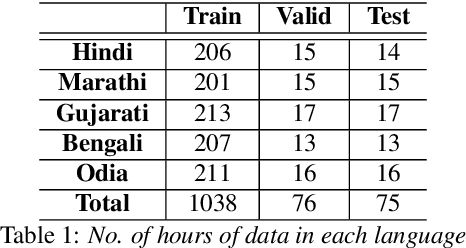
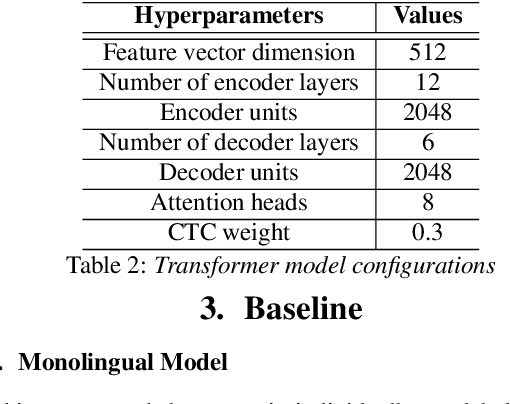
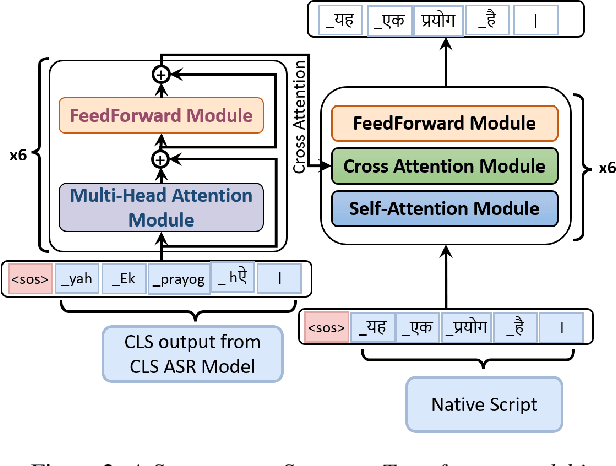
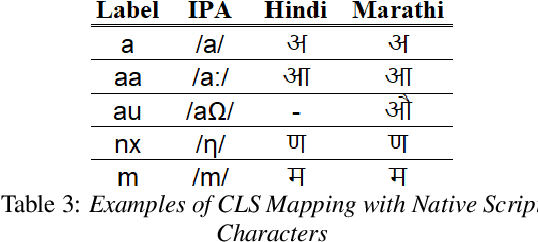
Building a multilingual Automated Speech Recognition (ASR) system in a linguistically diverse country like India can be a challenging task due to the differences in scripts and the limited availability of speech data. This problem can be solved by exploiting the fact that many of these languages are phonetically similar. These languages can be converted into a Common Label Set (CLS) by mapping similar sounds to common labels. In this paper, new approaches are explored and compared to improve the performance of CLS based multilingual ASR model. Specific language information is infused in the ASR model by giving Language ID or using CLS to Native script converter on top of the CLS Multilingual model. These methods give a significant improvement in Word Error Rate (WER) compared to the CLS baseline. These methods are further tried on out-of-distribution data to check their robustness.