 Add to Chrome
 Add to Firefox
 Add to Edge
Audio-Visual Flamingo: Open Audio-Visual Intelligence for Long and Complex Videos
Jul 17, 2026
We present Audio-Visual Flamingo (AV-Flamingo), a fully open state-of-the-art audio-visual large language model (AV-LLM) for joint understanding and reasoning over audio, images, and long-form videos. Unlike prior AV-LLMs that primarily focus on short clips, AV-Flamingo is designed for understanding and reasoning over long and complex real-world (audio-visual) videos. To support this, we make three key contributions: (i) Audio-Visual-Skills, a large-scale collection of real-world videos with ~7M caption and question-answer training instances designed to emphasize temporal, compositional, and cross-modal audio-visual reasoning; (ii) a novel three-stage curriculum that progressively trains the model from short-range perception to long-horizon multi-event reasoning; and (iii) Temporal Audio-Visual Interleaved Chain-of-Thought, a reasoning framework that explicitly grounds intermediate reasoning steps to timestamps in long audio-visual streams, improving temporal alignment and interpretability. Extensive experiments across 15+ audio-visual, omni-modal, audio, and vision benchmarks show that AV-Flamingo outperforms similarly sized open models by clear margins and remains highly competitive with, and in some cases surpasses, much larger open-weight and closed models, particularly on long and complex real-world audio-visual understanding and reasoning tasks. Beyond benchmark performance, AV-Flamingo exhibits strong real-world utility and transfers well to unseen tasks, highlighting its robustness and generalization ability.

FIGMA: Towards FIne-Grained Music retrievAl
Jun 04, 2026Retrieving music using natural language descriptions has improved with contrastive audio-text models such as CLAP, but current systems remain limited to coarse semantic queries. When descriptions specify fine-grained musical attributes such as tempo, key, chord progression, or rhythmic structure, existing models often fail to retrieve the correct audio. We show that this limitation stems from the contrastive learning objective itself: despite being trained on long captions, CLAP-based models effectively utilize only the first few tokens, discarding much of the information encoded in detailed prompts. Then, we propose FIGMA (FIne-Grained Music RetrievAl), a multi-view contrastive architecture that addresses this limitation by jointly optimizing global audio-text alignment and frame-level, token-wise alignment. This design enables FIGMA to capture both high-level semantic context and fine-grained musical attributes within a unified representation space. Moreover, we formalize the task of Fine-Grained Music Retrieval and construct Fine-Grained Music Caption dataset (FGMCaps), a large-scale dataset of 380K music-caption pairs for training along with a 10K test set, both annotated with tempo, key, chord progression, beat count, as well as genre and mood. Extensive experiments demonstrate that FIGMA consistently outperforms existing CLAP-based music retrieval models across multiple music retrieval benchmarks, including out-of-domain evaluations, with relative improvements of up to 73.3%.
Learning Illumination Control in Diffusion Models
Apr 27, 2026Controlling illumination in images is essential for photography and visual content creation. While closed-source models have demonstrated impressive illumination control, open-source alternatives either require heavy control inputs like depth maps or do not release their data and code. We present a fully open-source and reproducible pipeline for learning illumination control in diffusion models. Our approach builds a data engine that transforms well-lit images into supervised training triplets consisting of a poorly-illuminated input image, a natural language lighting instruction, and a well-illuminated output image. We finetune a diffusion model on this data and demonstrate significant improvements over baseline SD 1.5, SDXL, and FLUX.1-dev models in perceptual similarity, structural similarity, and identity preservation. Our work provides a reproducible solution built entirely with open-source tools and publicly available data. We release all our code, data, and model weights publicly.
Audio Flamingo Next: Next-Generation Open Audio-Language Models for Speech, Sound, and Music
Apr 13, 2026We present Audio Flamingo Next (AF-Next), the next-generation and most capable large audio-language model in the Audio Flamingo series, designed to advance understanding and reasoning over speech, environmental sounds and music. Compared to Audio Flamingo 3, AF-Next introduces: (i) a stronger foundational audio-language model that significantly improves accuracy across diverse audio understanding tasks; (ii) scalable strategies for constructing large-scale audio understanding and reasoning data beyond existing academic benchmarks; (iii) support for long and complex audio inputs up to 30 minutes; and (iv) Temporal Audio Chain-of-Thought, a new reasoning paradigm that explicitly grounds intermediate reasoning steps to timestamps in long audio, enabling fine-grained temporal alignment and improved interpretability. To enable these capabilities, we first conduct a systematic analysis of Audio Flamingo 3 to identify key gaps in audio understanding and reasoning. We then curate and scale new large-scale datasets totaling over 1 million hours to address these limitations and expand the existing AudioSkills-XL, LongAudio-XL, AF-Think and AF-Chat datasets. AF-Next is trained using a curriculum-based strategy spanning pre-training, mid-training and post-training stages. Extensive experiments across 20 audio understanding and reasoning benchmarks, including challenging long-audio tasks, show that AF-Next outperforms similarly sized open models by large margins and remains highly competitive with and sometimes surpasses, much larger open-weight and closed models. Beyond benchmark performance, AF-Next exhibits strong real-world utility and transfers well to unseen tasks, highlighting its robustness and generalization ability. In addition to all data, code and methods, we open-source 3 variants of AF-Next, including AF-Next-Instruct, AF-Next-Think and AF-Next-Captioner.
MMOU: A Massive Multi-Task Omni Understanding and Reasoning Benchmark for Long and Complex Real-World Videos
Mar 14, 2026Multimodal Large Language Models (MLLMs) have shown strong performance in visual and audio understanding when evaluated in isolation. However, their ability to jointly reason over omni-modal (visual, audio, and textual) signals in long and complex videos remains largely unexplored. We introduce MMOU, a new benchmark designed to systematically evaluate multimodal understanding and reasoning under these challenging, real-world conditions. MMOU consists of 15,000 carefully curated questions paired with 9038 web-collected videos of varying length, spanning diverse domains and exhibiting rich, tightly coupled audio-visual content. The benchmark covers 13 fundamental skill categories, all of which require integrating evidence across modalities and time. All questions are manually annotated across multiple turns by professional annotators, ensuring high quality and reasoning fidelity. We evaluate 20+ state-of-the-art open-source and proprietary multimodal models on MMOU. The results expose substantial performance gaps: the best closed-source model achieves only 64.2% accuracy, while the strongest open-source model reaches just 46.8%. Our results highlight the challenges of long-form omni-modal understanding, revealing that current models frequently fail to apply even fundamental skills in long videos. Through detailed analysis, we further identify systematic failure modes and provide insights into where and why current models break.
Gencho: Room Impulse Response Generation from Reverberant Speech and Text via Diffusion Transformers
Feb 09, 2026Blind room impulse response (RIR) estimation is a core task for capturing and transferring acoustic properties; yet existing methods often suffer from limited modeling capability and degraded performance under unseen conditions. Moreover, emerging generative audio applications call for more flexible impulse response generation methods. We propose Gencho, a diffusion-transformer-based model that predicts complex spectrogram RIRs from reverberant speech. A structure-aware encoder leverages isolation between early and late reflections to encode the input audio into a robust representation for conditioning, while the diffusion decoder generates diverse and perceptually realistic impulse responses from it. Gencho integrates modularly with standard speech processing pipelines for acoustic matching. Results show richer generated RIRs than non-generative baselines while maintaining strong performance in standard RIR metrics. We further demonstrate its application to text-conditioned RIR generation, highlighting Gencho's versatility for controllable acoustic simulation and generative audio tasks.
Why Stop at Words? Unveiling the Bigger Picture through Line-Level OCR
Aug 29, 2025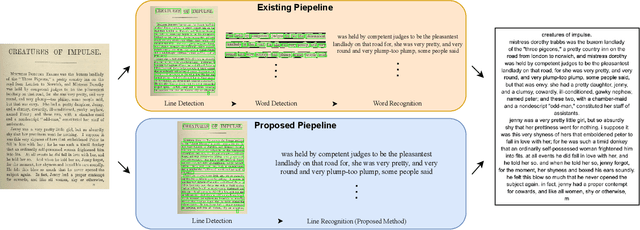
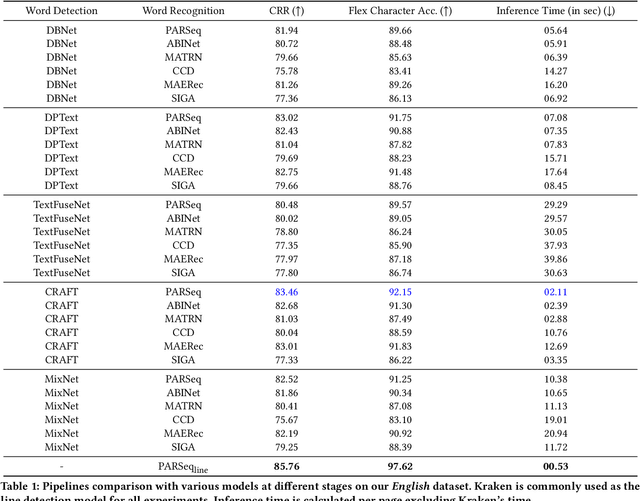
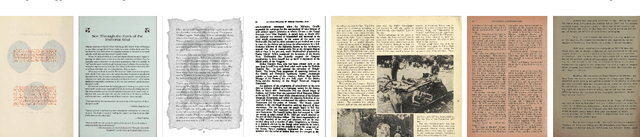
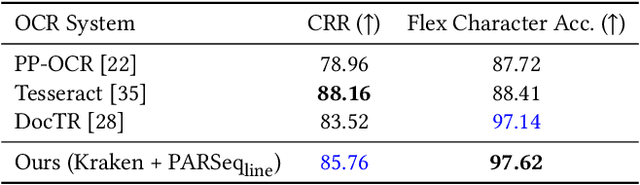
Conventional optical character recognition (OCR) techniques segmented each character and then recognized. This made them prone to error in character segmentation, and devoid of context to exploit language models. Advances in sequence to sequence translation in last decade led to modern techniques first detecting words and then inputting one word at a time to a model to directly output full words as sequence of characters. This allowed better utilization of language models and bypass error-prone character segmentation step. We observe that the above transition in style has moved the bottleneck in accuracy to word segmentation. Hence, in this paper, we propose a natural and logical progression from word level OCR to line-level OCR. The proposal allows to bypass errors in word detection, and provides larger sentence context for better utilization of language models. We show that the proposed technique not only improves the accuracy but also efficiency of OCR. Despite our thorough literature survey, we did not find any public dataset to train and benchmark such shift from word to line-level OCR. Hence, we also contribute a meticulously curated dataset of 251 English page images with line-level annotations. Our experimentation revealed a notable end-to-end accuracy improvement of 5.4%, underscoring the potential benefits of transitioning towards line-level OCR, especially for document images. We also report a 4 times improvement in efficiency compared to word-based pipelines. With continuous improvements in large language models, our methodology also holds potential to exploit such advances. Project Website: https://nishitanand.github.io/line-level-ocr-website
Aurelia: Test-time Reasoning Distillation in Audio-Visual LLMs
Mar 29, 2025Recent advancements in reasoning optimization have greatly enhanced the performance of large language models (LLMs). However, existing work fails to address the complexities of audio-visual scenarios, underscoring the need for further research. In this paper, we introduce AURELIA, a novel actor-critic based audio-visual (AV) reasoning framework that distills structured, step-by-step reasoning into AVLLMs at test time, improving their ability to process complex multi-modal inputs without additional training or fine-tuning. To further advance AVLLM reasoning skills, we present AVReasonBench, a challenging benchmark comprising 4500 audio-visual questions, each paired with detailed step-by-step reasoning. Our benchmark spans six distinct tasks, including AV-GeoIQ, which evaluates AV reasoning combined with geographical and cultural knowledge. Evaluating 18 AVLLMs on AVReasonBench reveals significant limitations in their multi-modal reasoning capabilities. Using AURELIA, we achieve up to a 100% relative improvement, demonstrating its effectiveness. This performance gain highlights the potential of reasoning-enhanced data generation for advancing AVLLMs in real-world applications. Our code and data will be publicly released at: https: //github.com/schowdhury671/aurelia.
Mitigating Memorization in LLMs using Activation Steering
Mar 08, 2025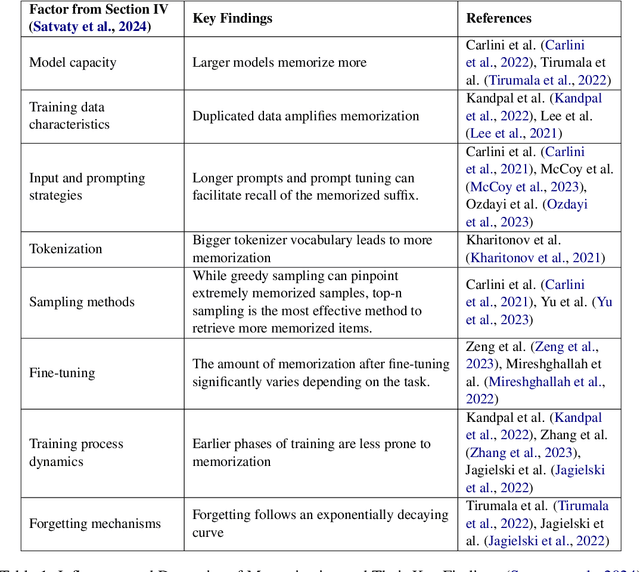
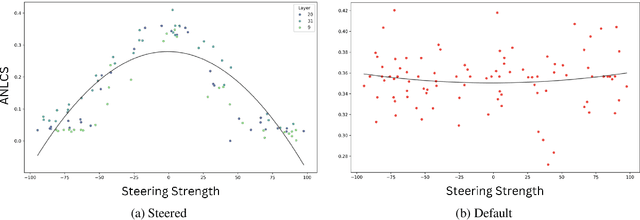
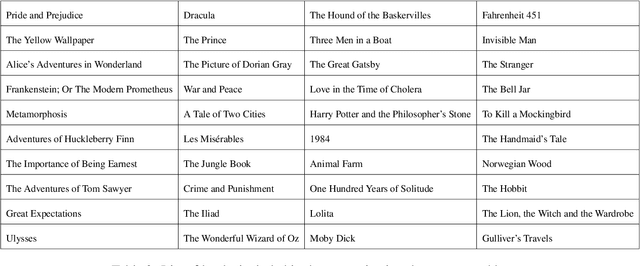
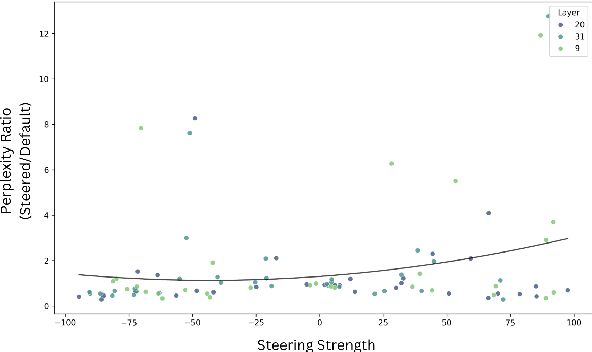
The memorization of training data by Large Language Models (LLMs) poses significant risks, including privacy leaks and the regurgitation of copyrighted content. Activation steering, a technique that directly intervenes in model activations, has emerged as a promising approach for manipulating LLMs. In this work, we explore the effectiveness of activation steering in reducing memorization while preserving generalization capabilities. We conduct empirical evaluations using a controlled memorization benchmark of literary material and demonstrate that our method successfully suppresses memorized content with minimal degradation in model performance in Gemma. Additionally, we analyze the trade-offs between suppression effectiveness and linguistic fluency, highlighting the advantages and limitations of activation-based interventions. Our findings contribute to ongoing efforts in developing safer and more privacy-preserving LLMs by providing a practical and efficient mechanism to mitigate unintended memorization.
TSPE: Task-Specific Prompt Ensemble for Improved Zero-Shot Audio Classification
Dec 31, 2024Audio-language models (ALMs) excel in zero-shot audio classification, a task where models classify previously unseen audio clips at test time by leveraging descriptive natural language prompts. We introduce TSPE (Task-Specific Prompt Ensemble), a simple, training-free hard prompting method that boosts ALEs' zero-shot performance by customizing prompts for diverse audio classification tasks. Rather than using generic template-based prompts like "Sound of a car" we generate context-rich prompts, such as "Sound of a car coming from a tunnel". Specifically, we leverage label information to identify suitable sound attributes, such as "loud" and "feeble", and appropriate sound sources, such as "tunnel" and "street" and incorporate this information into the prompts used by Audio-Language Models (ALMs) for audio classification. Further, to enhance audio-text alignment, we perform prompt ensemble across TSPE-generated task-specific prompts. When evaluated on 12 diverse audio classification datasets, TSPE improves performance across ALMs by showing an absolute improvement of 1.23-16.36% over vanilla zero-shot evaluation.