 Add to Chrome
 Add to Firefox
 Add to Edge
Accelerating Learned Video Compression via Low-Resolution Representation Learning
Jul 23, 2024
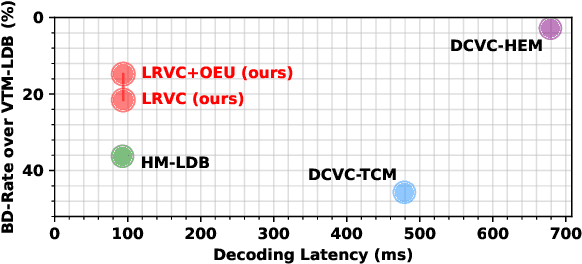
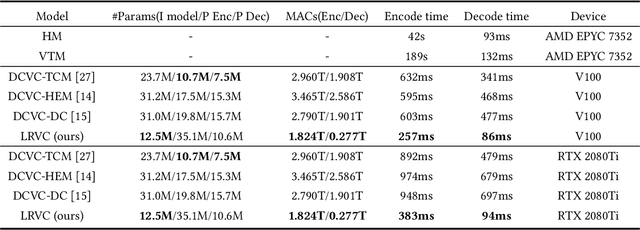
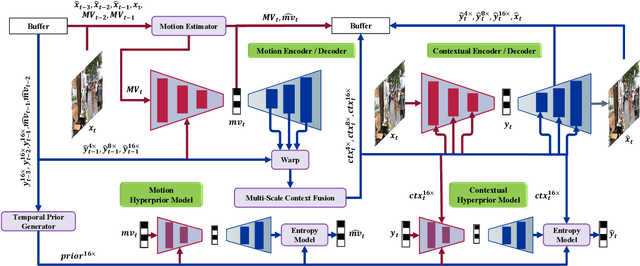

In recent years, the field of learned video compression has witnessed rapid advancement, exemplified by the latest neural video codecs DCVC-DC that has outperformed the upcoming next-generation codec ECM in terms of compression ratio. Despite this, learned video compression frameworks often exhibit low encoding and decoding speeds primarily due to their increased computational complexity and unnecessary high-resolution spatial operations, which hugely hinder their applications in reality. In this work, we introduce an efficiency-optimized framework for learned video compression that focuses on low-resolution representation learning, aiming to significantly enhance the encoding and decoding speeds. Firstly, we diminish the computational load by reducing the resolution of inter-frame propagated features obtained from reused features of decoded frames, including I-frames. We implement a joint training strategy for both the I-frame and P-frame models, further improving the compression ratio. Secondly, our approach efficiently leverages multi-frame priors for parameter prediction, minimizing computation at the decoding end. Thirdly, we revisit the application of the Online Encoder Update (OEU) strategy for high-resolution sequences, achieving notable improvements in compression ratio without compromising decoding efficiency. Our efficiency-optimized framework has significantly improved the balance between compression ratio and speed for learned video compression. In comparison to traditional codecs, our method achieves performance levels on par with the low-decay P configuration of the H.266 reference software VTM. Furthermore, when contrasted with DCVC-HEM, our approach delivers a comparable compression ratio while boosting encoding and decoding speeds by a factor of 3 and 7, respectively. On RTX 2080Ti, our method can decode each 1080p frame under 100ms.

CAPformer: Compression-Aware Pre-trained Transformer for Low-Light Image Enhancement
Jul 10, 2024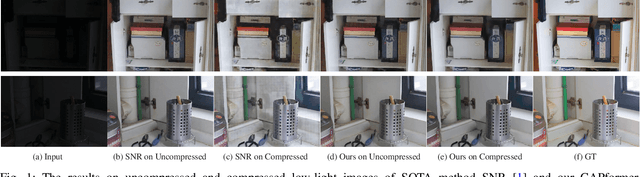
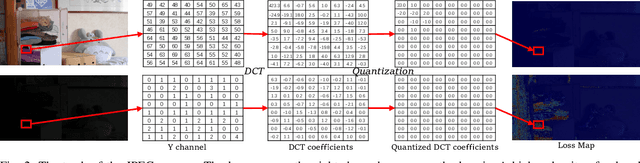

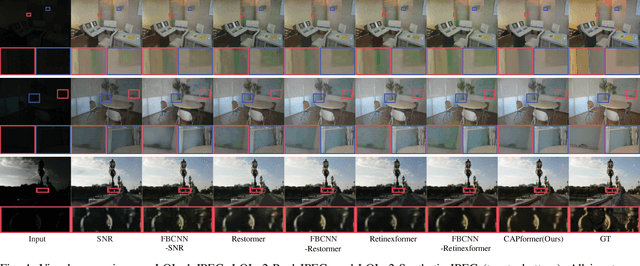
Low-Light Image Enhancement (LLIE) has advanced with the surge in phone photography demand, yet many existing methods neglect compression, a crucial concern for resource-constrained phone photography. Most LLIE methods overlook this, hindering their effectiveness. In this study, we investigate the effects of JPEG compression on low-light images and reveal substantial information loss caused by JPEG due to widespread low pixel values in dark areas. Hence, we propose the Compression-Aware Pre-trained Transformer (CAPformer), employing a novel pre-training strategy to learn lossless information from uncompressed low-light images. Additionally, the proposed Brightness-Guided Self-Attention (BGSA) mechanism enhances rational information gathering. Experiments demonstrate the superiority of our approach in mitigating compression effects on LLIE, showcasing its potential for improving LLIE in resource-constrained scenarios.
DevEval: A Manually-Annotated Code Generation Benchmark Aligned with Real-World Code Repositories
May 30, 2024How to evaluate the coding abilities of Large Language Models (LLMs) remains an open question. We find that existing benchmarks are poorly aligned with real-world code repositories and are insufficient to evaluate the coding abilities of LLMs. To address the knowledge gap, we propose a new benchmark named DevEval, which has three advances. (1) DevEval aligns with real-world repositories in multiple dimensions, e.g., code distributions and dependency distributions. (2) DevEval is annotated by 13 developers and contains comprehensive annotations (e.g., requirements, original repositories, reference code, and reference dependencies). (3) DevEval comprises 1,874 testing samples from 117 repositories, covering 10 popular domains (e.g., Internet, Database). Based on DevEval, we propose repository-level code generation and evaluate 8 popular LLMs on DevEval (e.g., gpt-4, gpt-3.5, StarCoder 2, DeepSeek Coder, CodeLLaMa). Our experiments reveal these LLMs' coding abilities in real-world code repositories. For example, in our experiments, the highest Pass@1 of gpt-4-turbo is only 53.04%. We also analyze LLMs' failed cases and summarize their shortcomings. We hope DevEval can facilitate the development of LLMs in real code repositories. DevEval, prompts, and LLMs' predictions have been released.
FastScene: Text-Driven Fast 3D Indoor Scene Generation via Panoramic Gaussian Splatting
May 09, 2024Text-driven 3D indoor scene generation holds broad applications, ranging from gaming and smart homes to AR/VR applications. Fast and high-fidelity scene generation is paramount for ensuring user-friendly experiences. However, existing methods are characterized by lengthy generation processes or necessitate the intricate manual specification of motion parameters, which introduces inconvenience for users. Furthermore, these methods often rely on narrow-field viewpoint iterative generations, compromising global consistency and overall scene quality. To address these issues, we propose FastScene, a framework for fast and higher-quality 3D scene generation, while maintaining the scene consistency. Specifically, given a text prompt, we generate a panorama and estimate its depth, since the panorama encompasses information about the entire scene and exhibits explicit geometric constraints. To obtain high-quality novel views, we introduce the Coarse View Synthesis (CVS) and Progressive Novel View Inpainting (PNVI) strategies, ensuring both scene consistency and view quality. Subsequently, we utilize Multi-View Projection (MVP) to form perspective views, and apply 3D Gaussian Splatting (3DGS) for scene reconstruction. Comprehensive experiments demonstrate FastScene surpasses other methods in both generation speed and quality with better scene consistency. Notably, guided only by a text prompt, FastScene can generate a 3D scene within a mere 15 minutes, which is at least one hour faster than state-of-the-art methods, making it a paradigm for user-friendly scene generation.
A Comprehensive Evaluation on Event Reasoning of Large Language Models
Apr 26, 2024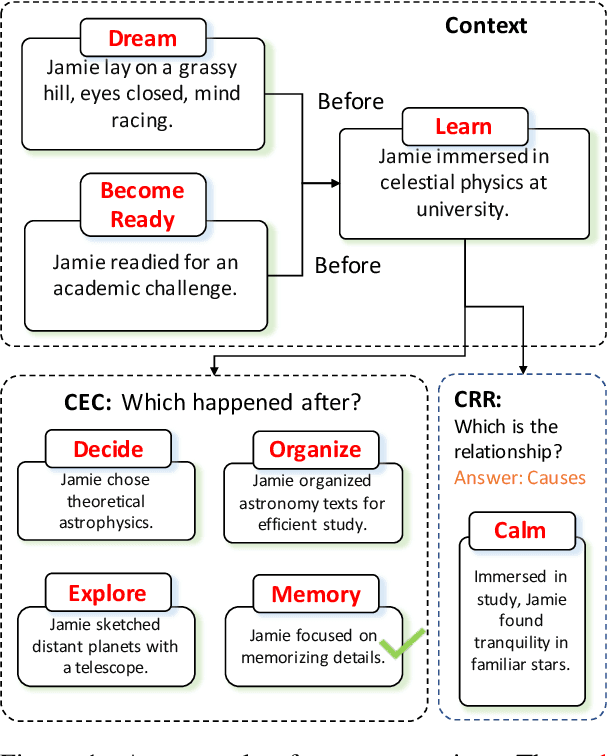
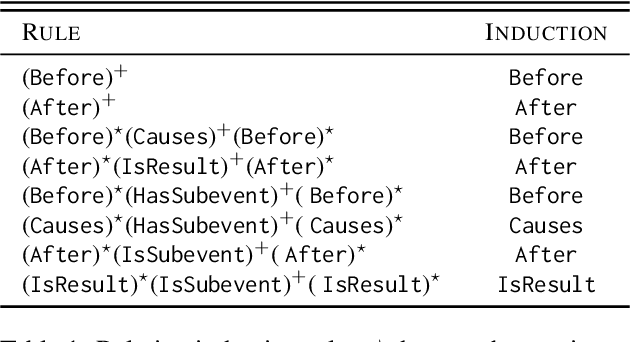
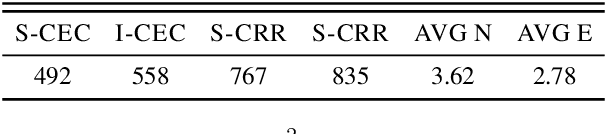
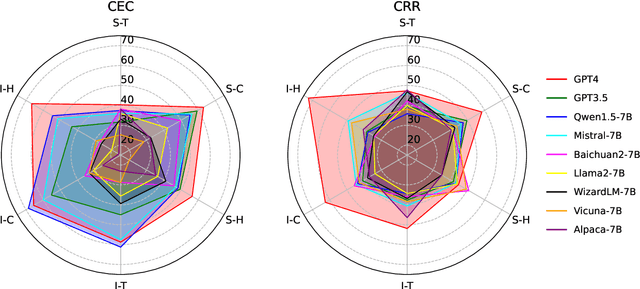
Event reasoning is a fundamental ability that underlies many applications. It requires event schema knowledge to perform global reasoning and needs to deal with the diversity of the inter-event relations and the reasoning paradigms. How well LLMs accomplish event reasoning on various relations and reasoning paradigms remains unknown. To mitigate this disparity, we comprehensively evaluate the abilities of event reasoning of LLMs. We introduce a novel benchmark EV2 for EValuation of EVent reasoning. EV2 consists of two levels of evaluation of schema and instance and is comprehensive in relations and reasoning paradigms. We conduct extensive experiments on EV2. We find that LLMs have abilities to accomplish event reasoning but their performances are far from satisfactory. We also notice the imbalance of event reasoning abilities in LLMs. Besides, LLMs have event schema knowledge, however, they're not aligned with humans on how to utilize the knowledge. Based on these findings, we introduce two methods to guide the LLMs to utilize the event schema knowledge. Both methods achieve improvements.
Latent Modulated Function for Computational Optimal Continuous Image Representation
Apr 25, 2024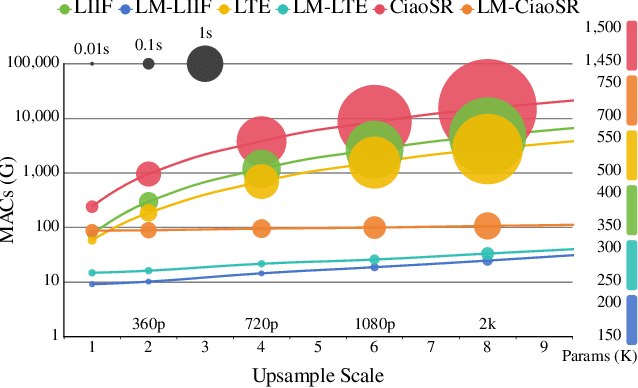
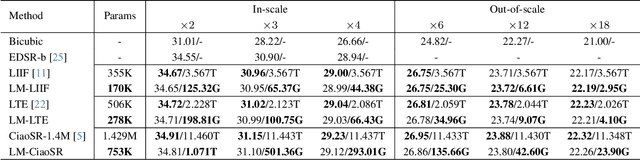
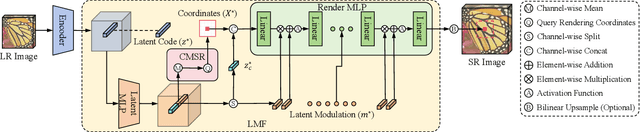
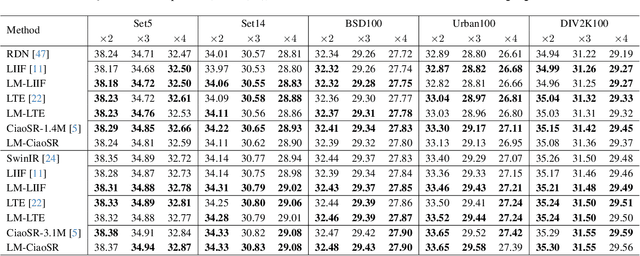
The recent work Local Implicit Image Function (LIIF) and subsequent Implicit Neural Representation (INR) based works have achieved remarkable success in Arbitrary-Scale Super-Resolution (ASSR) by using MLP to decode Low-Resolution (LR) features. However, these continuous image representations typically implement decoding in High-Resolution (HR) High-Dimensional (HD) space, leading to a quadratic increase in computational cost and seriously hindering the practical applications of ASSR. To tackle this problem, we propose a novel Latent Modulated Function (LMF), which decouples the HR-HD decoding process into shared latent decoding in LR-HD space and independent rendering in HR Low-Dimensional (LD) space, thereby realizing the first computational optimal paradigm of continuous image representation. Specifically, LMF utilizes an HD MLP in latent space to generate latent modulations of each LR feature vector. This enables a modulated LD MLP in render space to quickly adapt to any input feature vector and perform rendering at arbitrary resolution. Furthermore, we leverage the positive correlation between modulation intensity and input image complexity to design a Controllable Multi-Scale Rendering (CMSR) algorithm, offering the flexibility to adjust the decoding efficiency based on the rendering precision. Extensive experiments demonstrate that converting existing INR-based ASSR methods to LMF can reduce the computational cost by up to 99.9%, accelerate inference by up to 57 times, and save up to 76% of parameters, while maintaining competitive performance. The code is available at https://github.com/HeZongyao/LMF.
Exploring and Unleashing the Power of Large Language Models in Automated Code Translation
Apr 23, 2024

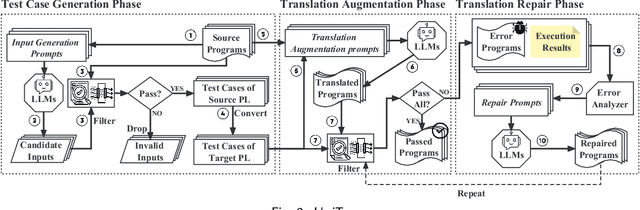
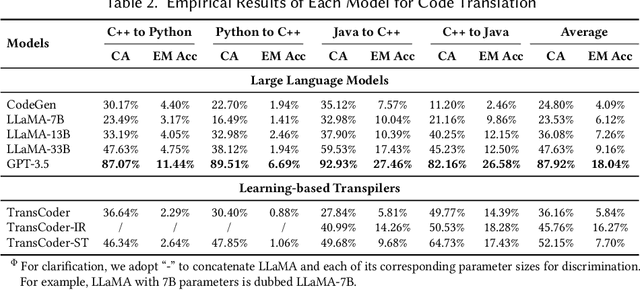
Code translation tools are developed for automatic source-to-source translation. Although learning-based transpilers have shown impressive enhancement against rule-based counterparts, owing to their task-specific pre-training on extensive monolingual corpora. Their current performance still remains unsatisfactory for practical deployment, and the associated training resources are also prohibitively expensive. LLMs pre-trained on huge amounts of human-written code/text have shown remarkable performance in many code intelligence tasks due to their powerful generality, even without task-specific training. Thus, LLMs can potentially circumvent the above limitations, but they have not been exhaustively explored yet. This paper investigates diverse LLMs and learning-based transpilers for automated code translation tasks, finding that: although certain LLMs have outperformed current transpilers, they still have some accuracy issues, where most of the failures are induced by a lack of comprehension of source programs (38.51%), missing clear instructions on I/O types in translation (14.94%), and ignoring discrepancies between source and target programs (41.38%). Enlightened by the above findings, we propose UniTrans, an Unified code Translation framework, applicable to various LLMs, for unleashing their power in this field. Specifically, UniTrans first craft a series of test cases for target programs with the assistance of source programs. Next, it harnesses the above auto-generated test cases to augment the code translation and then evaluate their correctness via execution. Afterward, UniTrans further (iteratively) repairs incorrectly translated programs prompted by test case execution results. Extensive experiments are conducted on six translation datasets between Python, Java, and C++. Three recent LLMs of diverse sizes are tested with UniTrans, and all achieve substantial improvements.
NTIRE 2024 Challenge on Low Light Image Enhancement: Methods and Results
Apr 22, 2024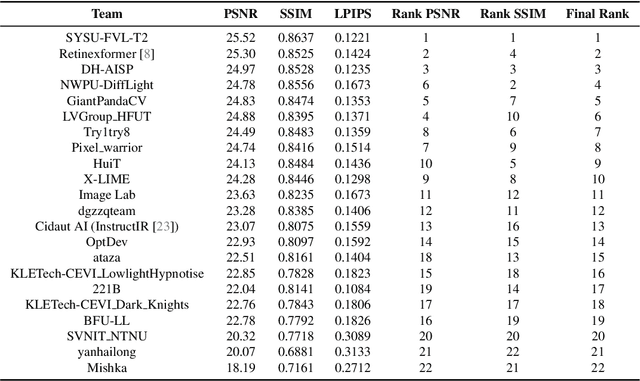
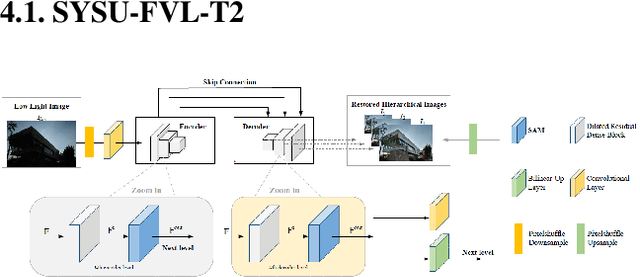
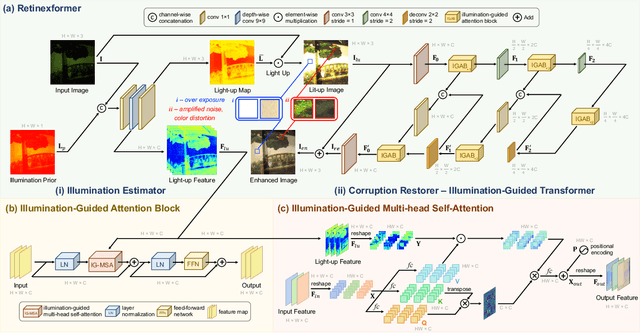
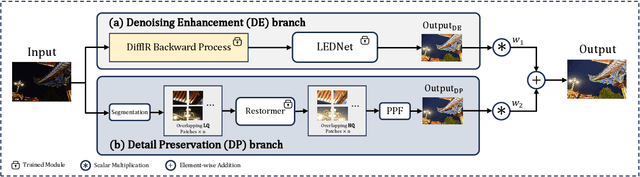
This paper reviews the NTIRE 2024 low light image enhancement challenge, highlighting the proposed solutions and results. The aim of this challenge is to discover an effective network design or solution capable of generating brighter, clearer, and visually appealing results when dealing with a variety of conditions, including ultra-high resolution (4K and beyond), non-uniform illumination, backlighting, extreme darkness, and night scenes. A notable total of 428 participants registered for the challenge, with 22 teams ultimately making valid submissions. This paper meticulously evaluates the state-of-the-art advancements in enhancing low-light images, reflecting the significant progress and creativity in this field.
A Survey on Self-Evolution of Large Language Models
Apr 22, 2024

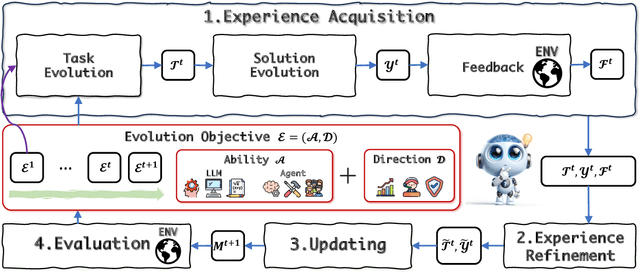

Large language models (LLMs) have significantly advanced in various fields and intelligent agent applications. However, current LLMs that learn from human or external model supervision are costly and may face performance ceilings as task complexity and diversity increase. To address this issue, self-evolution approaches that enable LLM to autonomously acquire, refine, and learn from experiences generated by the model itself are rapidly growing. This new training paradigm inspired by the human experiential learning process offers the potential to scale LLMs towards superintelligence. In this work, we present a comprehensive survey of self-evolution approaches in LLMs. We first propose a conceptual framework for self-evolution and outline the evolving process as iterative cycles composed of four phases: experience acquisition, experience refinement, updating, and evaluation. Second, we categorize the evolution objectives of LLMs and LLM-based agents; then, we summarize the literature and provide taxonomy and insights for each module. Lastly, we pinpoint existing challenges and propose future directions to improve self-evolution frameworks, equipping researchers with critical insights to fast-track the development of self-evolving LLMs.
EVIT: Event-Oriented Instruction Tuning for Event Reasoning
Apr 18, 2024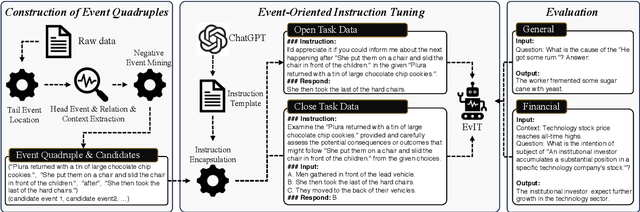
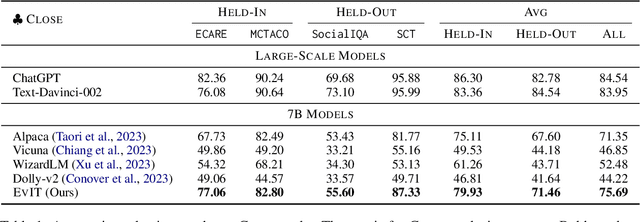
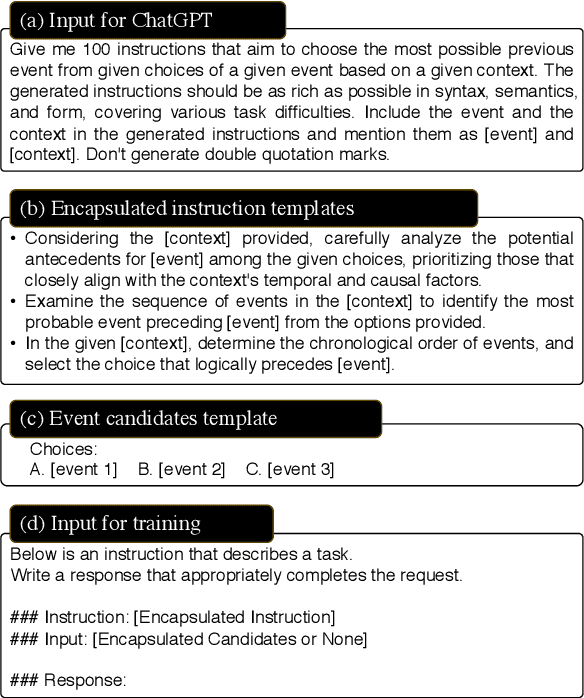

Events refer to specific occurrences, incidents, or happenings that take place under a particular background. Event reasoning aims to infer events according to certain relations and predict future events. The cutting-edge techniques for event reasoning play a crucial role in various natural language processing applications. Large language models (LLMs) have made significant advancements in event reasoning owing to their wealth of knowledge and reasoning capabilities. However, smaller instruction-tuned models currently in use do not consistently demonstrate exceptional proficiency in managing these tasks. This discrepancy arises from the absence of explicit modeling of events and the interconnections of them within their instruction data. Consequently, these models face challenges in comprehending event structures and semantics while struggling to bridge the gap between their interpretations and human understanding of events. Additionally, their limitations in grasping event relations lead to constrained event reasoning abilities to effectively deduce and incorporate pertinent event knowledge. In this paper, we propose Event-Oriented Instruction Tuning (EvIT) to train our LLM. Specifically, we first propose a novel structure named event quadruple which contains the structure and semantics of events and is complete in the event representation. We then design event-relation learning based on the structures. We encapsulate the learning into the instruction-tuning formulation to better stimulate the event reasoning capacity of our model. We design a heuristic unsupervised method to mine event quadruple from a large-scale corpus. At last, we finetune a Llama model on our Event-Oriented Instruction Tuning. We conduct extensive experiments on event reasoning tasks on several datasets. Automatic and human evaluations demonstrate EvIT achieves competitive performances on event reasoning.