 Add to Chrome
 Add to Firefox
 Add to Edge
Is the Trigger Essential? A Feature-Based Triggerless Backdoor Attack in Vertical Federated Learning
Feb 24, 2026
As a distributed collaborative machine learning paradigm, vertical federated learning (VFL) allows multiple passive parties with distinct features and one active party with labels to collaboratively train a model. Although it is known for the privacy-preserving capabilities, VFL still faces significant privacy and security threats from backdoor attacks. Existing backdoor attacks typically involve an attacker implanting a trigger into the model during the training phase and executing the attack by adding the trigger to the samples during the inference phase. However, in this paper, we find that triggers are not essential for backdoor attacks in VFL. In light of this, we disclose a new backdoor attack pathway in VFL by introducing a feature-based triggerless backdoor attack. This attack operates under a more stringent security assumption, where the attacker is honest-but-curious rather than malicious during the training phase. It comprises three modules: label inference for the targeted backdoor attack, poison generation with amplification and perturbation mechanisms, and backdoor execution to implement the attack. Extensive experiments on five benchmark datasets demonstrate that our attack outperforms three baseline backdoor attacks by 2 to 50 times while minimally impacting the main task. Even in VFL scenarios with 32 passive parties and only one set of auxiliary data, our attack maintains high performance. Moreover, when confronted with distinct defense strategies, our attack remains largely unaffected and exhibits strong robustness. We hope that the disclosure of this triggerless backdoor attack pathway will encourage the community to revisit security threats in VFL scenarios and inspire researchers to develop more robust and practical defense strategies.

DatawiseAgent: A Notebook-Centric LLM Agent Framework for Automated Data Science
Mar 10, 2025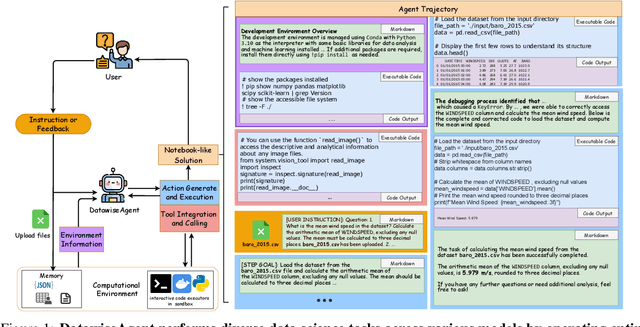

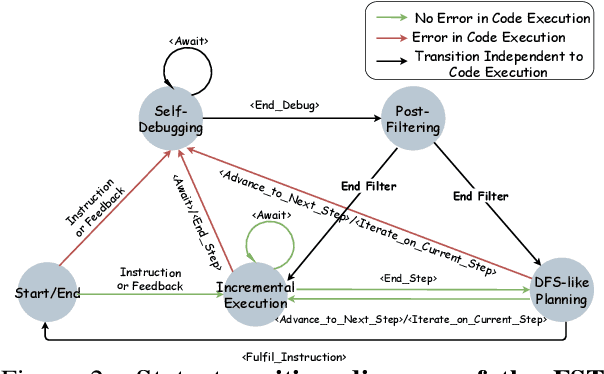
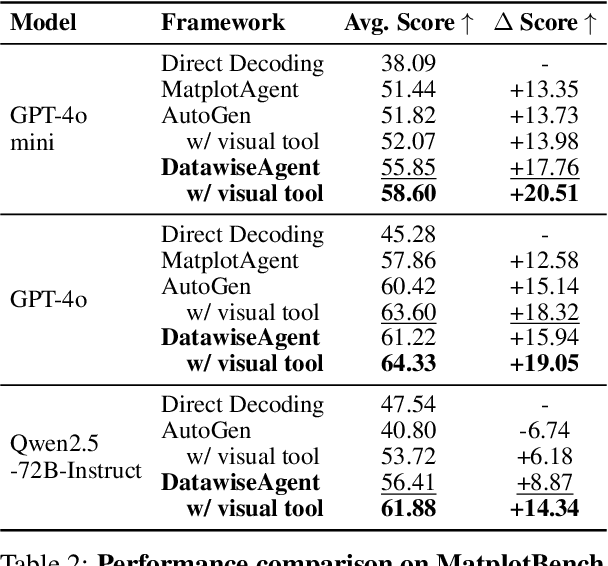
Data Science tasks are multifaceted, dynamic, and often domain-specific. Existing LLM-based approaches largely concentrate on isolated phases, neglecting the interdependent nature of many data science tasks and limiting their capacity for comprehensive end-to-end support. We propose DatawiseAgent, a notebook-centric LLM agent framework that unifies interactions among user, agent and the computational environment through markdown and executable code cells, supporting flexible and adaptive automated data science. Built on a Finite State Transducer(FST), DatawiseAgent orchestrates four stages, including DSF-like planning, incremental execution, self-debugging, and post-filtering. Specifically, the DFS-like planning stage systematically explores the solution space, while incremental execution harnesses real-time feedback and accommodates LLM's limited capabilities to progressively complete tasks. The self-debugging and post-filtering modules further enhance reliability by diagnosing and correcting errors and pruning extraneous information. Extensive experiments on diverse tasks, including data analysis, visualization, and data modeling, show that DatawiseAgent consistently outperforms or matches state-of-the-art methods across multiple model settings. These results highlight its potential to generalize across data science scenarios and lay the groundwork for more efficient, fully automated workflows.
EVIT: Event-Oriented Instruction Tuning for Event Reasoning
Apr 18, 2024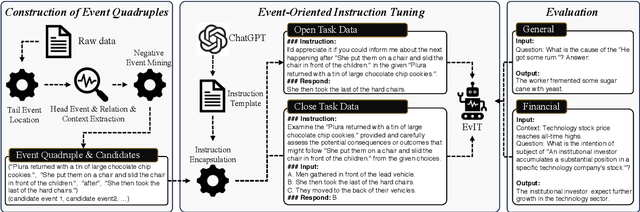
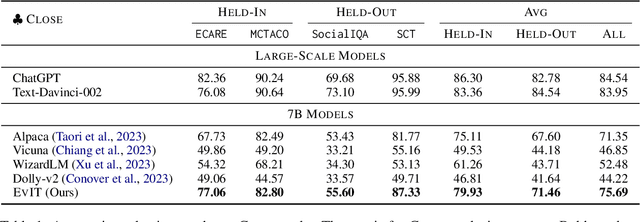
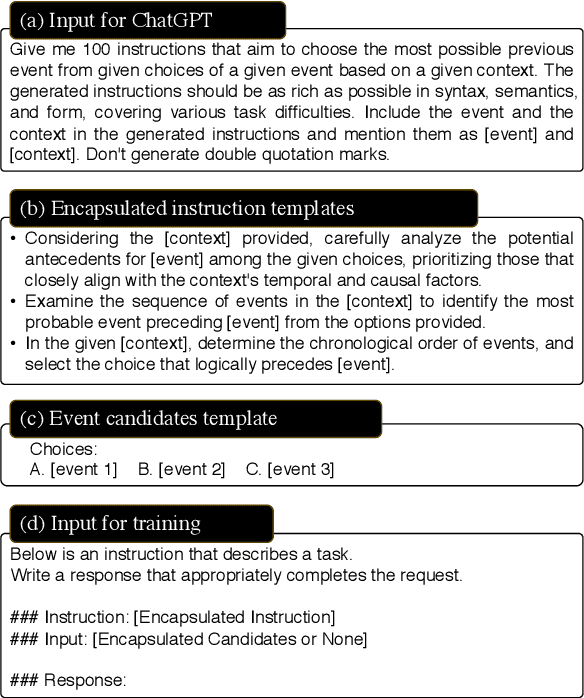

Events refer to specific occurrences, incidents, or happenings that take place under a particular background. Event reasoning aims to infer events according to certain relations and predict future events. The cutting-edge techniques for event reasoning play a crucial role in various natural language processing applications. Large language models (LLMs) have made significant advancements in event reasoning owing to their wealth of knowledge and reasoning capabilities. However, smaller instruction-tuned models currently in use do not consistently demonstrate exceptional proficiency in managing these tasks. This discrepancy arises from the absence of explicit modeling of events and the interconnections of them within their instruction data. Consequently, these models face challenges in comprehending event structures and semantics while struggling to bridge the gap between their interpretations and human understanding of events. Additionally, their limitations in grasping event relations lead to constrained event reasoning abilities to effectively deduce and incorporate pertinent event knowledge. In this paper, we propose Event-Oriented Instruction Tuning (EvIT) to train our LLM. Specifically, we first propose a novel structure named event quadruple which contains the structure and semantics of events and is complete in the event representation. We then design event-relation learning based on the structures. We encapsulate the learning into the instruction-tuning formulation to better stimulate the event reasoning capacity of our model. We design a heuristic unsupervised method to mine event quadruple from a large-scale corpus. At last, we finetune a Llama model on our Event-Oriented Instruction Tuning. We conduct extensive experiments on event reasoning tasks on several datasets. Automatic and human evaluations demonstrate EvIT achieves competitive performances on event reasoning.