 Add to Chrome
 Add to Firefox
 Add to Edge
Decision-Making under Combinatorial Risk
Jun 08, 2026
Decision-making under risk is typically studied through single-shot lottery choices. Yet many real decisions involve combinatorial risk, where risk arises from multiple risky components, so the lottery over outcomes is induced rather than given outright and can be costly to evaluate exactly. We introduce an investment-allocation task to study decision under combinatorial risk, where investing in a component raises its success probability and thereby reshapes the outcome distribution. Participants favor the option with the larger probability increment, and, when increments are equal, the option with the higher initial success probability. Revealing the induced probability mass function (PMF) substantially changes behavior, making participants less responsive to combinatorial-risk features and reducing choice variance. To explain these patterns, we move beyond standard benchmarks and hand-crafted hypotheses with symbolic regression to discover compact descriptive models. The discovered models rely mainly on combinatorial-risk features, such as the after-investment success probability, rather than exact evaluation of the full induced distribution. Behavior under the displayed PMF is then well explained by augmenting this model with a prospect-theoretic residual model. The results show that people navigate combinatorial risk primarily through its core features, shifting toward lottery valuation only when the induced PMF is displayed.

Learning Where to Embed: Noise-Aware Positional Embedding for Query Retrieval in Small-Object Detection
Apr 16, 2026Transformer-based detectors have advanced small-object detection, but they often remain inefficient and vulnerable to background-induced query noise, which motivates deep decoders to refine low-quality queries. We present HELP (Heatmap-guided Embedding Learning Paradigm), a noise-aware positional-semantic fusion framework that studies where to embed positional information by selectively preserving positional encodings in foreground-salient regions while suppressing background clutter. Within HELP, we introduce Heatmap-guided Positional Embedding (HPE) as the core embedding mechanism and visualize it with a heatbar for interpretable diagnosis and fine-tuning. HPE is integrated into both the encoder and decoder: it guides noise-suppressed feature encoding by injecting heatmap-aware positional encoding, and it enables high-quality query retrieval by filtering background-dominant embeddings via a gradient-based mask filter before decoding. To address feature sparsity in complex small targets, we integrate Linear-Snake Convolution to enrich retrieval-relevant representations. The gradient-based heatmap supervision is used during training only, incurring no additional gradient computation at inference. As a result, our design reduces decoder layers from eight to three and achieves a 59.4% parameter reduction (66.3M vs. 163M) while maintaining consistent accuracy gains under a reduced compute budget across benchmarks. Code Repository: https://github.com/yidimopozhibai/Noise-Suppressed-Query-Retrieval
Exploring and Unleashing the Power of Large Language Models in Automated Code Translation
Apr 23, 2024

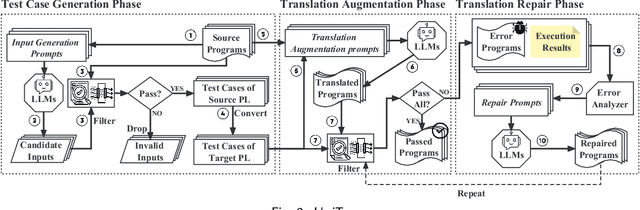
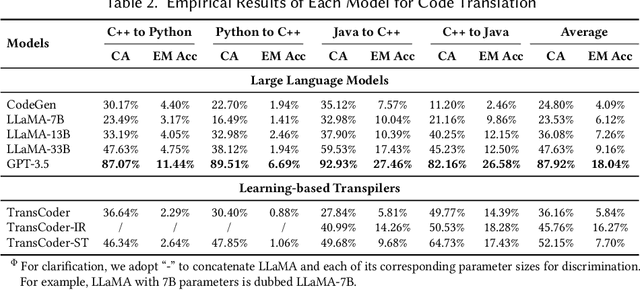
Code translation tools are developed for automatic source-to-source translation. Although learning-based transpilers have shown impressive enhancement against rule-based counterparts, owing to their task-specific pre-training on extensive monolingual corpora. Their current performance still remains unsatisfactory for practical deployment, and the associated training resources are also prohibitively expensive. LLMs pre-trained on huge amounts of human-written code/text have shown remarkable performance in many code intelligence tasks due to their powerful generality, even without task-specific training. Thus, LLMs can potentially circumvent the above limitations, but they have not been exhaustively explored yet. This paper investigates diverse LLMs and learning-based transpilers for automated code translation tasks, finding that: although certain LLMs have outperformed current transpilers, they still have some accuracy issues, where most of the failures are induced by a lack of comprehension of source programs (38.51%), missing clear instructions on I/O types in translation (14.94%), and ignoring discrepancies between source and target programs (41.38%). Enlightened by the above findings, we propose UniTrans, an Unified code Translation framework, applicable to various LLMs, for unleashing their power in this field. Specifically, UniTrans first craft a series of test cases for target programs with the assistance of source programs. Next, it harnesses the above auto-generated test cases to augment the code translation and then evaluate their correctness via execution. Afterward, UniTrans further (iteratively) repairs incorrectly translated programs prompted by test case execution results. Extensive experiments are conducted on six translation datasets between Python, Java, and C++. Three recent LLMs of diverse sizes are tested with UniTrans, and all achieve substantial improvements.
A Rational Model of Dimension-reduced Human Categorization
May 22, 2023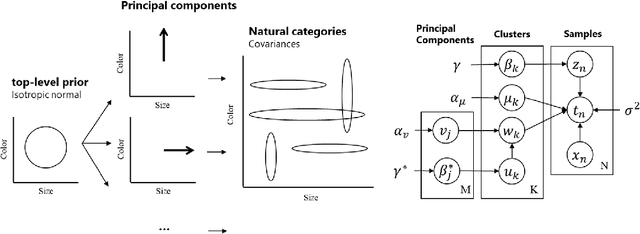
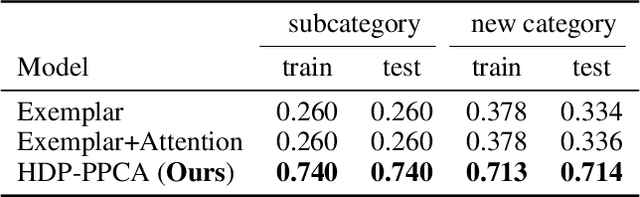

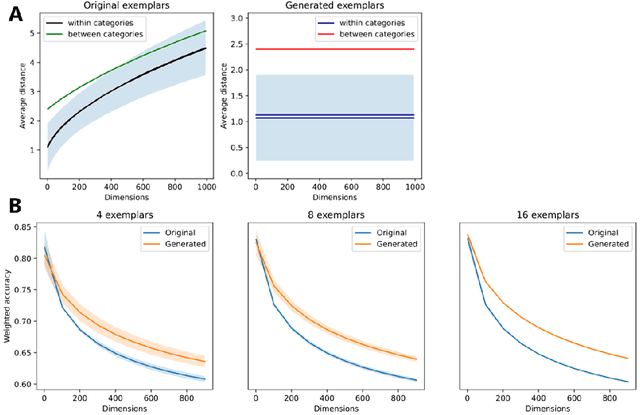
Existing models in cognitive science typically assume human categorization as graded generalization behavior in a multidimensional psychological space. However, category representations in these models may suffer from the curse of dimensionality in a natural setting. People generally rely on a tractable yet sufficient set of features to understand the complex environment. We propose a rational model of categorization based on a hierarchical mixture of probabilistic principal components, that simultaneously learn category representations and an economical collection of features. The model captures dimensional biases in human categorization and supports zero-shot learning. We further exploit a generative process within a low-dimensional latent space to provide a better account of categorization with high-dimensional stimuli. We validate the model with simulation and behavioral experiments.