 Add to Chrome
 Add to Firefox
 Add to Edge
Beyond Sequential Interaction: Benchmarking Parallel Execution and Coordination for GUI Agents
Jul 17, 2026
Graphical user interface (GUI) agents are systems powered by large multimodal models (LMMs). They perceive screen state and execute user instructions through GUI actions such as clicking, typing, and scrolling on desktops and mobile devices. However, current agents scale poorly to long-horizon tasks: actions incur costly LMM inferences, and performance degrades as context grows. Humans divide such workloads among collaborators who complete sub-tasks in parallel. Yet parallel coordination among GUI agents has received little attention. To close this gap, we introduce ParaGUIBench, to our knowledge, the first benchmark dedicated to parallel execution and coordination of multiple GUI agents on separate desktop instances. It consists of three components: a multi-device Docker infrastructure with a shared file system; a dataset of 233 tasks spanning six task categories; and an evaluation system with efficiency metrics, including step reduction ratio and token cost. We further introduce ParaGUI, a planner-worker agent that decomposes GUI tasks and dispatches sub-tasks to concurrent workers on separate desktop instances. On ParaGUIBench, ParaGUI reaches a 46.4% success rate, outperforming the strongest serial baseline (Claude Sonnet 4.6) by 12.9 points while using roughly half the steps and less than half the tokens. These results show that parallel execution can improve both success rate and efficiency on decomposable, long-horizon GUI tasks, pointing to a direction worth further study.

SafeRelBench: A Spatial-Relation-Aware Benchmark for Process-Level Safety in VLM-Driven Embodied Agents
Jul 16, 2026Vision-language models (VLMs) are increasingly used as the reasoning backbone of embodied agents, enabling robots to interpret visual scenes, follow language instructions, and plan multi-step actions. In household environments, however, safety depends not only on recognizing objects, but also on how actions change the physical scene over time. Existing embodied safety evaluations largely focus on static risk recognition, unsafe instruction refusal, or final-state task completion. As a result, process-level safety failures induced by spatial relations such as support, containment, and proximity remain insufficiently studied. To address this gap, we introduce SAFERELBENCH, a spatial-relation-aware safety benchmark with 507 executable evaluation samples, including 248 spatial-relation samples and 259 non-spatial control samples. Using SAFERELBENCH to evaluate seven open- and closed-source VLM-driven embodied agents, we find a substantial gap between task success and process-level safety compliance: models often complete the requested task while violating process-level safety constraints. Unlike prior benchmarks, SAFERELBENCH explicitly tests whether agents satisfy safety conditions before risk-prone actions, making spatial relations a core dimension in embodied safety assessment. More broadly, our results show that safe embodied intelligence requires not only stronger perception and planning, but also reliable reasoning about how object relations shape risk during interaction.
SAGA: Scene-Aware, Goal-Evolving Agents for Long-Horizon CivRealm Strategy Planning
Jun 29, 2026Long-horizon strategic planning in complex strategy games demands concurrent reasoning across multiple decision domains under imperfect information and sparse reward. Existing LLM-based agents suffer from three systematic failures: scene blindness from raw tile coordinates, context overflow and domain coupling from monolithic state dumps, and shallow cross-game learning that treats each episode in isolation. We present SAGA, an LLM multi-agent framework with three mechanisms each directly targeting one class of failure: (i) a Map-Semantic Scene Graph that encodes typed spatial relations among game entities into per-unit natural-language context, resolving spatial blindness without global token inflation; (ii) a Tool-Augmented Planner that pulls fine-grained domain state on demand and dispatches per-domain directives to dedicated specialist controllers, eliminating context overflow, domain coupling, and mechanical constraint violations; and (iii) a Dual-Horizon Feedback Loop that combines periodic within-game goal generation with structured cross-game causal post-mortem, enabling principled strategic evolution without manual reward engineering. Evaluated on FreeCiv, SAGA attains the highest mean civilization score -- the environment's sole sparse objective reward -- with lower variance than the two strongest baselines, and is the only method that significantly surpasses every baseline on infrastructure construction, the resource axis most readily sacrificed under multi-objective conflict. It outscores the two strongest baselines in most head-to-head games while cutting output tokens (the dominant decoding cost) by 27%. Equipped with the cross-game evolution module, SAGA reaches the highest end-of-chain score across five successive episodes. Ablation studies confirm that each architectural component contributes independently to this advantage.
AirGroundBench: Probing Spatial Intelligence in Multimodal Large Models under Heterogeneous Multi-View Embodied Collaboration
Jun 26, 2026In recent years, multimodal large language models (MLLMs) have shown strong potential for embodied intelligence, yet their ability to maintain geometrically consistent spatial understanding across heterogeneous views remains under-evaluated. Existing benchmarks largely focus on single-agent, single-view perception, leaving a gap in the systematic assessment of collaborative air-ground settings, where multi-scale observations are complementary but introduce scale mismatch, asymmetric occlusion, and reference-frame inconsistencies. We present AirGroundBench, a diagnostic benchmark for evaluating multi-view spatial intelligence in heterogeneous UAV-UGV collaboration. AirGroundBench is built from 11 high-fidelity simulated environments with 1,021 synchronized air-ground observation pairs, yielding approximately 62,000 dual-view, four-option single-choice visual question answering instances and 115 closed-loop vision-language navigation episodes. It covers 10 task types organized into four progressively demanding capability dimensions: spatial perception, cross-view alignment, spatial transformation and reasoning, and embodied decision-making. To support geometry-grounded evaluation and analysis, we provide structured spatial annotations, including cross-view object identities and metric 2D and 3D bounding boxes. Evaluations of 13 representative MLLMs under UAV-only, UGV-only, and dual-view input settings reveal consistent bottlenecks: models perform relatively well on spatial perception but struggle with cross-view alignment and transformation-intensive reasoning, and these deficits propagate to sequential decision-making in vision-language navigation. Although dual-view inputs provide measurable gains over single-view variants, a persistent gap from human performance remains, highlighting geometric consistency as a key limitation of current embodied MLLMs.
Omni-RRM: Advancing Omni Reward Modeling via Automatic Rubric-Grounded Preference Synthesis
Jan 31, 2026Multimodal large language models (MLLMs) have shown remarkable capabilities, yet their performance is often capped by the coarse nature of existing alignment techniques. A critical bottleneck remains the lack of effective reward models (RMs): existing RMs are predominantly vision-centric, return opaque scalar scores, and rely on costly human annotations. We introduce \textbf{Omni-RRM}, the first open-source rubric-grounded reward model that produces structured, multi-dimension preference judgments with dimension-wise justifications across \textbf{text, image, video, and audio}. At the core of our approach is \textbf{Omni-Preference}, a large-scale dataset built via a fully automated pipeline: we synthesize candidate response pairs by contrasting models of different capabilities, and use strong teacher models to \emph{reconcile and filter} preferences while providing a modality-aware \emph{rubric-grounded rationale} for each pair. This eliminates the need for human-labeled training preferences. Omni-RRM is trained in two stages: supervised fine-tuning to learn the rubric-grounded outputs, followed by reinforcement learning (GRPO) to sharpen discrimination on difficult, low-contrast pairs. Comprehensive evaluations show that Omni-RRM achieves state-of-the-art accuracy on video (80.2\% on ShareGPT-V) and audio (66.8\% on Audio-HH-RLHF) benchmarks, and substantially outperforms existing open-source RMs on image tasks, with a 17.7\% absolute gain over its base model on overall accuracy. Omni-RRM also improves downstream performance via Best-of-$N$ selection and transfers to text-only preference benchmarks. Our data, code, and models are available at https://anonymous.4open.science/r/Omni-RRM-CC08.
S$^3$-Attention:Attention-Aligned Endogenous Retrieval for Memory-Bounded Long-Context Inference
Jan 25, 2026Large language models are increasingly applied to multi-document and long-form inputs, yet long-context inference remains memory- and noise-inefficient. Key-value (KV) caching scales linearly with context length, while external retrieval methods often return lexically similar but causally irrelevant passages. We present S3-Attention, a memory-first inference-time framework that treats long-context processing as attention-aligned endogenous retrieval. S3-Attention decodes transient key and query projections into top-k sparse feature identifiers using lightweight sparse autoencoders, and constructs a CPU-based inverted index mapping features to token positions or spans during a single streaming scan. This design allows the KV cache to be discarded entirely and bounds GPU memory usage by the scan chunk size. At generation time, feature co-activation is used to retrieve compact evidence spans, optionally fused with BM25 for exact lexical matching. Under a unified LongBench evaluation protocol with fixed prompting, decoding, and matched token budgets, S3-Hybrid closely matches full-context inference across multiple model families and improves robustness in several information-dense settings. We also report an engineering limitation of the current prototype, which incurs higher wall-clock latency than optimized full-KV baselines, motivating future kernel-level optimization.
Interpretable Safety Alignment via SAE-Constructed Low-Rank Subspace Adaptation
Dec 29, 2025Parameter-efficient fine-tuning has become the dominant paradigm for adapting large language models to downstream tasks. Low-rank adaptation methods such as LoRA operate under the assumption that task-relevant weight updates reside in a low-rank subspace, yet this subspace is learned implicitly from data in a black-box manner, offering no interpretability or direct control. We hypothesize that this difficulty stems from polysemanticity--individual dimensions encoding multiple entangled concepts. To address this, we leverage pre-trained Sparse Autoencoders (SAEs) to identify task-relevant features in a disentangled feature space, then construct an explicit, interpretable low-rank subspace to guide adapter initialization. We provide theoretical analysis proving that under monosemanticity assumptions, SAE-based subspace identification achieves arbitrarily small recovery error, while direct identification in polysemantic space suffers an irreducible error floor. On safety alignment, our method achieves up to 99.6% safety rate--exceeding full fine-tuning by 7.4 percentage points and approaching RLHF-based methods--while updating only 0.19-0.24% of parameters. Crucially, our method provides interpretable insights into the learned alignment subspace through the semantic grounding of SAE features. Our work demonstrates that incorporating mechanistic interpretability into the fine-tuning process can simultaneously improve both performance and transparency.
Unlocking the Address Book: Dissecting the Sparse Semantic Structure of LLM Key-Value Caches via Sparse Autoencoders
Dec 11, 2025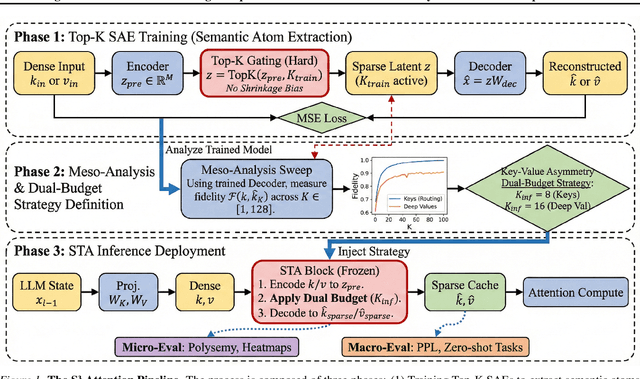
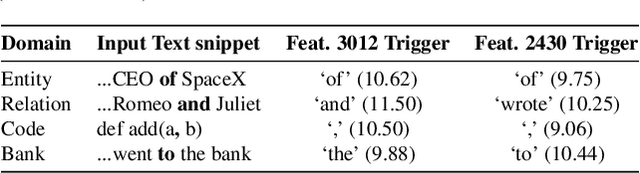
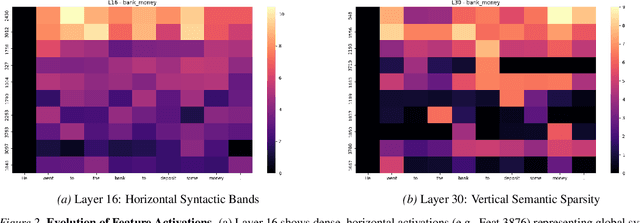
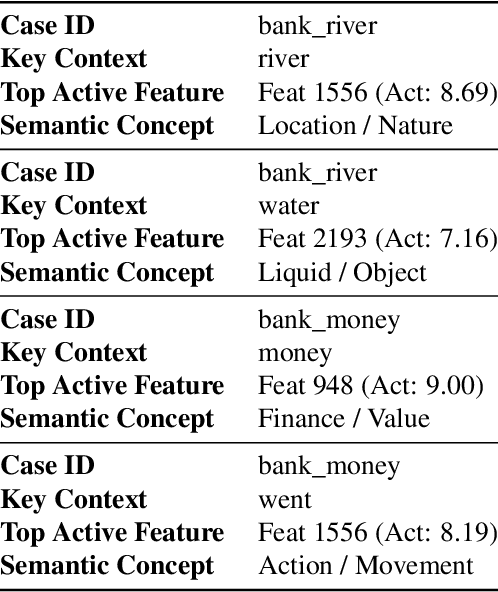
The Key-Value (KV) cache is the primary memory bottleneck in long-context Large Language Models, yet it is typically treated as an opaque numerical tensor. In this work, we propose \textbf{STA-Attention}, a framework that utilizes Top-K Sparse Autoencoders (SAEs) to decompose the KV cache into interpretable ``semantic atoms.'' Unlike standard $L_1$-regularized SAEs, our Top-K approach eliminates shrinkage bias, preserving the precise dot-product geometry required for attention. Our analysis uncovers a fundamental \textbf{Key-Value Asymmetry}: while Key vectors serve as highly sparse routers dominated by a ``Semantic Elbow,'' deep Value vectors carry dense content payloads requiring a larger budget. Based on this structure, we introduce a Dual-Budget Strategy that selectively preserves the most informative semantic components while filtering representational noise. Experiments on Yi-6B, Mistral-7B, Qwen2.5-32B, and others show that our semantic reconstructions maintain perplexity and zero-shot performance comparable to the original models, effectively bridging the gap between mechanistic interpretability and faithful attention modeling.
Beyond Darkness: Thermal-Supervised 3D Gaussian Splatting for Low-Light Novel View Synthesis
Nov 17, 2025Under extremely low-light conditions, novel view synthesis (NVS) faces severe degradation in terms of geometry, color consistency, and radiometric stability. Standard 3D Gaussian Splatting (3DGS) pipelines fail when applied directly to underexposed inputs, as independent enhancement across views causes illumination inconsistencies and geometric distortion. To address this, we present DTGS, a unified framework that tightly couples Retinex-inspired illumination decomposition with thermal-guided 3D Gaussian Splatting for illumination-invariant reconstruction. Unlike prior approaches that treat enhancement as a pre-processing step, DTGS performs joint optimization across enhancement, geometry, and thermal supervision through a cyclic enhancement-reconstruction mechanism. A thermal supervisory branch stabilizes both color restoration and geometry learning by dynamically balancing enhancement, structural, and thermal losses. Moreover, a Retinex-based decomposition module embedded within the 3DGS loop provides physically interpretable reflectance-illumination separation, ensuring consistent color and texture across viewpoints. To evaluate our method, we construct RGBT-LOW, a new multi-view low-light thermal dataset capturing severe illumination degradation. Extensive experiments show that DTGS significantly outperforms existing low-light enhancement and 3D reconstruction baselines, achieving superior radiometric consistency, geometric fidelity, and color stability under extreme illumination.
GUI Knowledge Bench: Revealing the Knowledge Gap Behind VLM Failures in GUI Tasks
Oct 30, 2025Large vision language models (VLMs) have advanced graphical user interface (GUI) task automation but still lag behind humans. We hypothesize this gap stems from missing core GUI knowledge, which existing training schemes (such as supervised fine tuning and reinforcement learning) alone cannot fully address. By analyzing common failure patterns in GUI task execution, we distill GUI knowledge into three dimensions: (1) interface perception, knowledge about recognizing widgets and system states; (2) interaction prediction, knowledge about reasoning action state transitions; and (3) instruction understanding, knowledge about planning, verifying, and assessing task completion progress. We further introduce GUI Knowledge Bench, a benchmark with multiple choice and yes/no questions across six platforms (Web, Android, MacOS, Windows, Linux, IOS) and 292 applications. Our evaluation shows that current VLMs identify widget functions but struggle with perceiving system states, predicting actions, and verifying task completion. Experiments on real world GUI tasks further validate the close link between GUI knowledge and task success. By providing a structured framework for assessing GUI knowledge, our work supports the selection of VLMs with greater potential prior to downstream training and provides insights for building more capable GUI agents.