 Add to Chrome
 Add to Firefox
 Add to Edge
Beyond Teacher Likelihood: Group-Calibrated On-Policy Distillation for Long-Context Reasoning
Aug 19, 2026
On-policy distillation (OPD) trains a student on its own responses using dense token-level guidance from a stronger teacher. In long-context tasks, however, token-level teacher support can favor locally plausible responses that omit evidence distributed across the input or violate global task constraints. Task-specific verifiers, in contrast, evaluate task completion at the response level and may return graded rewards that reflect partial success. We diagnose this mismatch on fixed responses from two representative long-context evidence-aggregation tasks. Across longer input ranges, trajectory-level OPD scores become progressively less aligned with verifier rewards, indicating teacher-verifier disagreement. Motivated by this observation, we introduce Group-Calibrated On-Policy Distillation (GC-OPD). GC-OPD separately normalizes verifier rewards and trajectory-level OPD scores within each rollout group and uses their difference as a signed teacher-verifier disagreement residual. Relative-advantage-based credit assignment (RACA) distributes this trajectory-level residual across tokens according to their relative OPD advantages while preserving the original OPD signal. Across five long-context benchmarks, post-training with GC-OPD raises the five-benchmark averages of the official Qwen3-4B and Qwen3-8B checkpoints from 29.08 to 40.47 and from 35.12 to 44.65, respectively. Vanilla OPD reaches 39.31 and 43.56 under the same setup. Controlled ablations show that the signed residual is more effective than either an additional OPD-derived term or direct group-normalized verifier reward addition, while RACA further improves over uniform token allocation. Together, these results demonstrate that group-relative residual calibration can incorporate verifier outcomes without discarding dense token-level guidance. Code is available at https://github.com/SolereZhang/GC-OPD.

A*-Thought: Efficient Reasoning via Bidirectional Compression for Low-Resource Settings
May 30, 2025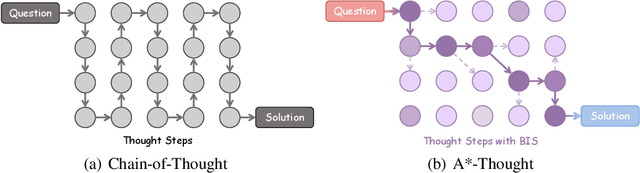
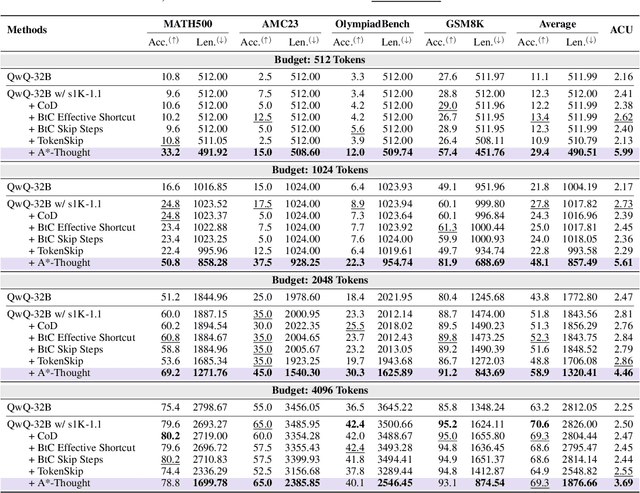
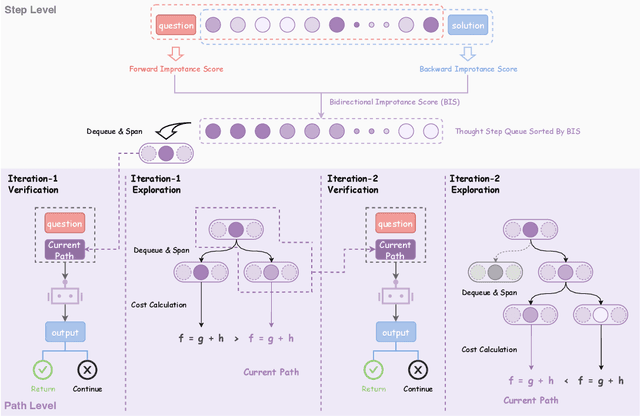

Large Reasoning Models (LRMs) achieve superior performance by extending the thought length. However, a lengthy thinking trajectory leads to reduced efficiency. Most of the existing methods are stuck in the assumption of overthinking and attempt to reason efficiently by compressing the Chain-of-Thought, but this often leads to performance degradation. To address this problem, we introduce A*-Thought, an efficient tree search-based unified framework designed to identify and isolate the most essential thoughts from the extensive reasoning chains produced by these models. It formulates the reasoning process of LRMs as a search tree, where each node represents a reasoning span in the giant reasoning space. By combining the A* search algorithm with a cost function specific to the reasoning path, it can efficiently compress the chain of thought and determine a reasoning path with high information density and low cost. In addition, we also propose a bidirectional importance estimation mechanism, which further refines this search process and enhances its efficiency beyond uniform sampling. Extensive experiments on several advanced math tasks show that A*-Thought effectively balances performance and efficiency over a huge search space. Specifically, A*-Thought can improve the performance of QwQ-32B by 2.39$\times$ with low-budget and reduce the length of the output token by nearly 50% with high-budget. The proposed method is also compatible with several other LRMs, demonstrating its generalization capability. The code can be accessed at: https://github.com/AI9Stars/AStar-Thought.