 Add to Chrome
 Add to Firefox
 Add to Edge
HarnessSafe: Evaluating Safety Across Persistent Carriers in Agent Harnesses
Aug 07, 2026
Modern agent harnesses persist state across tasks and sessions through persistent carriers like memory, skills, tools, and shared artifacts. However, this capability creates delayed safety risks: attacker-influenced content can cross system boundaries and later affect the execution of a benign request. Existing benchmarks typically focus on a few carriers or harnesses, while end-to-end attack-success rates reveal little about how risks propagate. To this end, we present HarnessSafe, a benchmark comprising 328 executable cases across seven persistent-carrier families and evaluated on most mainstream agent harnesses. Each case is specified as a Persistent-Risk Lifecycle that traces attacker influence from its initial entry, through persistence across carriers and system boundaries, to a later benign trigger and an observable violation. We further introduce a multi-stage, trace-based evaluation that uses observable execution evidence to determine how far each attack chain progresses and where it is stopped. Experiments show that containment is carrier-specific and strongly depends on the harness-model configuration. Both the harness and model backend substantially shape containment outcomes, while attack success rates cannot reflect distinct lifecycle progression patterns.

Beyond Sequential Interaction: Benchmarking Parallel Execution and Coordination for GUI Agents
Jul 17, 2026Graphical user interface (GUI) agents are systems powered by large multimodal models (LMMs). They perceive screen state and execute user instructions through GUI actions such as clicking, typing, and scrolling on desktops and mobile devices. However, current agents scale poorly to long-horizon tasks: actions incur costly LMM inferences, and performance degrades as context grows. Humans divide such workloads among collaborators who complete sub-tasks in parallel. Yet parallel coordination among GUI agents has received little attention. To close this gap, we introduce ParaGUIBench, to our knowledge, the first benchmark dedicated to parallel execution and coordination of multiple GUI agents on separate desktop instances. It consists of three components: a multi-device Docker infrastructure with a shared file system; a dataset of 233 tasks spanning six task categories; and an evaluation system with efficiency metrics, including step reduction ratio and token cost. We further introduce ParaGUI, a planner-worker agent that decomposes GUI tasks and dispatches sub-tasks to concurrent workers on separate desktop instances. On ParaGUIBench, ParaGUI reaches a 46.4% success rate, outperforming the strongest serial baseline (Claude Sonnet 4.6) by 12.9 points while using roughly half the steps and less than half the tokens. These results show that parallel execution can improve both success rate and efficiency on decomposable, long-horizon GUI tasks, pointing to a direction worth further study.
SAGA: Scene-Aware, Goal-Evolving Agents for Long-Horizon CivRealm Strategy Planning
Jun 29, 2026Long-horizon strategic planning in complex strategy games demands concurrent reasoning across multiple decision domains under imperfect information and sparse reward. Existing LLM-based agents suffer from three systematic failures: scene blindness from raw tile coordinates, context overflow and domain coupling from monolithic state dumps, and shallow cross-game learning that treats each episode in isolation. We present SAGA, an LLM multi-agent framework with three mechanisms each directly targeting one class of failure: (i) a Map-Semantic Scene Graph that encodes typed spatial relations among game entities into per-unit natural-language context, resolving spatial blindness without global token inflation; (ii) a Tool-Augmented Planner that pulls fine-grained domain state on demand and dispatches per-domain directives to dedicated specialist controllers, eliminating context overflow, domain coupling, and mechanical constraint violations; and (iii) a Dual-Horizon Feedback Loop that combines periodic within-game goal generation with structured cross-game causal post-mortem, enabling principled strategic evolution without manual reward engineering. Evaluated on FreeCiv, SAGA attains the highest mean civilization score -- the environment's sole sparse objective reward -- with lower variance than the two strongest baselines, and is the only method that significantly surpasses every baseline on infrastructure construction, the resource axis most readily sacrificed under multi-objective conflict. It outscores the two strongest baselines in most head-to-head games while cutting output tokens (the dominant decoding cost) by 27%. Equipped with the cross-game evolution module, SAGA reaches the highest end-of-chain score across five successive episodes. Ablation studies confirm that each architectural component contributes independently to this advantage.
AirGroundBench: Probing Spatial Intelligence in Multimodal Large Models under Heterogeneous Multi-View Embodied Collaboration
Jun 26, 2026In recent years, multimodal large language models (MLLMs) have shown strong potential for embodied intelligence, yet their ability to maintain geometrically consistent spatial understanding across heterogeneous views remains under-evaluated. Existing benchmarks largely focus on single-agent, single-view perception, leaving a gap in the systematic assessment of collaborative air-ground settings, where multi-scale observations are complementary but introduce scale mismatch, asymmetric occlusion, and reference-frame inconsistencies. We present AirGroundBench, a diagnostic benchmark for evaluating multi-view spatial intelligence in heterogeneous UAV-UGV collaboration. AirGroundBench is built from 11 high-fidelity simulated environments with 1,021 synchronized air-ground observation pairs, yielding approximately 62,000 dual-view, four-option single-choice visual question answering instances and 115 closed-loop vision-language navigation episodes. It covers 10 task types organized into four progressively demanding capability dimensions: spatial perception, cross-view alignment, spatial transformation and reasoning, and embodied decision-making. To support geometry-grounded evaluation and analysis, we provide structured spatial annotations, including cross-view object identities and metric 2D and 3D bounding boxes. Evaluations of 13 representative MLLMs under UAV-only, UGV-only, and dual-view input settings reveal consistent bottlenecks: models perform relatively well on spatial perception but struggle with cross-view alignment and transformation-intensive reasoning, and these deficits propagate to sequential decision-making in vision-language navigation. Although dual-view inputs provide measurable gains over single-view variants, a persistent gap from human performance remains, highlighting geometric consistency as a key limitation of current embodied MLLMs.
Omni-RRM: Advancing Omni Reward Modeling via Automatic Rubric-Grounded Preference Synthesis
Jan 31, 2026Multimodal large language models (MLLMs) have shown remarkable capabilities, yet their performance is often capped by the coarse nature of existing alignment techniques. A critical bottleneck remains the lack of effective reward models (RMs): existing RMs are predominantly vision-centric, return opaque scalar scores, and rely on costly human annotations. We introduce \textbf{Omni-RRM}, the first open-source rubric-grounded reward model that produces structured, multi-dimension preference judgments with dimension-wise justifications across \textbf{text, image, video, and audio}. At the core of our approach is \textbf{Omni-Preference}, a large-scale dataset built via a fully automated pipeline: we synthesize candidate response pairs by contrasting models of different capabilities, and use strong teacher models to \emph{reconcile and filter} preferences while providing a modality-aware \emph{rubric-grounded rationale} for each pair. This eliminates the need for human-labeled training preferences. Omni-RRM is trained in two stages: supervised fine-tuning to learn the rubric-grounded outputs, followed by reinforcement learning (GRPO) to sharpen discrimination on difficult, low-contrast pairs. Comprehensive evaluations show that Omni-RRM achieves state-of-the-art accuracy on video (80.2\% on ShareGPT-V) and audio (66.8\% on Audio-HH-RLHF) benchmarks, and substantially outperforms existing open-source RMs on image tasks, with a 17.7\% absolute gain over its base model on overall accuracy. Omni-RRM also improves downstream performance via Best-of-$N$ selection and transfers to text-only preference benchmarks. Our data, code, and models are available at https://anonymous.4open.science/r/Omni-RRM-CC08.
Unlocking the Address Book: Dissecting the Sparse Semantic Structure of LLM Key-Value Caches via Sparse Autoencoders
Dec 11, 2025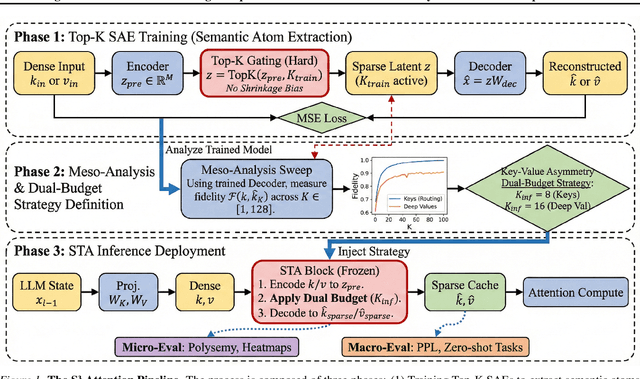
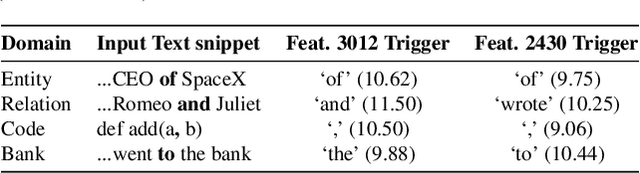
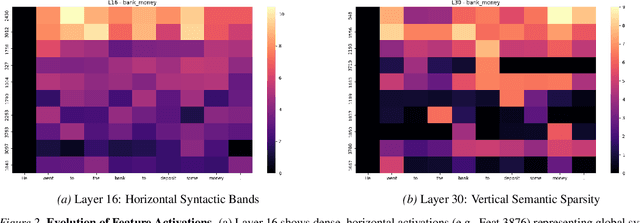
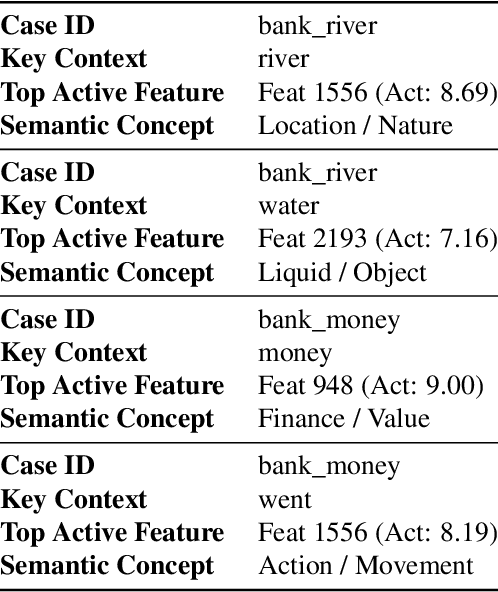
The Key-Value (KV) cache is the primary memory bottleneck in long-context Large Language Models, yet it is typically treated as an opaque numerical tensor. In this work, we propose \textbf{STA-Attention}, a framework that utilizes Top-K Sparse Autoencoders (SAEs) to decompose the KV cache into interpretable ``semantic atoms.'' Unlike standard $L_1$-regularized SAEs, our Top-K approach eliminates shrinkage bias, preserving the precise dot-product geometry required for attention. Our analysis uncovers a fundamental \textbf{Key-Value Asymmetry}: while Key vectors serve as highly sparse routers dominated by a ``Semantic Elbow,'' deep Value vectors carry dense content payloads requiring a larger budget. Based on this structure, we introduce a Dual-Budget Strategy that selectively preserves the most informative semantic components while filtering representational noise. Experiments on Yi-6B, Mistral-7B, Qwen2.5-32B, and others show that our semantic reconstructions maintain perplexity and zero-shot performance comparable to the original models, effectively bridging the gap between mechanistic interpretability and faithful attention modeling.
Beyond Darkness: Thermal-Supervised 3D Gaussian Splatting for Low-Light Novel View Synthesis
Nov 17, 2025Under extremely low-light conditions, novel view synthesis (NVS) faces severe degradation in terms of geometry, color consistency, and radiometric stability. Standard 3D Gaussian Splatting (3DGS) pipelines fail when applied directly to underexposed inputs, as independent enhancement across views causes illumination inconsistencies and geometric distortion. To address this, we present DTGS, a unified framework that tightly couples Retinex-inspired illumination decomposition with thermal-guided 3D Gaussian Splatting for illumination-invariant reconstruction. Unlike prior approaches that treat enhancement as a pre-processing step, DTGS performs joint optimization across enhancement, geometry, and thermal supervision through a cyclic enhancement-reconstruction mechanism. A thermal supervisory branch stabilizes both color restoration and geometry learning by dynamically balancing enhancement, structural, and thermal losses. Moreover, a Retinex-based decomposition module embedded within the 3DGS loop provides physically interpretable reflectance-illumination separation, ensuring consistent color and texture across viewpoints. To evaluate our method, we construct RGBT-LOW, a new multi-view low-light thermal dataset capturing severe illumination degradation. Extensive experiments show that DTGS significantly outperforms existing low-light enhancement and 3D reconstruction baselines, achieving superior radiometric consistency, geometric fidelity, and color stability under extreme illumination.
GUI Knowledge Bench: Revealing the Knowledge Gap Behind VLM Failures in GUI Tasks
Oct 30, 2025Large vision language models (VLMs) have advanced graphical user interface (GUI) task automation but still lag behind humans. We hypothesize this gap stems from missing core GUI knowledge, which existing training schemes (such as supervised fine tuning and reinforcement learning) alone cannot fully address. By analyzing common failure patterns in GUI task execution, we distill GUI knowledge into three dimensions: (1) interface perception, knowledge about recognizing widgets and system states; (2) interaction prediction, knowledge about reasoning action state transitions; and (3) instruction understanding, knowledge about planning, verifying, and assessing task completion progress. We further introduce GUI Knowledge Bench, a benchmark with multiple choice and yes/no questions across six platforms (Web, Android, MacOS, Windows, Linux, IOS) and 292 applications. Our evaluation shows that current VLMs identify widget functions but struggle with perceiving system states, predicting actions, and verifying task completion. Experiments on real world GUI tasks further validate the close link between GUI knowledge and task success. By providing a structured framework for assessing GUI knowledge, our work supports the selection of VLMs with greater potential prior to downstream training and provides insights for building more capable GUI agents.
SCOMatch: Alleviating Overtrusting in Open-set Semi-supervised Learning
Sep 26, 2024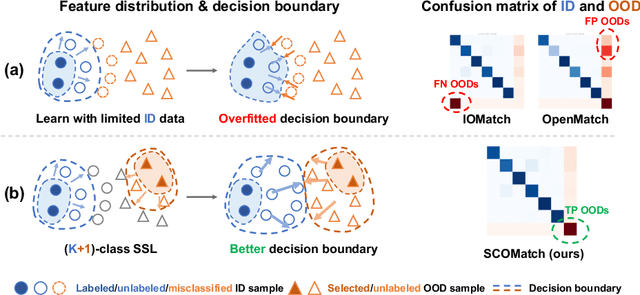
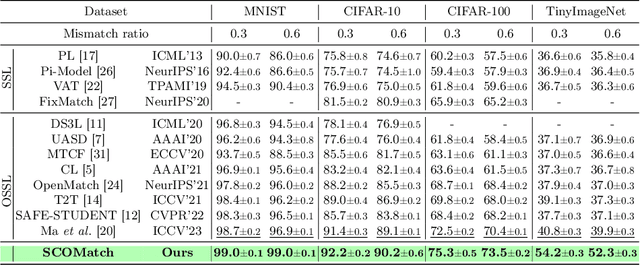
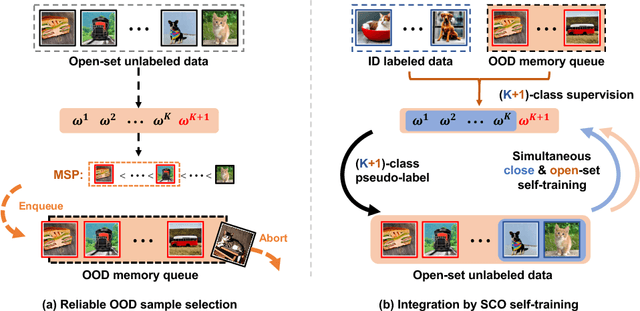
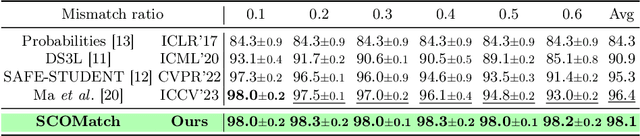
Open-set semi-supervised learning (OSSL) leverages practical open-set unlabeled data, comprising both in-distribution (ID) samples from seen classes and out-of-distribution (OOD) samples from unseen classes, for semi-supervised learning (SSL). Prior OSSL methods initially learned the decision boundary between ID and OOD with labeled ID data, subsequently employing self-training to refine this boundary. These methods, however, suffer from the tendency to overtrust the labeled ID data: the scarcity of labeled data caused the distribution bias between the labeled samples and the entire ID data, which misleads the decision boundary to overfit. The subsequent self-training process, based on the overfitted result, fails to rectify this problem. In this paper, we address the overtrusting issue by treating OOD samples as an additional class, forming a new SSL process. Specifically, we propose SCOMatch, a novel OSSL method that 1) selects reliable OOD samples as new labeled data with an OOD memory queue and a corresponding update strategy and 2) integrates the new SSL process into the original task through our Simultaneous Close-set and Open-set self-training. SCOMatch refines the decision boundary of ID and OOD classes across the entire dataset, thereby leading to improved results. Extensive experimental results show that SCOMatch significantly outperforms the state-of-the-art methods on various benchmarks. The effectiveness is further verified through ablation studies and visualization.
Generative Iris Prior Embedded Transformer for Iris Restoration
Jun 28, 2024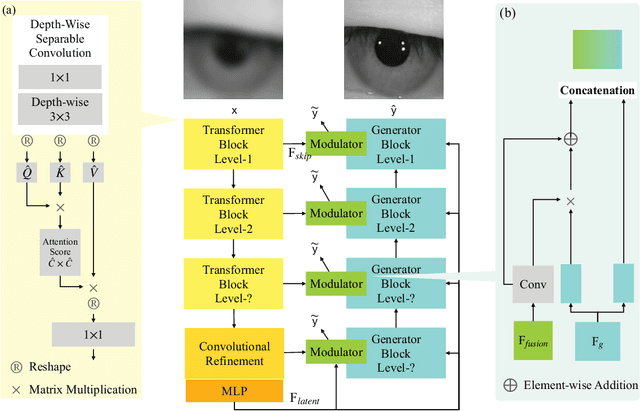
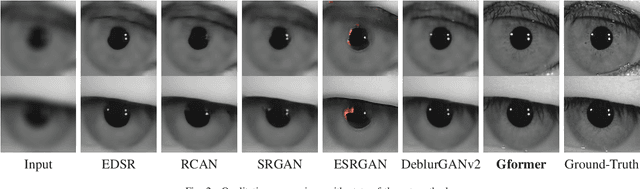
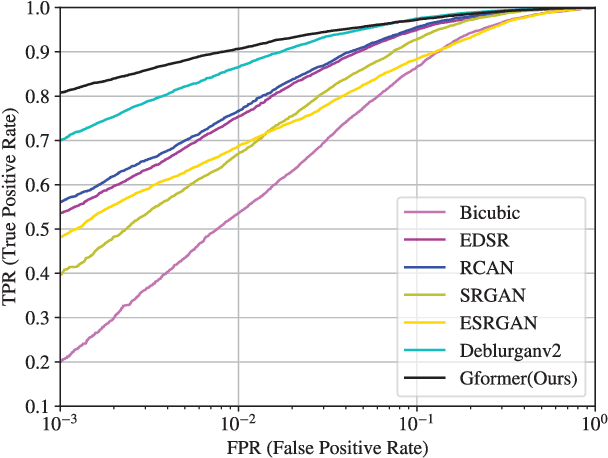
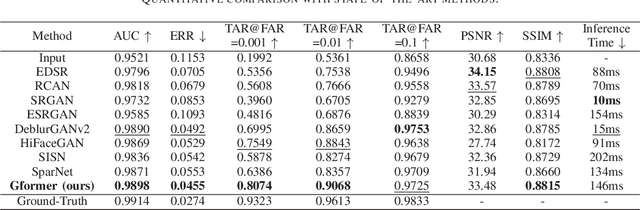
Iris restoration from complexly degraded iris images, aiming to improve iris recognition performance, is a challenging problem. Due to the complex degradation, directly training a convolutional neural network (CNN) without prior cannot yield satisfactory results. In this work, we propose a generative iris prior embedded Transformer model (Gformer), in which we build a hierarchical encoder-decoder network employing Transformer block and generative iris prior. First, we tame Transformer blocks to model long-range dependencies in target images. Second, we pretrain an iris generative adversarial network (GAN) to obtain the rich iris prior, and incorporate it into the iris restoration process with our iris feature modulator. Our experiments demonstrate that the proposed Gformer outperforms state-of-the-art methods. Besides, iris recognition performance has been significantly improved after applying Gformer.
* Our code is available at https://github.com/sawyercharlton/Gformer