 Add to Chrome
 Add to Firefox
 Add to Edge
Are Large Kernels Better Teachers than Transformers for ConvNets?
May 30, 2023
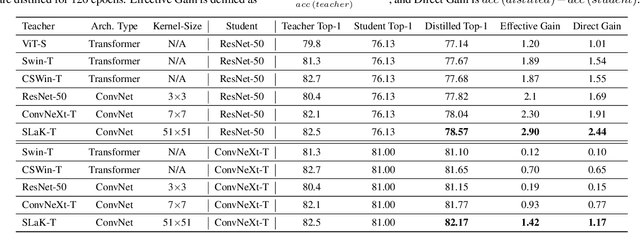
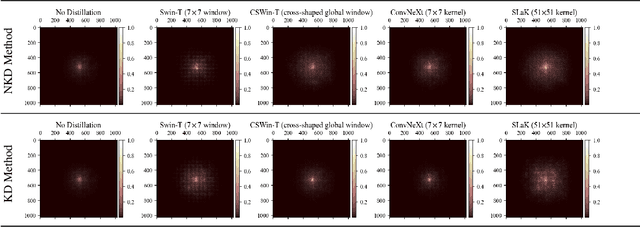
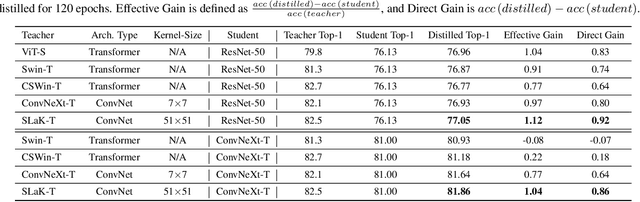
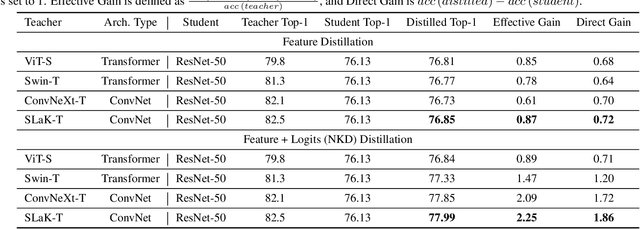
This paper reveals a new appeal of the recently emerged large-kernel Convolutional Neural Networks (ConvNets): as the teacher in Knowledge Distillation (KD) for small-kernel ConvNets. While Transformers have led state-of-the-art (SOTA) performance in various fields with ever-larger models and labeled data, small-kernel ConvNets are considered more suitable for resource-limited applications due to the efficient convolution operation and compact weight sharing. KD is widely used to boost the performance of small-kernel ConvNets. However, previous research shows that it is not quite effective to distill knowledge (e.g., global information) from Transformers to small-kernel ConvNets, presumably due to their disparate architectures. We hereby carry out a first-of-its-kind study unveiling that modern large-kernel ConvNets, a compelling competitor to Vision Transformers, are remarkably more effective teachers for small-kernel ConvNets, due to more similar architectures. Our findings are backed up by extensive experiments on both logit-level and feature-level KD ``out of the box", with no dedicated architectural nor training recipe modifications. Notably, we obtain the \textbf{best-ever pure ConvNet} under 30M parameters with \textbf{83.1\%} top-1 accuracy on ImageNet, outperforming current SOTA methods including ConvNeXt V2 and Swin V2. We also find that beneficial characteristics of large-kernel ConvNets, e.g., larger effective receptive fields, can be seamlessly transferred to students through this large-to-small kernel distillation. Code is available at: \url{https://github.com/VITA-Group/SLaK}.
* Accepted by ICML 2023

Dynamic Sparsity Is Channel-Level Sparsity Learner
May 30, 2023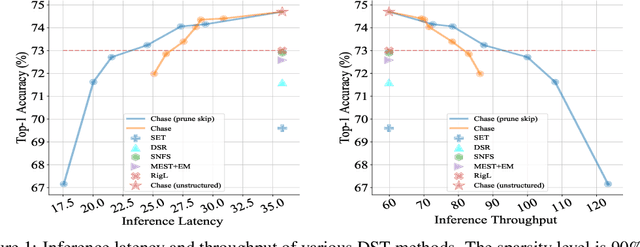
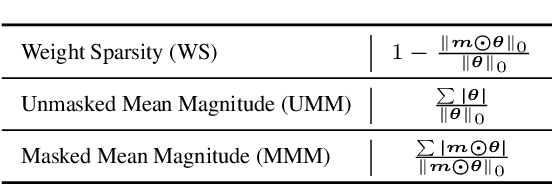
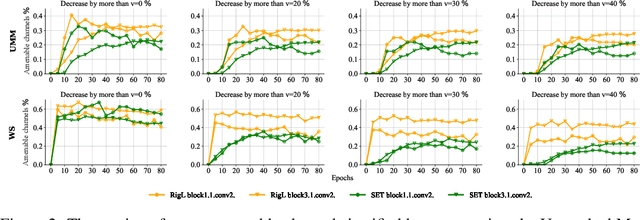
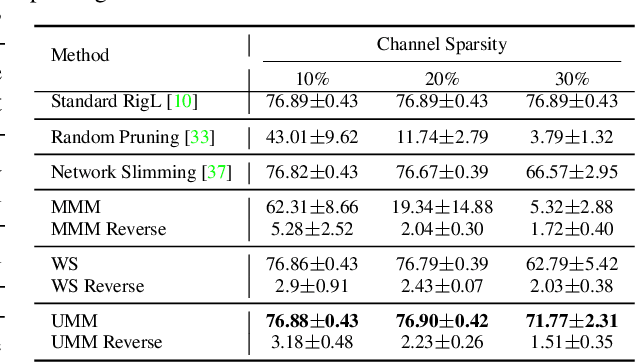
Sparse training has received an upsurging interest in machine learning due to its tantalizing saving potential for the entire training process as well as inference. Dynamic sparse training (DST), as a leading sparse training approach, can train deep neural networks at high sparsity from scratch to match the performance of their dense counterparts. However, most if not all DST prior arts demonstrate their effectiveness on unstructured sparsity with highly irregular sparse patterns, which receives limited support in common hardware. This limitation hinders the usage of DST in practice. In this paper, we propose Channel-aware dynamic sparse (Chase), which for the first time seamlessly translates the promise of unstructured dynamic sparsity to GPU-friendly channel-level sparsity (not fine-grained N:M or group sparsity) during one end-to-end training process, without any ad-hoc operations. The resulting small sparse networks can be directly accelerated by commodity hardware, without using any particularly sparsity-aware hardware accelerators. This appealing outcome is partially motivated by a hidden phenomenon of dynamic sparsity: off-the-shelf unstructured DST implicitly involves biased parameter reallocation across channels, with a large fraction of channels (up to 60\%) being sparser than others. By progressively identifying and removing these channels during training, our approach translates unstructured sparsity to channel-wise sparsity. Our experimental results demonstrate that Chase achieves 1.7 X inference throughput speedup on common GPU devices without compromising accuracy with ResNet-50 on ImageNet. We release our codes in https://github.com/luuyin/chase.
Towards Constituting Mathematical Structures for Learning to Optimize
May 29, 2023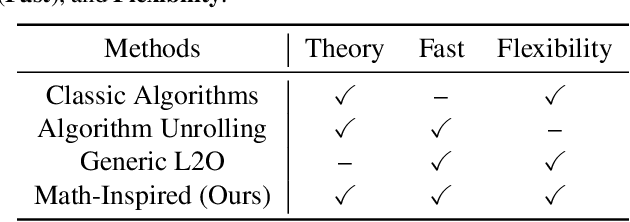
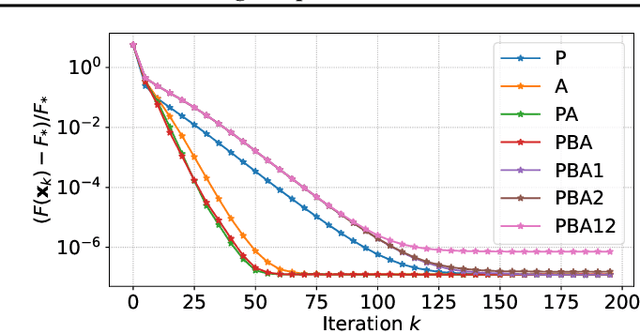

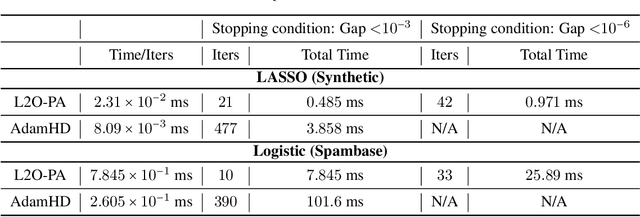
Learning to Optimize (L2O), a technique that utilizes machine learning to learn an optimization algorithm automatically from data, has gained arising attention in recent years. A generic L2O approach parameterizes the iterative update rule and learns the update direction as a black-box network. While the generic approach is widely applicable, the learned model can overfit and may not generalize well to out-of-distribution test sets. In this paper, we derive the basic mathematical conditions that successful update rules commonly satisfy. Consequently, we propose a novel L2O model with a mathematics-inspired structure that is broadly applicable and generalized well to out-of-distribution problems. Numerical simulations validate our theoretical findings and demonstrate the superior empirical performance of the proposed L2O model.
Prompt-Free Diffusion: Taking "Text" out of Text-to-Image Diffusion Models
May 25, 2023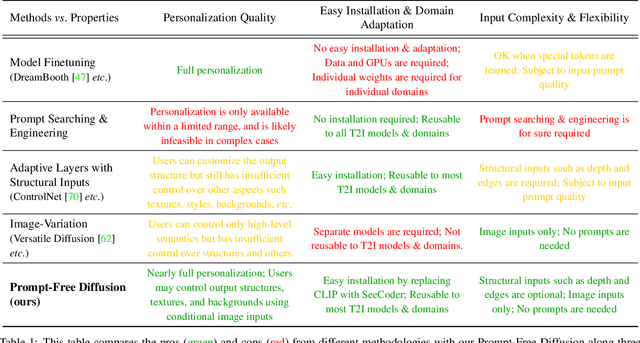
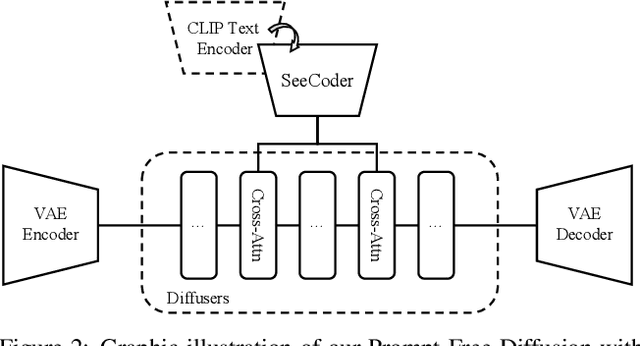
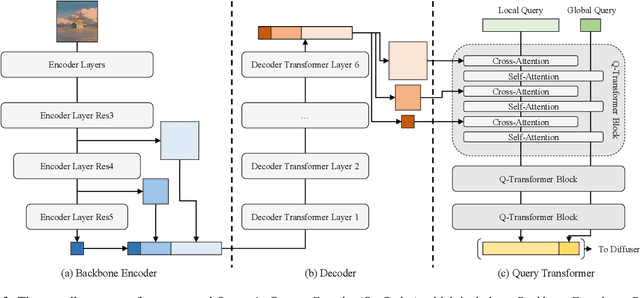
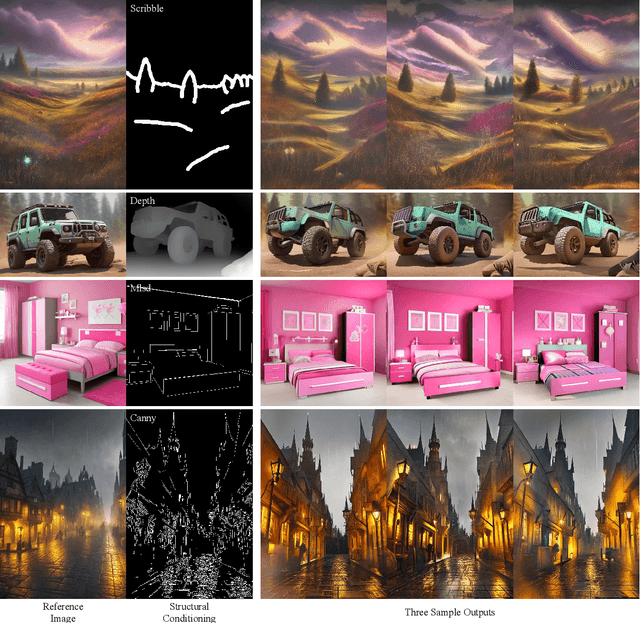
Text-to-image (T2I) research has grown explosively in the past year, owing to the large-scale pre-trained diffusion models and many emerging personalization and editing approaches. Yet, one pain point persists: the text prompt engineering, and searching high-quality text prompts for customized results is more art than science. Moreover, as commonly argued: "an image is worth a thousand words" - the attempt to describe a desired image with texts often ends up being ambiguous and cannot comprehensively cover delicate visual details, hence necessitating more additional controls from the visual domain. In this paper, we take a bold step forward: taking "Text" out of a pre-trained T2I diffusion model, to reduce the burdensome prompt engineering efforts for users. Our proposed framework, Prompt-Free Diffusion, relies on only visual inputs to generate new images: it takes a reference image as "context", an optional image structural conditioning, and an initial noise, with absolutely no text prompt. The core architecture behind the scene is Semantic Context Encoder (SeeCoder), substituting the commonly used CLIP-based or LLM-based text encoder. The reusability of SeeCoder also makes it a convenient drop-in component: one can also pre-train a SeeCoder in one T2I model and reuse it for another. Through extensive experiments, Prompt-Free Diffusion is experimentally found to (i) outperform prior exemplar-based image synthesis approaches; (ii) perform on par with state-of-the-art T2I models using prompts following the best practice; and (iii) be naturally extensible to other downstream applications such as anime figure generation and virtual try-on, with promising quality. Our code and models are open-sourced at https://github.com/SHI-Labs/Prompt-Free-Diffusion.
POPE: 6-DoF Promptable Pose Estimation of Any Object, in Any Scene, with One Reference
May 25, 2023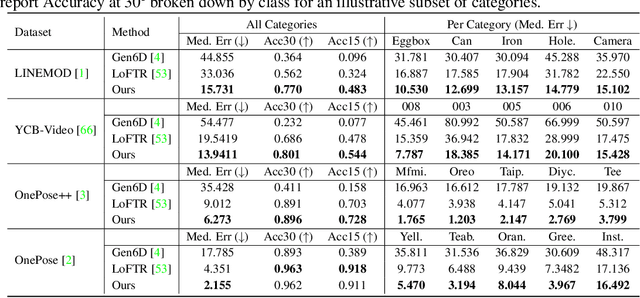
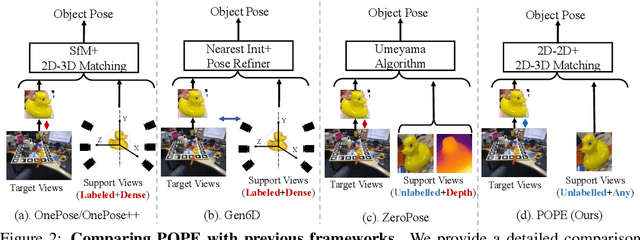

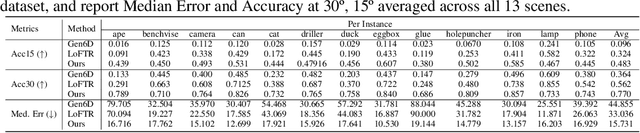
Despite the significant progress in six degrees-of-freedom (6DoF) object pose estimation, existing methods have limited applicability in real-world scenarios involving embodied agents and downstream 3D vision tasks. These limitations mainly come from the necessity of 3D models, closed-category detection, and a large number of densely annotated support views. To mitigate this issue, we propose a general paradigm for object pose estimation, called Promptable Object Pose Estimation (POPE). The proposed approach POPE enables zero-shot 6DoF object pose estimation for any target object in any scene, while only a single reference is adopted as the support view. To achieve this, POPE leverages the power of the pre-trained large-scale 2D foundation model, employs a framework with hierarchical feature representation and 3D geometry principles. Moreover, it estimates the relative camera pose between object prompts and the target object in new views, enabling both two-view and multi-view 6DoF pose estimation tasks. Comprehensive experimental results demonstrate that POPE exhibits unrivaled robust performance in zero-shot settings, by achieving a significant reduction in the averaged Median Pose Error by 52.38% and 50.47% on the LINEMOD and OnePose datasets, respectively. We also conduct more challenging testings in causally captured images (see Figure 1), which further demonstrates the robustness of POPE. Project page can be found with https://paulpanwang.github.io/POPE/.
MMG-Ego4D: Multi-Modal Generalization in Egocentric Action Recognition
May 12, 2023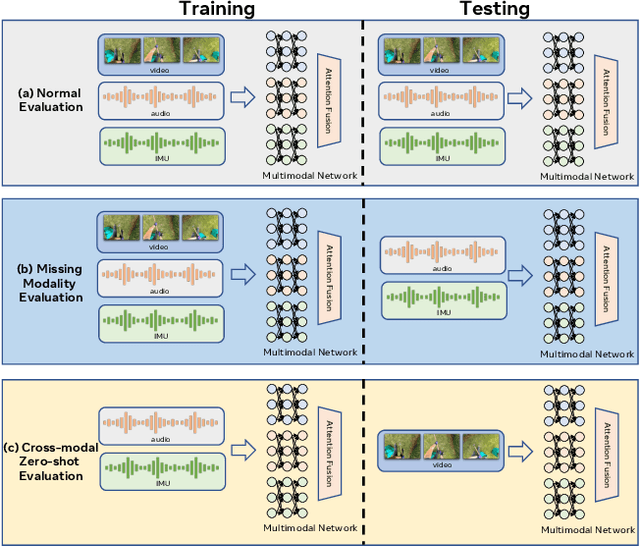
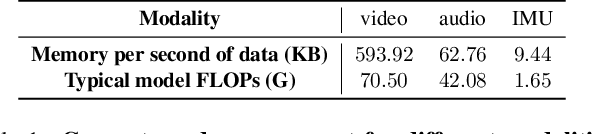
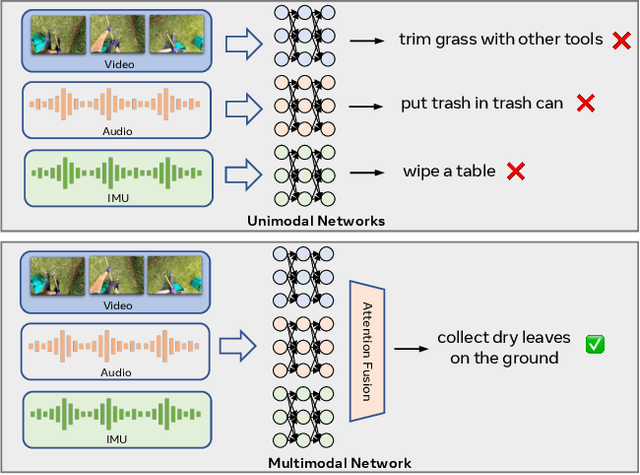
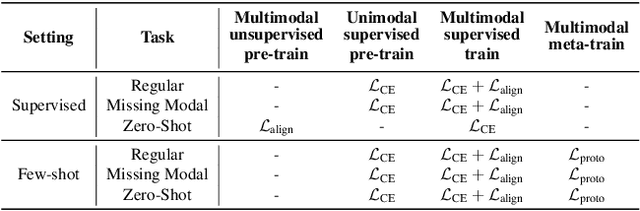
In this paper, we study a novel problem in egocentric action recognition, which we term as "Multimodal Generalization" (MMG). MMG aims to study how systems can generalize when data from certain modalities is limited or even completely missing. We thoroughly investigate MMG in the context of standard supervised action recognition and the more challenging few-shot setting for learning new action categories. MMG consists of two novel scenarios, designed to support security, and efficiency considerations in real-world applications: (1) missing modality generalization where some modalities that were present during the train time are missing during the inference time, and (2) cross-modal zero-shot generalization, where the modalities present during the inference time and the training time are disjoint. To enable this investigation, we construct a new dataset MMG-Ego4D containing data points with video, audio, and inertial motion sensor (IMU) modalities. Our dataset is derived from Ego4D dataset, but processed and thoroughly re-annotated by human experts to facilitate research in the MMG problem. We evaluate a diverse array of models on MMG-Ego4D and propose new methods with improved generalization ability. In particular, we introduce a new fusion module with modality dropout training, contrastive-based alignment training, and a novel cross-modal prototypical loss for better few-shot performance. We hope this study will serve as a benchmark and guide future research in multimodal generalization problems. The benchmark and code will be available at https://github.com/facebookresearch/MMG_Ego4D.
Outline, Then Details: Syntactically Guided Coarse-To-Fine Code Generation
May 08, 2023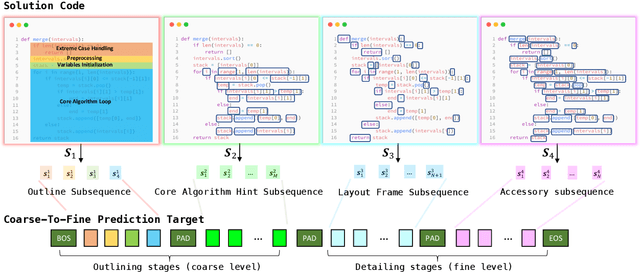
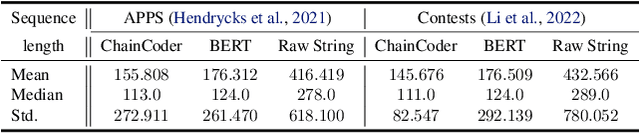
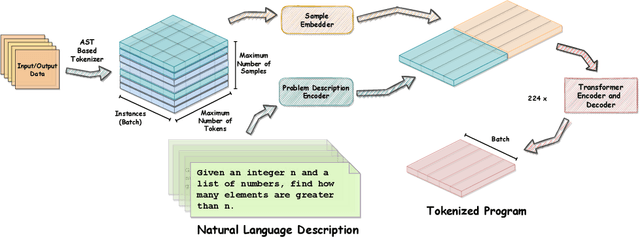
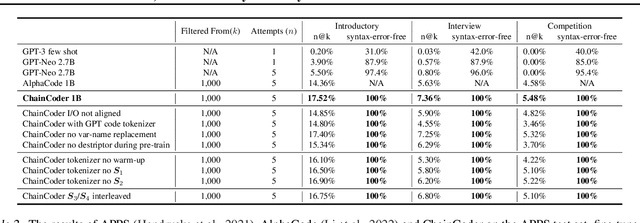
For a complicated algorithm, its implementation by a human programmer usually starts with outlining a rough control flow followed by iterative enrichments, eventually yielding carefully generated syntactic structures and variables in a hierarchy. However, state-of-the-art large language models generate codes in a single pass, without intermediate warm-ups to reflect the structured thought process of "outline-then-detail". Inspired by the recent success of chain-of-thought prompting, we propose ChainCoder, a program synthesis language model that generates Python code progressively, i.e. from coarse to fine in multiple passes. We first decompose source code into layout frame components and accessory components via abstract syntax tree parsing to construct a hierarchical representation. We then reform our prediction target into a multi-pass objective, each pass generates a subsequence, which is concatenated in the hierarchy. Finally, a tailored transformer architecture is leveraged to jointly encode the natural language descriptions and syntactically aligned I/O data samples. Extensive evaluations show that ChainCoder outperforms state-of-the-arts, demonstrating that our progressive generation eases the reasoning procedure and guides the language model to generate higher-quality solutions. Our codes are available at: https://github.com/VITA-Group/ChainCoder.
In-Context Learning Unlocked for Diffusion Models
May 01, 2023We present Prompt Diffusion, a framework for enabling in-context learning in diffusion-based generative models. Given a pair of task-specific example images, such as depth from/to image and scribble from/to image, and a text guidance, our model automatically understands the underlying task and performs the same task on a new query image following the text guidance. To achieve this, we propose a vision-language prompt that can model a wide range of vision-language tasks and a diffusion model that takes it as input. The diffusion model is trained jointly over six different tasks using these prompts. The resulting Prompt Diffusion model is the first diffusion-based vision-language foundation model capable of in-context learning. It demonstrates high-quality in-context generation on the trained tasks and generalizes effectively to new, unseen vision tasks with their respective prompts. Our model also shows compelling text-guided image editing results. Our framework, with code publicly available at https://github.com/Zhendong-Wang/Prompt-Diffusion, aims to facilitate research into in-context learning for computer vision.
Patch Diffusion: Faster and More Data-Efficient Training of Diffusion Models
Apr 25, 2023Diffusion models are powerful, but they require a lot of time and data to train. We propose Patch Diffusion, a generic patch-wise training framework, to significantly reduce the training time costs while improving data efficiency, which thus helps democratize diffusion model training to broader users. At the core of our innovations is a new conditional score function at the patch level, where the patch location in the original image is included as additional coordinate channels, while the patch size is randomized and diversified throughout training to encode the cross-region dependency at multiple scales. Sampling with our method is as easy as in the original diffusion model. Through Patch Diffusion, we could achieve $\mathbf{\ge 2\times}$ faster training, while maintaining comparable or better generation quality. Patch Diffusion meanwhile improves the performance of diffusion models trained on relatively small datasets, $e.g.$, as few as 5,000 images to train from scratch. We achieve state-of-the-art FID scores 1.77 on CelebA-64$\times$64 and 1.93 on AFHQv2-Wild-64$\times$64. We will share our code and pre-trained models soon.
AutoShot: A Short Video Dataset and State-of-the-Art Shot Boundary Detection
Apr 12, 2023The short-form videos have explosive popularity and have dominated the new social media trends. Prevailing short-video platforms,~\textit{e.g.}, Kuaishou (Kwai), TikTok, Instagram Reels, and YouTube Shorts, have changed the way we consume and create content. For video content creation and understanding, the shot boundary detection (SBD) is one of the most essential components in various scenarios. In this work, we release a new public Short video sHot bOundary deTection dataset, named SHOT, consisting of 853 complete short videos and 11,606 shot annotations, with 2,716 high quality shot boundary annotations in 200 test videos. Leveraging this new data wealth, we propose to optimize the model design for video SBD, by conducting neural architecture search in a search space encapsulating various advanced 3D ConvNets and Transformers. Our proposed approach, named AutoShot, achieves higher F1 scores than previous state-of-the-art approaches, e.g., outperforming TransNetV2 by 4.2%, when being derived and evaluated on our newly constructed SHOT dataset. Moreover, to validate the generalizability of the AutoShot architecture, we directly evaluate it on another three public datasets: ClipShots, BBC and RAI, and the F1 scores of AutoShot outperform previous state-of-the-art approaches by 1.1%, 0.9% and 1.2%, respectively. The SHOT dataset and code can be found in https://github.com/wentaozhu/AutoShot.git .