 Add to Chrome
 Add to Firefox
 Add to Edge
ArtAnno: Annotating Implicit Semantics in Artworks through LLM Agent-Driven Bidirectional Human-AI Augmentation
Aug 05, 2026
High-quality annotation of artworks is essential for computational art research, yet extracting implicit semantics remains challenging due to the reliance on culturally grounded meanings and deep contextual knowledge behind the images. Current AI-assisted annotation tools often lack assistance or rely on one-way workflows where experts have to perform extra manual calibrations to improve AI models, resulting in limited efficiency. To address this, we propose Bidirectional Human-AI Augmentation(BiHAA), a closed-loop framework in which skills and domain knowledge base evolve through real-time interaction and bidirectional HAI augmentation. Informed by a formative study with 20 artwork annotators from different backgrounds, we implement this framework in ArtAnno, an artwork annotation system driven by a multi-agent architecture. The system includes a Proactive Agentic Support Module, where AI augments humans through semantic mining and label suggestion, and an Interaction-Driven Evolution Module, where human expertise continuously enhances the AI through distilling annotation trajectories into reusable experience. Evaluation through a user study and two case studies demonstrates that our framework and system improve annotation efficiency, enable knowledge accumulation, and reduce the effort of information seeking and verification for annotators with limited domain expertise. We conclude by discussing broader implications and future directions.

When Graph Tokens Sink: A Mechanistic Analysis of Graph Language Models
Jun 02, 2026Graph Language Models (GLMs) have become a promising direction for adapting Large Language Models (LLMs) to graph learning tasks. By transforming graph topology and node information into graph tokens, GLMs allow LLMs to jointly process structured graph inputs and textual instructions. Yet, it remains unclear how LLMs internally interpret these graph tokens and whether graph tokens act as meaningful carriers of graph structure. In this work, we analyze how LLMs process graph information through graph-token behavior in representative GLM architectures. Findings. We find that the internal saliency of graph tokens in GLMs is not equivalent to graph information utilization. Graph sink tokens consistently emerge as activation-level outliers: they can be identified by massive activation values along a small set of hidden-state dimensions and are biased toward early graph-token positions. However, this activation-level saliency does not imply that these tokens are the main carriers of graph information. Unlike classical attention sinks in language and vision-language models, graph sink tokens do not necessarily attract the largest attention weights from query tokens. Through pruning, repositioning, and swapping interventions, we show that graph sink tokens are not the most important semantic or structural tokens for downstream prediction. Implications. Together, these results suggest that after current GLMs map graph structure into the LLM token space, the resulting graph-token representations do not naturally form a fully usable topology-aware internal representation; instead, they exhibit a decoupling between activation-level saliency and graph-semantic utility. This decoupling points to limitations in existing graph-token construction, placement, and alignment mechanisms.
Revisiting RAG Retrievers: An Information Theoretic Benchmark
Feb 25, 2026Retrieval-Augmented Generation (RAG) systems rely critically on the retriever module to surface relevant context for large language models. Although numerous retrievers have recently been proposed, each built on different ranking principles such as lexical matching, dense embeddings, or graph citations, there remains a lack of systematic understanding of how these mechanisms differ and overlap. Existing benchmarks primarily compare entire RAG pipelines or introduce new datasets, providing little guidance on selecting or combining retrievers themselves. Those that do compare retrievers directly use a limited set of evaluation tools which fail to capture complementary and overlapping strengths. This work presents MIGRASCOPE, a Mutual Information based RAG Retriever Analysis Scope. We revisit state-of-the-art retrievers and introduce principled metrics grounded in information and statistical estimation theory to quantify retrieval quality, redundancy, synergy, and marginal contribution. We further show that if chosen carefully, an ensemble of retrievers outperforms any single retriever. We leverage the developed tools over major RAG corpora to provide unique insights on contribution levels of the state-of-the-art retrievers. Our findings provide a fresh perspective on the structure of modern retrieval techniques and actionable guidance for designing robust and efficient RAG systems.
Explain What You Mean: Intent Augmented Knowledge Graph Recommender Built With LLM
May 16, 2025Interaction sparsity is the primary obstacle for recommendation systems. Sparsity manifests in environments with disproportional cardinality of groupings of entities, such as users and products in an online marketplace. It also is found for newly introduced entities, described as the cold-start problem. Recent efforts to mitigate this sparsity issue shifts the performance bottleneck to other areas in the computational pipeline. Those that focus on enriching sparse representations with connectivity data from other external sources propose methods that are resource demanding and require careful domain expert aided addition of this newly introduced data. Others that turn to Large Language Model (LLM) based recommenders will quickly encounter limitations surrounding data quality and availability. In this work, we propose LLM-based Intent Knowledge Graph Recommender (IKGR), a novel framework that leverages retrieval-augmented generation and an encoding approach to construct and densify a knowledge graph. IKGR learns latent user-item affinities from an interaction knowledge graph and further densifies it through mutual intent connectivity. This addresses sparsity issues and allows the model to make intent-grounded recommendations with an interpretable embedding translation layer. Through extensive experiments on real-world datasets, we demonstrate that IKGR overcomes knowledge gaps and achieves substantial gains over state-of-the-art baselines on both publicly available and our internal recommendation datasets.
Revisiting Zeroth-Order Optimization for Memory-Efficient LLM Fine-Tuning: A Benchmark
Feb 26, 2024

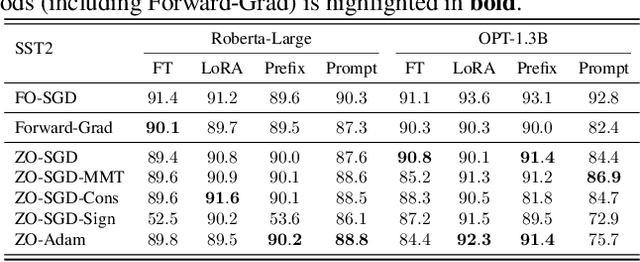
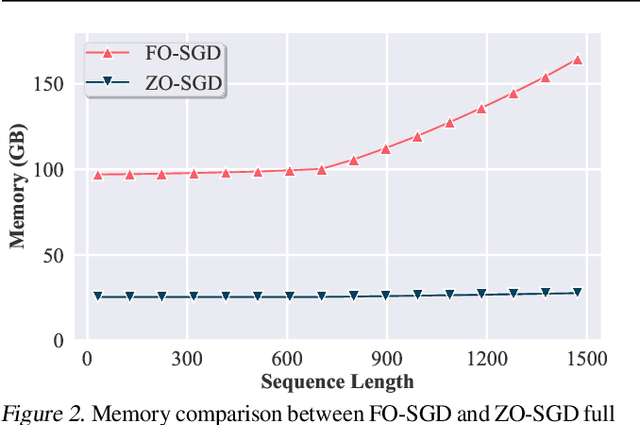
In the evolving landscape of natural language processing (NLP), fine-tuning pre-trained Large Language Models (LLMs) with first-order (FO) optimizers like SGD and Adam has become standard. Yet, as LLMs grow {in size}, the substantial memory overhead from back-propagation (BP) for FO gradient computation presents a significant challenge. Addressing this issue is crucial, especially for applications like on-device training where memory efficiency is paramount. This paper proposes a shift towards BP-free, zeroth-order (ZO) optimization as a solution for reducing memory costs during LLM fine-tuning, building on the initial concept introduced by MeZO. Unlike traditional ZO-SGD methods, our work expands the exploration to a wider array of ZO optimization techniques, through a comprehensive, first-of-its-kind benchmarking study across five LLM families (Roberta, OPT, LLaMA, Vicuna, Mistral), three task complexities, and five fine-tuning schemes. Our study unveils previously overlooked optimization principles, highlighting the importance of task alignment, the role of the forward gradient method, and the balance between algorithm complexity and fine-tuning performance. We further introduce novel enhancements to ZO optimization, including block-wise descent, hybrid training, and gradient sparsity. Our study offers a promising direction for achieving further memory-efficient LLM fine-tuning. Codes to reproduce all our experiments are at https://github.com/ZO-Bench/ZO-LLM .
Outline, Then Details: Syntactically Guided Coarse-To-Fine Code Generation
May 08, 2023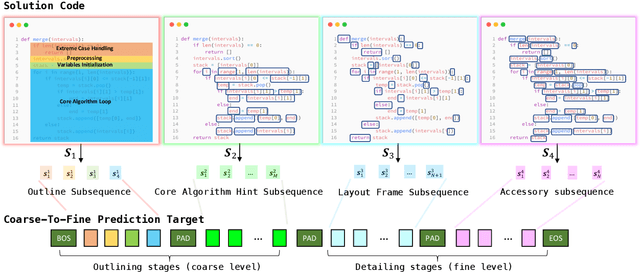
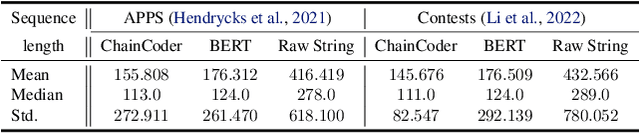
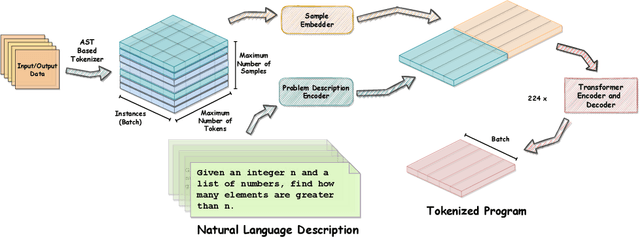
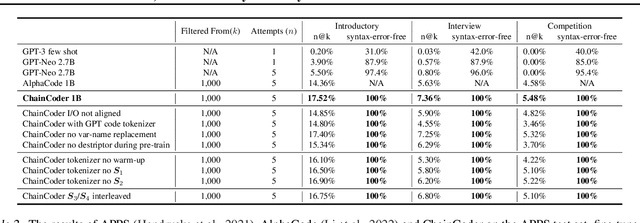
For a complicated algorithm, its implementation by a human programmer usually starts with outlining a rough control flow followed by iterative enrichments, eventually yielding carefully generated syntactic structures and variables in a hierarchy. However, state-of-the-art large language models generate codes in a single pass, without intermediate warm-ups to reflect the structured thought process of "outline-then-detail". Inspired by the recent success of chain-of-thought prompting, we propose ChainCoder, a program synthesis language model that generates Python code progressively, i.e. from coarse to fine in multiple passes. We first decompose source code into layout frame components and accessory components via abstract syntax tree parsing to construct a hierarchical representation. We then reform our prediction target into a multi-pass objective, each pass generates a subsequence, which is concatenated in the hierarchy. Finally, a tailored transformer architecture is leveraged to jointly encode the natural language descriptions and syntactically aligned I/O data samples. Extensive evaluations show that ChainCoder outperforms state-of-the-arts, demonstrating that our progressive generation eases the reasoning procedure and guides the language model to generate higher-quality solutions. Our codes are available at: https://github.com/VITA-Group/ChainCoder.
You Only Transfer What You Share: Intersection-Induced Graph Transfer Learning for Link Prediction
Feb 27, 2023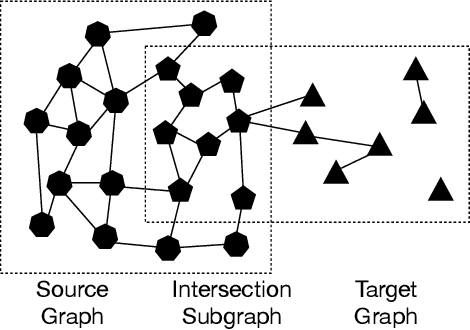
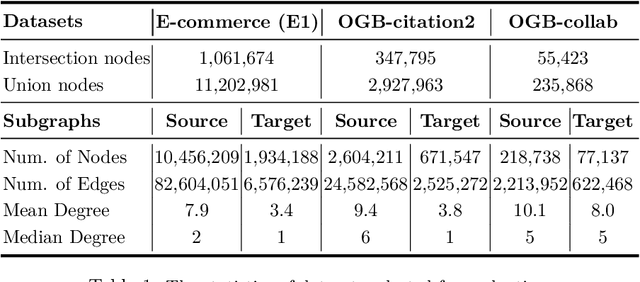
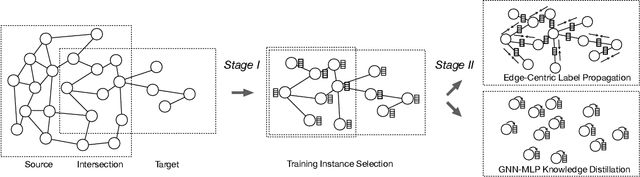
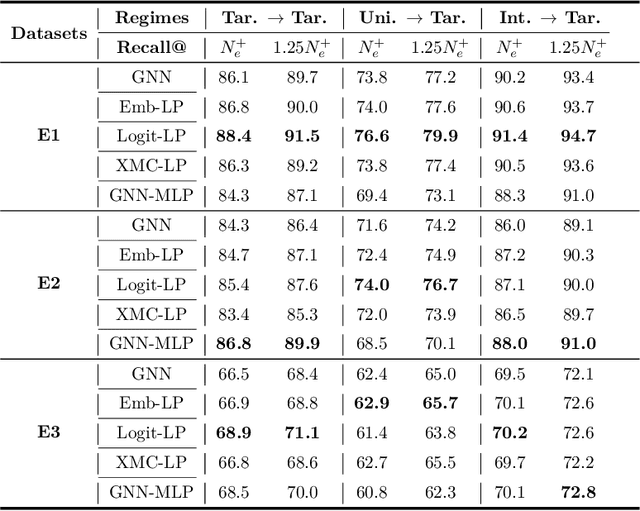
Link prediction is central to many real-world applications, but its performance may be hampered when the graph of interest is sparse. To alleviate issues caused by sparsity, we investigate a previously overlooked phenomenon: in many cases, a densely connected, complementary graph can be found for the original graph. The denser graph may share nodes with the original graph, which offers a natural bridge for transferring meaningful knowledge. We identify this setting as Graph Intersection-induced Transfer Learning (GITL), which is motivated by practical applications in e-commerce or academic co-authorship predictions. We develop a framework to effectively leverage the structural prior in this setting. We first create an intersection subgraph using the shared nodes between the two graphs, then transfer knowledge from the source-enriched intersection subgraph to the full target graph. In the second step, we consider two approaches: a modified label propagation, and a multi-layer perceptron (MLP) model in a teacher-student regime. Experimental results on proprietary e-commerce datasets and open-source citation graphs show that the proposed workflow outperforms existing transfer learning baselines that do not explicitly utilize the intersection structure.
Symbolic Visual Reinforcement Learning: A Scalable Framework with Object-Level Abstraction and Differentiable Expression Search
Dec 30, 2022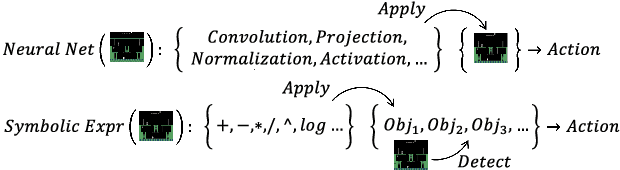
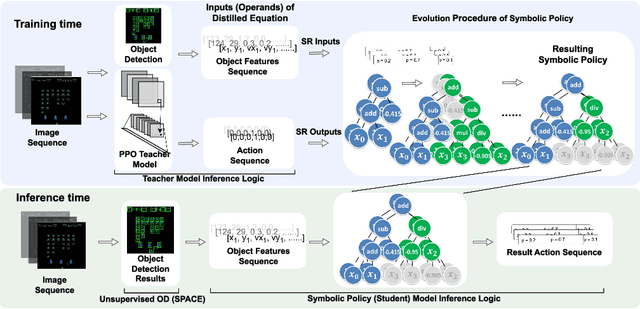
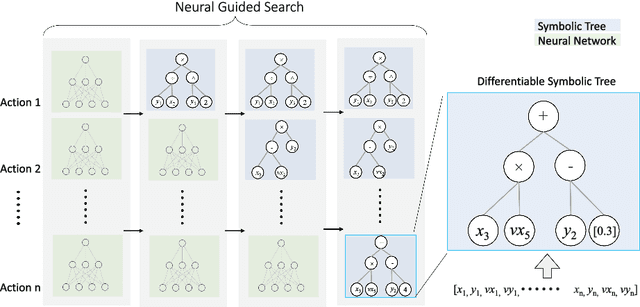
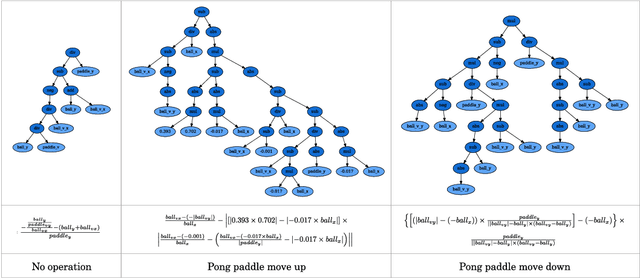
Learning efficient and interpretable policies has been a challenging task in reinforcement learning (RL), particularly in the visual RL setting with complex scenes. While neural networks have achieved competitive performance, the resulting policies are often over-parameterized black boxes that are difficult to interpret and deploy efficiently. More recent symbolic RL frameworks have shown that high-level domain-specific programming logic can be designed to handle both policy learning and symbolic planning. However, these approaches rely on coded primitives with little feature learning, and when applied to high-dimensional visual scenes, they can suffer from scalability issues and perform poorly when images have complex object interactions. To address these challenges, we propose \textit{Differentiable Symbolic Expression Search} (DiffSES), a novel symbolic learning approach that discovers discrete symbolic policies using partially differentiable optimization. By using object-level abstractions instead of raw pixel-level inputs, DiffSES is able to leverage the simplicity and scalability advantages of symbolic expressions, while also incorporating the strengths of neural networks for feature learning and optimization. Our experiments demonstrate that DiffSES is able to generate symbolic policies that are simpler and more and scalable than state-of-the-art symbolic RL methods, with a reduced amount of symbolic prior knowledge.
Search Behavior Prediction: A Hypergraph Perspective
Nov 29, 2022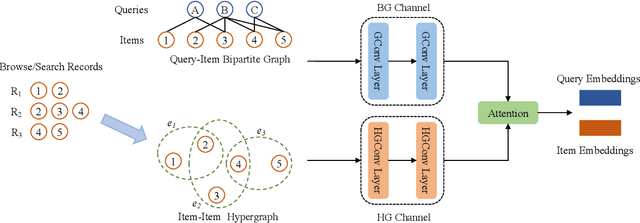
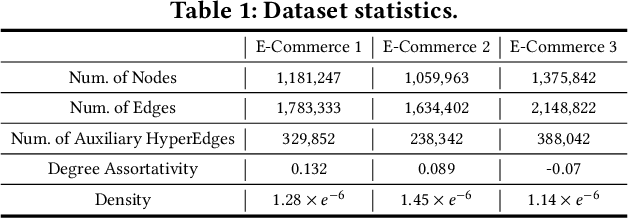
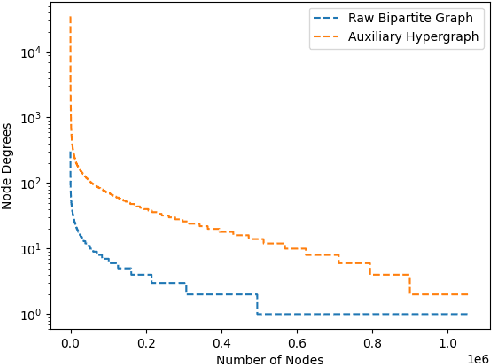
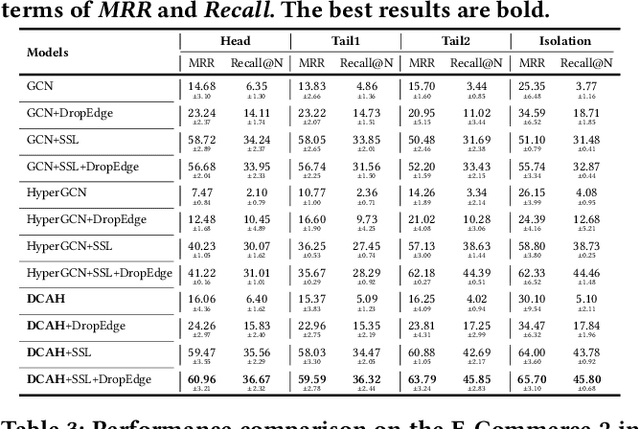
Although the bipartite shopping graphs are straightforward to model search behavior, they suffer from two challenges: 1) The majority of items are sporadically searched and hence have noisy/sparse query associations, leading to a \textit{long-tail} distribution. 2) Infrequent queries are more likely to link to popular items, leading to another hurdle known as \textit{disassortative mixing}. To address these two challenges, we go beyond the bipartite graph to take a hypergraph perspective, introducing a new paradigm that leverages \underline{auxiliary} information from anonymized customer engagement sessions to assist the \underline{main task} of query-item link prediction. This auxiliary information is available at web scale in the form of search logs. We treat all items appearing in the same customer session as a single hyperedge. The hypothesis is that items in a customer session are unified by a common shopping interest. With these hyperedges, we augment the original bipartite graph into a new \textit{hypergraph}. We develop a \textit{\textbf{D}ual-\textbf{C}hannel \textbf{A}ttention-Based \textbf{H}ypergraph Neural Network} (\textbf{DCAH}), which synergizes information from two potentially noisy sources (original query-item edges and item-item hyperedges). In this way, items on the tail are better connected due to the extra hyperedges, thereby enhancing their link prediction performance. We further integrate DCAH with self-supervised graph pre-training and/or DropEdge training, both of which effectively alleviate disassortative mixing. Extensive experiments on three proprietary E-Commerce datasets show that DCAH yields significant improvements of up to \textbf{24.6\% in mean reciprocal rank (MRR)} and \textbf{48.3\% in recall} compared to GNN-based baselines. Our source code is available at \url{https://github.com/amazon-science/dual-channel-hypergraph-neural-network}.
Symbolic Distillation for Learned TCP Congestion Control
Oct 24, 2022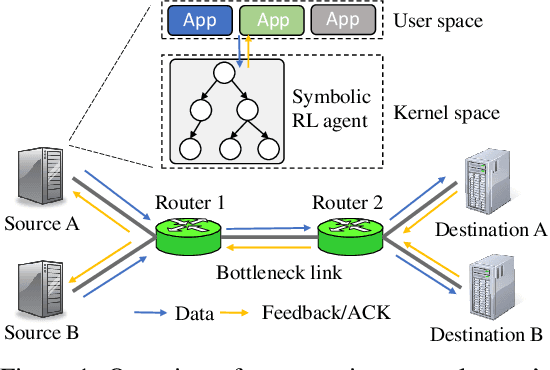
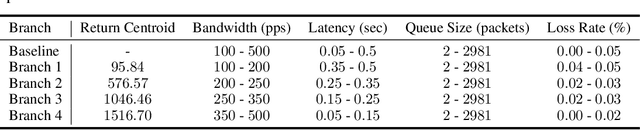
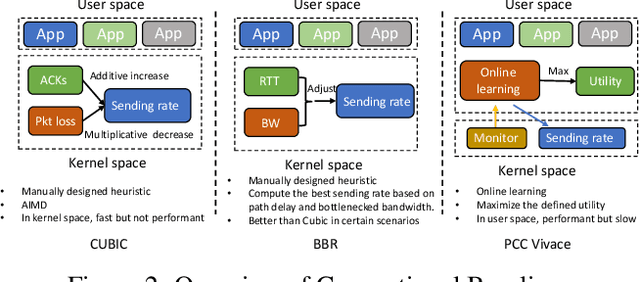
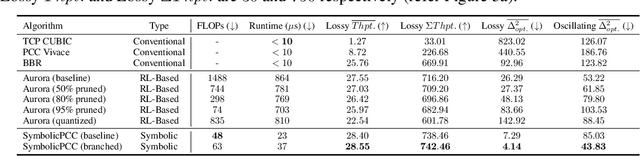
Recent advances in TCP congestion control (CC) have achieved tremendous success with deep reinforcement learning (RL) approaches, which use feedforward neural networks (NN) to learn complex environment conditions and make better decisions. However, such "black-box" policies lack interpretability and reliability, and often, they need to operate outside the traditional TCP datapath due to the use of complex NNs. This paper proposes a novel two-stage solution to achieve the best of both worlds: first to train a deep RL agent, then distill its (over-)parameterized NN policy into white-box, light-weight rules in the form of symbolic expressions that are much easier to understand and to implement in constrained environments. At the core of our proposal is a novel symbolic branching algorithm that enables the rule to be aware of the context in terms of various network conditions, eventually converting the NN policy into a symbolic tree. The distilled symbolic rules preserve and often improve performance over state-of-the-art NN policies while being faster and simpler than a standard neural network. We validate the performance of our distilled symbolic rules on both simulation and emulation environments. Our code is available at https://github.com/VITA-Group/SymbolicPCC.