 Add to Chrome
 Add to Firefox
 Add to Edge
From Search to Synthesis: Training LLMs as Zero-Shot Workflow Generators
Jun 29, 2026
Large language models (LLMs) excel across a wide range of tasks, yet their instance-specific solutions often lack the structural consistency needed for reliable deployment. Workflows that encode recurring algorithmic patterns at the task level provide a principled framework, offering robustness across instance variations, interpretable traces for debugging, and reusability across problem instances. However, manually designing such workflows requires significant expertise and effort, limiting their broader application. While automatic workflow generation could address this bottleneck, existing methods either produce instance-specific solutions without learning task-level patterns, or cannot generalize beyond their training configurations. We present MetaFlow, which casts workflow generation as a meta-learning problem: given a task and an operator set, the model learns to compose solution strategies. MetaFlow trains in two stages: supervised fine-tuning on synthetic workflow data, followed by reinforcement learning with verifiable rewards (RLVR) that uses execution feedback across problem instances in the task to improve end-to-end success. The resulting model produces effective workflows for trained tasks and exhibits strong generalization to untrained tasks and novel operator sets. Across benchmarks in question answering, code generation, and mathematical reasoning, MetaFlow achieves performance comparable to state-of-the-art baselines on in-domain tasks with single inference, while demonstrating remarkable zero-shot generalization capabilities on out-of-domain tasks and operator sets.

Powering Up Zeroth-Order Training via Subspace Gradient Orthogonalization
Feb 19, 2026Zeroth-order (ZO) optimization provides a gradient-free alternative to first-order (FO) methods by estimating gradients via finite differences of function evaluations, and has recently emerged as a memory-efficient paradigm for fine-tuning large-scale models by avoiding backpropagation. However, ZO optimization has a fundamental tension between accuracy and query efficiency. In this work, we show that ZO optimization can be substantially improved by unifying two complementary principles: (i) a projection-based subspace view that reduces gradient estimation variance by exploiting the intrinsic low-rank structure of model updates, and (ii) Muon-style spectral optimization that applies gradient orthogonalization to extract informative spectral structure from noisy ZO gradients. These findings form a unified framework of subspace gradient orthogonalization, which we instantiate in a new method, ZO-Muon, admitting a natural interpretation as a low-rank Muon optimizer in the ZO setting. Extensive experiments on large language models (LLMs) and vision transformers (ViTs) demonstrate that ZO-Muon significantly accelerates convergence and achieves a win-win improvement in accuracy and query/runtime efficiency. Notably, compared to the popular MeZO baseline, ZO-Muon requires only 24.7% of the queries to reach the same SST-2 performance for LLM fine-tuning, and improves accuracy by 25.1% on ViT-B fine-tuning on CIFAR-100.
DeepVision-103K: A Visually Diverse, Broad-Coverage, and Verifiable Mathematical Dataset for Multimodal Reasoning
Feb 18, 2026Reinforcement Learning with Verifiable Rewards (RLVR) has been shown effective in enhancing the visual reflection and reasoning capabilities of Large Multimodal Models (LMMs). However, existing datasets are predominantly derived from either small-scale manual construction or recombination of prior resources, which limits data diversity and coverage, thereby constraining further gains in model performance. To this end, we introduce \textbf{DeepVision-103K}, a comprehensive dataset for RLVR training that covers diverse K12 mathematical topics, extensive knowledge points, and rich visual elements. Models trained on DeepVision achieve strong performance on multimodal mathematical benchmarks, and generalize effectively to general multimodal reasoning tasks. Further analysis reveals enhanced visual perception, reflection and reasoning capabilities in trained models, validating DeepVision's effectiveness for advancing multimodal reasoning. Data: \href{https://huggingface.co/datasets/skylenage/DeepVision-103K}{this url}.
Exploration vs Exploitation: Rethinking RLVR through Clipping, Entropy, and Spurious Reward
Dec 21, 2025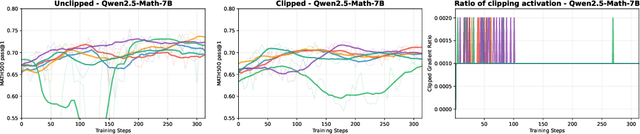
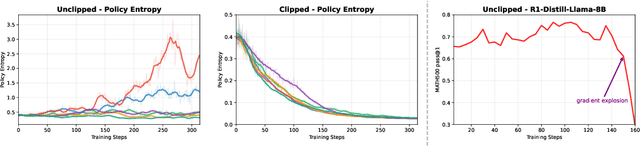

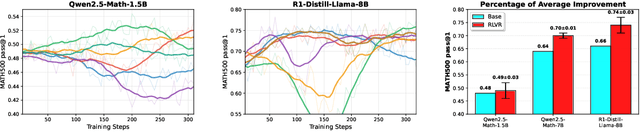
This paper examines the exploration-exploitation trade-off in reinforcement learning with verifiable rewards (RLVR), a framework for improving the reasoning of Large Language Models (LLMs). Recent studies suggest that RLVR can elicit strong mathematical reasoning in LLMs through two seemingly paradoxical mechanisms: spurious rewards, which suppress exploitation by rewarding outcomes unrelated to the ground truth, and entropy minimization, which suppresses exploration by pushing the model toward more confident and deterministic outputs, highlighting a puzzling dynamic: both discouraging exploitation and discouraging exploration improve reasoning performance, yet the underlying principles that reconcile these effects remain poorly understood. We focus on two fundamental questions: (i) how policy entropy relates to performance, and (ii) whether spurious rewards yield gains, potentially through the interplay of clipping bias and model contamination. Our results show that clipping bias under spurious rewards reduces policy entropy, leading to more confident and deterministic outputs, while entropy minimization alone is insufficient for improvement. We further propose a reward-misalignment model explaining why spurious rewards can enhance performance beyond contaminated settings. Our findings clarify the mechanisms behind spurious-reward benefits and provide principles for more effective RLVR training.
ComPO: Preference Alignment via Comparison Oracles
May 08, 2025
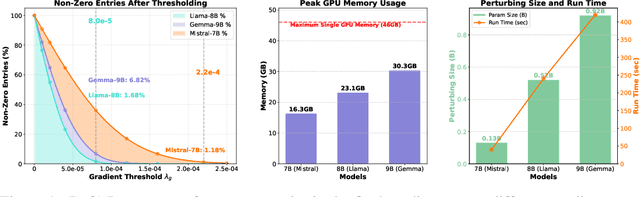
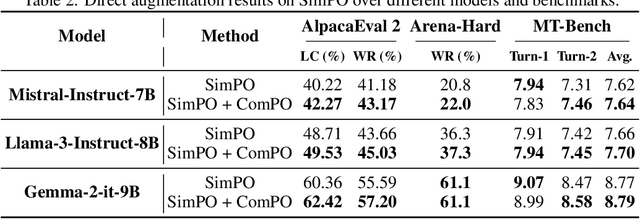
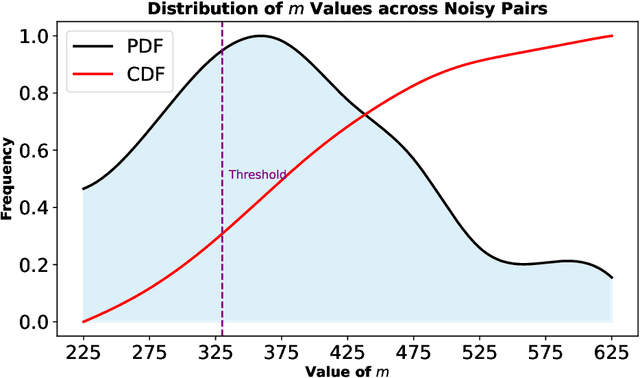
Direct alignment methods are increasingly used for aligning large language models (LLMs) with human preferences. However, these methods suffer from the issues of verbosity and likelihood displacement, which can be driven by the noisy preference pairs that induce similar likelihood for preferred and dispreferred responses. The contributions of this paper are two-fold. First, we propose a new preference alignment method based on comparison oracles and provide the convergence guarantee for its basic scheme. Second, we improve our method using some heuristics and conduct the experiments to demonstrate the flexibility and compatibility of practical scheme in improving the performance of LLMs using noisy preference pairs. Evaluations are conducted across multiple base and instruction-tuned models (Mistral-7B, Llama-3-8B and Gemma-2-9B) with benchmarks (AlpacaEval 2, MT-Bench and Arena-Hard). Experimental results show the effectiveness of our method as an alternative to addressing the limitations of existing direct alignment methods. A highlight of our work is that we evidence the importance of designing specialized methods for preference pairs with distinct likelihood margin, which complements the recent findings in \citet{Razin-2025-Unintentional}.
SymAgent: A Neural-Symbolic Self-Learning Agent Framework for Complex Reasoning over Knowledge Graphs
Feb 05, 2025Recent advancements have highlighted that Large Language Models (LLMs) are prone to hallucinations when solving complex reasoning problems, leading to erroneous results. To tackle this issue, researchers incorporate Knowledge Graphs (KGs) to improve the reasoning ability of LLMs. However, existing methods face two limitations: 1) they typically assume that all answers to the questions are contained in KGs, neglecting the incompleteness issue of KGs, and 2) they treat the KG as a static repository and overlook the implicit logical reasoning structures inherent in KGs. In this paper, we introduce SymAgent, an innovative neural-symbolic agent framework that achieves collaborative augmentation between KGs and LLMs. We conceptualize KGs as dynamic environments and transform complex reasoning tasks into a multi-step interactive process, enabling KGs to participate deeply in the reasoning process. SymAgent consists of two modules: Agent-Planner and Agent-Executor. The Agent-Planner leverages LLM's inductive reasoning capability to extract symbolic rules from KGs, guiding efficient question decomposition. The Agent-Executor autonomously invokes predefined action tools to integrate information from KGs and external documents, addressing the issues of KG incompleteness. Furthermore, we design a self-learning framework comprising online exploration and offline iterative policy updating phases, enabling the agent to automatically synthesize reasoning trajectories and improve performance. Experimental results demonstrate that SymAgent with weak LLM backbones (i.e., 7B series) yields better or comparable performance compared to various strong baselines. Further analysis reveals that our agent can identify missing triples, facilitating automatic KG updates.
Deeply Learned Robust Matrix Completion for Large-scale Low-rank Data Recovery
Dec 31, 2024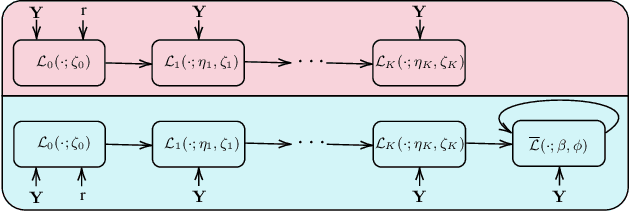
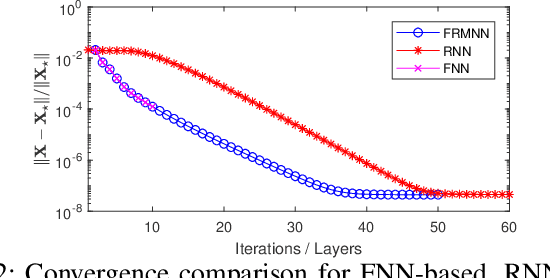
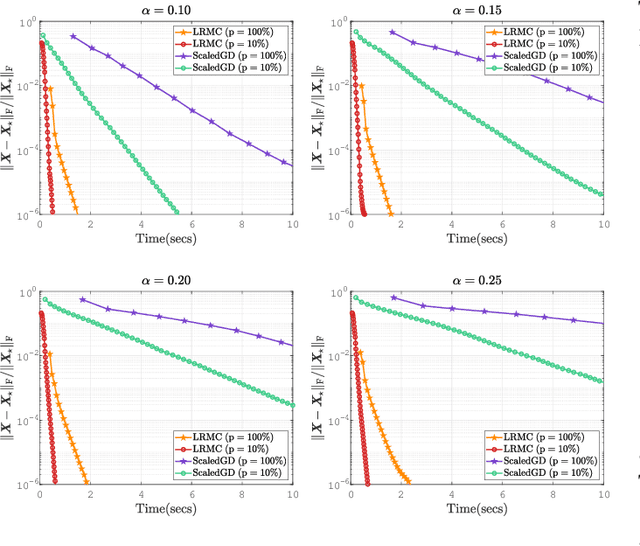
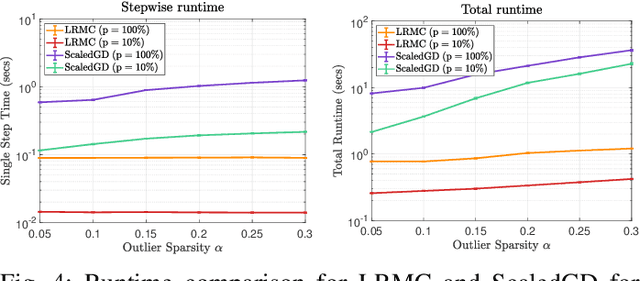
Robust matrix completion (RMC) is a widely used machine learning tool that simultaneously tackles two critical issues in low-rank data analysis: missing data entries and extreme outliers. This paper proposes a novel scalable and learnable non-convex approach, coined Learned Robust Matrix Completion (LRMC), for large-scale RMC problems. LRMC enjoys low computational complexity with linear convergence. Motivated by the proposed theorem, the free parameters of LRMC can be effectively learned via deep unfolding to achieve optimum performance. Furthermore, this paper proposes a flexible feedforward-recurrent-mixed neural network framework that extends deep unfolding from fix-number iterations to infinite iterations. The superior empirical performance of LRMC is verified with extensive experiments against state-of-the-art on synthetic datasets and real applications, including video background subtraction, ultrasound imaging, face modeling, and cloud removal from satellite imagery.
S$^3$Attention: Improving Long Sequence Attention with Smoothed Skeleton Sketching
Aug 16, 2024Attention based models have achieved many remarkable breakthroughs in numerous applications. However, the quadratic complexity of Attention makes the vanilla Attention based models hard to apply to long sequence tasks. Various improved Attention structures are proposed to reduce the computation cost by inducing low rankness and approximating the whole sequence by sub-sequences. The most challenging part of those approaches is maintaining the proper balance between information preservation and computation reduction: the longer sub-sequences used, the better information is preserved, but at the price of introducing more noise and computational costs. In this paper, we propose a smoothed skeleton sketching based Attention structure, coined S$^3$Attention, which significantly improves upon the previous attempts to negotiate this trade-off. S$^3$Attention has two mechanisms to effectively minimize the impact of noise while keeping the linear complexity to the sequence length: a smoothing block to mix information over long sequences and a matrix sketching method that simultaneously selects columns and rows from the input matrix. We verify the effectiveness of S$^3$Attention both theoretically and empirically. Extensive studies over Long Range Arena (LRA) datasets and six time-series forecasting show that S$^3$Attention significantly outperforms both vanilla Attention and other state-of-the-art variants of Attention structures.
Solving General Natural-Language-Description Optimization Problems with Large Language Models
Jul 09, 2024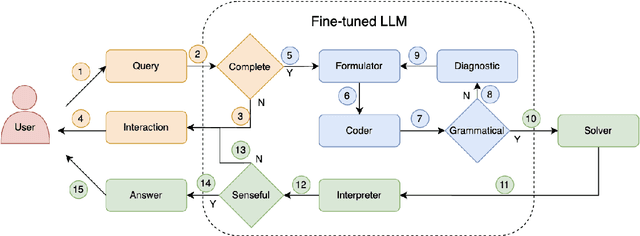
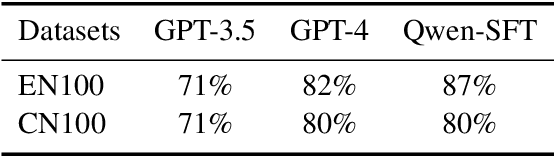

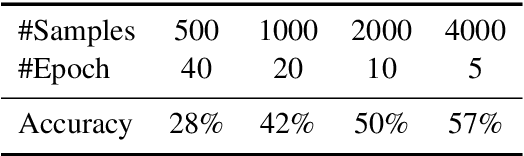
Optimization problems seek to find the best solution to an objective under a set of constraints, and have been widely investigated in real-world applications. Modeling and solving optimization problems in a specific domain typically require a combination of domain knowledge, mathematical skills, and programming ability, making it difficult for general users and even domain professionals. In this paper, we propose a novel framework called OptLLM that augments LLMs with external solvers. Specifically, OptLLM accepts user queries in natural language, convert them into mathematical formulations and programming codes, and calls the solvers to calculate the results for decision-making. In addition, OptLLM supports multi-round dialogues to gradually refine the modeling and solving of optimization problems. To illustrate the effectiveness of OptLLM, we provide tutorials on three typical optimization applications and conduct experiments on both prompt-based GPT models and a fine-tuned Qwen model using a large-scale selfdeveloped optimization dataset. Experimental results show that OptLLM works with various LLMs, and the fine-tuned model achieves an accuracy boost compared to the promptbased models. Some features of OptLLM framework have been available for trial since June 2023 (https://opt.alibabacloud.com/chat or https://opt.aliyun.com/chat).
Expressive Power of Graph Neural Networks for Quadratic Programs
Jun 09, 2024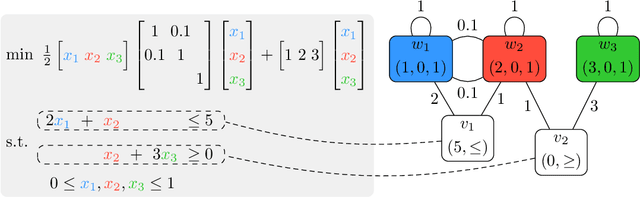


Quadratic programming (QP) is the most widely applied category of problems in nonlinear programming. Many applications require real-time/fast solutions, though not necessarily with high precision. Existing methods either involve matrix decomposition or use the preconditioned conjugate gradient method. For relatively large instances, these methods cannot achieve the real-time requirement unless there is an effective precondition. Recently, graph neural networks (GNNs) opened new possibilities for QP. Some promising empirical studies of applying GNNs for QP tasks show that GNNs can capture key characteristics of an optimization instance and provide adaptive guidance accordingly to crucial configurations during the solving process, or directly provide an approximate solution. Despite notable empirical observations, theoretical foundations are still lacking. In this work, we investigate the expressive or representative power of GNNs, a crucial aspect of neural network theory, specifically in the context of QP tasks, with both continuous and mixed-integer settings. We prove the existence of message-passing GNNs that can reliably represent key properties of quadratic programs, including feasibility, optimal objective value, and optimal solution. Our theory is validated by numerical results.