 Add to Chrome
 Add to Firefox
 Add to Edge
DiTango: Cost-Effective Parallel Diffusion Generation with Selective Attention State Reuse
Jul 17, 2026
Recent advances in AI-generated content have driven widespread adoption of Diffusion Transformers (DiTs) for high-resolution, long-duration content generation. While parallelization techniques accelerate diffusion inference, they face significant scalability challenges due to excessive communication overhead in multi-node environments. We observe that sequence partitions in Context Parallelism (CP) exhibit distinct heterogeneity: spatially proximate partitions contribute more significantly to attention computation results. By mapping this heterogeneous pattern to hierarchical communication topology, we can access high-contribution partitions with reduced communication cost. This insight motivates our novel selective attention state mechanism that strategically balances partial attention computation and historical result reuse across denoising steps. We present DiTango, an efficient parallel framework for DiT generation. DiTango features an anchor-guided state selection planner that optimizes computation-reuse decisions for each partition, complemented by a runtime that orchestrates efficient state-centric operations. This design achieves superior system efficiency while preserving generation quality. Experimental evaluation on popular diffusion models demonstrates that DiTango achieves up to 1.9x end-to-end and 3.2x attention speedup with near-linear scaling in multi-node settings, while maintaining generation quality comparable to state-of-the-art approaches.

WebRetriever: A Large-Scale Comprehensive Benchmark for Efficient Web Agent Evaluation
Jul 07, 2026As web agents increasingly demonstrate capabilities in automated task execution, the development of robust evaluation frameworks for assessing their navigation and task completion performance has emerged as a critical research priority. However, existing benchmarks exhibit fundamental limitations. First, they suffer from insufficient scale and limited domain diversity, constraining comprehensive evaluation of cross-domain generalization. Second, prevailing LLM-as-Judge evaluation methodologies inadequately capture fine-grained interaction semantics, particularly regarding precise query formulation and filtering operations. Third, current benchmarks predominantly emphasize navigation success metrics while neglecting critical requirements for real-world deployment scenarios. To address these limitations, we introduce WebRetriever, a large-scale benchmark encompassing 800 websites and 1,550 tasks across diverse domains, including consumer, professional, and enterprise sectors, with comprehensive coverage of user intent patterns. We propose NavEval (Navigation Evaluation), a novel LLM-as-Judge framework that leverages rich interaction context beyond visual screenshots, achieving state-of-the-art alignment with human judgment across multiple evaluation datasets. Furthermore, we establish three complementary evaluation protocols that collectively provide holistic assessment of web agent capabilities: navigation proficiency, knowledge-assisted interaction, and end-to-end task completion with information extraction. Extensive experimental analysis reveals substantial performance disparities across evaluation protocols, demonstrating that navigation success alone is an insufficient predictor of real-world application effectiveness. WebRetriever delivers fine-grained diagnostic insights into agent capabilities and establishes a rigorous foundation for advancing web agent research and development.
C$^2$T: Captioning-Structure and LLM-Aligned Common-Sense Reward Learning for Traffic--Vehicle Coordination
Apr 10, 2026State-of-the-art (SOTA) urban traffic control increasingly employs Multi-Agent Reinforcement Learning (MARL) to coordinate Traffic Light Controllers (TLCs) and Connected Autonomous Vehicles (CAVs). However, the performance of these systems is fundamentally capped by their hand-crafted, myopic rewards (e.g., intersection pressure), which fail to capture high-level, human-centric goals like safety, flow stability, and comfort. To overcome this limitation, we introduce C2T, a novel framework that learns a common-sense coordination model from traffic-vehicle dynamics. C2T distills "common-sense" knowledge from a Large Language Model (LLM) into a learned intrinsic reward function. This new reward is then used to guide the coordination policy of a cooperative multi-intersection TLC MARL system on CityFlow-based multi-intersection benchmarks. Our framework significantly outperforms strong MARL baselines in traffic efficiency, safety, and an energy-related proxy. We further highlight C2T's flexibility in principle, allowing distinct "efficiency-focused" versus "safety-focused" policies by modifying the LLM prompt.
Jano: Adaptive Diffusion Generation with Early-stage Convergence Awareness
Feb 28, 2026Diffusion models have achieved remarkable success in generative AI, yet their computational efficiency remains a significant challenge, particularly for Diffusion Transformers (DiTs) requiring intensive full-attention computation. While existing acceleration approaches focus on content-agnostic uniform optimization strategies, we observe that different regions in generated content exhibit heterogeneous convergence patterns during the denoising process. We present Jano, a training-free framework that leverages this insight for efficient region-aware generation. Jano introduces an early-stage complexity recognition algorithm that accurately identifies regional convergence requirements within initial denoising steps, coupled with an adaptive token scheduling runtime that optimizes computational resource allocation. Through comprehensive evaluation on state-of-the-art models, Jano achieves substantial acceleration (average 2.0 times speedup, up to 2.4 times) while preserving generation quality. Our work challenges conventional uniform processing assumptions and provides a practical solution for accelerating large-scale content generation. The source code of our implementation is available at https://github.com/chen-yy20/Jano.
DM0: An Embodied-Native Vision-Language-Action Model towards Physical AI
Feb 16, 2026Moving beyond the traditional paradigm of adapting internet-pretrained models to physical tasks, we present DM0, an Embodied-Native Vision-Language-Action (VLA) framework designed for Physical AI. Unlike approaches that treat physical grounding as a fine-tuning afterthought, DM0 unifies embodied manipulation and navigation by learning from heterogeneous data sources from the onset. Our methodology follows a comprehensive three-stage pipeline: Pretraining, Mid-Training, and Post-Training. First, we conduct large-scale unified pretraining on the Vision-Language Model (VLM) using diverse corpora--seamlessly integrating web text, autonomous driving scenarios, and embodied interaction logs-to jointly acquire semantic knowledge and physical priors. Subsequently, we build a flow-matching action expert atop the VLM. To reconcile high-level reasoning with low-level control, DM0 employs a hybrid training strategy: for embodied data, gradients from the action expert are not backpropagated to the VLM to preserve generalized representations, while the VLM remains trainable on non-embodied data. Furthermore, we introduce an Embodied Spatial Scaffolding strategy to construct spatial Chain-of-Thought (CoT) reasoning, effectively constraining the action solution space. Experiments on the RoboChallenge benchmark demonstrate that DM0 achieves state-of-the-art performance in both Specialist and Generalist settings on Table30.
Step 3.5 Flash: Open Frontier-Level Intelligence with 11B Active Parameters
Feb 11, 2026We introduce Step 3.5 Flash, a sparse Mixture-of-Experts (MoE) model that bridges frontier-level agentic intelligence and computational efficiency. We focus on what matters most when building agents: sharp reasoning and fast, reliable execution. Step 3.5 Flash pairs a 196B-parameter foundation with 11B active parameters for efficient inference. It is optimized with interleaved 3:1 sliding-window/full attention and Multi-Token Prediction (MTP-3) to reduce the latency and cost of multi-round agentic interactions. To reach frontier-level intelligence, we design a scalable reinforcement learning framework that combines verifiable signals with preference feedback, while remaining stable under large-scale off-policy training, enabling consistent self-improvement across mathematics, code, and tool use. Step 3.5 Flash demonstrates strong performance across agent, coding, and math tasks, achieving 85.4% on IMO-AnswerBench, 86.4% on LiveCodeBench-v6 (2024.08-2025.05), 88.2% on tau2-Bench, 69.0% on BrowseComp (with context management), and 51.0% on Terminal-Bench 2.0, comparable to frontier models such as GPT-5.2 xHigh and Gemini 3.0 Pro. By redefining the efficiency frontier, Step 3.5 Flash provides a high-density foundation for deploying sophisticated agents in real-world industrial environments.
STEP3-VL-10B Technical Report
Jan 15, 2026We present STEP3-VL-10B, a lightweight open-source foundation model designed to redefine the trade-off between compact efficiency and frontier-level multimodal intelligence. STEP3-VL-10B is realized through two strategic shifts: first, a unified, fully unfrozen pre-training strategy on 1.2T multimodal tokens that integrates a language-aligned Perception Encoder with a Qwen3-8B decoder to establish intrinsic vision-language synergy; and second, a scaled post-training pipeline featuring over 1k iterations of reinforcement learning. Crucially, we implement Parallel Coordinated Reasoning (PaCoRe) to scale test-time compute, allocating resources to scalable perceptual reasoning that explores and synthesizes diverse visual hypotheses. Consequently, despite its compact 10B footprint, STEP3-VL-10B rivals or surpasses models 10$\times$-20$\times$ larger (e.g., GLM-4.6V-106B, Qwen3-VL-235B) and top-tier proprietary flagships like Gemini 2.5 Pro and Seed-1.5-VL. Delivering best-in-class performance, it records 92.2% on MMBench and 80.11% on MMMU, while excelling in complex reasoning with 94.43% on AIME2025 and 75.95% on MathVision. We release the full model suite to provide the community with a powerful, efficient, and reproducible baseline.
HARDMath2: A Benchmark for Applied Mathematics Built by Students as Part of a Graduate Class
May 17, 2025Large language models (LLMs) have shown remarkable progress in mathematical problem-solving, but evaluation has largely focused on problems that have exact analytical solutions or involve formal proofs, often overlooking approximation-based problems ubiquitous in applied science and engineering. To fill this gap, we build on prior work and present HARDMath2, a dataset of 211 original problems covering the core topics in an introductory graduate applied math class, including boundary-layer analysis, WKB methods, asymptotic solutions of nonlinear partial differential equations, and the asymptotics of oscillatory integrals. This dataset was designed and verified by the students and instructors of a core graduate applied mathematics course at Harvard. We build the dataset through a novel collaborative environment that challenges students to write and refine difficult problems consistent with the class syllabus, peer-validate solutions, test different models, and automatically check LLM-generated solutions against their own answers and numerical ground truths. Evaluation results show that leading frontier models still struggle with many of the problems in the dataset, highlighting a gap in the mathematical reasoning skills of current LLMs. Importantly, students identified strategies to create increasingly difficult problems by interacting with the models and exploiting common failure modes. This back-and-forth with the models not only resulted in a richer and more challenging benchmark but also led to qualitative improvements in the students' understanding of the course material, which is increasingly important as we enter an age where state-of-the-art language models can solve many challenging problems across a wide domain of fields.
Krysalis Hand: A Lightweight, High-Payload, 18-DoF Anthropomorphic End-Effector for Robotic Learning and Dexterous Manipulation
Apr 17, 2025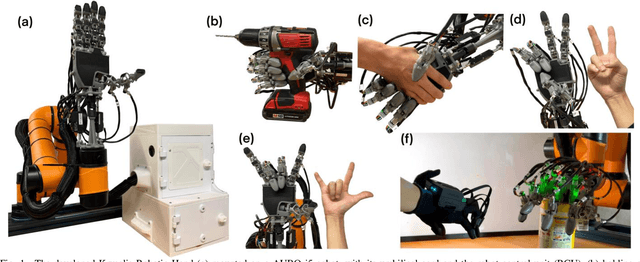
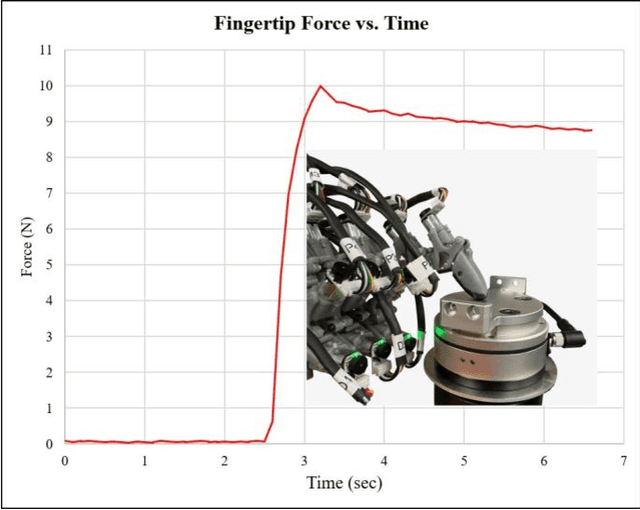
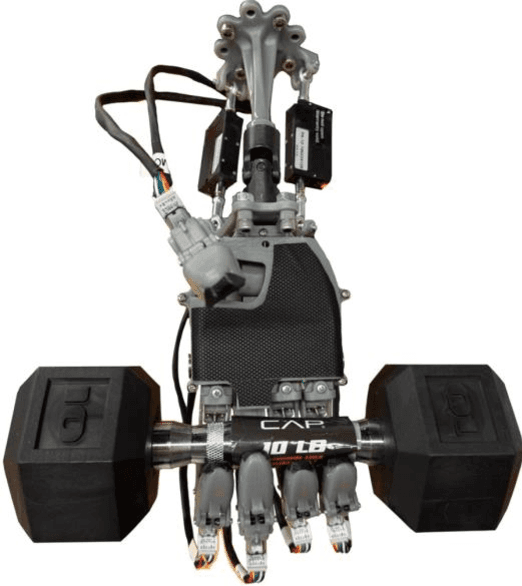
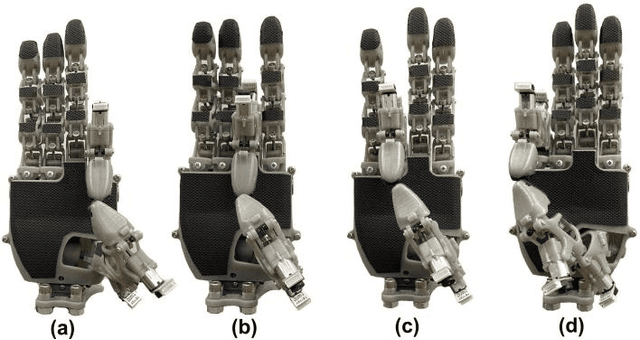
This paper presents the Krysalis Hand, a five-finger robotic end-effector that combines a lightweight design, high payload capacity, and a high number of degrees of freedom (DoF) to enable dexterous manipulation in both industrial and research settings. This design integrates the actuators within the hand while maintaining an anthropomorphic form. Each finger joint features a self-locking mechanism that allows the hand to sustain large external forces without active motor engagement. This approach shifts the payload limitation from the motor strength to the mechanical strength of the hand, allowing the use of smaller, more cost-effective motors. With 18 DoF and weighing only 790 grams, the Krysalis Hand delivers an active squeezing force of 10 N per finger and supports a passive payload capacity exceeding 10 lbs. These characteristics make Krysalis Hand one of the lightest, strongest, and most dexterous robotic end-effectors of its kind. Experimental evaluations validate its ability to perform intricate manipulation tasks and handle heavy payloads, underscoring its potential for industrial applications as well as academic research. All code related to the Krysalis Hand, including control and teleoperation, is available on the project GitHub repository: https://github.com/Soltanilara/Krysalis_Hand
Dynamic Attention and Bi-directional Fusion for Safety Helmet Wearing Detection
Nov 28, 2024Ensuring construction site safety requires accurate and real-time detection of workers' safety helmet use, despite challenges posed by cluttered environments, densely populated work areas, and hard-to-detect small or overlapping objects caused by building obstructions. This paper proposes a novel algorithm for safety helmet wearing detection, incorporating a dynamic attention within the detection head to enhance multi-scale perception. The mechanism combines feature-level attention for scale adaptation, spatial attention for spatial localization, and channel attention for task-specific insights, improving small object detection without additional computational overhead. Furthermore, a two-way fusion strategy enables bidirectional information flow, refining feature fusion through adaptive multi-scale weighting, and enhancing recognition of occluded targets. Experimental results demonstrate a 1.7% improvement in mAP@[.5:.95] compared to the best baseline while reducing GFLOPs by 11.9% on larger sizes. The proposed method surpasses existing models, providing an efficient and practical solution for real-world construction safety monitoring.