 Add to Chrome
 Add to Firefox
 Add to Edge
AdaBoost Does Not Always Cycle: A Computer-Assisted Counterexample
Apr 08, 2026
We give a computer-assisted counterexample to the open question, posed by Rudin, Schapire, and Daubechies in COLT 2012, of whether exhaustive AdaBoost always converges to a finite cycle. The construction is based on a block-product gadget whose two factors share an exact period-2 orbit for their 5-step branch maps, but whose linearized return maps have dominant eigenvalues with an irrational logarithmic ratio. This irrationality forces the burst-winner sequence to have an irrational asymptotic frequency, precluding eventual periodicity. All assertions are certified by exact rational arithmetic. This work was developed in collaboration with GPT-5.4 Pro and Claude Opus 4.6.

HorizonMath: Measuring AI Progress Toward Mathematical Discovery with Automatic Verification
Mar 16, 2026Can AI make progress on important, unsolved mathematical problems? Large language models are now capable of sophisticated mathematical and scientific reasoning, but whether they can perform novel research is still widely debated and underexplored. We introduce HorizonMath, a benchmark of over 100 predominantly unsolved problems spanning 8 domains in computational and applied mathematics, paired with an open-source evaluation framework for automated verification. Our benchmark targets a class of problems where discovery is hard, requiring meaningful mathematical insight, but verification is computationally efficient and simple. Because these solutions are unknown, HorizonMath is immune to data contamination, and most state-of-the-art models score near 0%. Existing research-level benchmarks instead rely on formal proof verification or manual review, both of which are expensive to scale. Using this platform, we find two problems for which GPT 5.4 Pro proposes solutions that improve on the best-known published results, representing potential novel contributions (pending expert review). We release HorizonMath as an open challenge and a growing community resource, where correct solutions to problems in the unsolved problem classes could constitute novel results in the mathematical literature.
HARDMath2: A Benchmark for Applied Mathematics Built by Students as Part of a Graduate Class
May 17, 2025Large language models (LLMs) have shown remarkable progress in mathematical problem-solving, but evaluation has largely focused on problems that have exact analytical solutions or involve formal proofs, often overlooking approximation-based problems ubiquitous in applied science and engineering. To fill this gap, we build on prior work and present HARDMath2, a dataset of 211 original problems covering the core topics in an introductory graduate applied math class, including boundary-layer analysis, WKB methods, asymptotic solutions of nonlinear partial differential equations, and the asymptotics of oscillatory integrals. This dataset was designed and verified by the students and instructors of a core graduate applied mathematics course at Harvard. We build the dataset through a novel collaborative environment that challenges students to write and refine difficult problems consistent with the class syllabus, peer-validate solutions, test different models, and automatically check LLM-generated solutions against their own answers and numerical ground truths. Evaluation results show that leading frontier models still struggle with many of the problems in the dataset, highlighting a gap in the mathematical reasoning skills of current LLMs. Importantly, students identified strategies to create increasingly difficult problems by interacting with the models and exploiting common failure modes. This back-and-forth with the models not only resulted in a richer and more challenging benchmark but also led to qualitative improvements in the students' understanding of the course material, which is increasingly important as we enter an age where state-of-the-art language models can solve many challenging problems across a wide domain of fields.
Humanity's Last Exam
Jan 24, 2025Benchmarks are important tools for tracking the rapid advancements in large language model (LLM) capabilities. However, benchmarks are not keeping pace in difficulty: LLMs now achieve over 90\% accuracy on popular benchmarks like MMLU, limiting informed measurement of state-of-the-art LLM capabilities. In response, we introduce Humanity's Last Exam (HLE), a multi-modal benchmark at the frontier of human knowledge, designed to be the final closed-ended academic benchmark of its kind with broad subject coverage. HLE consists of 3,000 questions across dozens of subjects, including mathematics, humanities, and the natural sciences. HLE is developed globally by subject-matter experts and consists of multiple-choice and short-answer questions suitable for automated grading. Each question has a known solution that is unambiguous and easily verifiable, but cannot be quickly answered via internet retrieval. State-of-the-art LLMs demonstrate low accuracy and calibration on HLE, highlighting a significant gap between current LLM capabilities and the expert human frontier on closed-ended academic questions. To inform research and policymaking upon a clear understanding of model capabilities, we publicly release HLE at https://lastexam.ai.
HARDMath: A Benchmark Dataset for Challenging Problems in Applied Mathematics
Oct 13, 2024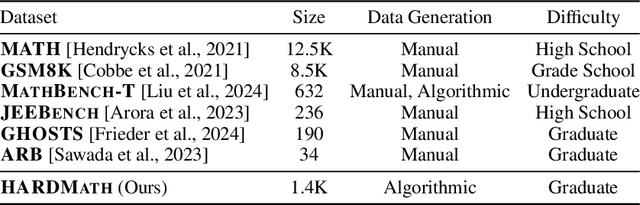
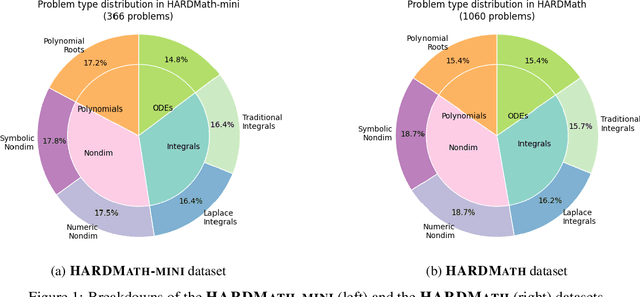

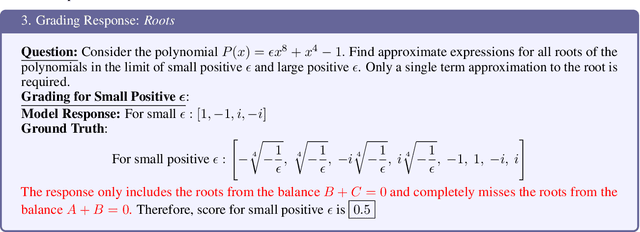
Advanced applied mathematics problems are underrepresented in existing Large Language Model (LLM) benchmark datasets. To address this, we introduce HARDMath, a dataset inspired by a graduate course on asymptotic methods, featuring challenging applied mathematics problems that require analytical approximation techniques. These problems demand a combination of mathematical reasoning, computational tools, and subjective judgment, making them difficult for LLMs. Our framework auto-generates a large number of problems with solutions validated against numerical ground truths. We evaluate both open- and closed-source LLMs on HARDMath-mini, a sub-sampled test set of 366 problems, as well as on 40 word problems formulated in applied science contexts. Even leading closed-source models like GPT-4 achieve only 43.8% overall accuracy with few-shot Chain-of-Thought prompting, and all models demonstrate significantly lower performance compared to results on existing mathematics benchmark datasets. We additionally conduct a detailed error analysis to gain insights into the failure cases of LLMs. These results demonstrate limitations of current LLM performance on advanced graduate-level applied math problems and underscore the importance of datasets like HARDMath to advance mathematical abilities of LLMs.