 Add to Chrome
 Add to Firefox
 Add to Edge
A-MFST: Adaptive Multi-Flow Sparse Tracker for Real-Time Tissue Tracking Under Occlusion
Oct 25, 2024
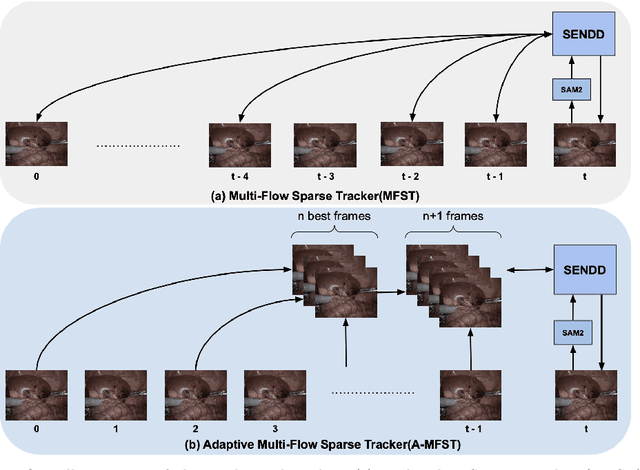


Purpose: Tissue tracking is critical for downstream tasks in robot-assisted surgery. The Sparse Efficient Neural Depth and Deformation (SENDD) model has previously demonstrated accurate and real-time sparse point tracking, but struggled with occlusion handling. This work extends SENDD to enhance occlusion detection and tracking consistency while maintaining real-time performance. Methods: We use the Segment Anything Model2 (SAM2) to detect and mask occlusions by surgical tools, and we develop and integrate into SENDD an Adaptive Multi-Flow Sparse Tracker (A-MFST) with forward-backward consistency metrics, to enhance occlusion and uncertainty estimation. A-MFST is an unsupervised variant of the Multi-Flow Dense Tracker (MFT). Results: We evaluate our approach on the STIR dataset and demonstrate a significant improvement in tracking accuracy under occlusion, reducing average tracking errors by 12 percent in Mean Endpoint Error (MEE) and showing a 6 percent improvement in the averaged accuracy over thresholds of 4, 8, 16, 32, and 64 pixels. The incorporation of forward-backward consistency further improves the selection of optimal tracking paths, reducing drift and enhancing robustness. Notably, these improvements were achieved without compromising the model's real-time capabilities. Conclusions: Using A-MFST and SAM2, we enhance SENDD's ability to track tissue in real time under instrument and tissue occlusions.

Denoising diffusion probabilistic models are optimally adaptive to unknown low dimensionality
Oct 24, 2024The denoising diffusion probabilistic model (DDPM) has emerged as a mainstream generative model in generative AI. While sharp convergence guarantees have been established for the DDPM, the iteration complexity is, in general, proportional to the ambient data dimension, resulting in overly conservative theory that fails to explain its practical efficiency. This has motivated the recent work Li and Yan (2024a) to investigate how the DDPM can achieve sampling speed-ups through automatic exploitation of intrinsic low dimensionality of data. We strengthen this prior work by demonstrating, in some sense, optimal adaptivity to unknown low dimensionality. For a broad class of data distributions with intrinsic dimension $k$, we prove that the iteration complexity of the DDPM scales nearly linearly with $k$, which is optimal when using KL divergence to measure distributional discrepancy. Our theory is established based on a key observation: the DDPM update rule is equivalent to running a suitably parameterized SDE upon discretization, where the nonlinear component of the drift term is intrinsically low-dimensional.
Preference Optimization with Multi-Sample Comparisons
Oct 16, 2024Recent advancements in generative models, particularly large language models (LLMs) and diffusion models, have been driven by extensive pretraining on large datasets followed by post-training. However, current post-training methods such as reinforcement learning from human feedback (RLHF) and direct alignment from preference methods (DAP) primarily utilize single-sample comparisons. These approaches often fail to capture critical characteristics such as generative diversity and bias, which are more accurately assessed through multiple samples. To address these limitations, we introduce a novel approach that extends post-training to include multi-sample comparisons. To achieve this, we propose Multi-sample Direct Preference Optimization (mDPO) and Multi-sample Identity Preference Optimization (mIPO). These methods improve traditional DAP methods by focusing on group-wise characteristics. Empirically, we demonstrate that multi-sample comparison is more effective in optimizing collective characteristics~(e.g., diversity and bias) for generative models than single-sample comparison. Additionally, our findings suggest that multi-sample comparisons provide a more robust optimization framework, particularly for dataset with label noise.
Stochastic Runge-Kutta Methods: Provable Acceleration of Diffusion Models
Oct 07, 2024Diffusion models play a pivotal role in contemporary generative modeling, claiming state-of-the-art performance across various domains. Despite their superior sample quality, mainstream diffusion-based stochastic samplers like DDPM often require a large number of score function evaluations, incurring considerably higher computational cost compared to single-step generators like generative adversarial networks. While several acceleration methods have been proposed in practice, the theoretical foundations for accelerating diffusion models remain underexplored. In this paper, we propose and analyze a training-free acceleration algorithm for SDE-style diffusion samplers, based on the stochastic Runge-Kutta method. The proposed sampler provably attains $\varepsilon^2$ error -- measured in KL divergence -- using $\widetilde O(d^{3/2} / \varepsilon)$ score function evaluations (for sufficiently small $\varepsilon$), strengthening the state-of-the-art guarantees $\widetilde O(d^{3} / \varepsilon)$ in terms of dimensional dependency. Numerical experiments validate the efficiency of the proposed method.
GTSinger: A Global Multi-Technique Singing Corpus with Realistic Music Scores for All Singing Tasks
Sep 26, 2024


The scarcity of high-quality and multi-task singing datasets significantly hinders the development of diverse controllable and personalized singing tasks, as existing singing datasets suffer from low quality, limited diversity of languages and singers, absence of multi-technique information and realistic music scores, and poor task suitability. To tackle these problems, we present GTSinger, a large global, multi-technique, free-to-use, high-quality singing corpus with realistic music scores, designed for all singing tasks, along with its benchmarks. Particularly, (1) we collect 80.59 hours of high-quality singing voices, forming the largest recorded singing dataset; (2) 20 professional singers across nine widely spoken languages offer diverse timbres and styles; (3) we provide controlled comparison and phoneme-level annotations of six commonly used singing techniques, helping technique modeling and control; (4) GTSinger offers realistic music scores, assisting real-world musical composition; (5) singing voices are accompanied by manual phoneme-to-audio alignments, global style labels, and 16.16 hours of paired speech for various singing tasks. Moreover, to facilitate the use of GTSinger, we conduct four benchmark experiments: technique-controllable singing voice synthesis, technique recognition, style transfer, and speech-to-singing conversion. The corpus and demos can be found at http://gtsinger.github.io. We provide the dataset and the code for processing data and conducting benchmarks at https://huggingface.co/datasets/GTSinger/GTSinger and https://github.com/GTSinger/GTSinger.
Efficient Multi-Policy Evaluation for Reinforcement Learning
Aug 16, 2024To unbiasedly evaluate multiple target policies, the dominant approach among RL practitioners is to run and evaluate each target policy separately. However, this evaluation method is far from efficient because samples are not shared across policies, and running target policies to evaluate themselves is actually not optimal. In this paper, we address these two weaknesses by designing a tailored behavior policy to reduce the variance of estimators across all target policies. Theoretically, we prove that executing this behavior policy with manyfold fewer samples outperforms on-policy evaluation on every target policy under characterized conditions. Empirically, we show our estimator has a substantially lower variance compared with previous best methods and achieves state-of-the-art performance in a broad range of environments.
A Sharp Convergence Theory for The Probability Flow ODEs of Diffusion Models
Aug 05, 2024Diffusion models, which convert noise into new data instances by learning to reverse a diffusion process, have become a cornerstone in contemporary generative modeling. In this work, we develop non-asymptotic convergence theory for a popular diffusion-based sampler (i.e., the probability flow ODE sampler) in discrete time, assuming access to $\ell_2$-accurate estimates of the (Stein) score functions. For distributions in $\mathbb{R}^d$, we prove that $d/\varepsilon$ iterations -- modulo some logarithmic and lower-order terms -- are sufficient to approximate the target distribution to within $\varepsilon$ total-variation distance. This is the first result establishing nearly linear dimension-dependency (in $d$) for the probability flow ODE sampler. Imposing only minimal assumptions on the target data distribution (e.g., no smoothness assumption is imposed), our results also characterize how $\ell_2$ score estimation errors affect the quality of the data generation processes. In contrast to prior works, our theory is developed based on an elementary yet versatile non-asymptotic approach without the need of resorting to SDE and ODE toolboxes.
How to Make Cross Encoder a Good Teacher for Efficient Image-Text Retrieval?
Jul 10, 2024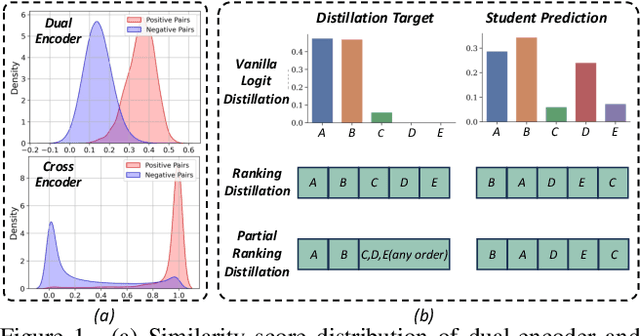
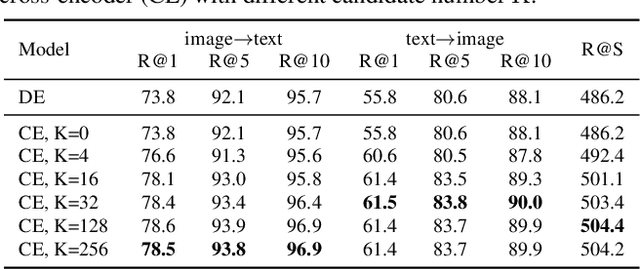
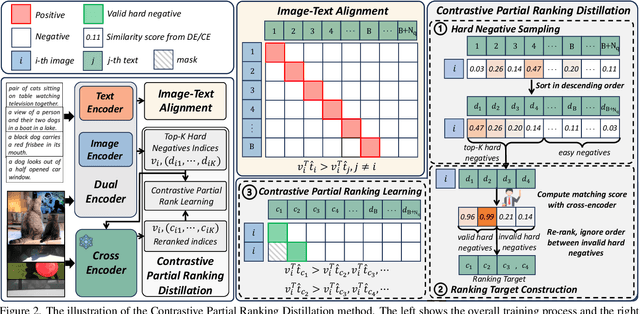
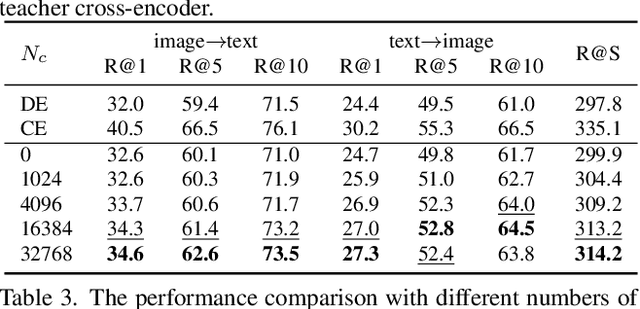
Dominant dual-encoder models enable efficient image-text retrieval but suffer from limited accuracy while the cross-encoder models offer higher accuracy at the expense of efficiency. Distilling cross-modality matching knowledge from cross-encoder to dual-encoder provides a natural approach to harness their strengths. Thus we investigate the following valuable question: how to make cross-encoder a good teacher for dual-encoder? Our findings are threefold:(1) Cross-modal similarity score distribution of cross-encoder is more concentrated while the result of dual-encoder is nearly normal making vanilla logit distillation less effective. However ranking distillation remains practical as it is not affected by the score distribution.(2) Only the relative order between hard negatives conveys valid knowledge while the order information between easy negatives has little significance.(3) Maintaining the coordination between distillation loss and dual-encoder training loss is beneficial for knowledge transfer. Based on these findings we propose a novel Contrastive Partial Ranking Distillation (CPRD) method which implements the objective of mimicking relative order between hard negative samples with contrastive learning. This approach coordinates with the training of the dual-encoder effectively transferring valid knowledge from the cross-encoder to the dual-encoder. Extensive experiments on image-text retrieval and ranking tasks show that our method surpasses other distillation methods and significantly improves the accuracy of dual-encoder.
EA-VTR: Event-Aware Video-Text Retrieval
Jul 10, 2024
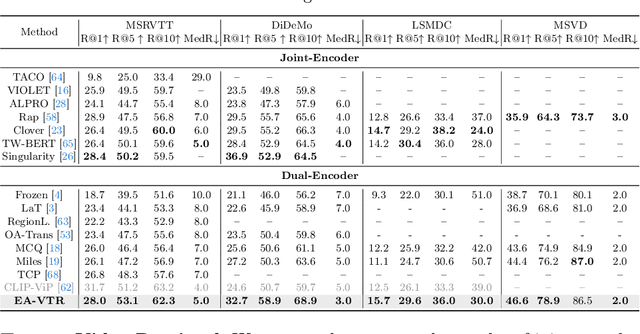
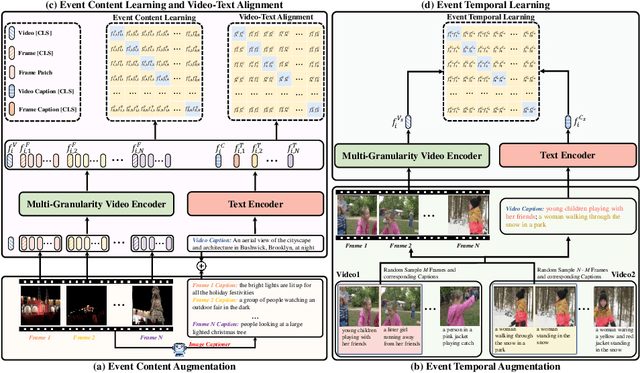
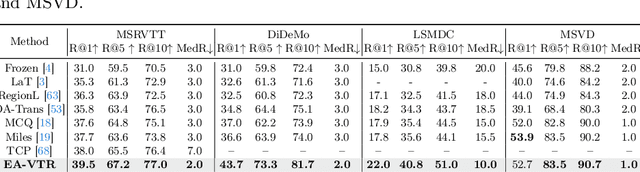
Understanding the content of events occurring in the video and their inherent temporal logic is crucial for video-text retrieval. However, web-crawled pre-training datasets often lack sufficient event information, and the widely adopted video-level cross-modal contrastive learning also struggles to capture detailed and complex video-text event alignment. To address these challenges, we make improvements from both data and model perspectives. In terms of pre-training data, we focus on supplementing the missing specific event content and event temporal transitions with the proposed event augmentation strategies. Based on the event-augmented data, we construct a novel Event-Aware Video-Text Retrieval model, ie, EA-VTR, which achieves powerful video-text retrieval ability through superior video event awareness. EA-VTR can efficiently encode frame-level and video-level visual representations simultaneously, enabling detailed event content and complex event temporal cross-modal alignment, ultimately enhancing the comprehensive understanding of video events. Our method not only significantly outperforms existing approaches on multiple datasets for Text-to-Video Retrieval and Video Action Recognition tasks, but also demonstrates superior event content perceive ability on Multi-event Video-Text Retrieval and Video Moment Retrieval tasks, as well as outstanding event temporal logic understanding ability on Test of Time task.
Language Models Encode Collaborative Signals in Recommendation
Jul 07, 2024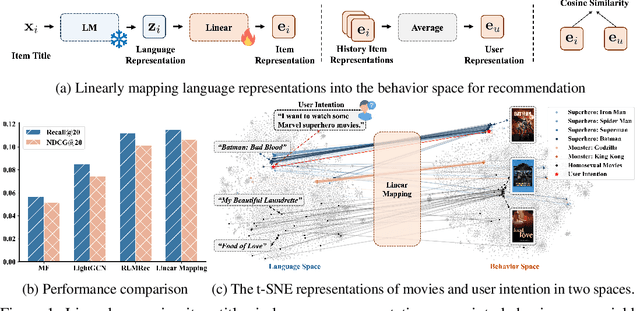
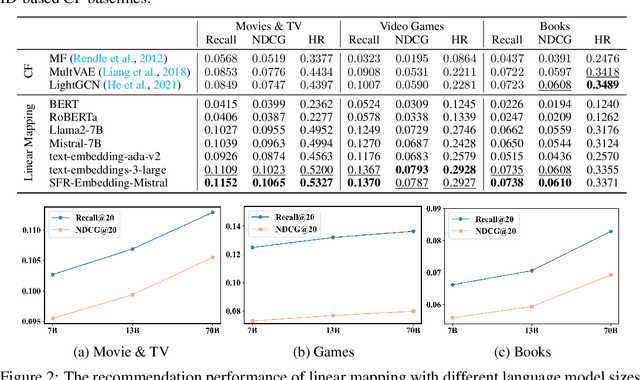

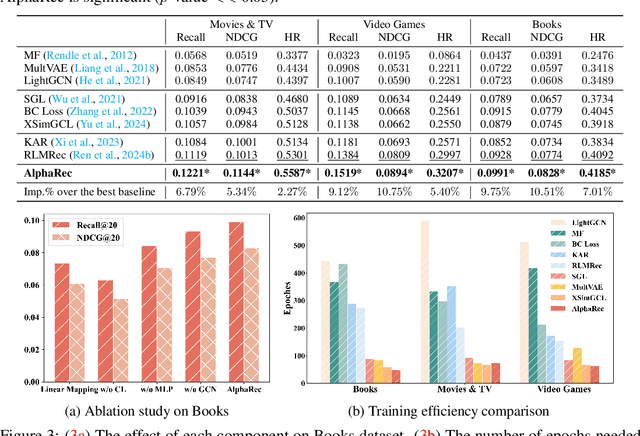
Recent studies empirically indicate that language models (LMs) encode rich world knowledge beyond mere semantics, attracting significant attention across various fields. However, in the recommendation domain, it remains uncertain whether LMs implicitly encode user preference information. Contrary to the prevailing understanding that LMs and traditional recommender models learn two distinct representation spaces due to a huge gap in language and behavior modeling objectives, this work rethinks such understanding and explores extracting a recommendation space directly from the language representation space. Surprisingly, our findings demonstrate that item representations, when linearly mapped from advanced LM representations, yield superior recommendation performance. This outcome suggests the homomorphism between the language representation space and an effective recommendation space, implying that collaborative signals may indeed be encoded within advanced LMs. Motivated by these findings, we propose a simple yet effective collaborative filtering (CF) model named AlphaRec, which utilizes language representations of item textual metadata (e.g., titles) instead of traditional ID-based embeddings. Specifically, AlphaRec is comprised of three main components: a multilayer perceptron (MLP), graph convolution, and contrastive learning (CL) loss function, making it extremely easy to implement and train. Our empirical results show that AlphaRec outperforms leading ID-based CF models on multiple datasets, marking the first instance of such a recommender with text embeddings achieving this level of performance. Moreover, AlphaRec introduces a new language-representation-based CF paradigm with several desirable advantages: being easy to implement, lightweight, rapid convergence, superior zero-shot recommendation abilities in new domains, and being aware of user intention.