 Add to Chrome
 Add to Firefox
 Add to Edge
Debiased Multimodal Personality Understanding through Dual Causal Intervention
May 07, 2026
Multimodalpersonalityunderstandingplaysacriticalroleinhuman centered artificial intelligence. Previous work mainly focus on learn-ing rich multimodal representations for video personality under standing. However, they often suffer from potential harm caused by subject bias (e.g., observable age and unobservable mental states), as subjects originate from diverse demographic backgrounds. Learn ing such spurious associations between multimodal features and traits may lead to unfair personality understanding. In this work, weconstruct aStructural Causal Model (SCM)toanalyze theimpact of these biases from a causal perspective, and propose a novel Dual Causal Adjustment Network (DCAN) to mitigate the interference of subject attributes on personality understanding. Specifically, we design a Back-door Adjustment Causal Learning (BACL) module to block spurious correlations from observable demographic factors via a prototype-based confounder dictionary, and subsequently ap ply a Front-door Adjustment Causal Learning (FACL) module to ad dress latent and unobservable biases throughalearnedmediatordic tionary intervention, thereby achieving causal disentanglement of representations for deconfounded reasoning. Importantly, we con struct a Demographic-annotated Multimodal Student Personality (DMSP) dataset to support the analysis and discussion of fairness related factors. Extensive experiments on the benchmark dataset CFI-V2 and our DMSPdataset demonstrate that DCAN consistently improves prediction accuracy, reaching 92.11% and 92.90%, respec tively. Meanwhile, the improvementsinthefairnessmetricsofequal opportunity and demographic parity are 6.57% and 7.97% on CFI-V2, and 15.38% and 20.06% on the DMSP dataset. Our code and DMSP dataset are available at https://github.com/Sabrina-han/DCAN

Efficient Sampling with Discrete Diffusion Models: Sharp and Adaptive Guarantees
Feb 16, 2026Diffusion models over discrete spaces have recently shown striking empirical success, yet their theoretical foundations remain incomplete. In this paper, we study the sampling efficiency of score-based discrete diffusion models under a continuous-time Markov chain (CTMC) formulation, with a focus on $τ$-leaping-based samplers. We establish sharp convergence guarantees for attaining $\varepsilon$ accuracy in Kullback-Leibler (KL) divergence for both uniform and masking noising processes. For uniform discrete diffusion, we show that the $τ$-leaping algorithm achieves an iteration complexity of order $\tilde O(d/\varepsilon)$, with $d$ the ambient dimension of the target distribution, eliminating linear dependence on the vocabulary size $S$ and improving existing bounds by a factor of $d$; moreover, we establish a matching algorithmic lower bound showing that linear dependence on the ambient dimension is unavoidable in general. For masking discrete diffusion, we introduce a modified $τ$-leaping sampler whose convergence rate is governed by an intrinsic information-theoretic quantity, termed the effective total correlation, which is bounded by $d \log S$ but can be sublinear or even constant for structured data. As a consequence, the sampler provably adapts to low-dimensional structure without prior knowledge or algorithmic modification, yielding sublinear convergence rates for various practical examples (such as hidden Markov models, image data, and random graphs). Our analysis requires no boundedness or smoothness assumptions on the score estimator beyond control of the score entropy loss.
On the Learning Dynamics of RLVR at the Edge of Competence
Feb 16, 2026Reinforcement learning with verifiable rewards (RLVR) has been a main driver of recent breakthroughs in large reasoning models. Yet it remains a mystery how rewards based solely on final outcomes can help overcome the long-horizon barrier to extended reasoning. To understand this, we develop a theory of the training dynamics of RL for transformers on compositional reasoning tasks. Our theory characterizes how the effectiveness of RLVR is governed by the smoothness of the difficulty spectrum. When data contains abrupt discontinuities in difficulty, learning undergoes grokking-type phase transitions, producing prolonged plateaus before progress recurs. In contrast, a smooth difficulty spectrum leads to a relay effect: persistent gradient signals on easier problems elevate the model's capabilities to the point where harder ones become tractable, resulting in steady and continuous improvement. Our theory explains how RLVR can improve performance at the edge of competence, and suggests that appropriately designed data mixtures can yield scalable gains. As a technical contribution, our analysis develops and adapts tools from Fourier analysis on finite groups to our setting. We validate the predicted mechanisms empirically via synthetic experiments.
Transformers Meet In-Context Learning: A Universal Approximation Theory
Jun 05, 2025Modern large language models are capable of in-context learning, the ability to perform new tasks at inference time using only a handful of input-output examples in the prompt, without any fine-tuning or parameter updates. We develop a universal approximation theory to better understand how transformers enable in-context learning. For any class of functions (each representing a distinct task), we demonstrate how to construct a transformer that, without any further weight updates, can perform reliable prediction given only a few in-context examples. In contrast to much of the recent literature that frames transformers as algorithm approximators -- i.e., constructing transformers to emulate the iterations of optimization algorithms as a means to approximate solutions of learning problems -- our work adopts a fundamentally different approach rooted in universal function approximation. This alternative approach offers approximation guarantees that are not constrained by the effectiveness of the optimization algorithms being approximated, thereby extending far beyond convex problems and linear function classes. Our construction sheds light on how transformers can simultaneously learn general-purpose representations and adapt dynamically to in-context examples.
Actor-Critics Can Achieve Optimal Sample Efficiency
May 06, 2025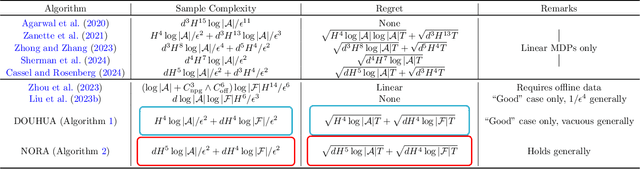
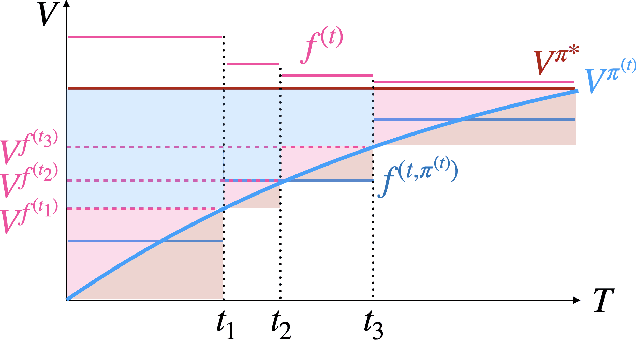
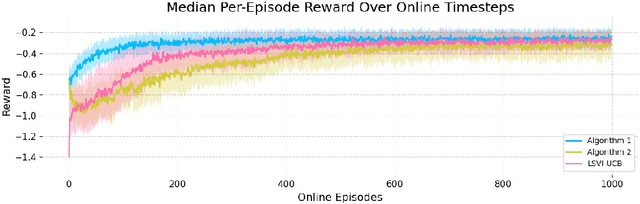
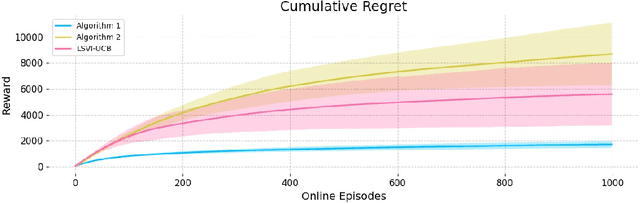
Actor-critic algorithms have become a cornerstone in reinforcement learning (RL), leveraging the strengths of both policy-based and value-based methods. Despite recent progress in understanding their statistical efficiency, no existing work has successfully learned an $\epsilon$-optimal policy with a sample complexity of $O(1/\epsilon^2)$ trajectories with general function approximation when strategic exploration is necessary. We address this open problem by introducing a novel actor-critic algorithm that attains a sample-complexity of $O(dH^5 \log|\mathcal{A}|/\epsilon^2 + d H^4 \log|\mathcal{F}|/ \epsilon^2)$ trajectories, and accompanying $\sqrt{T}$ regret when the Bellman eluder dimension $d$ does not increase with $T$ at more than a $\log T$ rate. Here, $\mathcal{F}$ is the critic function class, $\mathcal{A}$ is the action space, and $H$ is the horizon in the finite horizon MDP setting. Our algorithm integrates optimism, off-policy critic estimation targeting the optimal Q-function, and rare-switching policy resets. We extend this to the setting of Hybrid RL, showing that initializing the critic with offline data yields sample efficiency gains compared to purely offline or online RL. Further, utilizing access to offline data, we provide a \textit{non-optimistic} provably efficient actor-critic algorithm that only additionally requires $N_{\text{off}} \geq c_{\text{off}}^*dH^4/\epsilon^2$ in exchange for omitting optimism, where $c_{\text{off}}^*$ is the single-policy concentrability coefficient and $N_{\text{off}}$ is the number of offline samples. This addresses another open problem in the literature. We further provide numerical experiments to support our theoretical findings.
Dimension-Free Convergence of Diffusion Models for Approximate Gaussian Mixtures
Apr 07, 2025Diffusion models are distinguished by their exceptional generative performance, particularly in producing high-quality samples through iterative denoising. While current theory suggests that the number of denoising steps required for accurate sample generation should scale linearly with data dimension, this does not reflect the practical efficiency of widely used algorithms like Denoising Diffusion Probabilistic Models (DDPMs). This paper investigates the effectiveness of diffusion models in sampling from complex high-dimensional distributions that can be well-approximated by Gaussian Mixture Models (GMMs). For these distributions, our main result shows that DDPM takes at most $\widetilde{O}(1/\varepsilon)$ iterations to attain an $\varepsilon$-accurate distribution in total variation (TV) distance, independent of both the ambient dimension $d$ and the number of components $K$, up to logarithmic factors. Furthermore, this result remains robust to score estimation errors. These findings highlight the remarkable effectiveness of diffusion models in high-dimensional settings given the universal approximation capability of GMMs, and provide theoretical insights into their practical success.
Uncertainty quantification for Markov chains with application to temporal difference learning
Feb 19, 2025Markov chains are fundamental to statistical machine learning, underpinning key methodologies such as Markov Chain Monte Carlo (MCMC) sampling and temporal difference (TD) learning in reinforcement learning (RL). Given their widespread use, it is crucial to establish rigorous probabilistic guarantees on their convergence, uncertainty, and stability. In this work, we develop novel, high-dimensional concentration inequalities and Berry-Esseen bounds for vector- and matrix-valued functions of Markov chains, addressing key limitations in existing theoretical tools for handling dependent data. We leverage these results to analyze the TD learning algorithm, a widely used method for policy evaluation in RL. Our analysis yields a sharp high-probability consistency guarantee that matches the asymptotic variance up to logarithmic factors. Furthermore, we establish a $O(T^{-\frac{1}{4}}\log T)$ distributional convergence rate for the Gaussian approximation of the TD estimator, measured in convex distance. These findings provide new insights into statistical inference for RL algorithms, bridging the gaps between classical stochastic approximation theory and modern reinforcement learning applications.
Denoising diffusion probabilistic models are optimally adaptive to unknown low dimensionality
Oct 24, 2024The denoising diffusion probabilistic model (DDPM) has emerged as a mainstream generative model in generative AI. While sharp convergence guarantees have been established for the DDPM, the iteration complexity is, in general, proportional to the ambient data dimension, resulting in overly conservative theory that fails to explain its practical efficiency. This has motivated the recent work Li and Yan (2024a) to investigate how the DDPM can achieve sampling speed-ups through automatic exploitation of intrinsic low dimensionality of data. We strengthen this prior work by demonstrating, in some sense, optimal adaptivity to unknown low dimensionality. For a broad class of data distributions with intrinsic dimension $k$, we prove that the iteration complexity of the DDPM scales nearly linearly with $k$, which is optimal when using KL divergence to measure distributional discrepancy. Our theory is established based on a key observation: the DDPM update rule is equivalent to running a suitably parameterized SDE upon discretization, where the nonlinear component of the drift term is intrinsically low-dimensional.
Statistical Inference for Temporal Difference Learning with Linear Function Approximation
Oct 21, 2024Statistical inference with finite-sample validity for the value function of a given policy in Markov decision processes (MDPs) is crucial for ensuring the reliability of reinforcement learning. Temporal Difference (TD) learning, arguably the most widely used algorithm for policy evaluation, serves as a natural framework for this purpose.In this paper, we study the consistency properties of TD learning with Polyak-Ruppert averaging and linear function approximation, and obtain three significant improvements over existing results. First, we derive a novel sharp high-dimensional probability convergence guarantee that depends explicitly on the asymptotic variance and holds under weak conditions. We further establish refined high-dimensional Berry-Esseen bounds over the class of convex sets that guarantee faster rates than those in the literature. Finally, we propose a plug-in estimator for the asymptotic covariance matrix, designed for efficient online computation. These results enable the construction of confidence regions and simultaneous confidence intervals for the linear parameters of the value function, with guaranteed finite-sample coverage. We demonstrate the applicability of our theoretical findings through numerical experiments.
Stochastic Runge-Kutta Methods: Provable Acceleration of Diffusion Models
Oct 07, 2024Diffusion models play a pivotal role in contemporary generative modeling, claiming state-of-the-art performance across various domains. Despite their superior sample quality, mainstream diffusion-based stochastic samplers like DDPM often require a large number of score function evaluations, incurring considerably higher computational cost compared to single-step generators like generative adversarial networks. While several acceleration methods have been proposed in practice, the theoretical foundations for accelerating diffusion models remain underexplored. In this paper, we propose and analyze a training-free acceleration algorithm for SDE-style diffusion samplers, based on the stochastic Runge-Kutta method. The proposed sampler provably attains $\varepsilon^2$ error -- measured in KL divergence -- using $\widetilde O(d^{3/2} / \varepsilon)$ score function evaluations (for sufficiently small $\varepsilon$), strengthening the state-of-the-art guarantees $\widetilde O(d^{3} / \varepsilon)$ in terms of dimensional dependency. Numerical experiments validate the efficiency of the proposed method.