 Add to Chrome
 Add to Firefox
 Add to Edge
Video = World + Event Stream
Jul 16, 2026
We present Wan-Streamer v0.3, which reframes our native-streaming interaction model under a single organizing view: a video is a world plus an event stream. The world is the persistent context in which a video unfolds, including the environment, scene, subjects, ambient acoustic conditions, voice characteristics, and other relatively stable conditions. The event stream is everything that changes over time within that world, including scene or environmental changes, subject behavior, speech, and other sounds. This yields a general-purpose pretraining task over large amounts of real video: given a world and incoming input, predict how the world moves, changes, and responds in real time. The resulting competence can be specialized to a broad family of real-time downstream tasks. We instantiate it on real-time full-duplex audio-visual interaction, where the event stream is the agent's speech together with free-form behavior. Functionally, the model's multimodal understanding process is vision-language-action-like: it maps multimodal user input to language-form speech and behavior actions. Wan-Streamer v0.3 preserves the v0.2 operating point: 640x368 video at 25 FPS, a 160 ms streaming unit, approximately 200 ms model-side response latency, and approximately 550 ms total interaction latency under a 350 ms bidirectional network budget.

Wan-Streamer v0.2: Higher Resolution, Same Latency
Jul 05, 2026We present Wan-Streamer v0.2, a latency-preserving upgrade of the native-streaming, end-to-end audio-visual interaction model. v0.2 keeps the v0.1 modeling formulation, but raises the interactive output stream from 192x336 to 640x368 while preserving approximately 200 ms model-side signal-to-signal latency at 25 FPS. The higher-resolution stream supports scene-grounded mid-shot agents whose posture, gaze, hands, nearby objects, and local scene layout remain legible during real-time conversation. To support the larger visual stream without adding user-visible delay, v0.2 keeps the thinker as a single-GPU low-latency path for streaming perception, the short language/state Transformer pass that builds the generation cache, and final decoding. The performer becomes a multi-GPU Ulysses-style context-parallel group for the expensive next-unit latent generation. Each performer rank writes incoming K/V into a pre-sharded local cache. The long high-resolution latent video sequence is split across ranks for denoising and gathered through Ulysses communication, while the much shorter audio latent sequence is generated without sequence sharding. In this split, the thinker's language/state computation reaches the performer only as K/V conditioning, so no separate language sequence has to be communicated inside the performer group. This concentrates additional hardware on visual generation while preserving the compact thinker-performer boundary, keeping total remote interaction latency at approximately 550 ms when a 350 ms bidirectional network budget is included.
Think in Strokes, Not Pixels: Process-Driven Image Generation via Interleaved Reasoning
Apr 07, 2026Humans paint images incrementally: they plan a global layout, sketch a coarse draft, inspect, and refine details, and most importantly, each step is grounded in the evolving visual states. However, can unified multimodal models trained on text-image interleaved datasets also imagine the chain of intermediate states? In this paper, we introduce process-driven image generation, a multi-step paradigm that decomposes synthesis into an interleaved reasoning trajectory of thoughts and actions. Rather than generating images in a single step, our approach unfolds across multiple iterations, each consisting of 4 stages: textual planning, visual drafting, textual reflection, and visual refinement. The textual reasoning explicitly conditions how the visual state should evolve, while the generated visual intermediate in turn constrains and grounds the next round of textual reasoning. A core challenge of process-driven generation stems from the ambiguity of intermediate states: how can models evaluate each partially-complete image? We address this through dense, step-wise supervision that maintains two complementary constraints: for the visual intermediate states, we enforce the spatial and semantic consistency; for the textual intermediate states, we preserve the prior visual knowledge while enabling the model to identify and correct prompt-violating elements. This makes the generation process explicit, interpretable, and directly supervisable. To validate proposed method, we conduct experiments under various text-to-image generation benchmarks.
FreeInv: Free Lunch for Improving DDIM Inversion
Mar 29, 2025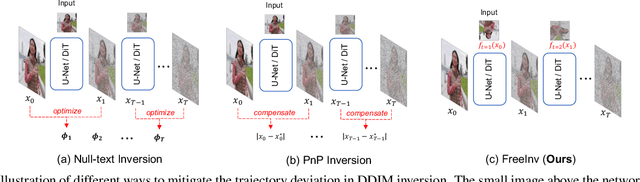
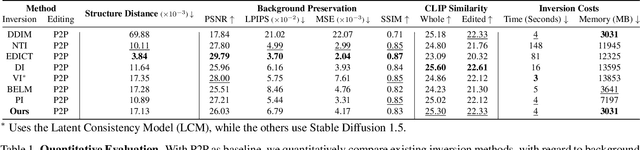
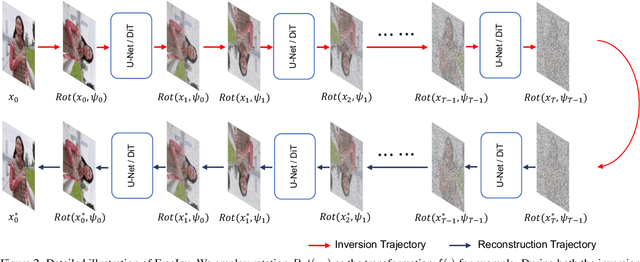
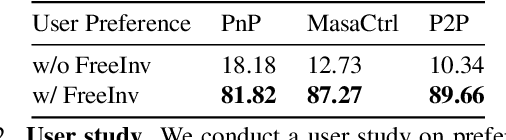
Naive DDIM inversion process usually suffers from a trajectory deviation issue, i.e., the latent trajectory during reconstruction deviates from the one during inversion. To alleviate this issue, previous methods either learn to mitigate the deviation or design cumbersome compensation strategy to reduce the mismatch error, exhibiting substantial time and computation cost. In this work, we present a nearly free-lunch method (named FreeInv) to address the issue more effectively and efficiently. In FreeInv, we randomly transform the latent representation and keep the transformation the same between the corresponding inversion and reconstruction time-step. It is motivated from a statistical perspective that an ensemble of DDIM inversion processes for multiple trajectories yields a smaller trajectory mismatch error on expectation. Moreover, through theoretical analysis and empirical study, we show that FreeInv performs an efficient ensemble of multiple trajectories. FreeInv can be freely integrated into existing inversion-based image and video editing techniques. Especially for inverting video sequences, it brings more significant fidelity and efficiency improvements. Comprehensive quantitative and qualitative evaluation on PIE benchmark and DAVIS dataset shows that FreeInv remarkably outperforms conventional DDIM inversion, and is competitive among previous state-of-the-art inversion methods, with superior computation efficiency.
Normalizing Batch Normalization for Long-Tailed Recognition
Jan 06, 2025
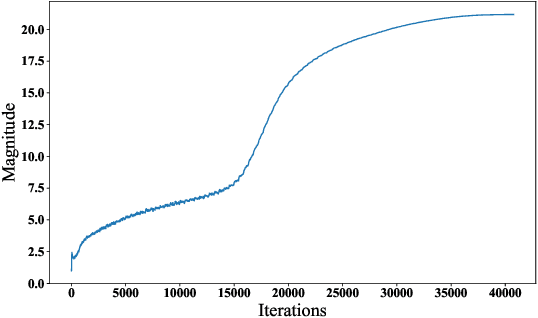


In real-world scenarios, the number of training samples across classes usually subjects to a long-tailed distribution. The conventionally trained network may achieve unexpected inferior performance on the rare class compared to the frequent class. Most previous works attempt to rectify the network bias from the data-level or from the classifier-level. Differently, in this paper, we identify that the bias towards the frequent class may be encoded into features, i.e., the rare-specific features which play a key role in discriminating the rare class are much weaker than the frequent-specific features. Based on such an observation, we introduce a simple yet effective approach, normalizing the parameters of Batch Normalization (BN) layer to explicitly rectify the feature bias. To achieve this end, we represent the Weight/Bias parameters of a BN layer as a vector, normalize it into a unit one and multiply the unit vector by a scalar learnable parameter. Through decoupling the direction and magnitude of parameters in BN layer to learn, the Weight/Bias exhibits a more balanced distribution and thus the strength of features becomes more even. Extensive experiments on various long-tailed recognition benchmarks (i.e., CIFAR-10/100-LT, ImageNet-LT and iNaturalist 2018) show that our method outperforms previous state-of-the-arts remarkably. The code and checkpoints are available at https://github.com/yuxiangbao/NBN.
Federated Learning via Input-Output Collaborative Distillation
Dec 22, 2023
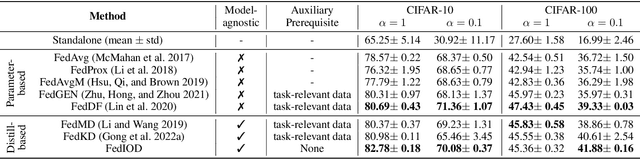

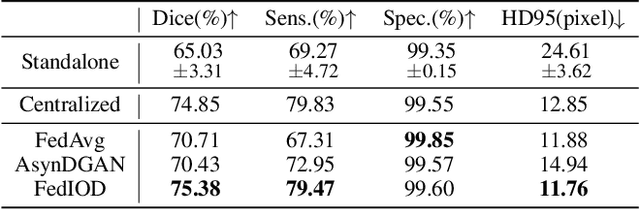
Federated learning (FL) is a machine learning paradigm in which distributed local nodes collaboratively train a central model without sharing individually held private data. Existing FL methods either iteratively share local model parameters or deploy co-distillation. However, the former is highly susceptible to private data leakage, and the latter design relies on the prerequisites of task-relevant real data. Instead, we propose a data-free FL framework based on local-to-central collaborative distillation with direct input and output space exploitation. Our design eliminates any requirement of recursive local parameter exchange or auxiliary task-relevant data to transfer knowledge, thereby giving direct privacy control to local users. In particular, to cope with the inherent data heterogeneity across locals, our technique learns to distill input on which each local model produces consensual yet unique results to represent each expertise. Our proposed FL framework achieves notable privacy-utility trade-offs with extensive experiments on image classification and segmentation tasks under various real-world heterogeneous federated learning settings on both natural and medical images.
LatentWarp: Consistent Diffusion Latents for Zero-Shot Video-to-Video Translation
Nov 01, 2023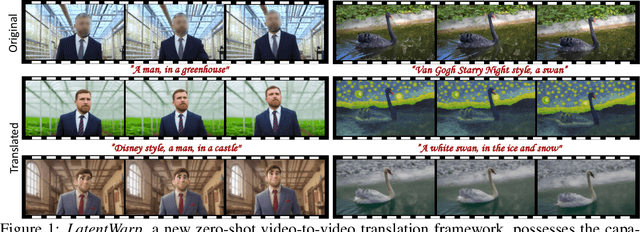


Leveraging the generative ability of image diffusion models offers great potential for zero-shot video-to-video translation. The key lies in how to maintain temporal consistency across generated video frames by image diffusion models. Previous methods typically adopt cross-frame attention, \emph{i.e.,} sharing the \textit{key} and \textit{value} tokens across attentions of different frames, to encourage the temporal consistency. However, in those works, temporal inconsistency issue may not be thoroughly solved, rendering the fidelity of generated videos limited.%The current state of the art cross-frame attention method aims at maintaining fine-grained visual details across frames, but it is still challenged by the temporal coherence problem. In this paper, we find the bottleneck lies in the unconstrained query tokens and propose a new zero-shot video-to-video translation framework, named \textit{LatentWarp}. Our approach is simple: to constrain the query tokens to be temporally consistent, we further incorporate a warping operation in the latent space to constrain the query tokens. Specifically, based on the optical flow obtained from the original video, we warp the generated latent features of last frame to align with the current frame during the denoising process. As a result, the corresponding regions across the adjacent frames can share closely-related query tokens and attention outputs, which can further improve latent-level consistency to enhance visual temporal coherence of generated videos. Extensive experiment results demonstrate the superiority of \textit{LatentWarp} in achieving video-to-video translation with temporal coherence.
Anti-Retroactive Interference for Lifelong Learning
Aug 27, 2022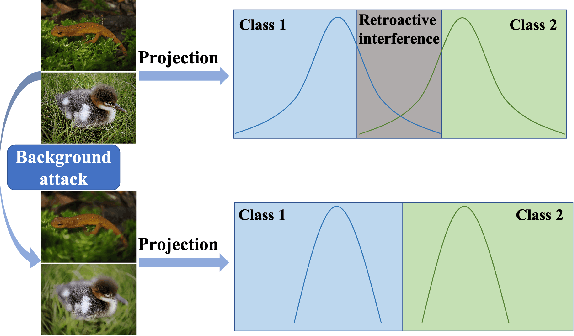
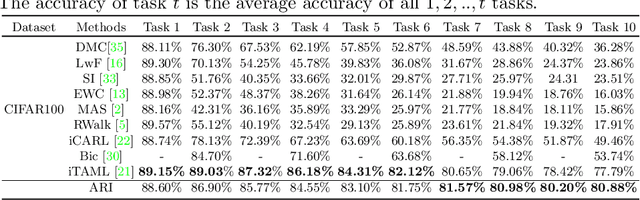
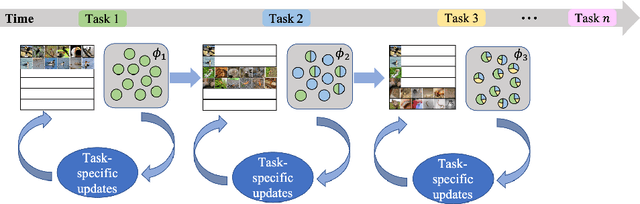
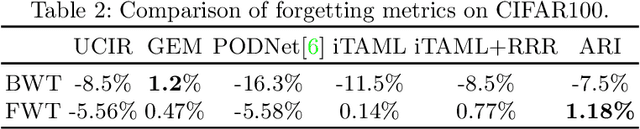
Humans can continuously learn new knowledge. However, machine learning models suffer from drastic dropping in performance on previous tasks after learning new tasks. Cognitive science points out that the competition of similar knowledge is an important cause of forgetting. In this paper, we design a paradigm for lifelong learning based on meta-learning and associative mechanism of the brain. It tackles the problem from two aspects: extracting knowledge and memorizing knowledge. First, we disrupt the sample's background distribution through a background attack, which strengthens the model to extract the key features of each task. Second, according to the similarity between incremental knowledge and base knowledge, we design an adaptive fusion of incremental knowledge, which helps the model allocate capacity to the knowledge of different difficulties. It is theoretically analyzed that the proposed learning paradigm can make the models of different tasks converge to the same optimum. The proposed method is validated on the MNIST, CIFAR100, CUB200 and ImageNet100 datasets.