 Add to Chrome
 Add to Firefox
 Add to Edge
Decision-Metric Alignment in Latent World Models: Diagnostics and Action-Conditioned Objectives for MPC Planning
Aug 19, 2026
JEPA-style latent world models can use Euclidean distance to a goal latent as the cost for model-predictive control (MPC). Strong decoding of task variables, however, does not guarantee that this particular cost ranks candidate action sequences by real task progress. We call the latter property \emph{decision-metric alignment}. We introduce Plan-Real Spearman, which measures latent--real rank agreement on random plans, and CEM-stage Spearman, which measures the same agreement as cross-entropy-method (CEM) search concentrates its proposal. We analyze sufficient conditions under which latent distance preserves real-cost rankings, identifying encoder distortion, terminal rollout error, and candidate margins as the controlling quantities. Guided by the observed empirical alignment gap, DA-LeWM augments LeWM with inverse-dynamics and demonstration-conditioned goal-action heads. Across all our experiments, DA-LeWM accelerates convergence and achieves higher online success than LeWM, while probe scores remain similar. These results show that action-conditioned objectives improve the geometry used by Euclidean-cost, CEM-based latent MPC.

Visko Orbis 1.0: A Live Model for Real-Time Interactive Long Video Generation
Jul 29, 2026We present Visko Orbis 1.0, a Live Model for real-time, interactive long-video generation. Users can change the prompt at any moment during generation, and the update becomes visible in real time. Visko Orbis 1.0 supports long-form text-to-video, image-to-video, and video continuation, with multilingual prompts and prompt switching while generation is in progress. A bounded multi-scale memory preserves subjects, scenes, and style across chunks, sustaining hour-scale rollouts without evident quality or color drift. Built on a distilled chunk-wise streaming generator and a streaming video upscaler, Visko Orbis 1.0 delivers real-time 4K video generation at 24 FPS using an optimized GPU serving engine. In long-form Arena comparisons, Visko Orbis 1.0 obtains the highest overall-preference and temporal-stability ratings among state-of-the-art real-time interactive video-generation systems.
HiFi-UMI: Learning Deployable Manipulation Policies from High-Fidelity UMI Data Alone
Jul 28, 2026Learning deployable manipulation policies is bottlenecked by the scarcity of data that is both high-fidelity and scalable. Real-robot teleoperation is accurate but costly to scale; robot-free UMI capture scales readily, and current practice uses the resulting data mainly for pre-training, adding a small real-robot "anchor" at post-training. We ask whether raising the fidelity of robot-free UMI data, rather than shrinking the real-robot fraction, can remove that anchor. We present HiFi-UMI, a portable UMI data-production system co-designed for trajectory accuracy, inter-gripper relative pose, synchronization, and field of view: head-mounted offline stereo-inertial SLAM, native rather than reconstructed relative pose, a shared microsecond GPIO trigger, and two wide-angle cameras per hand covering ~200 degrees. It reaches 3 mm workspace-local end-effector accuracy without external tracking infrastructure. Using this corpus, we demonstrate zero-robot post-training: a policy post-trained solely on HiFi-UMI demonstrations deploys directly on a real robot and matches in-domain teleoperation across three backbones spanning the vision-language-action and world-action-model families, with success-rate differences of -2.5, +3.1, and -0.6 percentage points on StarVLA-QwenPI, OpenPI-pi_0.5, and LingBot-VA; the strongest policy reaches 85% on a precision insertion task, even though the teleoperation baseline is collected in the evaluation scene and no HiFi-UMI trajectory is. Pre-training on 4,000 hours from the same corpus lowers action error on ten unseen tasks by 41% and, on StarVLA-QwenPI, raises real-robot success by a further 18.1 percentage points. We open-source HiFi-UMI-2K, 2,000 hours of microsecond-synchronized, ultra-wide-FoV demonstrations, each automatically reconstructed and validated through simulation replay, as a large-scale, high-fidelity resource for the robot-learning community.
Diagnosing Semantic Handoff Failures in Agent-Orchestrated Vision-Language-Action Skill Composition
Jul 07, 2026Long-horizon household tasks require robots to compose many language-conditioned skills, yet the boundary between consecutive skills is rarely explicit. A skill may satisfy its own postcondition while leaving the robot, objects, or camera views in a state from which the next skill cannot reliably start. We study this semantic handoff problem in BEHAVIOR-1K through an agent-orchestrated vision-language-action execution harness. The harness invokes $π_{0.5}$-based skill checkpoints trained from cleaned BEHAVIOR-1K demonstrations, assigns each skill typed arguments and a step budget, and uses multi-view vision-language model verification to decide whether execution should advance, retry, or replan. To separate isolated skill competence from long-horizon compositional robustness, we evaluate the same checkpoints under two initial-state distributions: clean skill-boundary snapshots and chained terminal states produced by previous skills. Selected navigation, grasping, placement, and door-opening skills achieve 77--100% success from clean snapshots under human-reviewed verification, yet composed rollouts still frequently stall from chained states. Execution traces attribute these failures to next-skill readiness, target grounding, and low-level control execution, revealing a substantial gap between single-skill success and reliable long-horizon task completion. These findings turn near-zero end-to-end task success into actionable diagnostics, showing that future VLA skill libraries must learn robustness to the messy chained-state distribution that clean demonstrations systematically underrepresent.
Emotion Diffusion Classifier with Adaptive Margin Discrepancy Training for Facial Expression Recognition
Mar 31, 2026Facial Expression Recognition (FER) is essential for human-machine interaction, as it enables machines to interpret human emotions and internal states from facial affective behaviors. Although deep learning has significantly advanced FER performance, most existing deep-learning-based FER methods rely heavily on discriminative classifiers for fast predictions. These models tend to learn shortcuts and are vulnerable to even minor distribution shifts. To address this issue, we adopt a conditional generative diffusion model and introduce the Emotion Diffusion Classifier (EmoDC) for FER, which demonstrates enhanced adversarial robustness. However, retraining EmoDC using standard strategies fails to penalize incorrect categorical descriptions, leading to suboptimal recognition performance. To improve EmoDC, we propose margin-based discrepancy training, which encourages accurate predictions when conditioned on correct categorical descriptions and penalizes predictions conditioned on mismatched ones. This method enforces a minimum margin between noise-prediction errors for correct and incorrect categories, thereby enhancing the model's discriminative capability. Nevertheless, using a fixed margin fails to account for the varying difficulty of noise prediction across different images, limiting its effectiveness. To overcome this limitation, we propose Adaptive Margin Discrepancy Training (AMDiT), which dynamically adjusts the margin for each sample. Extensive experiments show that AMDiT significantly improves the accuracy of EmoDC over the Base model with standard denoising diffusion training on the RAF-DB basic subset, the RAF-DB compound subset, SFEW-2.0, and AffectNet, in 100-step evaluations. Additionally, EmoDC outperforms state-of-the-art discriminative classifiers in terms of robustness against noise and blur.
SA$^{2}$Net: Scale-Adaptive Structure-Affinity Transformation for Spine Segmentation from Ultrasound Volume Projection Imaging
Oct 30, 2025Spine segmentation, based on ultrasound volume projection imaging (VPI), plays a vital role for intelligent scoliosis diagnosis in clinical applications. However, this task faces several significant challenges. Firstly, the global contextual knowledge of spines may not be well-learned if we neglect the high spatial correlation of different bone features. Secondly, the spine bones contain rich structural knowledge regarding their shapes and positions, which deserves to be encoded into the segmentation process. To address these challenges, we propose a novel scale-adaptive structure-aware network (SA$^{2}$Net) for effective spine segmentation. First, we propose a scale-adaptive complementary strategy to learn the cross-dimensional long-distance correlation features for spinal images. Second, motivated by the consistency between multi-head self-attention in Transformers and semantic level affinity, we propose structure-affinity transformation to transform semantic features with class-specific affinity and combine it with a Transformer decoder for structure-aware reasoning. In addition, we adopt a feature mixing loss aggregation method to enhance model training. This method improves the robustness and accuracy of the segmentation process. The experimental results demonstrate that our SA$^{2}$Net achieves superior segmentation performance compared to other state-of-the-art methods. Moreover, the adaptability of SA$^{2}$Net to various backbones enhances its potential as a promising tool for advanced scoliosis diagnosis using intelligent spinal image analysis. The code and experimental demo are available at https://github.com/taetiseo09/SA2Net.
4KAgent: Agentic Any Image to 4K Super-Resolution
Jul 09, 2025We present 4KAgent, a unified agentic super-resolution generalist system designed to universally upscale any image to 4K resolution (and even higher, if applied iteratively). Our system can transform images from extremely low resolutions with severe degradations, for example, highly distorted inputs at 256x256, into crystal-clear, photorealistic 4K outputs. 4KAgent comprises three core components: (1) Profiling, a module that customizes the 4KAgent pipeline based on bespoke use cases; (2) A Perception Agent, which leverages vision-language models alongside image quality assessment experts to analyze the input image and make a tailored restoration plan; and (3) A Restoration Agent, which executes the plan, following a recursive execution-reflection paradigm, guided by a quality-driven mixture-of-expert policy to select the optimal output for each step. Additionally, 4KAgent embeds a specialized face restoration pipeline, significantly enhancing facial details in portrait and selfie photos. We rigorously evaluate our 4KAgent across 11 distinct task categories encompassing a total of 26 diverse benchmarks, setting new state-of-the-art on a broad spectrum of imaging domains. Our evaluations cover natural images, portrait photos, AI-generated content, satellite imagery, fluorescence microscopy, and medical imaging like fundoscopy, ultrasound, and X-ray, demonstrating superior performance in terms of both perceptual (e.g., NIQE, MUSIQ) and fidelity (e.g., PSNR) metrics. By establishing a novel agentic paradigm for low-level vision tasks, we aim to catalyze broader interest and innovation within vision-centric autonomous agents across diverse research communities. We will release all the code, models, and results at: https://4kagent.github.io.
NTIRE 2025 Challenge on UGC Video Enhancement: Methods and Results
May 05, 2025This paper presents an overview of the NTIRE 2025 Challenge on UGC Video Enhancement. The challenge constructed a set of 150 user-generated content videos without reference ground truth, which suffer from real-world degradations such as noise, blur, faded colors, compression artifacts, etc. The goal of the participants was to develop an algorithm capable of improving the visual quality of such videos. Given the widespread use of UGC on short-form video platforms, this task holds substantial practical importance. The evaluation was based on subjective quality assessment in crowdsourcing, obtaining votes from over 8000 assessors. The challenge attracted more than 25 teams submitting solutions, 7 of which passed the final phase with source code verification. The outcomes may provide insights into the state-of-the-art in UGC video enhancement and highlight emerging trends and effective strategies in this evolving research area. All data, including the processed videos and subjective comparison votes and scores, is made publicly available at https://github.com/msu-video-group/NTIRE25_UGC_Video_Enhancement.
The Tenth NTIRE 2025 Efficient Super-Resolution Challenge Report
Apr 14, 2025This paper presents a comprehensive review of the NTIRE 2025 Challenge on Single-Image Efficient Super-Resolution (ESR). The challenge aimed to advance the development of deep models that optimize key computational metrics, i.e., runtime, parameters, and FLOPs, while achieving a PSNR of at least 26.90 dB on the $\operatorname{DIV2K\_LSDIR\_valid}$ dataset and 26.99 dB on the $\operatorname{DIV2K\_LSDIR\_test}$ dataset. A robust participation saw \textbf{244} registered entrants, with \textbf{43} teams submitting valid entries. This report meticulously analyzes these methods and results, emphasizing groundbreaking advancements in state-of-the-art single-image ESR techniques. The analysis highlights innovative approaches and establishes benchmarks for future research in the field.
Safeguarding Vision-Language Models: Mitigating Vulnerabilities to Gaussian Noise in Perturbation-based Attacks
Apr 02, 2025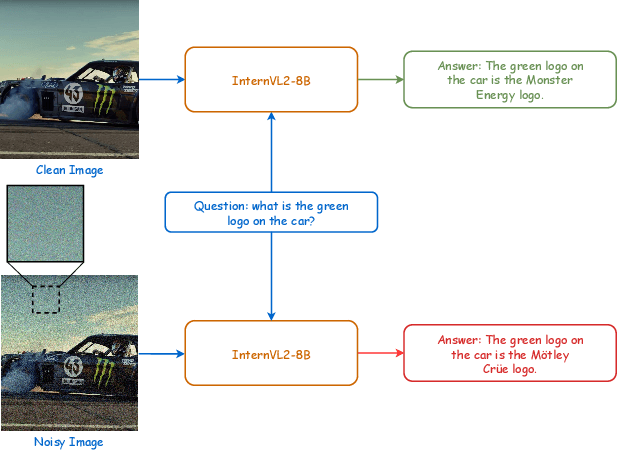

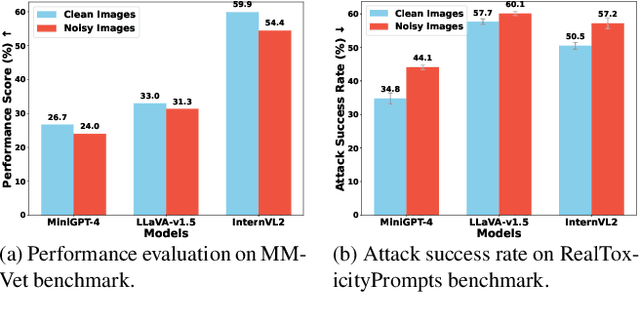
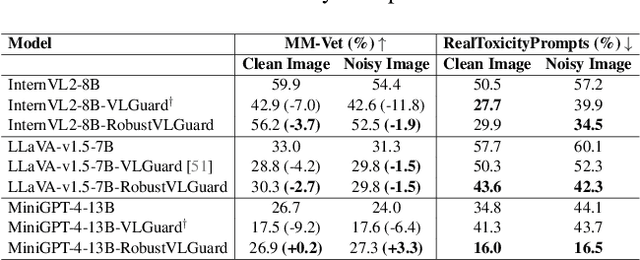
Vision-Language Models (VLMs) extend the capabilities of Large Language Models (LLMs) by incorporating visual information, yet they remain vulnerable to jailbreak attacks, especially when processing noisy or corrupted images. Although existing VLMs adopt security measures during training to mitigate such attacks, vulnerabilities associated with noise-augmented visual inputs are overlooked. In this work, we identify that missing noise-augmented training causes critical security gaps: many VLMs are susceptible to even simple perturbations such as Gaussian noise. To address this challenge, we propose Robust-VLGuard, a multimodal safety dataset with aligned / misaligned image-text pairs, combined with noise-augmented fine-tuning that reduces attack success rates while preserving functionality of VLM. For stronger optimization-based visual perturbation attacks, we propose DiffPure-VLM, leveraging diffusion models to convert adversarial perturbations into Gaussian-like noise, which can be defended by VLMs with noise-augmented safety fine-tuning. Experimental results demonstrate that the distribution-shifting property of diffusion model aligns well with our fine-tuned VLMs, significantly mitigating adversarial perturbations across varying intensities. The dataset and code are available at https://github.com/JarvisUSTC/DiffPure-RobustVLM.