 Add to Chrome
 Add to Firefox
 Add to Edge
HiFi-UMI: Learning Deployable Manipulation Policies from High-Fidelity UMI Data Alone
Jul 28, 2026
Learning deployable manipulation policies is bottlenecked by the scarcity of data that is both high-fidelity and scalable. Real-robot teleoperation is accurate but costly to scale; robot-free UMI capture scales readily, and current practice uses the resulting data mainly for pre-training, adding a small real-robot "anchor" at post-training. We ask whether raising the fidelity of robot-free UMI data, rather than shrinking the real-robot fraction, can remove that anchor. We present HiFi-UMI, a portable UMI data-production system co-designed for trajectory accuracy, inter-gripper relative pose, synchronization, and field of view: head-mounted offline stereo-inertial SLAM, native rather than reconstructed relative pose, a shared microsecond GPIO trigger, and two wide-angle cameras per hand covering ~200 degrees. It reaches 3 mm workspace-local end-effector accuracy without external tracking infrastructure. Using this corpus, we demonstrate zero-robot post-training: a policy post-trained solely on HiFi-UMI demonstrations deploys directly on a real robot and matches in-domain teleoperation across three backbones spanning the vision-language-action and world-action-model families, with success-rate differences of -2.5, +3.1, and -0.6 percentage points on StarVLA-QwenPI, OpenPI-pi_0.5, and LingBot-VA; the strongest policy reaches 85% on a precision insertion task, even though the teleoperation baseline is collected in the evaluation scene and no HiFi-UMI trajectory is. Pre-training on 4,000 hours from the same corpus lowers action error on ten unseen tasks by 41% and, on StarVLA-QwenPI, raises real-robot success by a further 18.1 percentage points. We open-source HiFi-UMI-2K, 2,000 hours of microsecond-synchronized, ultra-wide-FoV demonstrations, each automatically reconstructed and validated through simulation replay, as a large-scale, high-fidelity resource for the robot-learning community.

Mechanisms of Width Scaling in Normalized Residual Networks: The Effective Alignment Dimension
Jul 27, 2026Existing theories of neural-network width characterize asymptotic limits, but provide limited guidance on whether an expansion direction identified from finite training data remains beneficial on unseen data. We study this problem for function-preserving residual expansion and introduce the effective alignment dimension, a measurable quantity describing the signal-noise geometry of activation gradients. By deriving the exact mean and variance of the inner product between independently estimated training and test gradients, we obtain a finite-sample upper bound on misalignment probability. The bound depends only on the effective alignment dimension and an effective sample size, requiring finite second moments and a nonzero population gradient, without covariance spectral assumptions or prescribed width-growth rates. We integrate this certificate into the train-test residual-expansion framework, yielding a high-probability condition for test-risk improvement. Experiments across width-controlled LLaMA-style Transformers, Pythia, and ResNet-20 show that wider models exhibit larger effective alignment dimensions and lower empirical misalignment. Direct residual interventions confirm that the alignment statistic predicts the sign and magnitude of held-out loss changes.
Latent Diffusion Policy: Shaping Latent Spaces for Diffusion-Based Robotic Manipulation
Jun 07, 2026Diffusion-based visuomotor policies operating directly in raw action spaces conflate scene comprehension with trajectory generation within a single denoising process. The resulting velocity field must simultaneously encode scene information and generate precise trajectories, increasing learning complexity and limiting performance on tasks demanding precise temporal coordination across multiple arms. To simplify this joint learning problem, we introduce Latent Diffusion Policy (LDP), a two-stage framework performing flow matching in a deliberately shaped latent space. By absorbing scene understanding into an observation-conditioned CVAE encoder, LDP concentrates the conditional distribution of each observation. Consequently, the flow model avoids implicitly resolving scene-dependent structures; instead, it generates within a pre-concentrated distribution featuring a smoother velocity field, simplifying learning from limited demonstrations. Furthermore, to capture temporal dependencies among latent tokens, LDP trains with per-token diffusion forcing and employs staircase inference sampling to resolve the resulting distributional mismatch. We also propose reconstruction FID (rFID) as a lightweight proxy predicting downstream task success solely from latent space statistics. On coordination-intensive tasks from RoboTwin 2.0, LDP outperforms DP3 by a substantial margin and transfers effectively to real-world bimanual deployments.
PocketDP3: Efficient Pocket-Scale 3D Visuomotor Policy
Jan 29, 2026Recently, 3D vision-based diffusion policies have shown strong capability in learning complex robotic manipulation skills. However, a common architectural mismatch exists in these models: a tiny yet efficient point-cloud encoder is often paired with a massive decoder. Given a compact scene representation, we argue that this may lead to substantial parameter waste in the decoder. Motivated by this observation, we propose PocketDP3, a pocket-scale 3D diffusion policy that replaces the heavy conditional U-Net decoder used in prior methods with a lightweight Diffusion Mixer (DiM) built on MLP-Mixer blocks. This architecture enables efficient fusion across temporal and channel dimensions, significantly reducing model size. Notably, without any additional consistency distillation techniques, our method supports two-step inference without sacrificing performance, improving practicality for real-time deployment. Across three simulation benchmarks--RoboTwin2.0, Adroit, and MetaWorld--PocketDP3 achieves state-of-the-art performance with fewer than 1% of the parameters of prior methods, while also accelerating inference. Real-world experiments further demonstrate the practicality and transferability of our method in real-world settings. Code will be released.
Information Filtering via Variational Regularization for Robot Manipulation
Jan 29, 2026Diffusion-based visuomotor policies built on 3D visual representations have achieved strong performance in learning complex robotic skills. However, most existing methods employ an oversized denoising decoder. While increasing model capacity can improve denoising, empirical evidence suggests that it also introduces redundancy and noise in intermediate feature blocks. Crucially, we find that randomly masking backbone features at inference time (without changing training) can improve performance, confirming the presence of task-irrelevant noise in intermediate features. To this end, we propose Variational Regularization (VR), a lightweight module that imposes a timestep-conditioned Gaussian over backbone features and applies a KL-divergence regularizer, forming an adaptive information bottleneck. Extensive experiments on three simulation benchmarks (RoboTwin2.0, Adroit, and MetaWorld) show that, compared to the baseline DP3, our approach improves the success rate by 6.1% on RoboTwin2.0 and by 4.1% on Adroit and MetaWorld, achieving new state-of-the-art results. Real-world experiments further demonstrate that our method performs well in practical deployments. Code will released.
CKA-Guided Modular Quantization: Beyond Bit-Width to Algorithmic Diversity
Dec 18, 2025Current mainstream post-training quantization methods for large language models typically apply a uniform quantization strategy across all network layers, overlooking the substantial differences in algorithmic suitability among layers. To address this limitation, we propose CKA Guided Modular Quantization, a fine-tuning-free, plug-and-play framework for algorithmic heterogeneous quantization. Our method independently evaluates multiple PTQ algorithms on each layer and employs Linear Centered Kernel Alignment (CKA) as a metric to automatically select the optimal quantization strategy per layer. The individually optimized strategies are then integrated to construct a hybrid quantized model. Experiments demonstrate that our approach consistently outperforms both uniform quantization baselines and state-of-the-art mixed-precision methods across mainstream LLMs including LLaMA and Qwen ,in terms of perplexity (PPL) and downstream task performance.
ISS Policy : Scalable Diffusion Policy with Implicit Scene Supervision
Dec 17, 2025Vision-based imitation learning has enabled impressive robotic manipulation skills, but its reliance on object appearance while ignoring the underlying 3D scene structure leads to low training efficiency and poor generalization. To address these challenges, we introduce \emph{Implicit Scene Supervision (ISS) Policy}, a 3D visuomotor DiT-based diffusion policy that predicts sequences of continuous actions from point cloud observations. We extend DiT with a novel implicit scene supervision module that encourages the model to produce outputs consistent with the scene's geometric evolution, thereby improving the performance and robustness of the policy. Notably, ISS Policy achieves state-of-the-art performance on both single-arm manipulation tasks (MetaWorld) and dexterous hand manipulation (Adroit). In real-world experiments, it also demonstrates strong generalization and robustness. Additional ablation studies show that our method scales effectively with both data and parameters. Code and videos will be released.
STORM: Spatial-Temporal Iterative Optimization for Reliable Multicopter Trajectory Generation
Mar 05, 2025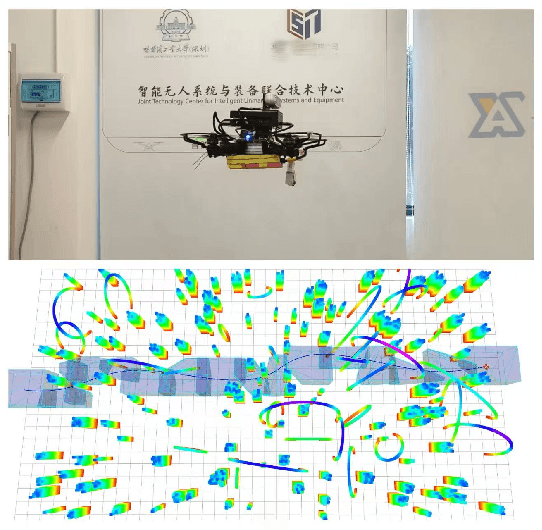
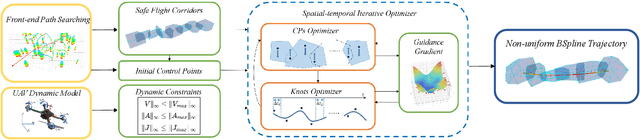
Efficient and safe trajectory planning plays a critical role in the application of quadrotor unmanned aerial vehicles. Currently, the inherent trade-off between constraint compliance and computational efficiency enhancement in UAV trajectory optimization problems has not been sufficiently addressed. To enhance the performance of UAV trajectory optimization, we propose a spatial-temporal iterative optimization framework. Firstly, B-splines are utilized to represent UAV trajectories, with rigorous safety assurance achieved through strict enforcement of constraints on control points. Subsequently, a set of QP-LP subproblems via spatial-temporal decoupling and constraint linearization is derived. Finally, an iterative optimization strategy incorporating guidance gradients is employed to obtain high-performance UAV trajectories in different scenarios. Both simulation and real-world experimental results validate the efficiency and high-performance of the proposed optimization framework in generating safe and fast trajectories. Our source codes will be released for community reference at https://hitsz-mas.github.io/STORM