 Add to Chrome
 Add to Firefox
 Add to Edge
CAGS: Color-Adaptive Volumetric Video Streaming with Dynamic 3D Gaussian Splatting
May 10, 2026
Volumetric video (VV) streaming enables real-time, immersive access to remote 3D environments, powering telepresence, ecological monitoring, and robotic teleoperation. These applications turn VV streaming into a real-time interface to remote physical environments, imposing new system-level demands for photorealistic scene representation, low-latency interaction, and robust performance under heterogeneous networks. 3D Gaussian Splatting (3DGS) has been widely used for real-time photorealistic rendering, offering superior visual quality and rendering performance, but it faces challenges due to bandwidth consumption. Furthermore, as the foundation of adaptive VV streaming, existing Levels of Detail (LoD) methods based on density are not well-suited to Gaussian representations, leading to visible gaps and severe quality degradation. Recent studies have also explored attribute compression techniques to reduce bandwidth consumption. Our preliminary studies reveal that aggressive attribute compression primarily causes color distortion, which can be effectively corrected in the rendered image using a reference image. Motivated by these findings, we propose a novel Color-Adaptive scheme for adaptive VV streaming that uses vector quantization (VQ) to establish LoDs and correct color distortions with low-resolution reference images. We further present CAGS, an adaptive VV streaming system compatible with diverse Gaussian representations, which integrates the Color-Adaptive scheme by rendering reference images on the streaming server and performing color restoration on the client. Extensive experiments on our prototype system demonstrate that CAGS outperforms the existing adaptive streaming systems in PSNR by 5$\sim$20 dB under fluctuating bandwidth, operates significantly faster than existing scalable Gaussian compression methods, and generalizes across different Gaussian representations.
* SIGGRAPH 2026 Conference Paper. Code is available at https://github.com/yindaheng98/ColorAdaptiveGaussianSplatting

ST-Prune: Training-Free Spatio-Temporal Token Pruning for Vision-Language Models in Autonomous Driving
Apr 21, 2026Vision-Language Models (VLMs) have become central to autonomous driving systems, yet their deployment is severely bottlenecked by the massive computational overhead of multi-view camera and multi-frame video input. Existing token pruning methods, primarily designed for single-image inputs, treat each frame or view in isolation and thus fail to exploit the inherent spatio-temporal redundancies in driving scenarios. To bridge this gap, we propose ST-Prune, a training-free, plug-and-play framework comprising two complementary modules: Motion-aware Temporal Pruning (MTP) and Ring-view Spatial Pruning (RSP). MTP addresses temporal redundancy by encoding motion volatility and temporal recency as soft constraints within the diversity selection objective, prioritizing dynamic trajectories and current-frame content over static historical background. RSP further resolves spatial redundancy by exploiting the ring-view camera geometry to penalize bilateral cross-view similarity, eliminating duplicate projections and residual background that temporal pruning alone cannot suppress. These two modules together constitute a complete spatio-temporal pruning process, preserving key scene information under strict compression. Validated across four benchmarks spanning perception, prediction, and planning, ST-Prune establishes new state-of-the-art for training-free token pruning. Notably, even at 90\% token reduction, ST-Prune achieves near-lossless performance with certain metrics surpassing the full-model baseline, while maintaining inference speeds comparable to existing pruning approaches.
Emotion Diffusion Classifier with Adaptive Margin Discrepancy Training for Facial Expression Recognition
Mar 31, 2026Facial Expression Recognition (FER) is essential for human-machine interaction, as it enables machines to interpret human emotions and internal states from facial affective behaviors. Although deep learning has significantly advanced FER performance, most existing deep-learning-based FER methods rely heavily on discriminative classifiers for fast predictions. These models tend to learn shortcuts and are vulnerable to even minor distribution shifts. To address this issue, we adopt a conditional generative diffusion model and introduce the Emotion Diffusion Classifier (EmoDC) for FER, which demonstrates enhanced adversarial robustness. However, retraining EmoDC using standard strategies fails to penalize incorrect categorical descriptions, leading to suboptimal recognition performance. To improve EmoDC, we propose margin-based discrepancy training, which encourages accurate predictions when conditioned on correct categorical descriptions and penalizes predictions conditioned on mismatched ones. This method enforces a minimum margin between noise-prediction errors for correct and incorrect categories, thereby enhancing the model's discriminative capability. Nevertheless, using a fixed margin fails to account for the varying difficulty of noise prediction across different images, limiting its effectiveness. To overcome this limitation, we propose Adaptive Margin Discrepancy Training (AMDiT), which dynamically adjusts the margin for each sample. Extensive experiments show that AMDiT significantly improves the accuracy of EmoDC over the Base model with standard denoising diffusion training on the RAF-DB basic subset, the RAF-DB compound subset, SFEW-2.0, and AffectNet, in 100-step evaluations. Additionally, EmoDC outperforms state-of-the-art discriminative classifiers in terms of robustness against noise and blur.
Cognitively Layered Data Synthesis for Domain Adaptation of LLMs to Space Situational Awareness
Mar 10, 2026Large language models (LLMs) demonstrate exceptional performance on general-purpose tasks. however, transferring them to complex engineering domains such as space situational awareness (SSA) remains challenging owing to insufficient structural alignment with mission chains, the absence of higher-order cognitive supervision, and poor correspondence between data quality criteria and engineering specifications. The core bottleneck is the construction of high-quality supervised fine-tuning (SFT) datasets. To this end, we propose BD-FDG (Bloom's Taxonomy-based Domain-specific Fine-tuning Data Generation), a framework that addresses incomplete knowledge coverage, shallow cognitive depth, and limited quality controllability through three mechanisms: structured knowledge organization, cognitively layered question modeling, and automated quality control. The framework uses a knowledge tree to ensure structured corpus coverage, designs a question generation scheme spanning nine categories and six cognitive levels from Remember to Create to produce samples with a continuous difficulty gradient, and applies a multidimensional scoring pipeline to enforce domain rigor and consistency. Using BD-FDG, we construct SSA-SFT, a domain dataset of approximately 230K samples, and fine-tune Qwen3-8B to obtain SSA-LLM-8B. Experiments show that SSA-LLM-8B achieves relative BLEU-1 improvements of 144\% (no-think) and 176\% (think) on the domain test set and a win rate of 82.21\% over the baseline in arena comparisons, while largely preserving general benchmark performance (MMLU-Pro, MATH-500). These results validate SFT data construction driven by cognitive layering as an effective paradigm for complex engineering domains and provide a transferable framework for domain-specific LLM adaptation.
Mamba Meets Scheduling: Learning to Solve Flexible Job Shop Scheduling with Efficient Sequence Modeling
Feb 25, 2026The Flexible Job Shop Problem (FJSP) is a well-studied combinatorial optimization problem with extensive applications for manufacturing and production scheduling. It involves assigning jobs to various machines to optimize criteria, such as minimizing total completion time. Current learning-based methods in this domain often rely on localized feature extraction models, limiting their capacity to capture overarching dependencies spanning operations and machines. This paper introduces an innovative architecture that harnesses Mamba, a state-space model with linear computational complexity, to facilitate comprehensive sequence modeling tailored for FJSP. In contrast to prevalent graph-attention-based frameworks that are computationally intensive for FJSP, we show our model is more efficient. Specifically, the proposed model possesses an encoder and a decoder. The encoder incorporates a dual Mamba block to extract operation and machine features separately. Additionally, we introduce an efficient cross-attention decoder to learn interactive embeddings of operations and machines. Our experimental results demonstrate that our method achieves faster solving speed and surpasses the performance of state-of-the-art learning-based methods for FJSP across various benchmarks.
RFM-Pose:Reinforcement-Guided Flow Matching for Fast Category-Level 6D Pose Estimation
Feb 05, 2026Object pose estimation is a fundamental problem in computer vision and plays a critical role in virtual reality and embodied intelligence, where agents must understand and interact with objects in 3D space. Recently, score based generative models have to some extent solved the rotational symmetry ambiguity problem in category level pose estimation, but their efficiency remains limited by the high sampling cost of score-based diffusion. In this work, we propose a new framework, RFM-Pose, that accelerates category-level 6D object pose generation while actively evaluating sampled hypotheses. To improve sampling efficiency, we adopt a flow-matching generative model and generate pose candidates along an optimal transport path from a simple prior to the pose distribution. To further refine these candidates, we cast the flow-matching sampling process as a Markov decision process and apply proximal policy optimization to fine-tune the sampling policy. In particular, we interpret the flow field as a learnable policy and map an estimator to a value network, enabling joint optimization of pose generation and hypothesis scoring within a reinforcement learning framework. Experiments on the REAL275 benchmark demonstrate that RFM-Pose achieves favorable performance while significantly reducing computational cost. Moreover, similar to prior work, our approach can be readily adapted to object pose tracking and attains competitive results in this setting.
Reasoning in a Combinatorial and Constrained World: Benchmarking LLMs on Natural-Language Combinatorial Optimization
Feb 02, 2026While large language models (LLMs) have shown strong performance in math and logic reasoning, their ability to handle combinatorial optimization (CO) -- searching high-dimensional solution spaces under hard constraints -- remains underexplored. To bridge the gap, we introduce NLCO, a \textbf{N}atural \textbf{L}anguage \textbf{C}ombinatorial \textbf{O}ptimization benchmark that evaluates LLMs on end-to-end CO reasoning: given a language-described decision-making scenario, the model must output a discrete solution without writing code or calling external solvers. NLCO covers 43 CO problems and is organized using a four-layer taxonomy of variable types, constraint families, global patterns, and objective classes, enabling fine-grained evaluation. We provide solver-annotated solutions and comprehensively evaluate LLMs by feasibility, solution optimality, and reasoning efficiency. Experiments across a wide range of modern LLMs show that high-performing models achieve strong feasibility and solution quality on small instances, but both degrade as instance size grows, even if more tokens are used for reasoning. We also observe systematic effects across the taxonomy: set-based tasks are relatively easy, whereas graph-structured problems and bottleneck objectives lead to more frequent failures.
From Pixels to Facts (Pix2Fact): Benchmarking Multi-Hop Reasoning for Fine-Grained Visual Fact Checking
Jan 31, 2026Despite progress on general tasks, VLMs struggle with challenges demanding both detailed visual grounding and deliberate knowledge-based reasoning, a synergy not captured by existing benchmarks that evaluate these skills separately. To close this gap, we introduce Pix2Fact, a new visual question-answering benchmark designed to evaluate expert-level perception and knowledge-intensive multi-hop reasoning. Pix2Fact contains 1,000 high-resolution (4K+) images spanning 8 daily-life scenarios and situations, with questions and answers meticulously crafted by annotators holding PhDs from top global universities working in partnership with a professional data annotation firm. Each question requires detailed visual grounding, multi-hop reasoning, and the integration of external knowledge to answer. Our evaluation of 9 state-of-the-art VLMs, including proprietary models like Gemini-3-Pro and GPT-5, reveals the substantial challenge posed by Pix2Fact: the most advanced model achieves only 24.0% average accuracy, in stark contrast to human performance of 56%. This significant gap underscores the limitations of current models in replicating human-level visual comprehension. We believe Pix2Fact will serve as a critical benchmark to drive the development of next-generation multimodal agents that combine fine-grained perception with robust, knowledge-based reasoning.
Divide-and-Conquer Decoupled Network for Cross-Domain Few-Shot Segmentation
Nov 11, 2025Cross-domain few-shot segmentation (CD-FSS) aims to tackle the dual challenge of recognizing novel classes and adapting to unseen domains with limited annotations. However, encoder features often entangle domain-relevant and category-relevant information, limiting both generalization and rapid adaptation to new domains. To address this issue, we propose a Divide-and-Conquer Decoupled Network (DCDNet). In the training stage, to tackle feature entanglement that impedes cross-domain generalization and rapid adaptation, we propose the Adversarial-Contrastive Feature Decomposition (ACFD) module. It decouples backbone features into category-relevant private and domain-relevant shared representations via contrastive learning and adversarial learning. Then, to mitigate the potential degradation caused by the disentanglement, the Matrix-Guided Dynamic Fusion (MGDF) module adaptively integrates base, shared, and private features under spatial guidance, maintaining structural coherence. In addition, in the fine-tuning stage, to enhanced model generalization, the Cross-Adaptive Modulation (CAM) module is placed before the MGDF, where shared features guide private features via modulation ensuring effective integration of domain-relevant information. Extensive experiments on four challenging datasets show that DCDNet outperforms existing CD-FSS methods, setting a new state-of-the-art for cross-domain generalization and few-shot adaptation.
Three-Stage Composite Outlier Identification of Wind Power Data: Integrating Physical Rules with Regression Learning and Mathematical Morphology
Apr 30, 2025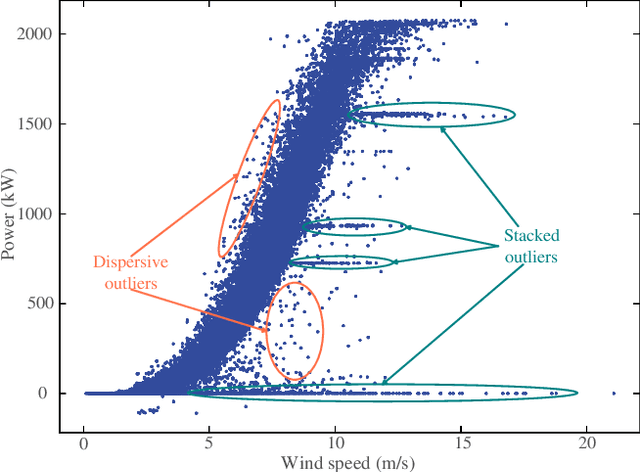
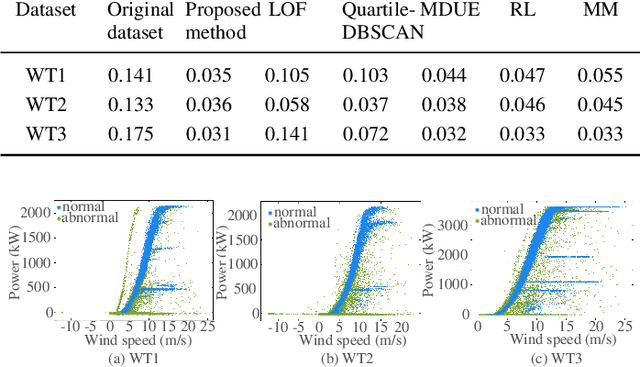
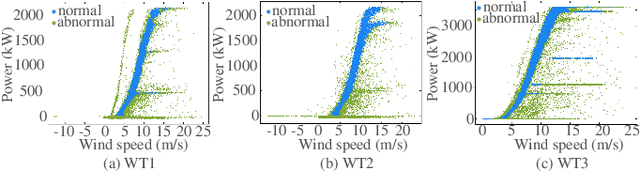
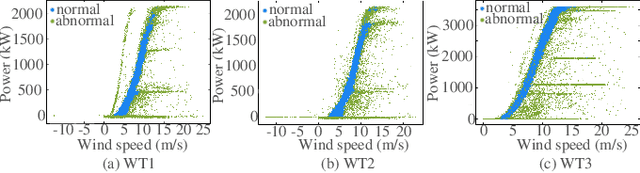
Existing studies on identifying outliers in wind speed-power datasets are often challenged by the complicated and irregular distributions of outliers, especially those being densely stacked yet staying close to normal data. This could degrade their identification reliability and robustness in practice. To address this defect, this paper develops a three-stage composite outlier identification method by systematically integrating three complementary techniques, i.e., physical rule-based preprocessing, regression learning-enabled detection, and mathematical morphology-based refinement. Firstly, the raw wind speed-power data are preprocessed via a set of simple yet efficient physical rules to filter out some outliers obviously going against the physical operating laws of practical wind turbines. Secondly, a robust wind speed-power regression learning model is built upon the random sample consensus algorithm. This model is able to reliably detect most outliers with the help of an adaptive threshold automatically set by the interquartile range method. Thirdly, by representing the wind speed-power data distribution with a two-dimensional image, mathematical morphology operations are applied to perform refined outlier identification from a data distribution perspective. This technique can identify outliers that are not effectively detected in the first two stages, including those densely stacked ones near normal data points. By integrating the above three techniques, the whole method is capable of identifying various types of outliers in a reliable and adaptive manner. Numerical test results with wind power datasets acquired from distinct wind turbines in practice and from simulation environments extensively demonstrate the superiority of the proposed method as well as its potential in enhancing wind power prediction.