 Add to Chrome
 Add to Firefox
 Add to Edge
Last But Not Least: Boundary Attention CalibratiON for Multimodal KV Cache Compression
Jun 16, 2026
Multimodal Large Language Models (MLLMs) achieve strong vision-language reasoning, but long visual contexts enlarge the KV cache and increase decoding latency. Existing compression methods rely on observation window attention for stable token-importance estimation, yet this aggregation can dilute sparse visual evidence and discard answer-critical tokens under aggressive compression. Therefore, we identify last-query attention as a complementary source for recovering such evidence, but its answer-irrelevant signals can mislead retention. We propose BACON, a plug-and-play method that calibrates observation window attention with last-query evidence and suppresses isolated noise via intra-layer coherence and inter-layer persistence. Across diverse benchmarks, models, budgets, and compression methods, BACON improves multimodal KV compression by 7.5% on average under the most aggressive budget, with gains up to 30.9%. Our project page is available at https://ryu1ion.github.io/official_BACON/

Beyond Uniform Token-Level Trust Region in LLM Reinforcement Learning
Jun 09, 2026Reinforcement learning with verifiable rewards (RLVR) has become standard for improving LLM reasoning. However, existing PPO-style trust-region mechanisms remain position-agnostic by enforcing uniform thresholds across all tokens independently. This pointwise treatment conflicts with autoregressive generation in two critical ways. First, uniform thresholds ignore autoregressive asymmetry. Early-stage deviations produce compounding sequence-level drift, causing static thresholds to under-regulate early divergence and excessively constrain late-stage exploration. Second, evaluating token-level divergence in isolation overlooks cumulative prefix drift, granting the same divergence allowance regardless of how far the conditioning history has already deviated from the rollout policy. To address this limitation, we propose CPPO (Cumulative Prefix-divergence Policy Optimization), a token-level masking rule that aligns updates with a finite-horizon policy-improvement bound via two coupled mechanisms. First, a position-weighted threshold imposes stricter limits at early positions whose effects persist longer, relaxing constraints for late-stage tokens. Second, a cumulative prefix budget tracks historical deviations, dynamically restricting further token-level deviation to prevent compounding errors along the prefix. Empirically, CPPO enhances training stability and significantly improves reasoning accuracy across various model scales.
LACO: Adaptive Latent Communication for Collaborative Driving
May 21, 2026Collaborative driving aims to improve safety and efficiency by enabling connected vehicles to coordinate under partial observability. Recent approaches have evolved from sharing visual features for perception to exchanging language-based reasoning through foundation models for behavioral coordination. Though communicating in language provides intuitive information, it introduces two challenges: high latency caused by autoregressive decoding and information loss caused by compressing rich internal representations into discrete tokens. To address these challenges, we analyze latent communication in collaborative driving under inherent limitations of multi-agent settings. Our analysis reveals agent identity confusion, where direct fusion of latent states entangles decision representations across vehicles. Motivated by this, we propose LACO, a training-free \textbf{LA}tent \textbf{CO}mmunication paradigm that seamlessly adapts pretrained driving models to collaborative settings. LACO introduces Iterative Latent Deliberation (ILD) for latent reasoning, Cross-Horizon Saliency Attribution (CHSA) for communication-efficient information selection, and Structured Semantic Knowledge Distillation (SSKD) to stabilize ego-centric decision making. Closed-loop experiments in CARLA show that LACO notably reduces communication and inference latency while maintaining strong collaborative driving performance.
Delta Forcing: Trust Region Steering for Interactive Autoregressive Video Generation
May 14, 2026Interactive real-time autoregressive video generation is essential for applications such as content creation and world modeling, where visual content must adapt to dynamically evolving event conditions. A fundamental challenge lies in balancing reactivity and stability: models must respond promptly to new events while maintaining temporal coherence over long horizons. Existing approaches distill bidirectional models into autoregressive generators and further adapt them via streaming long tuning, yet often exhibit persistent drift after condition changes. We identify the cause as conditional bias, where the teacher may provide condition-aligned but trajectory-agnostic guidance, biasing generation toward locally valid yet globally inconsistent modes. Inspired by Trust Region Policy Optimization, we propose Delta Forcing, a simple yet effective framework that constrains unreliable teacher supervision within an adaptive trust region. Specifically, Delta Forcing estimates transition consistency from the latent delta between teacher and generator trajectories, and uses it to balance teacher supervision with a monotonic continuity objective. This suppress unreliable teacher-induced shifts while preserving responsiveness to new events. Extensive experiments demonstrate that Delta Forcing significantly improves consistency while maintaining event reactivity.
AgenticCache: Cache-Driven Asynchronous Planning for Embodied AI Agents
Apr 27, 2026Embodied AI agents increasingly rely on large language models (LLMs) for planning, yet per-step LLM calls impose severe latency and cost. In this paper, we show that embodied tasks exhibit strong plan locality, where the next plan is largely predictable from the current one. Building on this, we introduce AgenticCache, a planning framework that reuses cached plans to avoid per-step LLM calls. In AgenticCache, each agent queries a runtime cache of frequent plan transitions, while a background Cache Updater asynchronously calls the LLM to validate and refine cached entries. Across four multi-agent embodied benchmarks, AgenticCache improves task success rate by 22% on average across 12 configurations (4 benchmarks x 3 models), reduces simulation latency by 65%, and lowers token usage by 50%. Cache-based plan reuse thus offers a practical path to low-latency, low-cost embodied agents. Code is available at https://github.com/hojoonleokim/MLSys26_AgenticCache.
PISCO: Precise Video Instance Insertion with Sparse Control
Feb 09, 2026The landscape of AI video generation is undergoing a pivotal shift: moving beyond general generation - which relies on exhaustive prompt-engineering and "cherry-picking" - towards fine-grained, controllable generation and high-fidelity post-processing. In professional AI-assisted filmmaking, it is crucial to perform precise, targeted modifications. A cornerstone of this transition is video instance insertion, which requires inserting a specific instance into existing footage while maintaining scene integrity. Unlike traditional video editing, this task demands several requirements: precise spatial-temporal placement, physically consistent scene interaction, and the faithful preservation of original dynamics - all achieved under minimal user effort. In this paper, we propose PISCO, a video diffusion model for precise video instance insertion with arbitrary sparse keyframe control. PISCO allows users to specify a single keyframe, start-and-end keyframes, or sparse keyframes at arbitrary timestamps, and automatically propagates object appearance, motion, and interaction. To address the severe distribution shift induced by sparse conditioning in pretrained video diffusion models, we introduce Variable-Information Guidance for robust conditioning and Distribution-Preserving Temporal Masking to stabilize temporal generation, together with geometry-aware conditioning for realistic scene adaptation. We further construct PISCO-Bench, a benchmark with verified instance annotations and paired clean background videos, and evaluate performance using both reference-based and reference-free perceptual metrics. Experiments demonstrate that PISCO consistently outperforms strong inpainting and video editing baselines under sparse control, and exhibits clear, monotonic performance improvements as additional control signals are provided. Project page: xiangbogaobarry.github.io/PISCO.
ARGaze: Autoregressive Transformers for Online Egocentric Gaze Estimation
Feb 04, 2026Online egocentric gaze estimation predicts where a camera wearer is looking from first-person video using only past and current frames, a task essential for augmented reality and assistive technologies. Unlike third-person gaze estimation, this setting lacks explicit head or eye signals, requiring models to infer current visual attention from sparse, indirect cues such as hand-object interactions and salient scene content. We observe that gaze exhibits strong temporal continuity during goal-directed activities: knowing where a person looked recently provides a powerful prior for predicting where they look next. Inspired by vision-conditioned autoregressive decoding in vision-language models, we propose ARGaze, which reformulates gaze estimation as sequential prediction: at each timestep, a transformer decoder predicts current gaze by conditioning on (i) current visual features and (ii) a fixed-length Gaze Context Window of recent gaze target estimates. This design enforces causality and enables bounded-resource streaming inference. We achieve state-of-the-art performance across multiple egocentric benchmarks under online evaluation, with extensive ablations validating that autoregressive modeling with bounded gaze history is critical for robust prediction. We will release our source code and pre-trained models.
LLM-FSM: Scaling Large Language Models for Finite-State Reasoning in RTL Code Generation
Feb 03, 2026Finite-state reasoning, the ability to understand and implement state-dependent behavior, is central to hardware design. In this paper, we present LLM-FSM, a benchmark that evaluates how well large language models (LLMs) can recover finite-state machine (FSM) behavior from natural-language specifications and translate it into correct register transfer-level (RTL) implementations. Unlike prior specification-to-RTL benchmarks that rely on manually constructed examples, LLM-FSM is built through a fully automated pipeline. LLM-FSM first constructs FSM with configurable state counts and constrained transition structures. It then prompts LLMs to express each FSM in a structured YAML format with an application context, and to further convert that YAML into a natural-language (NL) specification. From the same YAML, our pipeline synthesizes the reference RTL and testbench in a correct-by-construction manner. All 1,000 problems are verified using LLM-based and SAT-solver-based checks, with human review on a subset. Our experiments show that even the strongest LLMs exhibit sharply declining accuracy as FSM complexity increases. We further demonstrate that training-time scaling via supervised fine-tuning (SFT) generalizes effectively to out-of-distribution (OOD) tasks, while increasing test-time compute improves reasoning reliability. Finally, LLM-FSM remains extensible by allowing its FSM complexity to scale with future model capabilities.
AI-Driven Prediction of Cancer Pain Episodes: A Hybrid Decision Support Approach
Dec 18, 2025Lung cancer patients frequently experience breakthrough pain episodes, with up to 91% requiring timely intervention. To enable proactive pain management, we propose a hybrid machine learning and large language model pipeline that predicts pain episodes within 48 and 72 hours of hospitalization using both structured and unstructured electronic health record data. A retrospective cohort of 266 inpatients was analyzed, with features including demographics, tumor stage, vital signs, and WHO-tiered analgesic use. The machine learning module captured temporal medication trends, while the large language model interpreted ambiguous dosing records and free-text clinical notes. Integrating these modalities improved sensitivity and interpretability. Our framework achieved an accuracy of 0.874 (48h) and 0.917 (72h), with an improvement in sensitivity of 8.6% and 10.4% due to the augmentation of large language model. This hybrid approach offers a clinically interpretable and scalable tool for early pain episode forecasting, with potential to enhance treatment precision and optimize resource allocation in oncology care.
P3-LLM: An Integrated NPU-PIM Accelerator for LLM Inference Using Hybrid Numerical Formats
Nov 16, 2025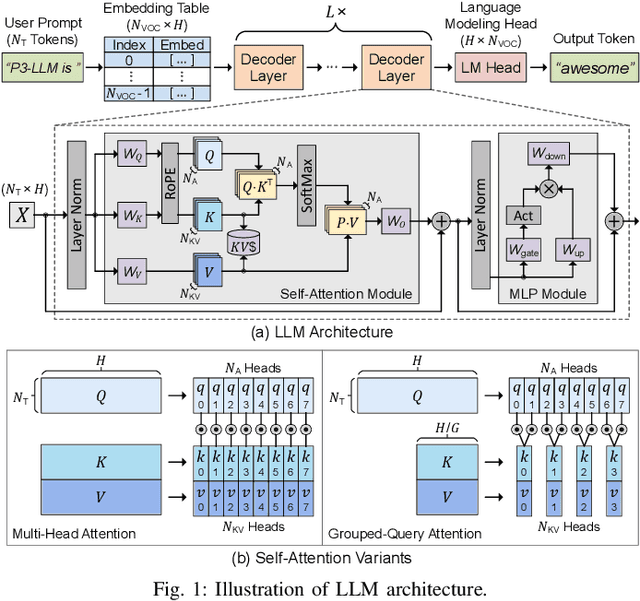
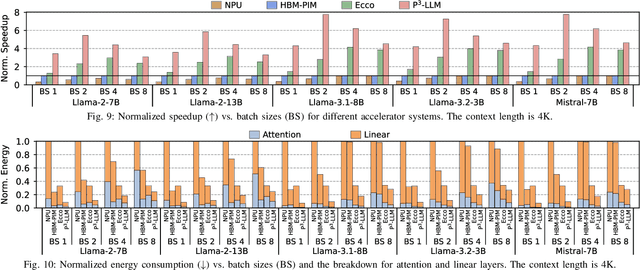
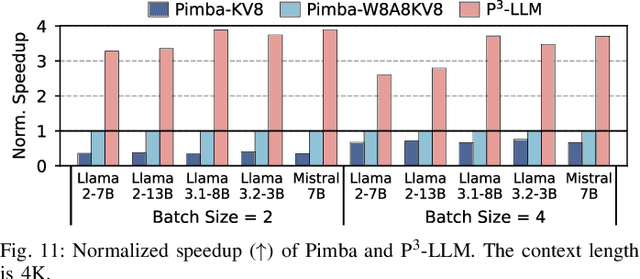
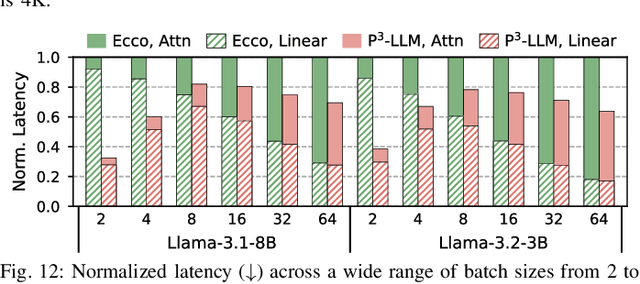
The substantial memory bandwidth and computational demands of large language models (LLMs) present critical challenges for efficient inference. To tackle this, the literature has explored heterogeneous systems that combine neural processing units (NPUs) with DRAM-based processing-in-memory (PIM) for LLM acceleration. However, existing high-precision (e.g., FP16) PIM compute units incur significant area and power overhead in DRAM technology, limiting the effective computation throughput. In this paper, we introduce P3-LLM, a novel NPU-PIM integrated accelerator for LLM inference using hybrid numerical formats. Our approach is threefold: First, we propose a flexible mixed-precision quantization scheme, which leverages hybrid numerical formats to quantize different LLM operands with high compression efficiency and minimal accuracy loss. Second, we architect an efficient PIM accelerator for P3-LLM, featuring enhanced compute units to support hybrid numerical formats. Our careful choice of numerical formats allows to co-design low-precision PIM compute units that significantly boost the computation throughput under iso-area constraints. Third, we optimize the low-precision dataflow of different LLM modules by applying operator fusion to minimize the overhead of runtime dequantization. Evaluation on a diverse set of representative LLMs and tasks demonstrates that P3-LLM achieves state-of-the-art accuracy in terms of both KV-cache quantization and weight-activation quantization. Combining the proposed quantization scheme with PIM architecture co-design, P3-LLM yields an average of $4.9\times$, $2.0\times$, and $3.4\times$ speedups over the state-of-the-art LLM accelerators HBM-PIM, Ecco, and Pimba, respectively. Our quantization code is available at https://github.com/yc2367/P3-LLM.git