 Add to Chrome
 Add to Firefox
 Add to Edge
Beyond Myopic World Models: Long-Horizon End-to-End Training for Direct Future Prediction
Aug 07, 2026
World models are expected to support imagination over extended temporal horizons, yet most are still trained through local few-step prediction objectives and deployed by recursively rolling out their own predictions. This creates a fundamental mismatch: few-step losses optimize local transition fidelity, while long-horizon prediction depends on how errors and gradients propagate through the entire trajectory. As a result, transitions with different downstream influence on the endpoint are treated uniformly during training, and small local errors are amplified through recursive inference. We argue that long-horizon accuracy is better achieved by optimizing directly, through an end-to-end endpoint prediction objective. To instantiate this paradigm, we introduce the Direct Prediction World Model (DPWM), a non-recursive architecture that compresses an action sequence of arbitrary length into a single embedding and predicts the endpoint observation in a single forward pass. This design avoids recurrent rollout in both prediction and gradient propagation, making long-horizon end-to-end training practical at horizons where unrolled autoregressive training becomes unstable. Empirically, DPWM substantially improves long-horizon endpoint prediction over recursive world-model baselines on continuous-control and pixel-based benchmarks, with larger gains as the prediction horizon increases. We further show that recurrent baselines benefit similarly when retrained with the same long-horizon endpoint objective, supporting our central claim that the training objective, rather than the particular backbone choice, is the main driver of long-horizon prediction accuracy. Our results suggest that world models can benefit from being trained and evaluated at the temporal scales where they are ultimately used, shifting the focus from local transition modeling toward long-horizon predictive accuracy.

Concept-Guided Spatial Regularization for World Models in Atari Pong
Jul 16, 2026World models are usually evaluated as components of model-based reinforcement learning (MBRL) systems, while the world models themselves are rarely studied in isolation. We examine five representative visual world-model agents in Atari Pong: DreamerV3, DIAMOND, TWISTER, Simulus, and STORM. After reproducing their training pipelines and matching the reported agent performance, we freeze the learned world models and evaluate them with a closed-loop rollout diagnostic: a policy trained separately from the corresponding MBRL agent interacts with each frozen model, and the generated video trajectories are inspected for visual and dynamical errors. Across all five models, the rollouts contain clear failures, including ball disappearance, incorrect ball motion, and invalid ball-paddle interactions. Beyond visual trajectories, we further evaluate them with pixel-space zero-shot MBRL, where a new policy is trained entirely inside a frozen world model and then evaluated in the real environment. Across all five models, the resulting policies substantially underperform those produced by the corresponding original MBRL training pipelines. The gap is particularly large for DreamerV3, whose mean return drops from -5.5 to -20.9, near the minimum Pong return of -21. We hypothesize that insufficient modeling of task-critical concepts, such as the ball in Pong, may contribute to these failures. We therefore propose Concept-Guided Spatial Regularization (CGSReg), an auxiliary pixel reconstruction loss applied to segmented concept regions. Experiments show that CGSReg improves both closed-loop rollouts and pixel-space zero-shot MBRL in DreamerV3, DIAMOND, and TWISTER. Its effects vary across the remaining models and evaluation metrics, indicating that CGSReg alone does not address all world-model bottlenecks.
MotionPyramid: Hierarchical Motion Representation and Residual Interfaces
Jun 15, 2026We ask whether the representational hierarchy seen in perception, from local primitives such as edges to higher level structures such as parts and objects, can be established for motion. In humanoid control, low level actions specify immediate motor commands, while meaningful behavior is organized over longer temporal scales, including contacts, gait fragments, balance recovery, reaching, and whole body skills. We introduce MotionPyramid, a hierarchical action representation that learns such structure from motion data. Starting from a motion tracking teacher, it trains a recursive stack of latent decoders: low level latents decode to immediate full body motor commands, while higher level latents unfold through lower levels into temporally extended motion programs. After pretraining, the hierarchy is frozen and reused by downstream reinforcement learning policies as a family of action interfaces at different control resolutions. Experiments show the learned levels form a motion hierarchy: coarser interfaces improve early learning and motion regularity by constraining exploration to structured segments, while finer interfaces preserve feedback control and final task precision. Representation probes show the hierarchy supports traversal, interpolation, transition, and qualitative composition, exposing editable control handles across temporal scales. Finally, we introduce Residual Interfaces, letting a downstream policy maintain coarse, segment level, and frame level residual commands through the frozen hierarchy. Analogous to residual or skip connections in deep networks, this allows coarse motion programs and fine residual corrections to coexist within one controller. MotionPyramid shows that motion, like perception, can be organized into a reusable multi level representation, providing structured abstraction without sacrificing controllability.
How Do Large Language Models Learn Concepts During Continual Pre-Training?
Jan 07, 2026Human beings primarily understand the world through concepts (e.g., dog), abstract mental representations that structure perception, reasoning, and learning. However, how large language models (LLMs) acquire, retain, and forget such concepts during continual pretraining remains poorly understood. In this work, we study how individual concepts are acquired and forgotten, as well as how multiple concepts interact through interference and synergy. We link these behavioral dynamics to LLMs' internal Concept Circuits, computational subgraphs associated with specific concepts, and incorporate Graph Metrics to characterize circuit structure. Our analysis reveals: (1) LLMs concept circuits provide a non-trivial, statistically significant signal of concept learning and forgetting; (2) Concept circuits exhibit a stage-wise temporal pattern during continual pretraining, with an early increase followed by gradual decrease and stabilization; (3) concepts with larger learning gains tend to exhibit greater forgetting under subsequent training; (4) semantically similar concepts induce stronger interference than weakly related ones; (5) conceptual knowledge differs in their transferability, with some significantly facilitating the learning of others. Together, our findings offer a circuit-level view of concept learning dynamics and inform the design of more interpretable and robust concept-aware training strategies for LLMs.
Clone Deterministic 3D Worlds with Geometrically-Regularized World Models
Oct 30, 2025A world model is an internal model that simulates how the world evolves. Given past observations and actions, it predicts the future of both the embodied agent and its environment. Accurate world models are essential for enabling agents to think, plan, and reason effectively in complex, dynamic settings. Despite rapid progress, current world models remain brittle and degrade over long horizons. We argue that a central cause is representation quality: exteroceptive inputs (e.g., images) are high-dimensional, and lossy or entangled latents make dynamics learning unnecessarily hard. We therefore ask whether improving representation learning alone can substantially improve world-model performance. In this work, we take a step toward building a truly accurate world model by addressing a fundamental yet open problem: constructing a model that can fully clone and overfit to a deterministic 3D world. We propose Geometrically-Regularized World Models (GRWM), which enforces that consecutive points along a natural sensory trajectory remain close in latent representation space. This approach yields significantly improved latent representations that align closely with the true topology of the environment. GRWM is plug-and-play, requires only minimal architectural modification, scales with trajectory length, and is compatible with diverse latent generative backbones. Across deterministic 3D settings and long-horizon prediction tasks, GRWM significantly increases rollout fidelity and stability. Analyses show that its benefits stem from learning a latent manifold with superior geometric structure. These findings support a clear takeaway: improving representation learning is a direct and useful path to robust world models, delivering reliable long-horizon predictions without enlarging the dynamics module.
Enhancing the Scalability and Applicability of Kohn-Sham Hamiltonians for Molecular Systems
Feb 26, 2025Density Functional Theory (DFT) is a pivotal method within quantum chemistry and materials science, with its core involving the construction and solution of the Kohn-Sham Hamiltonian. Despite its importance, the application of DFT is frequently limited by the substantial computational resources required to construct the Kohn-Sham Hamiltonian. In response to these limitations, current research has employed deep-learning models to efficiently predict molecular and solid Hamiltonians, with roto-translational symmetries encoded in their neural networks. However, the scalability of prior models may be problematic when applied to large molecules, resulting in non-physical predictions of ground-state properties. In this study, we generate a substantially larger training set (PubChemQH) than used previously and use it to create a scalable model for DFT calculations with physical accuracy. For our model, we introduce a loss function derived from physical principles, which we call Wavefunction Alignment Loss (WALoss). WALoss involves performing a basis change on the predicted Hamiltonian to align it with the observed one; thus, the resulting differences can serve as a surrogate for orbital energy differences, allowing models to make better predictions for molecular orbitals and total energies than previously possible. WALoss also substantially accelerates self-consistent-field (SCF) DFT calculations. Here, we show it achieves a reduction in total energy prediction error by a factor of 1347 and an SCF calculation speed-up by a factor of 18%. These substantial improvements set new benchmarks for achieving accurate and applicable predictions in larger molecular systems.
Efficient and Scalable Density Functional Theory Hamiltonian Prediction through Adaptive Sparsity
Feb 03, 2025Hamiltonian matrix prediction is pivotal in computational chemistry, serving as the foundation for determining a wide range of molecular properties. While SE(3) equivariant graph neural networks have achieved remarkable success in this domain, their substantial computational cost-driven by high-order tensor product (TP) operations-restricts their scalability to large molecular systems with extensive basis sets. To address this challenge, we introduce SPHNet, an efficient and scalable equivariant network that incorporates adaptive sparsity into Hamiltonian prediction. SPHNet employs two innovative sparse gates to selectively constrain non-critical interaction combinations, significantly reducing tensor product computations while maintaining accuracy. To optimize the sparse representation, we develop a Three-phase Sparsity Scheduler, ensuring stable convergence and achieving high performance at sparsity rates of up to 70 percent. Extensive evaluations on QH9 and PubchemQH datasets demonstrate that SPHNet achieves state-of-the-art accuracy while providing up to a 7x speedup over existing models. Beyond Hamiltonian prediction, the proposed sparsification techniques also hold significant potential for improving the efficiency and scalability of other SE(3) equivariant networks, further broadening their applicability and impact.
Self-Supervised Learning for Building Damage Assessment from Large-scale xBD Satellite Imagery Benchmark Datasets
Jun 01, 2022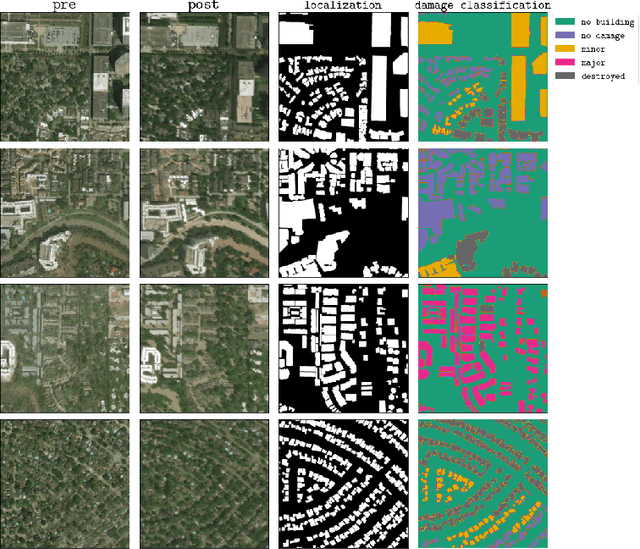
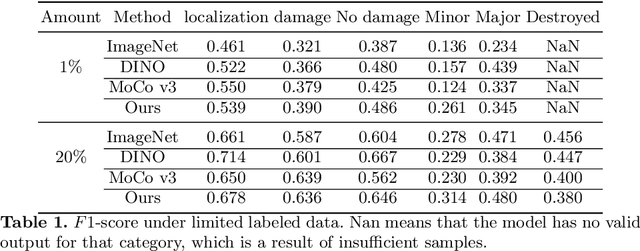
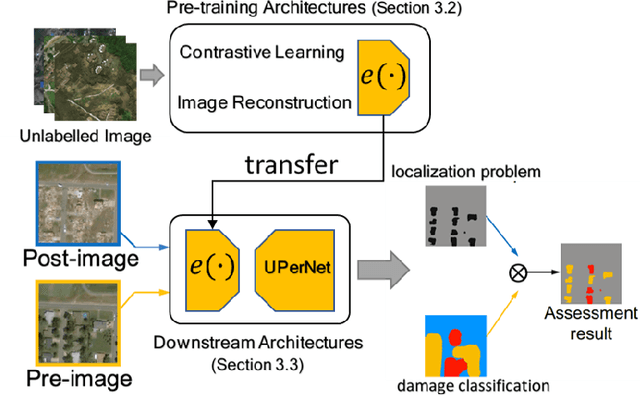
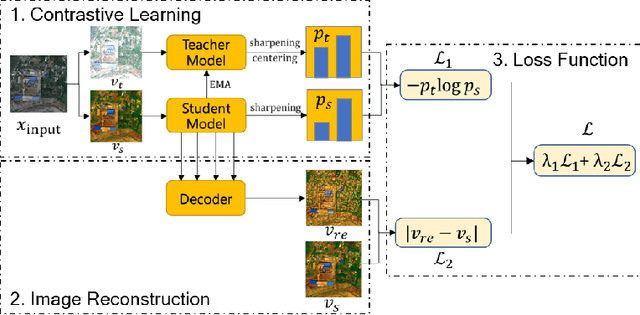
In the field of post-disaster assessment, for timely and accurate rescue and localization after a disaster, people need to know the location of damaged buildings. In deep learning, some scholars have proposed methods to make automatic and highly accurate building damage assessments by remote sensing images, which are proved to be more efficient than assessment by domain experts. However, due to the lack of a large amount of labeled data, these kinds of tasks can suffer from being able to do an accurate assessment, as the efficiency of deep learning models relies highly on labeled data. Although existing semi-supervised and unsupervised studies have made breakthroughs in this area, none of them has completely solved this problem. Therefore, we propose adopting a self-supervised comparative learning approach to address the task without the requirement of labeled data. We constructed a novel asymmetric twin network architecture and tested its performance on the xBD dataset. Experiment results of our model show the improvement compared to baseline and commonly used methods. We also demonstrated the potential of self-supervised methods for building damage recognition awareness.