 Add to Chrome
 Add to Firefox
 Add to Edge
TRACER: Token ReAssignment for Concept ERasure in Generative Recommendation
Jun 05, 2026
Generative recommendation formulates next-item prediction as autoregressive generation over semantic ID (SID) sequences derived from users' historical interactions, making modern recommender systems structurally similar to large language models (LLMs). As privacy and safety concerns grow, these systems increasingly require concept unlearning to remove sensitive or harmful concepts associated with items. However, existing LLM unlearning methods cannot be directly applied to generative recommendation. Unlike word tokens with explicit semantics, SIDs are abstract identifiers that are often shared by both forget and retain items, leading to severe conflicts between concept removal and recommendation utility preservation. To address this challenge, we propose TRACER, an end-to-end concept unlearning framework based on token reassignment. Rather than directly suppressing shared SIDs, TRACER reassigns concept-related items to alternative tokens that better facilitate forgetting while minimizing side effects on retained items. We further introduce a coherence regularizer to preserve semantic consistency among retain items during unlearning. Experiments on real-world recommendation datasets demonstrate that TRACER effectively removes target concepts while substantially better preserving recommendation utility than existing unlearning baselines.

LLM-HYPER: Generative CTR Modeling for Cold-Start Ad Personalization via LLM-Based Hypernetworks
Apr 13, 2026On online advertising platforms, newly introduced promotional ads face the cold-start problem, as they lack sufficient user feedback for model training. In this work, we propose LLM-HYPER, a novel framework that treats large language models (LLMs) as hypernetworks to directly generate the parameters of the click-through rate (CTR) estimator in a training-free manner. LLM-HYPER uses few-shot Chain-of-Thought prompting over multimodal ad content (text and images) to infer feature-wise model weights for a linear CTR predictor. By retrieving semantically similar past campaigns via CLIP embeddings and formatting them into prompt-based demonstrations, the LLM learns to reason about customer intent, feature influence, and content relevance. To ensure numerical stability and serviceability, we introduce normalization and calibration techniques that align the generated weights with production-ready CTR distributions. Extensive offline experiments show that LLM-HYPER significantly outperforms cold-start baselines in NDCG$@10$ by 55.9\%. Our real-world online A/B test on one of the top e-commerce platforms in the U.S. demonstrates the strong performance of LLM-HYPER, which drastically reduces the cold-start period and achieves competitive performance. LLM-HYPER has been successfully deployed in production.
CRAB: Codebook Rebalancing for Bias Mitigation in Generative Recommendation
Apr 06, 2026Generative recommendation (GeneRec) has introduced a new paradigm that represents items as discrete semantic tokens and predicts items in a generative manner. Despite its strong performance across multiple recommendation tasks, existing GeneRec approaches still suffer from severe popularity bias and may even exacerbate it. In this work, we conduct a comprehensive empirical analysis to uncover the root causes of this phenomenon, yielding two core insights: 1) imbalanced tokenization inherits and can further amplify popularity bias from historical item interactions; 2) current training procedures disproportionately favor popular tokens while neglecting semantic relationships among tokens, thereby intensifying popularity bias. Building on these insights, we propose CRAB, a post-hoc debiasing strategy for GeneRec that alleviates popularity bias by mitigating frequency imbalance among semantic tokens. Specifically, given a well-trained model, we first rebalance the codebook by splitting over-popular tokens while preserving their hierarchical semantic structure. Based on the adjusted codebook, we further introduce a tree-structured regularizer to enhance semantic consistency, encouraging more informative representations for unpopular tokens during training. Experiments on real-world datasets demonstrate that CRAB significantly improves recommendation performance by effectively alleviating popularity bias.
CURE:Circuit-Aware Unlearning for LLM-based Recommendation
Apr 04, 2026Recent advances in large language models (LLMs) have opened new opportunities for recommender systems by enabling rich semantic understanding and reasoning about user interests and item attributes. However, as privacy regulations tighten, incorporating user data into LLM-based recommendation (LLMRec) introduces significant privacy risks, making unlearning algorithms increasingly crucial for practical deployment. Despite growing interest in LLMRec unlearning, most existing approaches formulate unlearning as a weighted combination of forgetting and retaining objectives while updating model parameters in a uniform manner. Such formulations inevitably induce gradient conflicts between the two objectives, leading to unstable optimization and resulting in either ineffective unlearning or severe degradation of model utility. Moreover, the unlearning procedure remains largely black-box, undermining its transparency and trustworthiness. To tackle these challenges, we propose CURE, a circuit-aware unlearning framework that disentangles model components into functionally distinct subsets and selectively updates them. Here, a circuit refers to a computational subgraph that is causally responsible for task-specific behaviors. Specifically, we extract the core circuits underlying item recommendation and analyze how individual modules within these circuits contribute to the forget and retain objectives. Based on this analysis, these modules are categorized into forget-specific, retain-specific, and task-shared groups, each subject to function-specific update rules to mitigate gradient conflicts during unlearning. Experiments on real-world datasets show that our approach achieves more effective unlearning than existing baselines.
Segment and Matte Anything in a Unified Model
Jan 17, 2026Segment Anything (SAM) has recently pushed the boundaries of segmentation by demonstrating zero-shot generalization and flexible prompting after training on over one billion masks. Despite this, its mask prediction accuracy often falls short of the precision required in real-world applications. While several refinement modules have been proposed to boost SAM's segmentation quality, achieving highly accurate object delineation within a single, unified framework remains an open challenge. Furthermore, interactive image matting, which aims to generate fine-grained alpha mattes guided by diverse user hints, has not yet been explored in the context of SAM. Insights from recent studies highlight strong correlations between segmentation and matting, suggesting the feasibility of a unified model capable of both tasks. In this paper, we introduce Segment And Matte Anything (SAMA), a lightweight extension of SAM that delivers high-quality interactive image segmentation and matting with minimal extra parameters. Our Multi-View Localization Encoder (MVLE) captures detailed features from local views, while the Localization Adapter (Local-Adapter) refines mask outputs by recovering subtle boundary details. We also incorporate two prediction heads for each task into the architecture to generate segmentation and matting masks, simultaneously. Trained on a diverse dataset aggregated from publicly available sources, SAMA achieves state-of-the-art performance across multiple segmentation and matting benchmarks, showcasing its adaptability and effectiveness in a wide range of downstream tasks.
Triple Modality Fusion: Aligning Visual, Textual, and Graph Data with Large Language Models for Multi-Behavior Recommendations
Oct 16, 2024
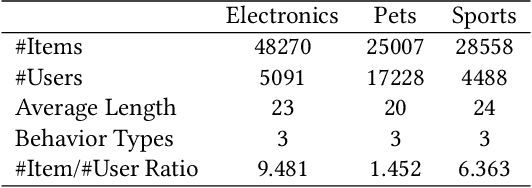
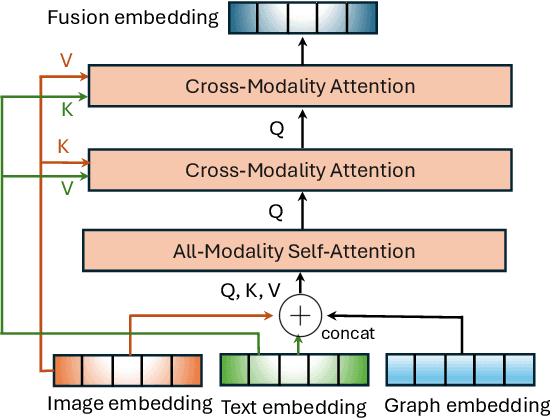
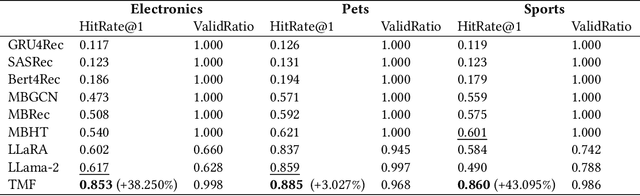
Integrating diverse data modalities is crucial for enhancing the performance of personalized recommendation systems. Traditional models, which often rely on singular data sources, lack the depth needed to accurately capture the multifaceted nature of item features and user behaviors. This paper introduces a novel framework for multi-behavior recommendations, leveraging the fusion of triple-modality, which is visual, textual, and graph data through alignment with large language models (LLMs). By incorporating visual information, we capture contextual and aesthetic item characteristics; textual data provides insights into user interests and item features in detail; and graph data elucidates relationships within the item-behavior heterogeneous graphs. Our proposed model called Triple Modality Fusion (TMF) utilizes the power of LLMs to align and integrate these three modalities, achieving a comprehensive representation of user behaviors. The LLM models the user's interactions including behaviors and item features in natural languages. Initially, the LLM is warmed up using only natural language-based prompts. We then devise the modality fusion module based on cross-attention and self-attention mechanisms to integrate different modalities from other models into the same embedding space and incorporate them into an LLM. Extensive experiments demonstrate the effectiveness of our approach in improving recommendation accuracy. Further ablation studies validate the effectiveness of our model design and benefits of the TMF.
Prompt Optimizer of Text-to-Image Diffusion Models for Abstract Concept Understanding
Apr 17, 2024
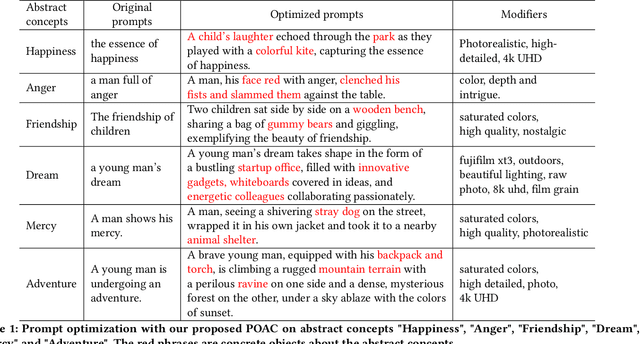
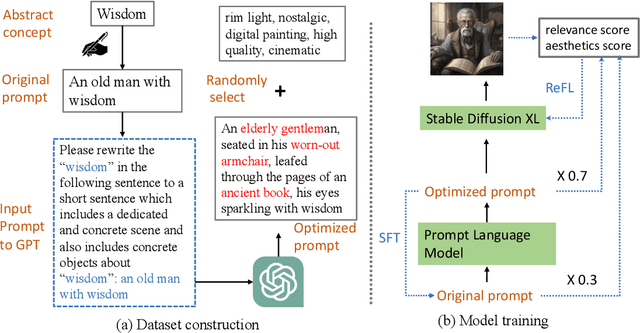
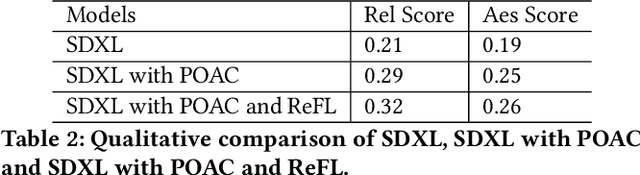
The rapid evolution of text-to-image diffusion models has opened the door of generative AI, enabling the translation of textual descriptions into visually compelling images with remarkable quality. However, a persistent challenge within this domain is the optimization of prompts to effectively convey abstract concepts into concrete objects. For example, text encoders can hardly express "peace", while can easily illustrate olive branches and white doves. This paper introduces a novel approach named Prompt Optimizer for Abstract Concepts (POAC) specifically designed to enhance the performance of text-to-image diffusion models in interpreting and generating images from abstract concepts. We propose a Prompt Language Model (PLM), which is initialized from a pre-trained language model, and then fine-tuned with a curated dataset of abstract concept prompts. The dataset is created with GPT-4 to extend the abstract concept to a scene and concrete objects. Our framework employs a Reinforcement Learning (RL)-based optimization strategy, focusing on the alignment between the generated images by a stable diffusion model and optimized prompts. Through extensive experiments, we demonstrate that our proposed POAC significantly improves the accuracy and aesthetic quality of generated images, particularly in the description of abstract concepts and alignment with optimized prompts. We also present a comprehensive analysis of our model's performance across diffusion models under different settings, showcasing its versatility and effectiveness in enhancing abstract concept representation.
LLM-Ensemble: Optimal Large Language Model Ensemble Method for E-commerce Product Attribute Value Extraction
Feb 29, 2024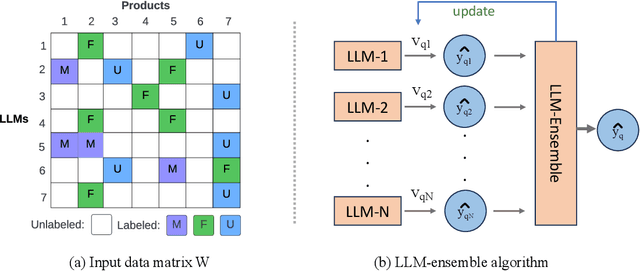
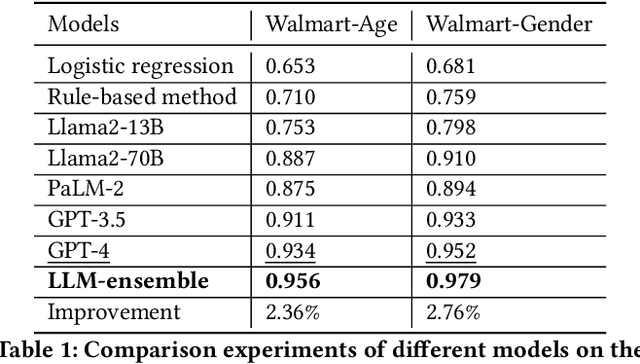
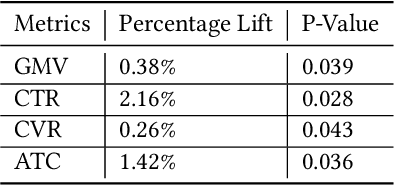
Product attribute value extraction is a pivotal component in Natural Language Processing (NLP) and the contemporary e-commerce industry. The provision of precise product attribute values is fundamental in ensuring high-quality recommendations and enhancing customer satisfaction. The recently emerging Large Language Models (LLMs) have demonstrated state-of-the-art performance in numerous attribute extraction tasks, without the need for domain-specific training data. Nevertheless, varying strengths and weaknesses are exhibited by different LLMs due to the diversity in data, architectures, and hyperparameters. This variation makes them complementary to each other, with no single LLM dominating all others. Considering the diverse strengths and weaknesses of LLMs, it becomes necessary to develop an ensemble method that leverages their complementary potentials. In this paper, we propose a novel algorithm called LLM-ensemble to ensemble different LLMs' outputs for attribute value extraction. We iteratively learn the weights for different LLMs to aggregate the labels with weights to predict the final attribute value. Not only can our proposed method be proven theoretically optimal, but it also ensures efficient computation, fast convergence, and safe deployment. We have also conducted extensive experiments with various state-of-the-art LLMs, including Llama2-13B, Llama2-70B, PaLM-2, GPT-3.5, and GPT-4, on Walmart's internal data. Our offline metrics demonstrate that the LLM-ensemble method outperforms all the state-of-the-art single LLMs on Walmart's internal dataset. This method has been launched in several production models, leading to improved Gross Merchandise Volume (GMV), Click-Through Rate (CTR), Conversion Rate (CVR), and Add-to-Cart Rate (ATC).