 Add to Chrome
 Add to Firefox
 Add to Edge
TokenPilot: Cache-Efficient Context Management for LLM Agents
Jun 15, 2026
As LLM agents are deployed in long-horizon sessions, context accumulation drives up inference costs. Existing approaches utilize text pruning or dynamic memory eviction to minimize token footprints; however, their unconstrained sequence mutations alter layouts, introducing prefix mismatches and cache invalidation. This reveals a critical trade-off between text sparsity and prompt cache continuity. To address this, we present TokenPilot, a dual-granularity context management framework. Globally, Ingestion-Aware Compaction acts as a framework harness to stabilize prompt prefixes and eliminate open-world environmental noise at the ingestion gate. Locally, Lifecycle-Aware Eviction monitors the ongoing residual utility of context segments, enforcing a conservative batch-turn schedule to offload content segments only when task relevance expires. Experiments on PinchBench and Claw-Eval under both isolated and continuous modes demonstrate that TokenPilot reduces costs by 61% and 56% in isolated mode, and 61% and 87% in continuous mode, while maintaining competitive performance compared to prior systems. TokenPilot has been integrated into LightMem2 at https://github.com/zjunlp/LightMem2.

When Should Models Change Their Minds? Contextual Belief Management in Large Language Models
May 28, 2026Long-horizon interactions require language models to manage accumulating information: when to update their state, when to preserve their state, and what to ignore. We study this challenge as \textbf{Contextual Belief Management (CBM)}: maintaining a predicted belief state aligned with formal evidence while isolating task-irrelevant noise. To make CBM measurable, we introduce BeliefTrack, a closed-world benchmark spanning Rule Discovery and Circuit Diagnosis, where a finite belief space and symbolic verifiers enable exact turn-level evaluation. BeliefTrack diagnoses three failures: Failed Stay, Failed Update, and Failed Isolation. Across multiple LLMs, vanilla models exhibit severe CBM failures, while explicit belief-tracking prompts provide limited gains. In contrast, reinforcement learning with belief-state rewards reduces failure rates by 70.9\% on average. Further probing reveals latent belief-state dynamics behind these failures, and representation-level steering reduces failure rates by 46.1\% across two tasks\footnote{Code is coming soon at https://github.com/zjunlp/CBM.
AI Online Filters to Real World Image Recognition
Feb 11, 2020
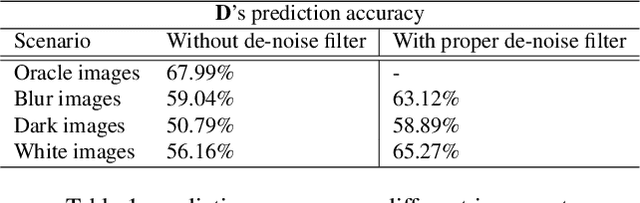

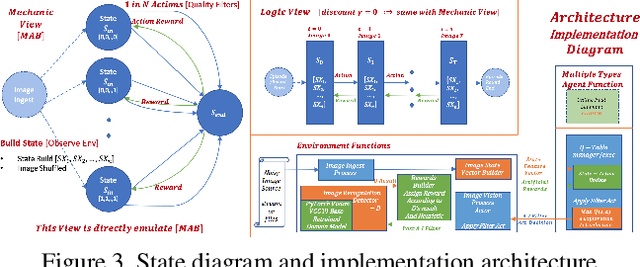
Deep artificial neural networks, trained with labeled data sets are widely used in numerous vision and robotics applications today. In terms of AI, these are called reflex models, referring to the fact that they do not self-evolve or actively adapt to environmental changes. As demand for intelligent robot control expands to many high level tasks, reinforcement learning and state based models play an increasingly important role. Herein, in computer vision and robotics domain, we study a novel approach to add reinforcement controls onto the image recognition reflex models to attain better overall performance, specifically to a wider environment range beyond what is expected of the task reflex models. Follow a common infrastructure with environment sensing and AI based modeling of self-adaptive agents, we implement multiple types of AI control agents. To the end, we provide comparative results of these agents with baseline, and an insightful analysis of their benefit to improve overall image recognition performance in real world.