 Add to Chrome
 Add to Firefox
 Add to Edge
LabVLA: Grounding Vision-Language-Action Models in Scientific Laboratories
Jun 11, 2026
Scientific laboratories increasingly rely on AI systems to reason about experiments, but the physical act of doing science remains largely outside their reach. AI can help read literature, generate hypotheses, and plan protocols, yet the execution of those protocols at the bench still requires a human operator. Vision-Language-Action (VLA) models provide one possible interface between written protocols and robot execution, but existing policies are trained mostly on household and tabletop demonstrations and rarely encounter the instruments, transparent liquids, or fixed protocol workflows found in scientific laboratories. Closing this gap requires both laboratory-specific supervision and a unified learning framework that can accommodate the diverse robot embodiments used to execute experimental protocols. We therefore identify data and embodiment as central bottlenecks alongside model design. To address the data side, we build RoboGenesis, a simulation-based workflow and data engine that composes configured laboratory workflows from atomic skills, validates and filters rollouts, and exports structured demonstrations across supported robot profiles. On the policy side, we present LabVLA, trained with a two-stage recipe: FAST action token pretraining first makes the Qwen3-VL-4B-Instruct backbone action aware before any continuous control is learned, and flow matching posttraining then attaches a DiT action expert under knowledge insulation. On the LabUtopia benchmark, LabVLA achieves the highest average success rate among all evaluated baselines under both in-distribution and out-of-distribution settings.

Aligning Agentic World Models via Knowledgeable Experience Learning
Jan 19, 2026Current Large Language Models (LLMs) exhibit a critical modal disconnect: they possess vast semantic knowledge but lack the procedural grounding to respect the immutable laws of the physical world. Consequently, while these agents implicitly function as world models, their simulations often suffer from physical hallucinations-generating plans that are logically sound but physically unexecutable. Existing alignment strategies predominantly rely on resource-intensive training or fine-tuning, which attempt to compress dynamic environmental rules into static model parameters. However, such parametric encapsulation is inherently rigid, struggling to adapt to the open-ended variability of physical dynamics without continuous, costly retraining. To bridge this gap, we introduce WorldMind, a framework that autonomously constructs a symbolic World Knowledge Repository by synthesizing environmental feedback. Specifically, it unifies Process Experience to enforce physical feasibility via prediction errors and Goal Experience to guide task optimality through successful trajectories. Experiments on EB-ALFRED and EB-Habitat demonstrate that WorldMind achieves superior performance compared to baselines with remarkable cross-model and cross-environment transferability.
OceanGym: A Benchmark Environment for Underwater Embodied Agents
Sep 30, 2025We introduce OceanGym, the first comprehensive benchmark for ocean underwater embodied agents, designed to advance AI in one of the most demanding real-world environments. Unlike terrestrial or aerial domains, underwater settings present extreme perceptual and decision-making challenges, including low visibility, dynamic ocean currents, making effective agent deployment exceptionally difficult. OceanGym encompasses eight realistic task domains and a unified agent framework driven by Multi-modal Large Language Models (MLLMs), which integrates perception, memory, and sequential decision-making. Agents are required to comprehend optical and sonar data, autonomously explore complex environments, and accomplish long-horizon objectives under these harsh conditions. Extensive experiments reveal substantial gaps between state-of-the-art MLLM-driven agents and human experts, highlighting the persistent difficulty of perception, planning, and adaptability in ocean underwater environments. By providing a high-fidelity, rigorously designed platform, OceanGym establishes a testbed for developing robust embodied AI and transferring these capabilities to real-world autonomous ocean underwater vehicles, marking a decisive step toward intelligent agents capable of operating in one of Earth's last unexplored frontiers. The code and data are available at https://github.com/OceanGPT/OceanGym.
KnowRL: Exploring Knowledgeable Reinforcement Learning for Factuality
Jun 24, 2025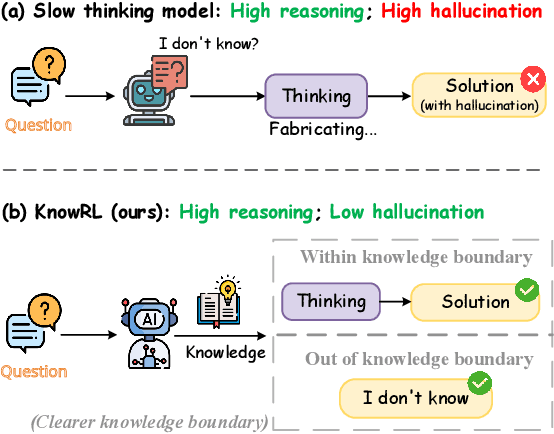
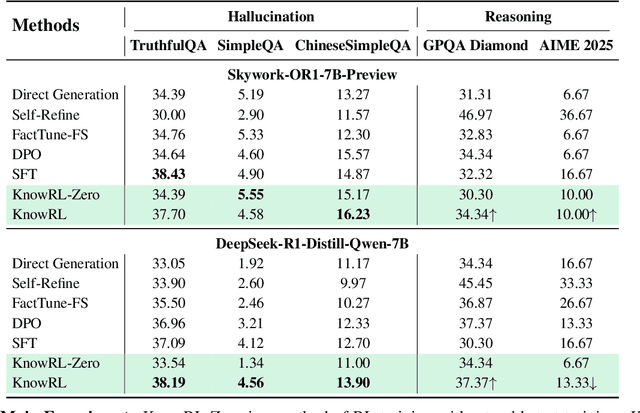
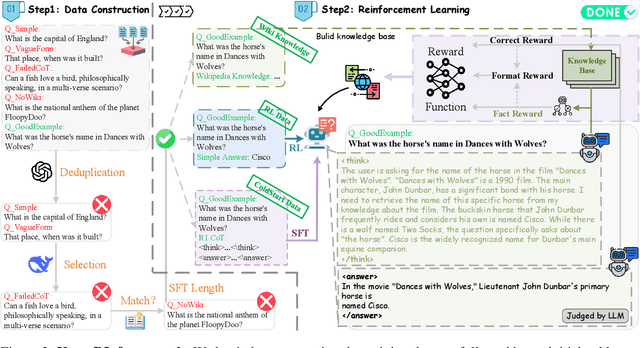
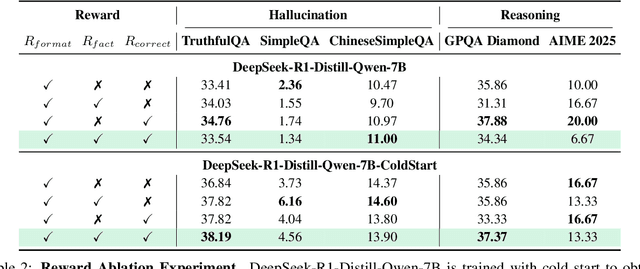
Large Language Models (LLMs), particularly slow-thinking models, often exhibit severe hallucination, outputting incorrect content due to an inability to accurately recognize knowledge boundaries during reasoning. While Reinforcement Learning (RL) can enhance complex reasoning abilities, its outcome-oriented reward mechanism often lacks factual supervision over the thinking process, further exacerbating the hallucination problem. To address the high hallucination in slow-thinking models, we propose Knowledge-enhanced RL, KnowRL. KnowRL guides models to perform fact-based slow thinking by integrating a factuality reward, based on knowledge verification, into the RL training process, helping them recognize their knowledge boundaries. KnowRL guides models to perform fact-based slow thinking by integrating a factuality reward, based on knowledge verification, into the RL training process, helping them recognize their knowledge boundaries. This targeted factual input during RL training enables the model to learn and internalize fact-based reasoning strategies. By directly rewarding adherence to facts within the reasoning steps, KnowRL fosters a more reliable thinking process. Experimental results on three hallucination evaluation datasets and two reasoning evaluation datasets demonstrate that KnowRL effectively mitigates hallucinations in slow-thinking models while maintaining their original strong reasoning capabilities. Our code is available at https://github.com/zjunlp/KnowRL.
Agentic Knowledgeable Self-awareness
Apr 04, 2025Large Language Models (LLMs) have achieved considerable performance across various agentic planning tasks. However, traditional agent planning approaches adopt a "flood irrigation" methodology that indiscriminately injects gold trajectories, external feedback, and domain knowledge into agent models. This practice overlooks the fundamental human cognitive principle of situational self-awareness during decision-making-the ability to dynamically assess situational demands and strategically employ resources during decision-making. We propose agentic knowledgeable self-awareness to address this gap, a novel paradigm enabling LLM-based agents to autonomously regulate knowledge utilization. Specifically, we propose KnowSelf, a data-centric approach that applies agents with knowledgeable self-awareness like humans. Concretely, we devise a heuristic situation judgement criterion to mark special tokens on the agent's self-explored trajectories for collecting training data. Through a two-stage training process, the agent model can switch between different situations by generating specific special tokens, achieving optimal planning effects with minimal costs. Our experiments demonstrate that KnowSelf can outperform various strong baselines on different tasks and models with minimal use of external knowledge. Code is available at https://github.com/zjunlp/KnowSelf.