 Add to Chrome
 Add to Firefox
 Add to Edge
Search2Skill: Skill Distillation Beyond Knowledge Boundaries Via Rubric-Based Reinforcement Learning
Aug 05, 2026
Reusable skills, which encapsulate the procedural knowledge required to solve real-world professional tasks, offer LLM-based agents a path toward self-evolution in expert domains. Existing self-evolving skill methods construct skills internally from the model's parametric knowledge or trajectories, and are therefore bounded by what the model already knows. However, the domain conventions and standard procedures underlying professional skills often lie beyond this boundary and are hard to elicit from the agent alone. To address this issue, we therefore propose a novel framework, Search2Skill, that automatically identifies the agent's capability gaps, searches external sources to address them, and distills the retrieved evidence into structured, reusable skills. Specifically, Search2Skill is optimized by a rubric-based reinforcement learning scheme that jointly improves when to search, how to search, and how to generate skills. Experiments on eight expert-level domains from three benchmarks show that Search2Skill consistently outperforms both search-augmented and trajectory-based skill-learning baselines under both streaming and held-out evaluation protocols. Further analyses show that the gains arise from skill abstraction rather than raw retrieved evidence, and that the acquired skills transfer across model scales.

The Tell-Tale Norm: $\ell_2$ Magnitude as a Signal for Reasoning Dynamics in Large Language Models
Jun 04, 2026Recent work has sought to understand Large Language Models (LLMs) reasoning, yet a principled, model-intrinsic signal that captures its layer-wise reasoning dynamics remains underexplored. We bridge this gap by demonstrating that the l2 norm of hidden states serves as an endogenous signal of the model's reasoning intensity. Using Sparse Autoencoders (SAEs) as a diagnostic probe, we observe that LLMs' internal reasoning is marked by a sharp increase in reasoning feature activations concentrated in late layers. Motivated by this pattern, we establish a formal link between reasoning intensity and the model's latent geometry and theoretically prove that the l2 norm of hidden states bounds the activation strength of SAE reasoning features. Empirical correlation analysis and causal interventions further validate the l2 norm as a faithful indicator, where heightened norms consistently correspond to critical reasoning steps. We then introduce three test-time scaling techniques guided by l2 norms: (i) Adaptive Layer-wise Reasoning Recursion, (ii) Endogenous Reasoning State Steering, and (iii) l2-guided Response Selection, which requires no additional training or data and is compatible with advanced inference engines. Experiments across model architectures and benchmarks show that l2-norm-based techniques significantly improve reasoning performance, offering a principled yet simple lens to perceive and control LLM latent reasoning dynamics. Our code is available at https://github.com/zjy1298/The-Tell-Tale-Norm.
ChemAgent: Self-updating Library in Large Language Models Improves Chemical Reasoning
Jan 11, 2025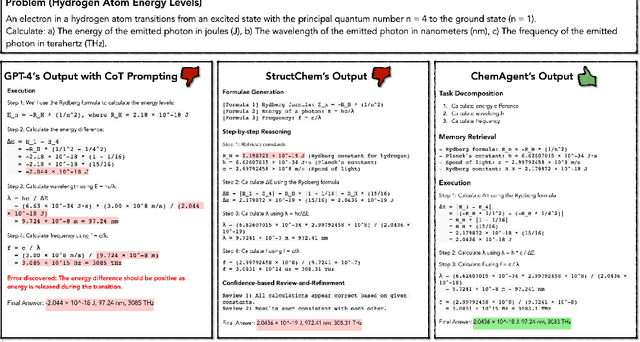
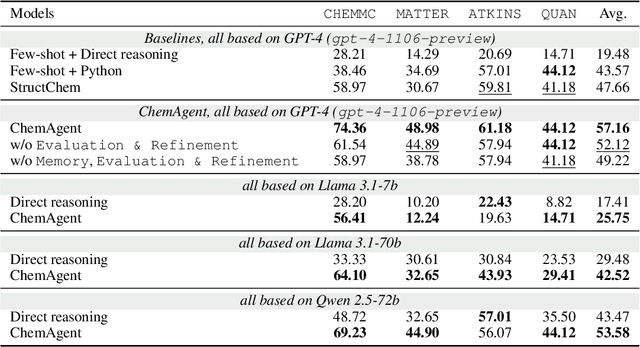
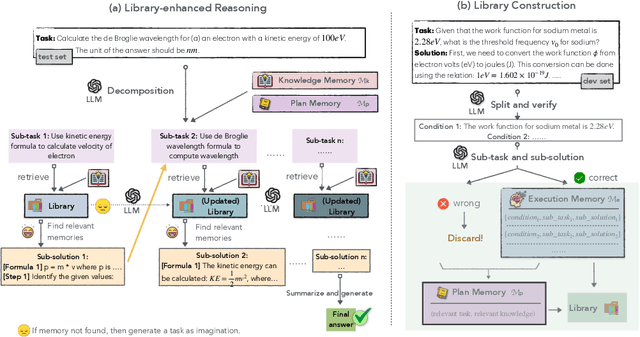
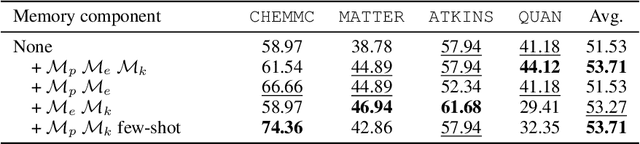
Chemical reasoning usually involves complex, multi-step processes that demand precise calculations, where even minor errors can lead to cascading failures. Furthermore, large language models (LLMs) encounter difficulties handling domain-specific formulas, executing reasoning steps accurately, and integrating code effectively when tackling chemical reasoning tasks. To address these challenges, we present ChemAgent, a novel framework designed to improve the performance of LLMs through a dynamic, self-updating library. This library is developed by decomposing chemical tasks into sub-tasks and compiling these sub-tasks into a structured collection that can be referenced for future queries. Then, when presented with a new problem, ChemAgent retrieves and refines pertinent information from the library, which we call memory, facilitating effective task decomposition and the generation of solutions. Our method designs three types of memory and a library-enhanced reasoning component, enabling LLMs to improve over time through experience. Experimental results on four chemical reasoning datasets from SciBench demonstrate that ChemAgent achieves performance gains of up to 46% (GPT-4), significantly outperforming existing methods. Our findings suggest substantial potential for future applications, including tasks such as drug discovery and materials science. Our code can be found at https://github.com/gersteinlab/chemagent
LHQ-SVC: Lightweight and High Quality Singing Voice Conversion Modeling
Sep 13, 2024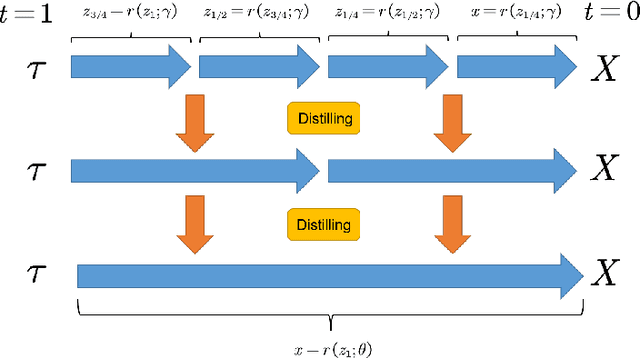
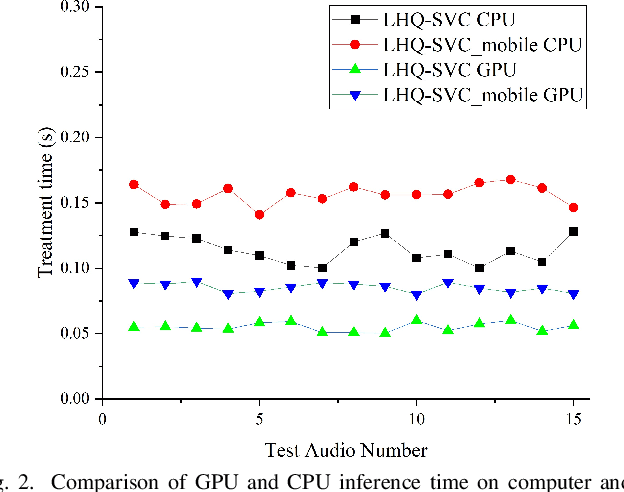
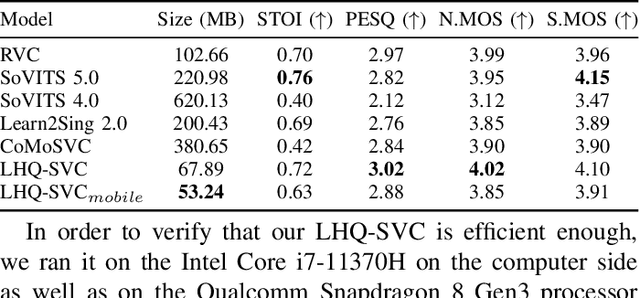
Singing Voice Conversion (SVC) has emerged as a significant subfield of Voice Conversion (VC), enabling the transformation of one singer's voice into another while preserving musical elements such as melody, rhythm, and timbre. Traditional SVC methods have limitations in terms of audio quality, data requirements, and computational complexity. In this paper, we propose LHQ-SVC, a lightweight, CPU-compatible model based on the SVC framework and diffusion model, designed to reduce model size and computational demand without sacrificing performance. We incorporate features to improve inference quality, and optimize for CPU execution by using performance tuning tools and parallel computing frameworks. Our experiments demonstrate that LHQ-SVC maintains competitive performance, with significant improvements in processing speed and efficiency across different devices. The results suggest that LHQ-SVC can meet