 Add to Chrome
 Add to Firefox
 Add to Edge
FlowPilot: Real-Time World-Action Modeling for Agile UAV Navigation
Aug 01, 2026
We present FlowPilot, a compact world-action model for real-time onboard UAV navigation from depth. Unlike map-then-optimize pipelines that require local reconstruction or end-to-end policies that lack explicit scene prediction, FlowPilot jointly denoises future depth observations and executable trajectories with flow matching. A dual-stream mixture-of-transformers couples video and action experts through shared attention, allowing future-scene prediction and trajectory generation to inform each other. At deployment, the model runs action-centrically and outputs only a trajectory. To ensure trackability, actions are parameterized as degree-7 Bernstein polynomials: the current state constrains the initial control points, and the network predicts five free control points, yielding C^2-continuous references with closed-form velocity, acceleration and jerk. FlowPilot is trained on a three-level depth pyramid spanning high-throughput simulation, photorealistic simulation, and real onboard data. In closed-loop simulation, it outperforms learning- and optimization-based baselines under increasing clutter and commanded speeds up to 8m/s. On a physical quadrotor, the full perception-to-action pipeline runs in under 18ms on a Jetson Orin NX and reaches 5.5m/s in cluttered indoor and forest environments using only onboard sensing and computation.

AeroAct: Action-Centered World-Action Models for Language-Conditioned Quadrotor Flight
Jul 16, 2026Language-conditioned quadrotor flight requires a policy to ground semantic goals, anticipate the visual consequences of ego-motion, and output control references that remain smooth and dynamically executable under rapidly changing first-person views. Existing aerial vision-language navigation and vision-language-action methods commonly use discrete actions, high-level waypoints, or instantaneous velocity commands, which provide limited supervision about how flight actions change future observations. We present AeroAct, an action-centered world-action model (WAM) for quadrotor navigation. To the best of our knowledge, AeroAct is the first WAM instantiated and demonstrated for real-world aerial flight. The model adapts a pretrained video diffusion Transformer to predict local trajectory-action chunks from egocentric visual history, proprioception, and language. Future first-person frames are used during training as dense consequence supervision, while deployment directly decodes actions without generating future video. To obtain aligned visual, state, language, and dynamically feasible action data, we build a DiffAero-based pipeline with complementary Isaac Lab and 3D Gaussian splatting renderers. We further introduce a low-cost handheld collection device that couples camera observations with motion estimates to recreate flight-like egocentric trajectories, and a self-guidance procedure that improves temporal consistency across overlapping trajectory chunks. Closed-loop simulation and real-world experiments show that temporal visual context improves target tracking and object-search performance, and that WAM-based policies can be executed on a physical quadrotor.
MAD: Mapping-Aware World Models for Agile Quadrotor Flight
Jun 03, 2026Agile quadrotor flight in cluttered scenes requires more than a reactive mapping from a depth image to a control command: the vehicle must remember which regions have been observed, infer nearby occupied space, and act under partial visibility and tight latency. In this paper, we present Mapping-Aware Dreamer (MAD), a geometry-aware world model for vision-based quadrotor flight. Instead of using raw-image reconstruction as the main self-supervised objective, MAD learns recurrent latent dynamics that reconstruct robocentric occupancy and visibility grid maps together with proprioceptive states. This design forces the latent state to encode local geometry, visibility history, and ego-motion in a form that is directly relevant to collision avoidance. MAD is trained in DiffAero using a GPU-parallel map-construction module that provides high-throughput supervision for occupancy and visibility. The learned representation is used in three policy-learning modes: imagination-based MAD-Dreamer and feature-extractor variants based on PPO and SHAC. Across visual navigation and racing tasks, MAD-based agents achieve higher success rates, faster flight, and better cross-task transfer than corresponding vision-only baselines. The model also produces interpretable map predictions and accurate ego-motion estimates from depth observations. We further deploy the learned policy on a physical quadrotor with an Intel RealSense D435i and demonstrate safe indoor and outdoor flight under limited sensing, reaching 9.66 m/s in simulation and 5.05 m/s in real-world forest experiments. These results show that mapping-aware world models provide a practical middle ground between modular aerial navigation and end-to-end learning.
Flexible Job Shop Scheduling via Dual Attention Network Based Reinforcement Learning
May 09, 2023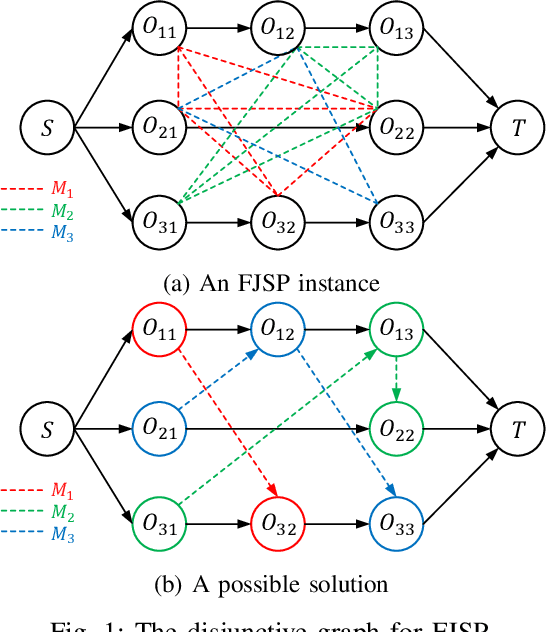
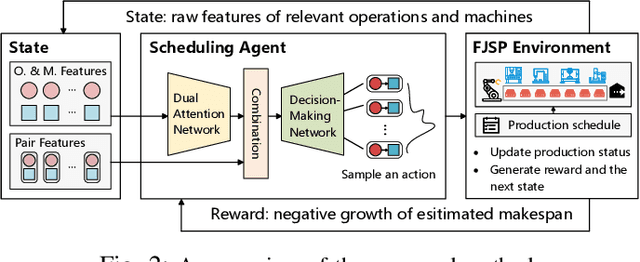
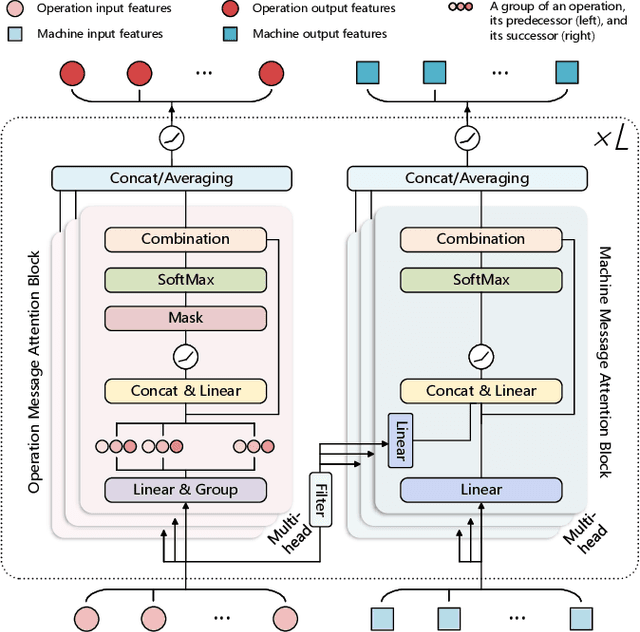
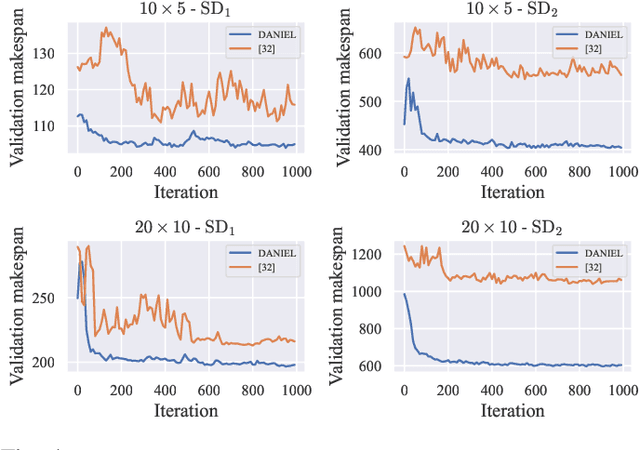
Flexible manufacturing has given rise to complex scheduling problems such as the flexible job shop scheduling problem (FJSP). In FJSP, operations can be processed on multiple machines, leading to intricate relationships between operations and machines. Recent works have employed deep reinforcement learning (DRL) to learn priority dispatching rules (PDRs) for solving FJSP. However, the quality of solutions still has room for improvement relative to that by the exact methods such as OR-Tools. To address this issue, this paper presents a novel end-to-end learning framework that weds the merits of self-attention models for deep feature extraction and DRL for scalable decision-making. The complex relationships between operations and machines are represented precisely and concisely, for which a dual-attention network (DAN) comprising several interconnected operation message attention blocks and machine message attention blocks is proposed. The DAN exploits the complicated relationships to construct production-adaptive operation and machine features to support high-quality decisionmaking. Experimental results using synthetic data as well as public benchmarks corroborate that the proposed approach outperforms both traditional PDRs and the state-of-the-art DRL method. Moreover, it achieves results comparable to exact methods in certain cases and demonstrates favorable generalization ability to large-scale and real-world unseen FJSP tasks.