 Add to Chrome
 Add to Firefox
 Add to Edge
UniSwap: Streaming Audio-Visual Identity Swapping for Talking Videos
Aug 12, 2026
Talking-video character replacement requires coordinated transfer of appearance and voice while preserving the source motion, scene, linguistic content, and audio-video timing. Existing methods use separately optimized models for the two modalities, making audio-visual consistency difficult to enforce. We present UniSwap, the first framework for streaming joint audio-visual identity replacement in talking videos. Given a source video, a reference image, and a reference voice clip, UniSwap transfers the reference appearance and vocal timbre within a single audio-visual diffusion transformer while preserving the source content and dynamics. To address the scarcity of aligned cross-identity training pairs, we introduce a swap-and-reconstruct pipeline that removes visual and vocal identity from real clips and uses the original clips as reconstruction targets. Starting from a bidirectional backbone, we progressively adapt the model through In-context Pretraining for joint replacement, Conditional Streaming Adaptation for block-causal KV-cached generation, and Efficient Self-forcing DMD for mitigating exposure bias and reducing sampling from 30 to 3 denoising steps per block. Efficient Multi-LoRA Switching enables the three DMD roles to share a single frozen backbone. Feature-RoPE Decomposition keeps cached positions within the training range, supporting stable long-form inference. Experiments demonstrate strong audio-visual synchronization, competitive identity preservation, efficient streaming, and stable long-form generation.

AVA-Encoder: Towards Agent-Native Video Representation Learning
Aug 12, 2026Creative agents still lack an effective way to learn from high-quality human films, limiting their ability to produce cinematic-grade videos. A key challenge is the absence of a structured video representation that is both faithful to film content and directly usable for agentic reasoning and manipulation. To address the challenge, we propose the Agentic Video Auto-Encoder (AVA-Encoder), a framework for learning agent-native video representations via agentic auto-encoding. AVA-Encoder transforms a video into a knowledge graph (KG) representation and then reconstructs it back into video. Its hierarchy and state nodes store structured text, while a linked asset layer holds generated images, audio, and video. Typed edges preserve the relations between these text descriptions and assets in a form that agents can easily understand, query, and edit. The video reconstruction differences drive a textual-gradient optimization framework, which expresses evaluation feedback as natural-language update directions for Data-Independent Encoding Policy Pseudo-Training in the outer loop and optional Data-Dependent KG Representation Refinement in the test-time inner loop. Extensive experiments show that AVA-Encoder improves by 20.7 percentage points over the strongest external baseline. In the controlled policy-only setting, its pseudo-trained shot-level Agentic Video Encoder policy also outperforms a carefully human-tuned policy while using 74.3% fewer system-prompt tokens. We release the complete AVA-Encoder framework, a reliable agentic video reconstruction benchmark, and the first dataset of high-quality film KG representations.
LiveAnimate: Stable Long-Form Streaming Human Animation in Real-Time
Aug 12, 2026Pose-driven human animation synthesizes a video of a target person from a single reference image and a driving pose stream. Real-time generation is essential for interactive applications such as live streaming, telepresence, and virtual avatars, yet diffusion-based systems require minutes to hours per clip, precluding responsive interaction. We present LiveAnimate, to our knowledge the first animation system to combine real-time streaming with stable long-form generation at billion scale, built on a 14B-parameter video Diffusion Transformer (DiT). A two-stage training pipeline first adapts a pretrained bidirectional DiT into a block-causal autoregressive generator through Reference-Anchored Teacher-Forcing Adaptation, and then reduces the sampling budget to three steps through Block-wise Self-Forcing Distillation. To preserve appearance over extended streams, we introduce Pose-Retrieval Sink Attention (PR-Sink), a bounded KV-cache mechanism combining a Static Sink that permanently anchors the first generated block, a Dynamic Sink that holds a pose-retrieved historical block, and a three-slot Rolling Window. When a pose recurs, PR-Sink restores the relevant appearance context without retaining the entire sequence, so memory and per-block latency remain constant regardless of stream duration. Together with Ulysses sequence parallelism and operator fusion, these designs enable 19.63\,FPS streaming inference on two NVIDIA H100 GPUs. On a three-minute benchmark, LiveAnimate maintains nearly constant perceptual quality and identity from the first 30 seconds to the final minute (IQA 4.047 vs.\ 4.026), while prior systems degrade substantially or require hours of offline computation for the same rollout. These results establish a new operating point in quality, latency, and duration for interactive full-body animation.
What to Edit Next: Visually Aligned Image-Editing Follow-Up Suggestions in Conversational Systems
Aug 03, 2026Conversational assistants increasingly recommend follow-up edits to help users continue a task. Existing systems primarily target text-only interactions, leaving image-creation conversations underexplored. In image-creation tasks, useful follow-up edit suggestions must reflect user preferences, offer diverse directions, and remain executable on the current image. We collected 100,000 real multi-turn image-creation conversation samples from Qwen App and found that 80.1% are image-dependent, underscoring the need for multimodal recommendation. We address this setting with a three-stage framework. In Stage 1, we use real online data to build a human-reviewed table of appropriate follow-up editing intents, then create SFT targets and fine-tune a multimodal policy. In Stage 2, to align rule-guided SFT suggestions with actual user choices, we use user click feedback to optimize the policy through multi-objective reinforcement learning. In Stage 3, to reduce visual inconsistencies between suggested edits and the current image, we introduce a visual verifier as additional training supervision. Extensive experiments demonstrate that our framework significantly outperforms baselines on both automatic and human evaluations. In a live user-randomized A/B test with millions of users, our final framework reduces visual inconsistency from 3.7% to 0.9%. Furthermore, it significantly improves recommendation CTR by 32.70%, image take-away rate by 16.32%, and average conversation turns per user by 39.90% (all p<0.05).
Rethinking Classifier-Free Guidance in On-Policy Diffusion Distillation
Jul 27, 2026On-policy distillation (OPD) adapts diffusion models by querying a teacher along trajectories generated by the current student, but how it should behave under classifier-free guidance (CFG), a default component of modern diffusion systems, remains poorly understood. Existing OPD methods naturally extend velocity matching to the CFG-composed prediction, directly matching teacher and student guided velocities. We show that this objective is under-identified at the branch level: positive- and negative-branch errors can compensate in the guided prediction. Through two contrasting cases, we find that naive matching remains effective under shared negative conditioning, where both branch errors decrease jointly. When the model's native CFG schema retains privileged information in the teacher's negative branch that is unavailable to the student, however, this joint reduction breaks down and the composed objective induces antagonistic branch-error dynamics, reducing the positive-branch error while increasing the negative-branch error. We term this failure mode Negative Branch Asymmetry (NBA). To address NBA, we introduce Positive--Direction Matching (PDM), a branch-aware OPD objective that separately constrains the positive prediction and the CFG conditional direction. We apply PDM to dense-to-sparse video control, where naive guided matching is highly sensitive to inference guidance scales, while branch-aware supervision enables more robust and effective knowledge transfer.
Search Beyond What Can Be Taught: Evolving the Knowledge Boundary in Agentic Visual Generation
Jul 06, 2026Visual generators excel at rendering, but they confidently fabricate what they do not know. User requests are unbounded, evolving, and deeply long-tailed: new characters, trending entities, post-cutoff events, and more. This world-knowledge bottleneck is structural: generators are trained on fixed corpora, but the visual world is open-ended. We construct SearchGen-20K and SearchGen-Bench, with 20,839 prompts spanning twelve failure categories and twenty-two domains, paired with a pre-executed multimodal SearchGen-Corpus-1M to support offline, reproducible research. On SearchGen-Bench, frontier open generators score only 21 to 28 out of 100, a 40-point collapse invisible to existing benchmarks. The natural remedy is to employ search tools, enabling agentic visual generation. However, we find that naive search fails: it retrieves indiscriminately, injecting noise into prompts the generator already handles. We trace the root cause to a generator-specific, evolving knowledge boundary: the divide between what a generator can internalize through training and what must remain in external context. Although this boundary is hard to specify in advance, we show that it is discoverable through a teach-then-search co-training framework. Even a minimal version of this co-training recipe produces monotonic improvement, laying the foundation for recursive self-improvement in visual generation that can meet world-knowledge-grounded requests. We release the full dataset, co-training corpus, and search corpus as a replayable harness for tool-augmented, world-knowledge-grounded visual generation.
Multi-modal expressive personality recognition in data non-ideal audiovisual based on multi-scale feature enhancement and modal augment
Mar 08, 2025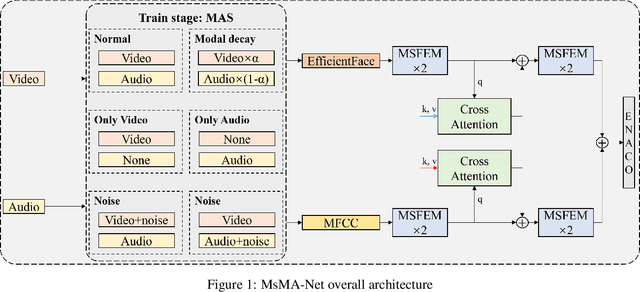
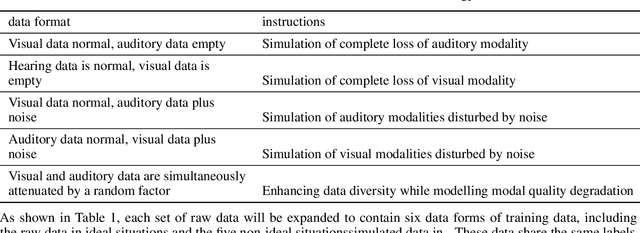
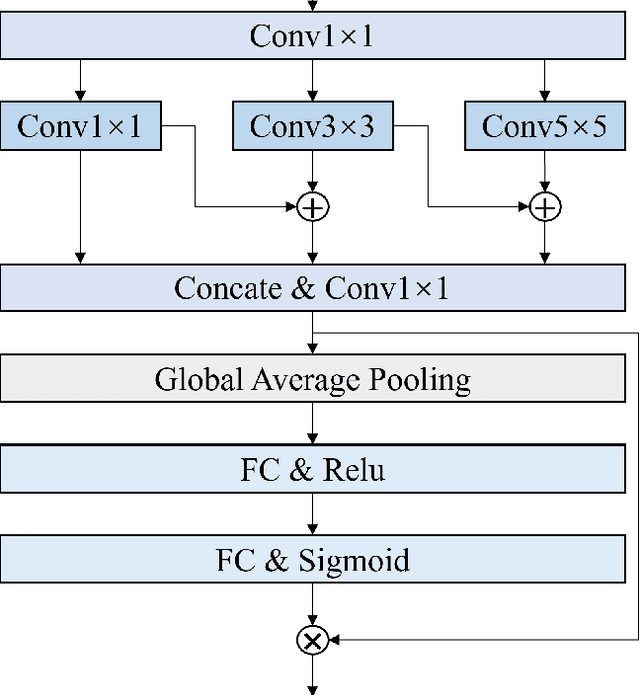
Automatic personality recognition is a research hotspot in the intersection of computer science and psychology, and in human-computer interaction, personalised has a wide range of applications services and other scenarios. In this paper, an end-to-end multimodal performance personality is established for both visual and auditory modal datarecognition network , and the through feature-level fusion , which effectively of the two modalities is carried out the cross-attention mechanismfuses the features of the two modal data; and a is proposed multiscale feature enhancement modalitiesmodule , which enhances for visual and auditory boththe expression of the information of effective the features and suppresses the interference of the redundant information. In addition, during the training process, this paper proposes a modal enhancement training strategy to simulate non-ideal such as modal loss and noise interferencedata situations , which enhances the adaptability ofand the model to non-ideal data scenarios improves the robustness of the model. Experimental results show that the method proposed in this paper is able to achieve an average Big Five personality accuracy of , which outperforms existing 0.916 on the personality analysis dataset ChaLearn First Impressionother methods based on audiovisual and audio-visual both modalities. The ablation experiments also validate our proposed , respectivelythe contribution of module and modality enhancement strategy to the model performance. Finally, we simulate in the inference phase multi-scale feature enhancement six non-ideal data scenarios to verify the modal enhancement strategy's improvement in model robustness.
GeoFormer: Learning Point Cloud Completion with Tri-Plane Integrated Transformer
Aug 13, 2024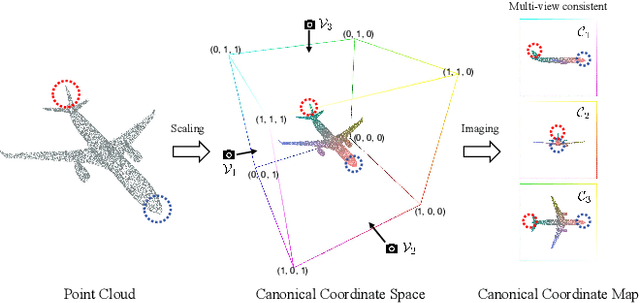
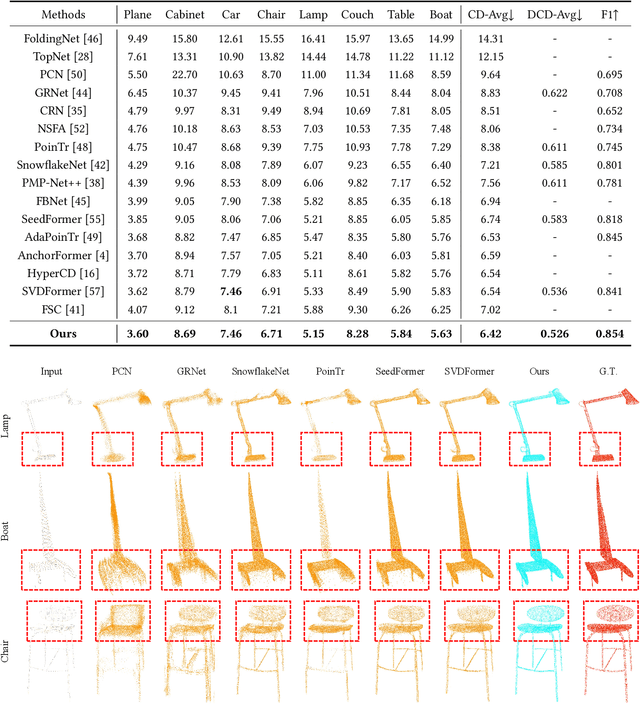
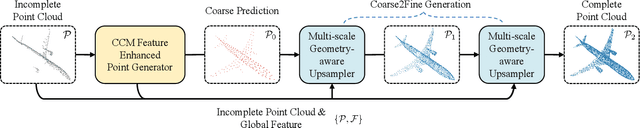
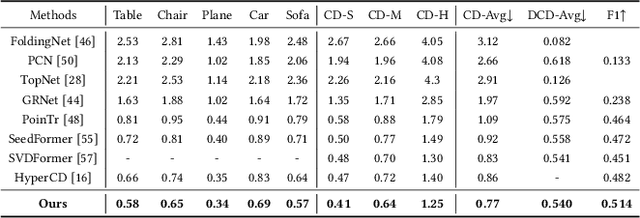
Point cloud completion aims to recover accurate global geometry and preserve fine-grained local details from partial point clouds. Conventional methods typically predict unseen points directly from 3D point cloud coordinates or use self-projected multi-view depth maps to ease this task. However, these gray-scale depth maps cannot reach multi-view consistency, consequently restricting the performance. In this paper, we introduce a GeoFormer that simultaneously enhances the global geometric structure of the points and improves the local details. Specifically, we design a CCM Feature Enhanced Point Generator to integrate image features from multi-view consistent canonical coordinate maps (CCMs) and align them with pure point features, thereby enhancing the global geometry feature. Additionally, we employ the Multi-scale Geometry-aware Upsampler module to progressively enhance local details. This is achieved through cross attention between the multi-scale features extracted from the partial input and the features derived from previously estimated points. Extensive experiments on the PCN, ShapeNet-55/34, and KITTI benchmarks demonstrate that our GeoFormer outperforms recent methods, achieving the state-of-the-art performance. Our code is available at \href{https://github.com/Jinpeng-Yu/GeoFormer}{https://github.com/Jinpeng-Yu/GeoFormer}.
Fast Personalized Text-to-Image Syntheses With Attention Injection
Mar 17, 2024Currently, personalized image generation methods mostly require considerable time to finetune and often overfit the concept resulting in generated images that are similar to custom concepts but difficult to edit by prompts. We propose an effective and fast approach that could balance the text-image consistency and identity consistency of the generated image and reference image. Our method can generate personalized images without any fine-tuning while maintaining the inherent text-to-image generation ability of diffusion models. Given a prompt and a reference image, we merge the custom concept into generated images by manipulating cross-attention and self-attention layers of the original diffusion model to generate personalized images that match the text description. Comprehensive experiments highlight the superiority of our method.
SSR-Encoder: Encoding Selective Subject Representation for Subject-Driven Generation
Dec 26, 2023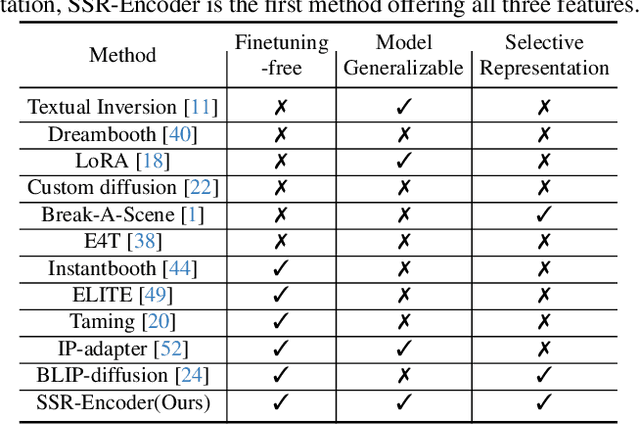
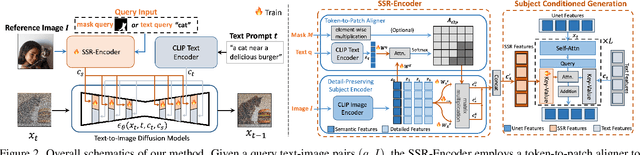
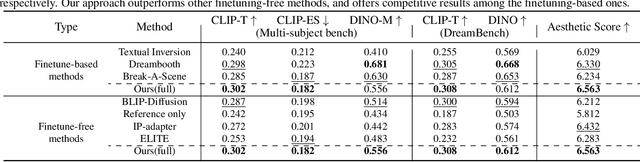
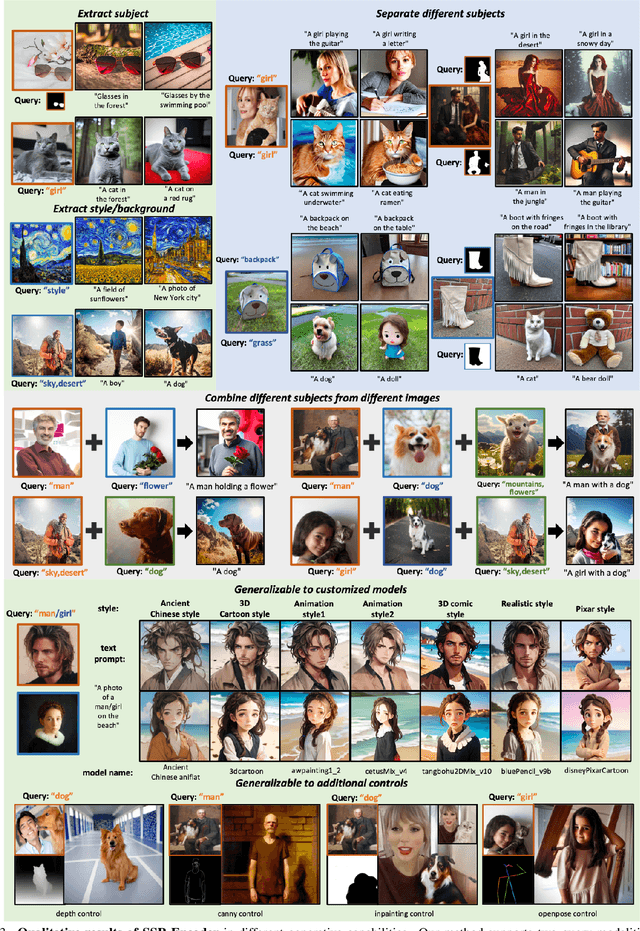
Recent advancements in subject-driven image generation have led to zero-shot generation, yet precise selection and focus on crucial subject representations remain challenging. Addressing this, we introduce the SSR-Encoder, a novel architecture designed for selectively capturing any subject from single or multiple reference images. It responds to various query modalities including text and masks, without necessitating test-time fine-tuning. The SSR-Encoder combines a Token-to-Patch Aligner that aligns query inputs with image patches and a Detail-Preserving Subject Encoder for extracting and preserving fine features of the subjects, thereby generating subject embeddings. These embeddings, used in conjunction with original text embeddings, condition the generation process. Characterized by its model generalizability and efficiency, the SSR-Encoder adapts to a range of custom models and control modules. Enhanced by the Embedding Consistency Regularization Loss for improved training, our extensive experiments demonstrate its effectiveness in versatile and high-quality image generation, indicating its broad applicability. Project page: https://ssr-encoder.github.io