 Add to Chrome
 Add to Firefox
 Add to Edge
Step-Audio: Unified Understanding and Generation in Intelligent Speech Interaction
Feb 18, 2025
Real-time speech interaction, serving as a fundamental interface for human-machine collaboration, holds immense potential. However, current open-source models face limitations such as high costs in voice data collection, weakness in dynamic control, and limited intelligence. To address these challenges, this paper introduces Step-Audio, the first production-ready open-source solution. Key contributions include: 1) a 130B-parameter unified speech-text multi-modal model that achieves unified understanding and generation, with the Step-Audio-Chat version open-sourced; 2) a generative speech data engine that establishes an affordable voice cloning framework and produces the open-sourced lightweight Step-Audio-TTS-3B model through distillation; 3) an instruction-driven fine control system enabling dynamic adjustments across dialects, emotions, singing, and RAP; 4) an enhanced cognitive architecture augmented with tool calling and role-playing abilities to manage complex tasks effectively. Based on our new StepEval-Audio-360 evaluation benchmark, Step-Audio achieves state-of-the-art performance in human evaluations, especially in terms of instruction following. On open-source benchmarks like LLaMA Question, shows 9.3% average performance improvement, demonstrating our commitment to advancing the development of open-source multi-modal language technologies. Our code and models are available at https://github.com/stepfun-ai/Step-Audio.

InfinitePOD: Building Datacenter-Scale High-Bandwidth Domain for LLM with Optical Circuit Switching Transceivers
Feb 07, 2025

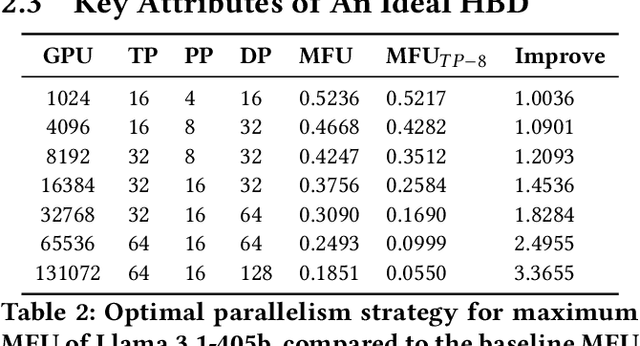
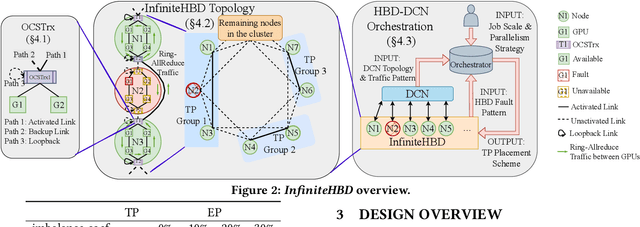
Scaling Large Language Model (LLM) training relies on multi-dimensional parallelism, where High-Bandwidth Domains (HBDs) are critical for communication-intensive parallelism like Tensor Parallelism (TP) and Expert Parallelism (EP). However, existing HBD architectures face fundamental limitations in scalability, cost, and fault resiliency: switch-centric HBDs (e.g., NVL-72) incur prohibitive scaling costs, while GPU-centric HBDs (e.g., TPUv3/Dojo) suffer from severe fault propagation. Switch-GPU hybrid HBDs such as TPUv4 takes a middle-ground approach by leveraging Optical Circuit Switches, but the fault explosion radius remains large at the cube level (e.g., 64 TPUs). We propose InfinitePOD, a novel transceiver-centric HBD architecture that unifies connectivity and dynamic switching at the transceiver level using Optical Circuit Switching (OCS). By embedding OCS within each transceiver, InfinitePOD achieves reconfigurable point-to-multipoint connectivity, allowing the topology to adapt into variable-size rings. This design provides: i) datacenter-wide scalability without cost explosion; ii) fault resilience by isolating failures to a single node, and iii) full bandwidth utilization for fault-free GPUs. Key innovations include a Silicon Photonic (SiPh) based low-cost OCS transceiver (OCSTrx), a reconfigurable k-hop ring topology co-designed with intra-/inter-node communication, and an HBD-DCN orchestration algorithm maximizing GPU utilization while minimizing cross-ToR datacenter network traffic. The evaluation demonstrates that InfinitePOD achieves 31% of the cost of NVL-72, near-zero GPU waste ratio (over one order of magnitude lower than NVL-72 and TPUv4), near-zero cross-ToR traffic when node fault ratios under 7%, and improves Model FLOPs Utilization by 3.37x compared to NVIDIA DGX (8 GPUs per Node).
Affine Frequency Division Multiplexing: Extending OFDM for Scenario-Flexibility and Resilience
Feb 07, 2025


Next-generation wireless networks are conceived to provide reliable and high-data-rate communication services for diverse scenarios, such as vehicle-to-vehicle, unmanned aerial vehicles, and satellite networks. The severe Doppler spreads in the underlying time-varying channels induce destructive inter-carrier interference (ICI) in the extensively adopted orthogonal frequency division multiplexing (OFDM) waveform, leading to severe performance degradation. This calls for a new air interface design that can accommodate the severe delay-Doppler spreads in highly dynamic channels while possessing sufficient flexibility to cater to various applications. This article provides a comprehensive overview of a promising chirp-based waveform named affine frequency division multiplexing (AFDM). It is featured with two tunable parameters and achieves optimal diversity order in doubly dispersive channels (DDC). We study the fundamental principle of AFDM, illustrating its intrinsic suitability for DDC. Based on that, several potential applications of AFDM are explored. Furthermore, the major challenges and the corresponding solutions of AFDM are presented, followed by several future research directions. Finally, we draw some instructive conclusions about AFDM, hoping to provide useful inspiration for its development.
Beyond Flat Text: Dual Self-inherited Guidance for Visual Text Generation
Jan 10, 2025
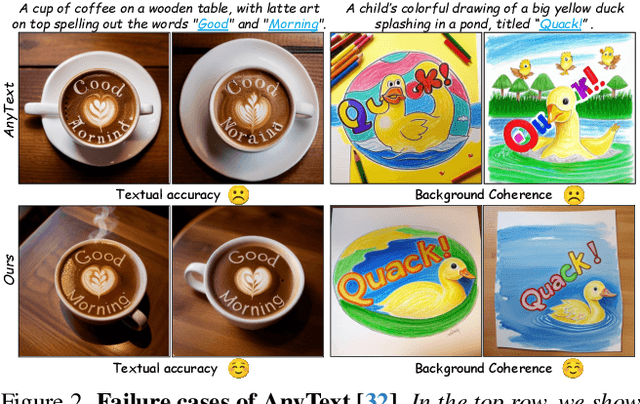
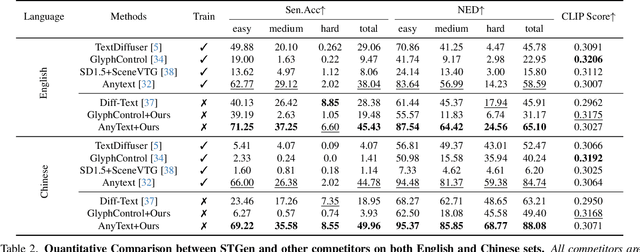
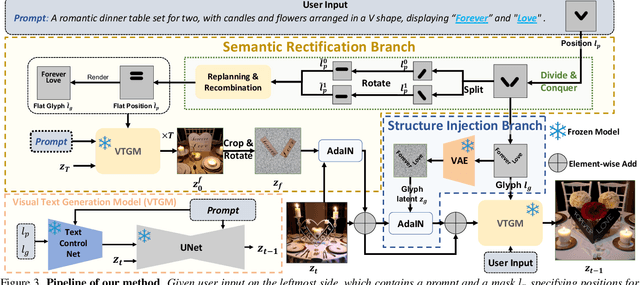
In real-world images, slanted or curved texts, especially those on cans, banners, or badges, appear as frequently, if not more so, than flat texts due to artistic design or layout constraints. While high-quality visual text generation has become available with the advanced generative capabilities of diffusion models, these models often produce distorted text and inharmonious text background when given slanted or curved text layouts due to training data limitation. In this paper, we introduce a new training-free framework, STGen, which accurately generates visual texts in challenging scenarios (\eg, slanted or curved text layouts) while harmonizing them with the text background. Our framework decomposes the visual text generation process into two branches: (i) \textbf{Semantic Rectification Branch}, which leverages the ability in generating flat but accurate visual texts of the model to guide the generation of challenging scenarios. The generated latent of flat text is abundant in accurate semantic information related both to the text itself and its background. By incorporating this, we rectify the semantic information of the texts and harmonize the integration of the text with its background in complex layouts. (ii) \textbf{Structure Injection Branch}, which reinforces the visual text structure during inference. We incorporate the latent information of the glyph image, rich in glyph structure, as a new condition to further strengthen the text structure. To enhance image harmony, we also apply an effective combination method to merge the priors, providing a solid foundation for generation. Extensive experiments across a variety of visual text layouts demonstrate that our framework achieves superior accuracy and outstanding quality.
Char-SAM: Turning Segment Anything Model into Scene Text Segmentation Annotator with Character-level Visual Prompts
Dec 27, 2024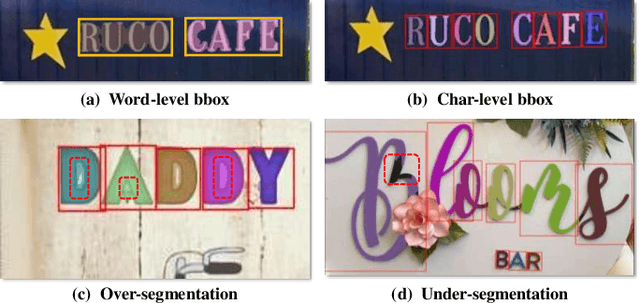
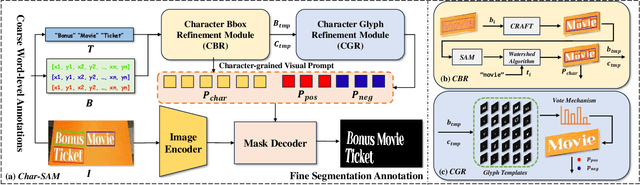
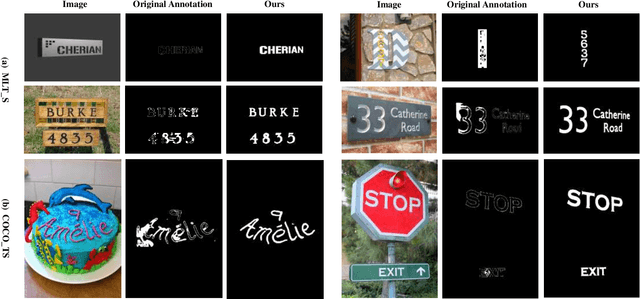
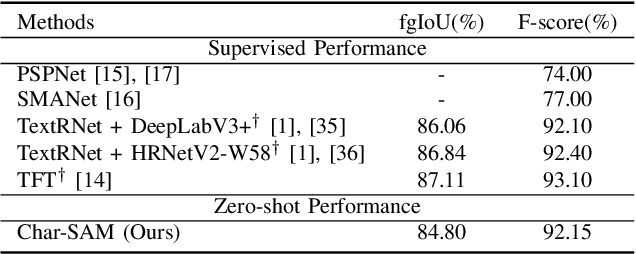
The recent emergence of the Segment Anything Model (SAM) enables various domain-specific segmentation tasks to be tackled cost-effectively by using bounding boxes as prompts. However, in scene text segmentation, SAM can not achieve desirable performance. The word-level bounding box as prompts is too coarse for characters, while the character-level bounding box as prompts suffers from over-segmentation and under-segmentation issues. In this paper, we propose an automatic annotation pipeline named Char-SAM, that turns SAM into a low-cost segmentation annotator with a Character-level visual prompt. Specifically, leveraging some existing text detection datasets with word-level bounding box annotations, we first generate finer-grained character-level bounding box prompts using the Character Bounding-box Refinement CBR module. Next, we employ glyph information corresponding to text character categories as a new prompt in the Character Glyph Refinement (CGR) module to guide SAM in producing more accurate segmentation masks, addressing issues of over-segmentation and under-segmentation. These modules fully utilize the bbox-to-mask capability of SAM to generate high-quality text segmentation annotations automatically. Extensive experiments on TextSeg validate the effectiveness of Char-SAM. Its training-free nature also enables the generation of high-quality scene text segmentation datasets from real-world datasets like COCO-Text and MLT17.
Less is More: Towards Green Code Large Language Models via Unified Structural Pruning
Dec 20, 2024The extensive application of Large Language Models (LLMs) in generative coding tasks has raised concerns due to their high computational demands and energy consumption. Unlike previous structural pruning methods designed for classification models that deal with lowdimensional classification logits, generative Code LLMs produce high-dimensional token logit sequences, making traditional pruning objectives inherently limited. Moreover, existing single component pruning approaches further constrain the effectiveness when applied to generative Code LLMs. In response, we propose Flab-Pruner, an innovative unified structural pruning method that combines vocabulary, layer, and Feed-Forward Network (FFN) pruning. This approach effectively reduces model parameters while maintaining performance. Additionally, we introduce a customized code instruction data strategy for coding tasks to enhance the performance recovery efficiency of the pruned model. Through extensive evaluations on three state-of-the-art Code LLMs across multiple generative coding tasks, the results demonstrate that Flab-Pruner retains 97% of the original performance after pruning 22% of the parameters and achieves the same or even better performance after post-training. The pruned models exhibit significant improvements in storage, GPU usage, computational efficiency, and environmental impact, while maintaining well robustness. Our research provides a sustainable solution for green software engineering and promotes the efficient deployment of LLMs in real-world generative coding intelligence applications.
LDP: Generalizing to Multilingual Visual Information Extraction by Language Decoupled Pretraining
Dec 19, 2024Visual Information Extraction (VIE) plays a crucial role in the comprehension of semi-structured documents, and several pre-trained models have been developed to enhance performance. However, most of these works are monolingual (usually English). Due to the extremely unbalanced quantity and quality of pre-training corpora between English and other languages, few works can extend to non-English scenarios. In this paper, we conduct systematic experiments to show that vision and layout modality hold invariance among images with different languages. If decoupling language bias from document images, a vision-layout-based model can achieve impressive cross-lingual generalization. Accordingly, we present a simple but effective multilingual training paradigm LDP (Language Decoupled Pre-training) for better utilization of monolingual pre-training data. Our proposed model LDM (Language Decoupled Model) is first pre-trained on the language-independent data, where the language knowledge is decoupled by a diffusion model, and then the LDM is fine-tuned on the downstream languages. Extensive experiments show that the LDM outperformed all SOTA multilingual pre-trained models, and also maintains competitiveness on downstream monolingual/English benchmarks.
SimADFuzz: Simulation-Feedback Fuzz Testing for Autonomous Driving Systems
Dec 18, 2024
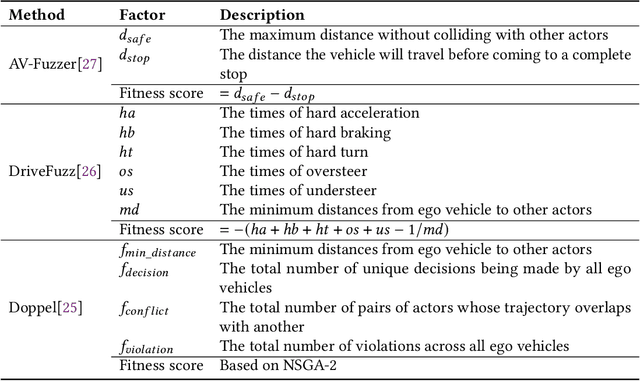

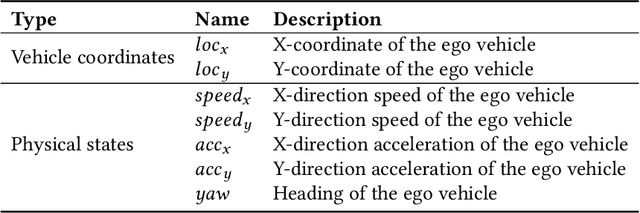
Autonomous driving systems (ADS) have achieved remarkable progress in recent years. However, ensuring their safety and reliability remains a critical challenge due to the complexity and uncertainty of driving scenarios. In this paper, we focus on simulation testing for ADS, where generating diverse and effective testing scenarios is a central task. Existing fuzz testing methods face limitations, such as overlooking the temporal and spatial dynamics of scenarios and failing to leverage simulation feedback (e.g., speed, acceleration and heading) to guide scenario selection and mutation. To address these issues, we propose SimADFuzz, a novel framework designed to generate high-quality scenarios that reveal violations in ADS behavior. Specifically, SimADFuzz employs violation prediction models, which evaluate the likelihood of ADS violations, to optimize scenario selection. Moreover, SimADFuzz proposes distance-guided mutation strategies to enhance interactions among vehicles in offspring scenarios, thereby triggering more edge-case behaviors of vehicles. Comprehensive experiments demonstrate that SimADFuzz outperforms state-of-the-art fuzzers by identifying 32 more unique violations, including 4 reproducible cases of vehicle-vehicle and vehicle-pedestrian collisions. These results demonstrate SimADFuzz's effectiveness in enhancing the robustness and safety of autonomous driving systems.
Track the Answer: Extending TextVQA from Image to Video with Spatio-Temporal Clues
Dec 17, 2024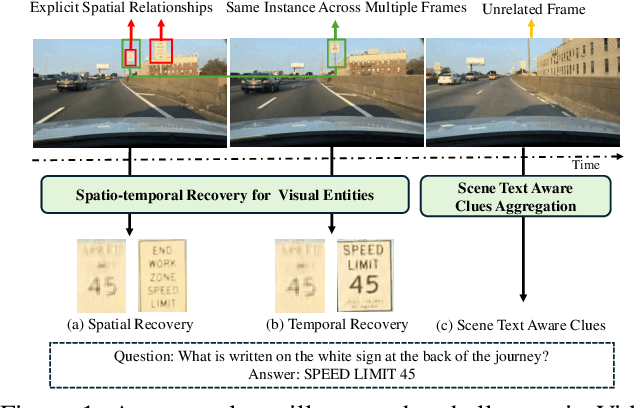

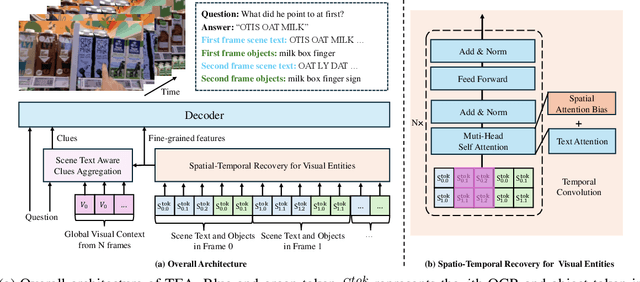

Video text-based visual question answering (Video TextVQA) is a practical task that aims to answer questions by jointly reasoning textual and visual information in a given video. Inspired by the development of TextVQA in image domain, existing Video TextVQA approaches leverage a language model (e.g. T5) to process text-rich multiple frames and generate answers auto-regressively. Nevertheless, the spatio-temporal relationships among visual entities (including scene text and objects) will be disrupted and models are susceptible to interference from unrelated information, resulting in irrational reasoning and inaccurate answering. To tackle these challenges, we propose the TEA (stands for ``\textbf{T}rack th\textbf{E} \textbf{A}nswer'') method that better extends the generative TextVQA framework from image to video. TEA recovers the spatio-temporal relationships in a complementary way and incorporates OCR-aware clues to enhance the quality of reasoning questions. Extensive experiments on several public Video TextVQA datasets validate the effectiveness and generalization of our framework. TEA outperforms existing TextVQA methods, video-language pretraining methods and video large language models by great margins.
Arbitrary Reading Order Scene Text Spotter with Local Semantics Guidance
Dec 13, 2024Scene text spotting has attracted the enthusiasm of relative researchers in recent years. Most existing scene text spotters follow the detection-then-recognition paradigm, where the vanilla detection module hardly determines the reading order and leads to failure recognition. After rethinking the auto-regressive scene text recognition method, we find that a well-trained recognizer can implicitly perceive the local semantics of all characters in a complete word or a sentence without a character-level detection module. Local semantic knowledge not only includes text content but also spatial information in the right reading order. Motivated by the above analysis, we propose the Local Semantics Guided scene text Spotter (LSGSpotter), which auto-regressively decodes the position and content of characters guided by the local semantics. Specifically, two effective modules are proposed in LSGSpotter. On the one hand, we design a Start Point Localization Module (SPLM) for locating text start points to determine the right reading order. On the other hand, a Multi-scale Adaptive Attention Module (MAAM) is proposed to adaptively aggregate text features in a local area. In conclusion, LSGSpotter achieves the arbitrary reading order spotting task without the limitation of sophisticated detection, while alleviating the cost of computational resources with the grid sampling strategy. Extensive experiment results show LSGSpotter achieves state-of-the-art performance on the InverseText benchmark. Moreover, our spotter demonstrates superior performance on English benchmarks for arbitrary-shaped text, achieving improvements of 0.7\% and 2.5\% on Total-Text and SCUT-CTW1500, respectively. These results validate our text spotter is effective for scene texts in arbitrary reading order and shape.