 Add to Chrome
 Add to Firefox
 Add to Edge
MVEI & EmObserver: Empowering MLLM-Oriented Visual Emotional Intelligence via Emotion Statement Judgement
Jul 23, 2026
Affective Image Content Analysis (AICA) aims to recognize and understand emotions elicited by visual content, representing an indispensable step toward Artificial General Intelligence (AGI). However, despite the rapid progress of Multimodal Large Language Models (MLLMs), systematic evaluation of their visual emotional intelligence remains largely absent from recent model releases. We attribute this gap to a structural mismatch between conventional AICA paradigms and the open-ended, instruction-driven nature of MLLMs, where further analysis reveals four major limitations: omission of plausible responses, limited emotion taxonomies, neglect of contextual factors, and labor-intensive annotation. To overcome these barriers, we introduce Emotion Statement Judgement (ESJ), a statement-verification formulation that preserves the expressiveness of the input space while constraining outputs to discriminative judgements. We further develop INSETS, a labor-efficient pipeline that instantiates ESJ at scale by constructing INSETS-462k and supporting MVEI, a rigorously refined benchmark spanning sentiment polarity, emotion interpretation, scene context, and perception subjectivity. Beyond evaluation, we build EmObserver, an emotion-oriented MLLM optimized on ESJ through an elaborate multi-stage recipe. Extensive evaluation of broad-spectrum MLLMs on MVEI reveals fine-grained insights into current artificial visual emotional intelligence, while experiments on multiple AICA benchmarks demonstrate the accuracy, generalization, and reasoning faithfulness of EmObserver. Collectively, these results establish ESJ as a practical formulation, MVEI as a comprehensive benchmark, and EmObserver as an advanced baseline for advancing MLLM-oriented visual emotional intelligence. Code will be released at: https://github.com/wdqqdw/EmObserver.

Benchmarking Living-Screen-Native GUI Agents on Short-Video Platforms
Jun 03, 2026GUI agents today assume a static screen, where the world is frozen between two actions. However, real interfaces such as short-video applications violate this assumption, as their content keeps playing, and a competent user must decide what to watch and for how long. We formalize this task as Living-Screen-Native GUI agents and introduce LivingScreen, the first benchmark instantiating it on short-video platforms, with a faithful browser-based environment, a three-tier task suite, and metrics that jointly score accuracy and information efficiency. Evaluating extensive frontier models, we find that none reaches the human cost-accuracy performance, and that their dominant failure mode is over- and under-observation, pointing to observation control as a missing capability axis for future GUI agents. All data and code will be available at https://github.com/BITHLP/LivingScreen.
Policy Split: Incentivizing Dual-Mode Exploration in LLM Reinforcement with Dual-Mode Entropy Regularization
Apr 13, 2026To encourage diverse exploration in reinforcement learning (RL) for large language models (LLMs) without compromising accuracy, we propose Policy Split, a novel paradigm that bifurcates the policy into normal and high-entropy modes with a high-entropy prompt. While sharing model parameters, the two modes undergo collaborative dual-mode entropy regularization tailored to distinct objectives. Specifically, the normal mode optimizes for task correctness, while the high-entropy mode incorporates a preference for exploration, and the two modes learn collaboratively. Extensive experiments demonstrate that our approach consistently outperforms established entropy-guided RL baselines across various model sizes in general and creative tasks. Further analysis reveals that Policy Split facilitates dual-mode exploration, where the high-entropy mode generates distinct behavioral patterns to the normal mode, providing unique learning signals.
Echo: Towards Advanced Audio Comprehension via Audio-Interleaved Reasoning
Feb 12, 2026The maturation of Large Audio Language Models (LALMs) has raised growing expectations for them to comprehend complex audio much like humans. Current efforts primarily replicate text-based reasoning by contextualizing audio content through a one-time encoding, which introduces a critical information bottleneck. Drawing inspiration from human cognition, we propose audio-interleaved reasoning to break through this bottleneck. It treats audio as an active reasoning component, enabling sustained audio engagement and perception-grounded analysis. To instantiate it, we introduce a two-stage training framework, first teaching LALMs to localize salient audio segments through supervised fine-tuning, and then incentivizing proficient re-listening via reinforcement learning. In parallel, a structured data generation pipeline is developed to produce high-quality training data. Consequently, we present Echo, a LALM capable of dynamically re-listening to audio in demand during reasoning. On audio comprehension benchmarks, Echo achieves overall superiority in both challenging expert-level and general-purpose tasks. Comprehensive analysis further confirms the efficiency and generalizability of audio-interleaved reasoning, establishing it as a promising direction for advancing audio comprehension. Project page: https://github.com/wdqqdw/Echo.
EmoCaliber: Advancing Reliable Visual Emotion Comprehension via Confidence Verbalization and Calibration
Dec 17, 2025Visual Emotion Comprehension (VEC) aims to infer sentiment polarities or emotion categories from affective cues embedded in images. In recent years, Multimodal Large Language Models (MLLMs) have established a popular paradigm in VEC, leveraging their generalizability to unify VEC tasks defined under diverse emotion taxonomies. While this paradigm achieves notable success, it typically formulates VEC as a deterministic task, requiring the model to output a single, definitive emotion label for each image. Such a formulation insufficiently accounts for the inherent subjectivity of emotion perception, overlooking alternative interpretations that may be equally plausible to different viewers. To address this limitation, we propose equipping MLLMs with capabilities to verbalize their confidence in emotion predictions. This additional signal provides users with an estimate of both the plausibility of alternative interpretations and the MLLMs' self-assessed competence, thereby enhancing reliability in practice. Building on this insight, we introduce a three-stage training framework that progressively endows with structured reasoning, teaches to verbalize confidence, and calibrates confidence expression, culminating in EmoCaliber, a confidence-aware MLLM for VEC. Through fair and comprehensive evaluations on the unified benchmark VECBench, EmoCaliber demonstrates overall superiority against existing methods in both emotion prediction and confidence estimation. These results validate the effectiveness of our approach and mark a feasible step toward more reliable VEC systems. Project page: https://github.com/wdqqdw/EmoCaliber.
Customizing Visual Emotion Evaluation for MLLMs: An Open-vocabulary, Multifaceted, and Scalable Approach
Sep 26, 2025Recently, Multimodal Large Language Models (MLLMs) have achieved exceptional performance across diverse tasks, continually surpassing previous expectations regarding their capabilities. Nevertheless, their proficiency in perceiving emotions from images remains debated, with studies yielding divergent results in zero-shot scenarios. We argue that this inconsistency stems partly from constraints in existing evaluation methods, including the oversight of plausible responses, limited emotional taxonomies, neglect of contextual factors, and labor-intensive annotations. To facilitate customized visual emotion evaluation for MLLMs, we propose an Emotion Statement Judgment task that overcomes these constraints. Complementing this task, we devise an automated pipeline that efficiently constructs emotion-centric statements with minimal human effort. Through systematically evaluating prevailing MLLMs, our study showcases their stronger performance in emotion interpretation and context-based emotion judgment, while revealing relative limitations in comprehending perception subjectivity. When compared to humans, even top-performing MLLMs like GPT4o demonstrate remarkable performance gaps, underscoring key areas for future improvement. By developing a fundamental evaluation framework and conducting a comprehensive MLLM assessment, we hope this work contributes to advancing emotional intelligence in MLLMs. Project page: https://github.com/wdqqdw/MVEI.
Gather and Trace: Rethinking Video TextVQA from an Instance-oriented Perspective
Aug 06, 2025Video text-based visual question answering (Video TextVQA) aims to answer questions by explicitly reading and reasoning about the text involved in a video. Most works in this field follow a frame-level framework which suffers from redundant text entities and implicit relation modeling, resulting in limitations in both accuracy and efficiency. In this paper, we rethink the Video TextVQA task from an instance-oriented perspective and propose a novel model termed GAT (Gather and Trace). First, to obtain accurate reading result for each video text instance, a context-aggregated instance gathering module is designed to integrate the visual appearance, layout characteristics, and textual contents of the related entities into a unified textual representation. Then, to capture dynamic evolution of text in the video flow, an instance-focused trajectory tracing module is utilized to establish spatio-temporal relationships between instances and infer the final answer. Extensive experiments on several public Video TextVQA datasets validate the effectiveness and generalization of our framework. GAT outperforms existing Video TextVQA methods, video-language pretraining methods, and video large language models in both accuracy and inference speed. Notably, GAT surpasses the previous state-of-the-art Video TextVQA methods by 3.86\% in accuracy and achieves ten times of faster inference speed than video large language models. The source code is available at https://github.com/zhangyan-ucas/GAT.
An Empirical Study on Configuring In-Context Learning Demonstrations for Unleashing MLLMs' Sentimental Perception Capability
May 22, 2025The advancements in Multimodal Large Language Models (MLLMs) have enabled various multimodal tasks to be addressed under a zero-shot paradigm. This paradigm sidesteps the cost of model fine-tuning, emerging as a dominant trend in practical application. Nevertheless, Multimodal Sentiment Analysis (MSA), a pivotal challenge in the quest for general artificial intelligence, fails to accommodate this convenience. The zero-shot paradigm exhibits undesirable performance on MSA, casting doubt on whether MLLMs can perceive sentiments as competent as supervised models. By extending the zero-shot paradigm to In-Context Learning (ICL) and conducting an in-depth study on configuring demonstrations, we validate that MLLMs indeed possess such capability. Specifically, three key factors that cover demonstrations' retrieval, presentation, and distribution are comprehensively investigated and optimized. A sentimental predictive bias inherent in MLLMs is also discovered and later effectively counteracted. By complementing each other, the devised strategies for three factors result in average accuracy improvements of 15.9% on six MSA datasets against the zero-shot paradigm and 11.2% against the random ICL baseline.
Char-SAM: Turning Segment Anything Model into Scene Text Segmentation Annotator with Character-level Visual Prompts
Dec 27, 2024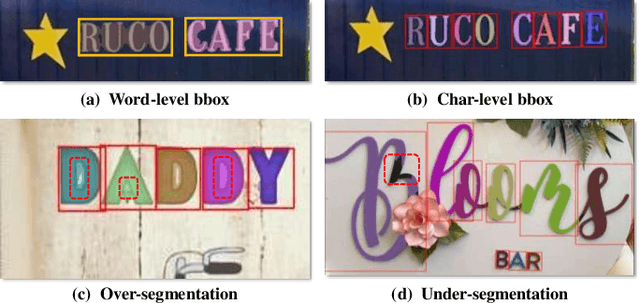
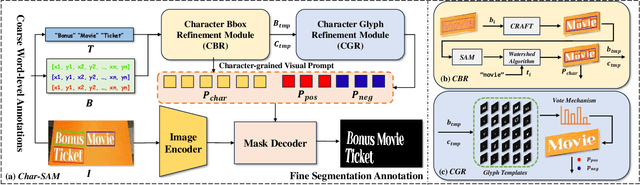
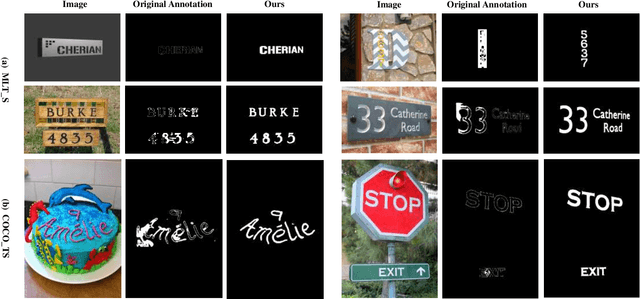
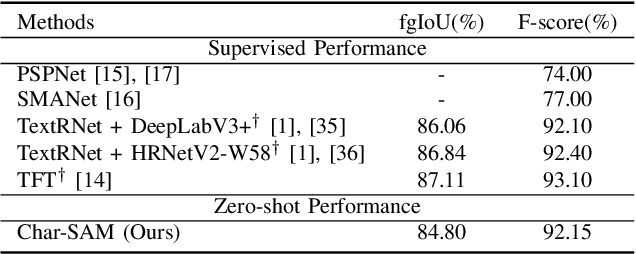
The recent emergence of the Segment Anything Model (SAM) enables various domain-specific segmentation tasks to be tackled cost-effectively by using bounding boxes as prompts. However, in scene text segmentation, SAM can not achieve desirable performance. The word-level bounding box as prompts is too coarse for characters, while the character-level bounding box as prompts suffers from over-segmentation and under-segmentation issues. In this paper, we propose an automatic annotation pipeline named Char-SAM, that turns SAM into a low-cost segmentation annotator with a Character-level visual prompt. Specifically, leveraging some existing text detection datasets with word-level bounding box annotations, we first generate finer-grained character-level bounding box prompts using the Character Bounding-box Refinement CBR module. Next, we employ glyph information corresponding to text character categories as a new prompt in the Character Glyph Refinement (CGR) module to guide SAM in producing more accurate segmentation masks, addressing issues of over-segmentation and under-segmentation. These modules fully utilize the bbox-to-mask capability of SAM to generate high-quality text segmentation annotations automatically. Extensive experiments on TextSeg validate the effectiveness of Char-SAM. Its training-free nature also enables the generation of high-quality scene text segmentation datasets from real-world datasets like COCO-Text and MLT17.
Track the Answer: Extending TextVQA from Image to Video with Spatio-Temporal Clues
Dec 17, 2024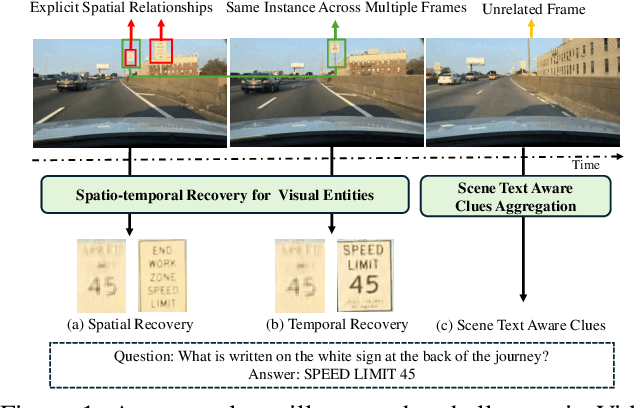

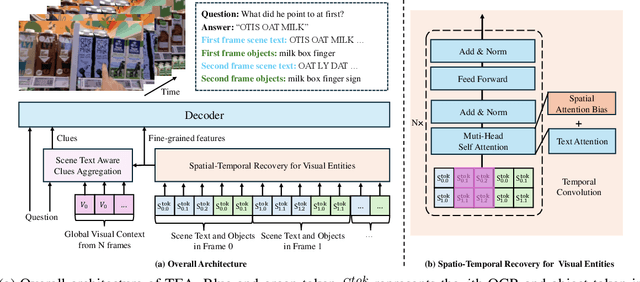

Video text-based visual question answering (Video TextVQA) is a practical task that aims to answer questions by jointly reasoning textual and visual information in a given video. Inspired by the development of TextVQA in image domain, existing Video TextVQA approaches leverage a language model (e.g. T5) to process text-rich multiple frames and generate answers auto-regressively. Nevertheless, the spatio-temporal relationships among visual entities (including scene text and objects) will be disrupted and models are susceptible to interference from unrelated information, resulting in irrational reasoning and inaccurate answering. To tackle these challenges, we propose the TEA (stands for ``\textbf{T}rack th\textbf{E} \textbf{A}nswer'') method that better extends the generative TextVQA framework from image to video. TEA recovers the spatio-temporal relationships in a complementary way and incorporates OCR-aware clues to enhance the quality of reasoning questions. Extensive experiments on several public Video TextVQA datasets validate the effectiveness and generalization of our framework. TEA outperforms existing TextVQA methods, video-language pretraining methods and video large language models by great margins.