 Add to Chrome
 Add to Firefox
 Add to Edge
Flexible Rate-Splitting for Joint Unicast and Multi-Group Multicast Transmission in RIS-Assisted mmWave Networks
May 31, 2026
Joint unicast and multi-group multicast transmission with RIS and RSMA is a promising enabler for 6G services. However, existing RSMA schemes for such scenarios split only unicast messages while leaving multicast messages intact, limiting the degree of freedom of interference management. To this end, we propose a joint rate splitting framework that splits both unicast and multicast information and two RSMA schemes. The common-common fusion (CCF-RSMA) scheme encodes the unicast common part into the global multicast common stream, while the private-common fusion (PCF-RSMA) scheme merges it with the group-specific multicast private part. For each scheme, we formulate energy efficiency (EE) maximization problems under both perfect and imperfect channel state information, and jointly optimize active beamforming, RIS phase shifts and rate allocation parameters. Simulation results demonstrate that the proposed schemes significantly outperform the comparative schemes in terms of EE, thereby proving the effectiveness of the proposed framework. Moreover, CCF-RSMA is more favorable in scenarios with larger groups and higher unicast QoS demands, whereas PCF-RSMA is better suited for scenarios with smaller groups and higher multicast QoS.

Integrated Channel Sounding and Communication: Requirements, Architecture, Challenges, and Key Technologies
Mar 16, 2026Channel models are essential for the design, evaluation, and optimization of wireless communication systems. The emerging space-air-ground-sea integrated network (SAGSIN), characterized by diverse service applications and extended-spectrum operations, places even greater demands on highly accurate channel models. However, conventional channel sounding is limited by generalized measurement campaigns, inadequate cross-band consistency, and insufficient real-time adaptability, making it unable to meet the needs of SAGSIN for scenario-specific and high-precision channel modeling. To address this challenge, we propose a novel technological framework, termed integrated channel sounding and communication (ICSC). By deeply integrating sounding and communication, the ICSC enables efficient and real-time acquisition of dynamic channel characteristics during communication processes, supporting fine-grained site- and scenario-specific measurements. Furthermore, leveraging artificial intelligence techniques, ICSC can identify channel conditions and adapt waveform parameters in real-time according to scenario variations, which in turn enhances communication performance. This article first introduces the fundamental principles of the ICSC framework, elaborates on its core concepts and key advantages, and demonstrates its feasibility through the development of an integrated verification system (IVS). Subsequently, the potential applications and opportunities of the ICSC are analyzed in depth, followed by a discussion of its future development directions and remaining challenges.
Flag-Preamble-Based Delay-Doppler Channel Estimation for Next-Evolution Waveforms
Mar 16, 2026Accurate delay-Doppler channel estimation is critical for next-evolution waveforms (NEWs) to enable reliable signal detection. This paper proposes a robust channel estimation algorithm that integrates Flag sequences optimized via an adaptive accelerated parallel majorization-minimization (AP-MM) algorithm with a proposed channel estimation algorithm. To enable efficient, low-complexity parameter extraction and further overcome the robustness issues of conventional greedy estimation, we introduce two key enhancements, i.e., a candidate selection strategy to mitigate spurious sidelobe peaks, and a global least squares (LS) refinement stage to eliminate error propagation caused by sidelobe masking effects. Numerical results demonstrate that the proposed scheme significantly outperforms traditional existing algorithms, achieving the desired estimation accuracy.
A Scalable Cloud-Edge Collaborative CKM Construction Framework Enabled by a Foundation Prior Model
Feb 07, 2026Channel knowledge maps (CKMs) provide a site-specific, location-indexed knowledge base that supports environment-aware communications and sensing in 6G networks. In practical deployments, CKM observations are often noisy and irregular due to coverage-induced sparsity and hardware-induced linear/nonlinear degradations. Conventional end-to-end algorithms couple CKM prior information with task- and device-specific observations, and require labeled data and separate training for each construction configuration, which is expensive and therefore incompatible with scalable edge deployments. Motivated by the trends toward cloud-edge collaboration and the Artificial Intelligence - Radio Access Network (AI-RAN) paradigm, we develop a cloud-edge collaborative framework for scalable CKM construction, which enables knowledge sharing across tasks, devices, and regions by explicitly decoupling a generalizable CKM prior from the information provided by local observations. A foundation model is trained once in the cloud using unlabeled data to learn a generalizable CKM prior. During inference, edge nodes combine the shared prior with local observations. Experiments on the CKMImageNet dataset show that the proposed method achieves competitive construction accuracy while substantially reducing training cost and data requirements, mitigating negative transfer, and offering clear advantages in generalization and deployment scalability.
SynthRM: A Synthetic Data Platform for Vision-Aided Mobile System Simulation
Jan 27, 2026Vision-aided wireless sensing is emerging as a cornerstone of 6G mobile computing. While data-driven approaches have advanced rapidly, establishing a precise geometric correspondence between ego-centric visual data and radio propagation remains a challenge. Existing paradigms typically either associate 2D topology maps and auxiliary information with radio maps, or provide 3D perspective views limited by sparse radio data. This spatial representation flattens the complex vertical interactions such as occlusion and diffraction that govern signal behavior in urban environments, rendering the task of cross-view signal inference mathematically ill-posed. To resolve this geometric ambiguity, we introduce SynthRM, a scalable synthetic data platform. SynthRM implements a Visible-Aligned-Surface simulation strategy: rather than probing a global volumetric grid, it performs ray-tracing directly onto the geometry exposed to the sensor. This approach ensures pixel-level consistency between visual semantics and electromagnetic response, transforming the learning objective into a physically well-posed problem. We demonstrate the platform's capabilities by presenting a diverse, city-scale dataset derived from procedurally generated environments. By combining efficient procedural synthesis with high-fidelity electromagnetic modeling, SynthRM provides a transparent, accessible foundation for developing next-generation mobile systems for environment-aware sensing and communication.
ISAC with Affine Frequency Division Multiplexing: An FMCW-Based Signal Processing Perspective
Nov 15, 2025This paper investigates the sensing potential of affine frequency division multiplexing (AFDM) in high-mobility integrated sensing and communication (ISAC) from the perspective of radar waveforms. We introduce an innovative parameter selection criterion that establishes a precise mathematical equivalence between AFDM subcarriers and Nyquist-sampled frequency-modulated continuous-wave (FMCW). This connection not only provides a clear physical insight into AFDM's sensing mechanism but also enables a direct mapping from the DAFT index to delay-Doppler (DD) parameters of wireless channels. Building on this, we develop a novel input-output model in a DD-parameterized DAFT (DD-DAFT) domain for AFDM, which explicitly reveals the inherent DD coupling effect arising from the chirp-channel interaction. Subsequently, we design two matched-filtering sensing algorithms. The first is performed in the time-frequency domain with low complexity, while the second is operated in the DD-DAFT domain to precisely resolve the DD coupling. Simulations show that our algorithms achieve effective pilot-free sensing and demonstrate a fundamental trade-off between sensing performance, communication overhead, and computational complexity. The proposed AFDM outperforms classical AFDM and other variants in most scenarios.
Ambiguity Function Analysis of AFDM Under Pulse-Shaped Random ISAC Signaling
Nov 06, 2025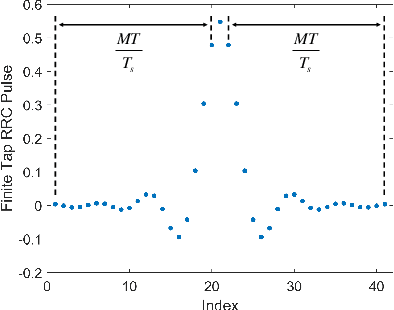
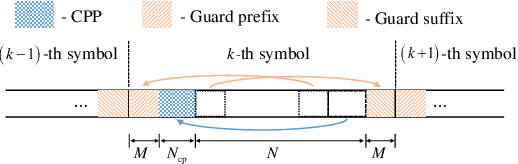
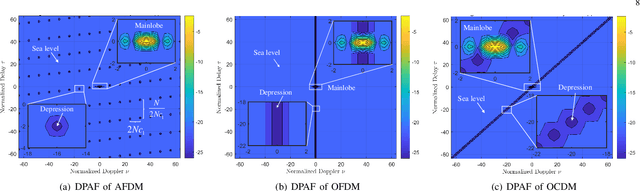
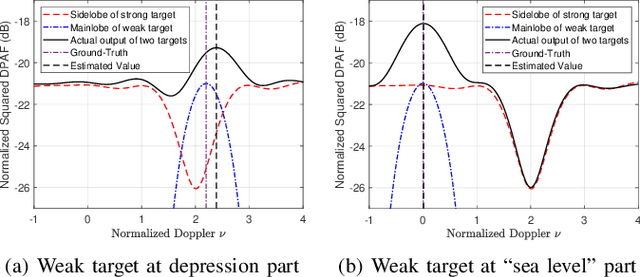
This paper investigates the ambiguity function (AF) of the emerging affine frequency division multiplexing (AFDM) waveform for Integrated Sensing and Communication (ISAC) signaling under a pulse shaping regime. Specifically, we first derive the closed-form expression of the average squared discrete period AF (DPAF) for AFDM waveform without pulse shaping, revealing that the AF depends on the parameter $c_1$ and the kurtosis of random communication data, while being independent of the parameter $c_2$. As a step further, we conduct a comprehensive analysis on the AFs of various waveforms, including AFDM, orthogonal frequency division multiplexing (OFDM) and orthogonal chirp-division multiplexing (OCDM). Our results indicate that all three waveforms exhibit the same number of regular depressions in the sidelobes of their AFs, which incurs performance loss for detecting and estimating weak targets. However, the AFDM waveform can flexibly control the positions of depressions by adjusting the parameter $c_1$, which motivates a novel design approach of the AFDM parameters to mitigate the adverse impact of depressions of the strong target on the weak target. Furthermore, a closed-form expression of the average squared DPAF for pulse-shaped random AFDM waveform is derived, which demonstrates that the pulse shaping filter generates the shaped mainlobe along the delay axis and the rapid roll-off sidelobes along the Doppler axis. Numerical results verify the effectiveness of our theoretical analysis and proposed design methodology for the AFDM modulation.
From OFDM to AFDM: Enabling Adaptive Integrated Sensing and Communication in High-Mobility Scenarios
Oct 31, 2025Integrated sensing and communication (ISAC) is a key feature of next-generation wireless networks, enabling a wide range of emerging applications such as vehicle-to-everything (V2X) and unmanned aerial vehicles (UAVs), which operate in high-mobility scenarios. Notably, the wireless channels within these applications typically exhibit severe delay and Doppler spreads. The latter causes serious communication performance degradation in the Orthogonal Frequency-Division Multiplexing (OFDM) waveform that is widely adopted in current wireless networks. To address this challenge, the recently proposed Doppler-resilient affine frequency division multiplexing (AFDM) waveform, which uses flexible chirp signals as subcarriers, shows great potential for achieving adaptive ISAC in high-mobility scenarios. This article provides a comprehensive overview of AFDM-ISAC. We begin by presenting the fundamentals of AFDM-ISAC, highlighting its inherent frequency-modulated continuous-wave (FMCW)-like characteristics. Then, we explore its ISAC performance limits by analyzing its diversity order, ambiguity function (AF), and Cramer-Rao Bound (CRB). Finally, we present several effective sensing algorithms and opportunities for AFDM-ISAC, with the aim of sparking new ideas in this emerging field.
Multiple-Mode Affine Frequency Division Multiplexing with Index Modulation
Jul 17, 2025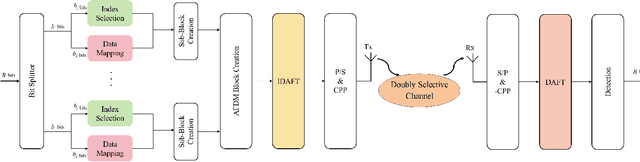
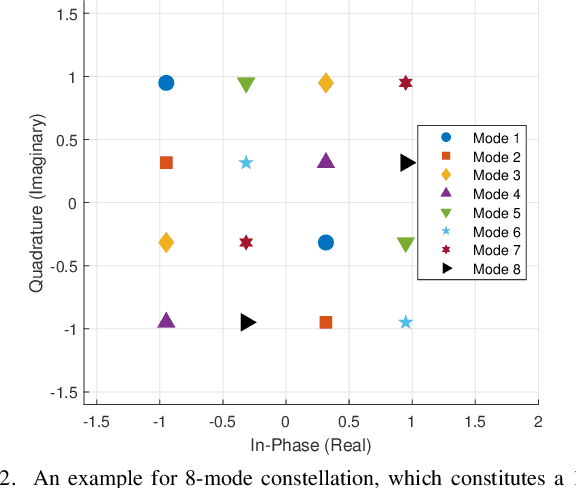
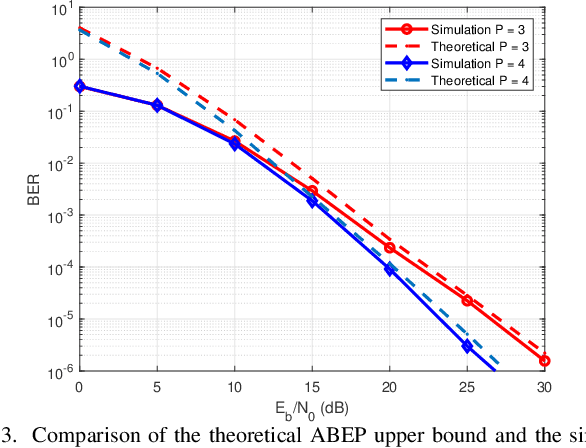
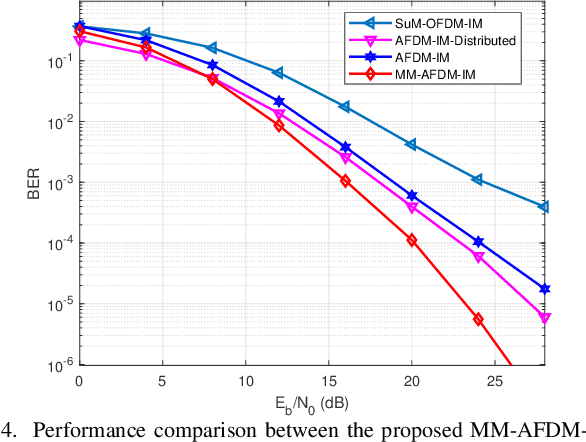
Affine frequency division multiplexing (AFDM), a promising multicarrier technique utilizing chirp signals, has been envisioned as an effective solution for high-mobility communication scenarios. In this paper, we develop a multiple-mode index modulation scheme tailored for AFDM, termed as MM-AFDM-IM, which aims to further improve the spectral and energy efficiencies of AFDM. Specifically, multiple constellation alphabets are selected for different chirp-based subcarriers (chirps). Aside from classical amplitude/phase modulation, additional information bits can be conveyed by the dynamic patterns of both constellation mode selection and chirp activation, without extra energy consumption. Furthermore, we discuss the mode selection strategy and derive an asymptotically tight upper bound on the bit error rate (BER) of the proposed scheme under maximum-likelihood detection. Simulation results are provided to demonstrate the superior performance of MM-AFDM-IM compared to conventional benchmark schemes.
AI-based Environment-Aware XL-MIMO Channel Estimation with Location-Specific Prior Knowledge Enabled by CKM
Jul 08, 2025Accurate and efficient acquisition of wireless channel state information (CSI) is crucial to enhance the communication performance of wireless systems. However, with the continuous densification of wireless links, increased channel dimensions, and the use of higher-frequency bands, channel estimation in the sixth generation (6G) and beyond wireless networks faces new challenges, such as insufficient orthogonal pilot sequences, inadequate signal-to-noise ratio (SNR) for channel training, and more sophisticated channel statistical distributions in complex environment. These challenges pose significant difficulties for classical channel estimation algorithms like least squares (LS) and maximum a posteriori (MAP). To address this problem, we propose a novel environment-aware channel estimation framework with location-specific prior channel distribution enabled by the new concept of channel knowledge map (CKM). To this end, we propose a new type of CKM called channel score function map (CSFM), which learns the channel probability density function (PDF) using artificial intelligence (AI) techniques. To fully exploit the prior information in CSFM, we propose a plug-and-play (PnP) based algorithm to decouple the regularized MAP channel estimation problem, thereby reducing the complexity of the optimization process. Besides, we employ Tweedie's formula to establish a connection between the channel score function, defined as the logarithmic gradient of the channel PDF, and the channel denoiser. This allows the use of the high-precision, environment-aware channel denoiser from the CSFM to approximate the channel score function, thus enabling efficient processing of the decoupled channel statistical components. Simulation results show that the proposed CSFM-PnP based channel estimation technique significantly outperforms the conventional techniques in the aforementioned challenging scenarios.