 Add to Chrome
 Add to Firefox
 Add to Edge
A First-Order Multi-Gradient Algorithm for Multi-Objective Bi-Level Optimization
Jan 17, 2024
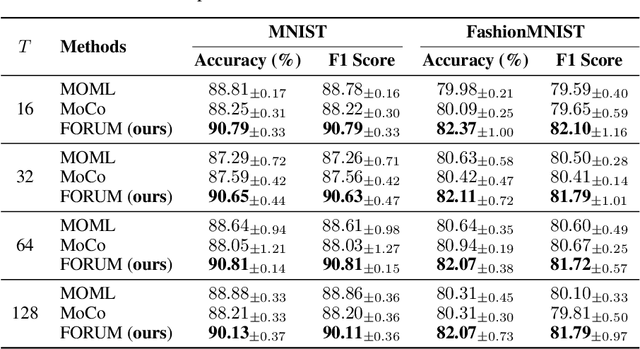
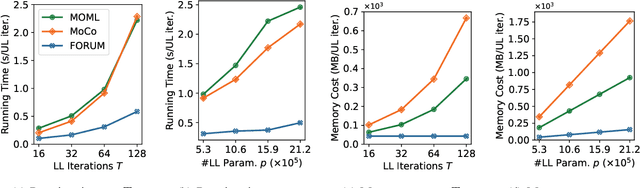
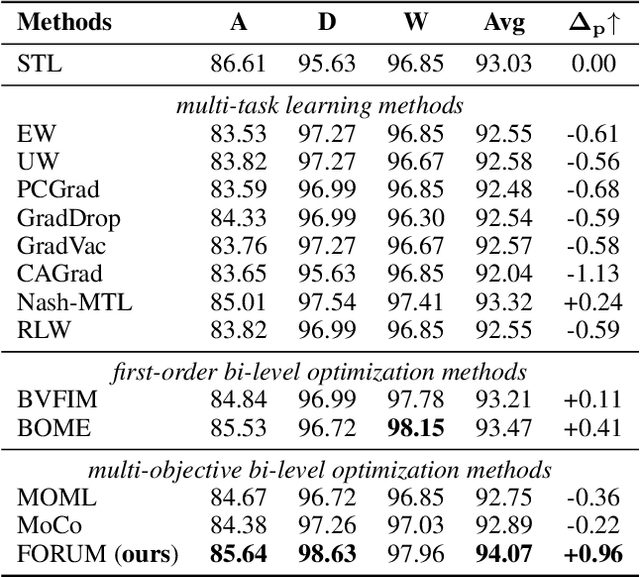
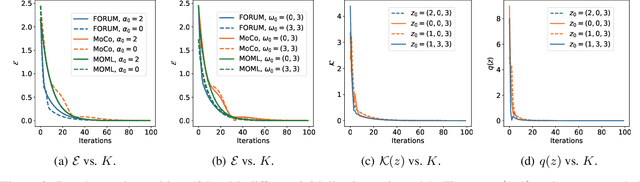
In this paper, we study the Multi-Objective Bi-Level Optimization (MOBLO) problem, where the upper-level subproblem is a multi-objective optimization problem and the lower-level subproblem is for scalar optimization. Existing gradient-based MOBLO algorithms need to compute the Hessian matrix, causing the computational inefficient problem. To address this, we propose an efficient first-order multi-gradient method for MOBLO, called FORUM. Specifically, we reformulate MOBLO problems as a constrained multi-objective optimization (MOO) problem via the value-function approach. Then we propose a novel multi-gradient aggregation method to solve the challenging constrained MOO problem. Theoretically, we provide the complexity analysis to show the efficiency of the proposed method and a non-asymptotic convergence result. Empirically, extensive experiments demonstrate the effectiveness and efficiency of the proposed FORUM method in different learning problems. In particular, it achieves state-of-the-art performance on three multi-task learning benchmark datasets.

Zone-Specific CSI Feedback for Massive MIMO: A Situation-Aware Deep Learning Approach
Jan 15, 2024Massive MIMO basestations, operating with frequency-division duplexing (FDD), require the users to feedback their channel state information (CSI) in order to design the precoding matrices. Given the powerful capabilities of deep neural networks in learning quantization codebooks, utilizing these networks in compressing the channels and reducing the massive MIMO CSI feedback overhead has recently gained increased interest. Learning one model, however, for the full cell or sector may not be optimal as the channel distribution could change significantly from one \textit{zone} (an area or region) to another. In this letter, we introduce the concept of \textit{zone-specific} CSI feedback. By partitioning the site space into multiple channel zones, the underlying channel distribution can be efficiently leveraged to reduce the CSI feedback. This concept leverages the implicit or explicit user position information to select the right zone-specific model and its parameters. To facilitate the evaluation of associated overhead, we introduce two novel metrics named \textit{model parameters transmission rate} (MPTR) and \textit{model parameters update rate} (MPUR). They jointly provide important insights and guidance for the system design and deployment. Simulation results show that significant gains could be achieved by the proposed framework. For example, using the large-scale Boston downtown scenario of DeepMIMO, the proposed zone-specific CSI feedback approach can on average achieve around 6dB NMSE gain compared to the other solutions, while keeping the same model complexity.
Decentralized Interference-Aware Codebook Learning in Millimeter Wave MIMO Systems
Jan 15, 2024Beam codebooks are integral components of the future millimeter wave (mmWave) multiple input multiple output (MIMO) system to relax the reliance on the instantaneous channel state information (CSI). The design of these codebooks, therefore, becomes one of the fundamental problems for these systems, and the well-designed codebooks play key roles in enabling efficient and reliable communications. Prior work has primarily focused on the codebook learning problem within a single cell/network and under stationary interference. In this work, we generalize the interference-aware codebook learning problem to networks with multiple cells/basestations. One of the key differences compared to the single-cell codebook learning problem is that the underlying environment becomes non-stationary, as the behavior of one base station will influence the learning of the others. Moreover, to encompass some of the challenging scenarios, information exchange between the different learning nodes is not allowed, which leads to a fully decentralized system with significantly increased learning difficulties. To tackle the non-stationarity, the averaging of the measurements is used to estimate the interference nulling performance of a particular beam, based on which a decision rule is provided. Furthermore, we theoretically justify the adoption of such estimator and prove that it is a sufficient statistic for the underlying quantity of interest in an asymptotic sense. Finally, a novel reward function based on averaging is proposed to fully decouple the learning of the multiple agents running at different nodes. Simulation results show that the developed solution is capable of learning well-shaped codebook patterns for different networks that significantly suppress the interference without information exchange, highlighting ...
Online Test-Time Adaptation of Spatial-Temporal Traffic Flow Forecasting
Jan 08, 2024Accurate spatial-temporal traffic flow forecasting is crucial in aiding traffic managers in implementing control measures and assisting drivers in selecting optimal travel routes. Traditional deep-learning based methods for traffic flow forecasting typically rely on historical data to train their models, which are then used to make predictions on future data. However, the performance of the trained model usually degrades due to the temporal drift between the historical and future data. To make the model trained on historical data better adapt to future data in a fully online manner, this paper conducts the first study of the online test-time adaptation techniques for spatial-temporal traffic flow forecasting problems. To this end, we propose an Adaptive Double Correction by Series Decomposition (ADCSD) method, which first decomposes the output of the trained model into seasonal and trend-cyclical parts and then corrects them by two separate modules during the testing phase using the latest observed data entry by entry. In the proposed ADCSD method, instead of fine-tuning the whole trained model during the testing phase, a lite network is attached after the trained model, and only the lite network is fine-tuned in the testing process each time a data entry is observed. Moreover, to satisfy that different time series variables may have different levels of temporal drift, two adaptive vectors are adopted to provide different weights for different time series variables. Extensive experiments on four real-world traffic flow forecasting datasets demonstrate the effectiveness of the proposed ADCSD method. The code is available at https://github.com/Pengxin-Guo/ADCSD.
Large Language Models as Visual Cross-Domain Learners
Jan 06, 2024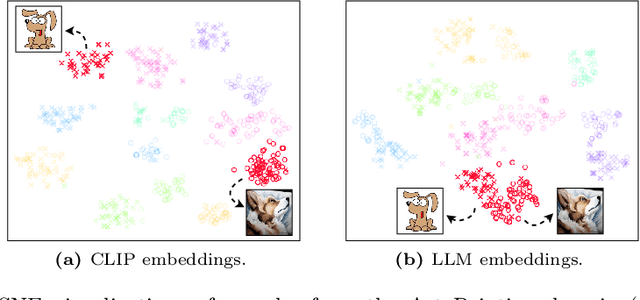

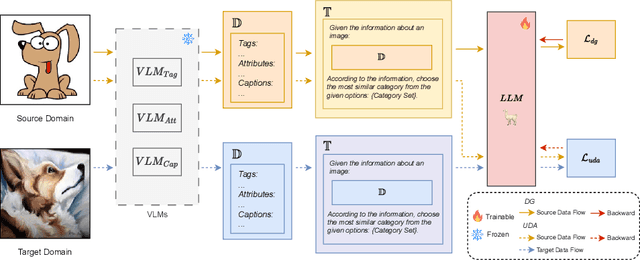
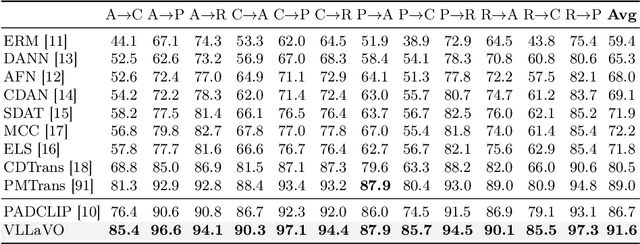
Recent advances achieved by deep learning models rely on the independent and identically distributed assumption, hindering their applications in real-world scenarios with domain shifts. To address the above issues, cross-domain learning aims at extracting domain-invariant knowledge to reduce the domain shift between training and testing data. However, in visual cross-domain learning, traditional methods concentrate solely on the image modality, neglecting the use of the text modality to alleviate the domain shift. In this work, we propose Large Language models as Visual cross-dOmain learners (LLaVO). LLaVO uses vision-language models to convert images into detailed textual descriptions. A large language model is then finetuned on textual descriptions of the source/target domain generated by a designed instruction template. Extensive experimental results on various cross-domain tasks under the domain generalization and unsupervised domain adaptation settings have demonstrated the effectiveness of the proposed method.
StyleSinger: Style Transfer for Out-of-Domain Singing Voice Synthesis
Jan 02, 2024Style transfer for out-of-domain (OOD) singing voice synthesis (SVS) focuses on generating high-quality singing voices with unseen styles (such as timbre, emotion, pronunciation, and articulation skills) derived from reference singing voice samples. However, the endeavor to model the intricate nuances of singing voice styles is an arduous task, as singing voices possess a remarkable degree of expressiveness. Moreover, existing SVS methods encounter a decline in the quality of synthesized singing voices in OOD scenarios, as they rest upon the assumption that the target vocal attributes are discernible during the training phase. To overcome these challenges, we propose StyleSinger, the first singing voice synthesis model for zero-shot style transfer of out-of-domain reference singing voice samples. StyleSinger incorporates two critical approaches for enhanced effectiveness: 1) the Residual Style Adaptor (RSA) which employs a residual quantization module to capture diverse style characteristics in singing voices, and 2) the Uncertainty Modeling Layer Normalization (UMLN) to perturb the style attributes within the content representation during the training phase and thus improve the model generalization. Our extensive evaluations in zero-shot style transfer undeniably establish that StyleSinger outperforms baseline models in both audio quality and similarity to the reference singing voice samples. Access to singing voice samples can be found at https://stylesinger.github.io/.
Quantum-Assisted Joint Caching and Power Allocation for Integrated Satellite-Terrestrial Networks
Dec 22, 2023Low earth orbit (LEO) satellite network can complement terrestrial networks for achieving global wireless coverage and improving delay-sensitive Internet services. This paper proposes an integrated satellite-terrestrial network (ISTN) architecture to provide ground users with seamless and reliable content delivery services. For optimal service provisioning in this architecture, we formulate an optimization model to maximize the network throughput by jointly optimizing content delivery policy, cache placement, and transmission power allocation. The resulting optimization model is a large-scale mixed-integer nonlinear program (MINLP) that is intractable for classical computer solvers. Inspired by quantum computing techniques, we propose a hybrid quantum-classical generalized Benders' decomposition (HQCGBD) algorithm to address this challenge. Specifically, we first exploit the generalized Benders' decomposition (GBD) to decompose the problem into a master problem and a subproblem and then leverage the state-of-art quantum annealer to solve the challenging master problem.
Mixture of Cluster-conditional LoRA Experts for Vision-language Instruction Tuning
Dec 19, 2023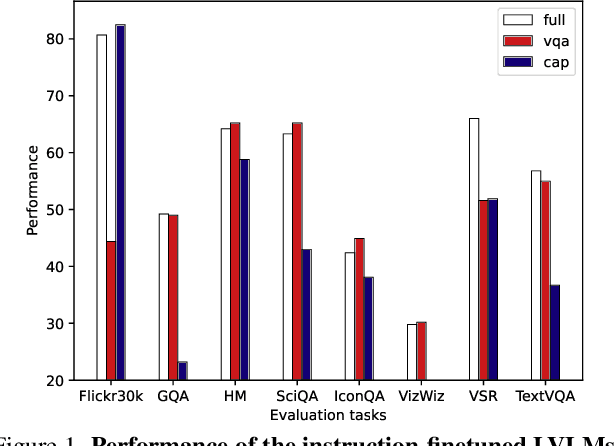
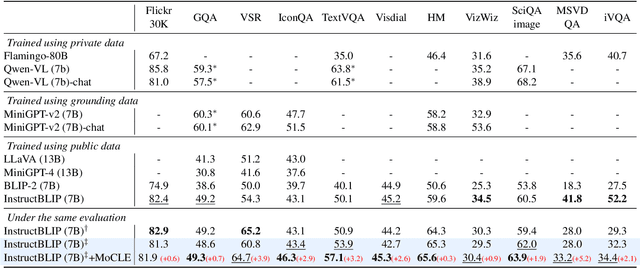

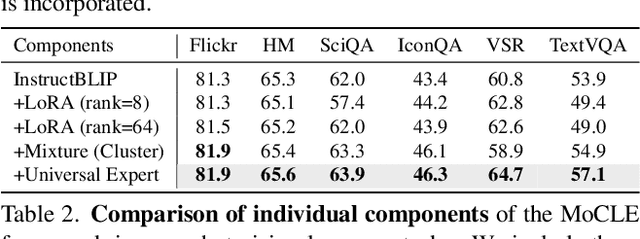
Instruction tuning of the Large Vision-language Models (LVLMs) has revolutionized the development of versatile models with zero-shot generalization across a wide range of downstream vision-language tasks. However, diversity of training tasks of different sources and formats would lead to inevitable task conflicts, where different tasks conflicts for the same set of model parameters, resulting in sub-optimal instruction-following abilities. To address that, we propose the Mixture of Cluster-conditional LoRA Experts (MoCLE), a novel Mixture of Experts (MoE) architecture designed to activate the task-customized model parameters based on the instruction clusters. A separate universal expert is further incorporated to improve the generalization capabilities of MoCLE for novel instructions. Extensive experiments on 10 zero-shot tasks demonstrate the effectiveness of MoCLE.
Memory-Efficient Reversible Spiking Neural Networks
Dec 13, 2023Spiking neural networks (SNNs) are potential competitors to artificial neural networks (ANNs) due to their high energy-efficiency on neuromorphic hardware. However, SNNs are unfolded over simulation time steps during the training process. Thus, SNNs require much more memory than ANNs, which impedes the training of deeper SNN models. In this paper, we propose the reversible spiking neural network to reduce the memory cost of intermediate activations and membrane potentials during training. Firstly, we extend the reversible architecture along temporal dimension and propose the reversible spiking block, which can reconstruct the computational graph and recompute all intermediate variables in forward pass with a reverse process. On this basis, we adopt the state-of-the-art SNN models to the reversible variants, namely reversible spiking ResNet (RevSResNet) and reversible spiking transformer (RevSFormer). Through experiments on static and neuromorphic datasets, we demonstrate that the memory cost per image of our reversible SNNs does not increase with the network depth. On CIFAR10 and CIFAR100 datasets, our RevSResNet37 and RevSFormer-4-384 achieve comparable accuracies and consume 3.79x and 3.00x lower GPU memory per image than their counterparts with roughly identical model complexity and parameters. We believe that this work can unleash the memory constraints in SNN training and pave the way for training extremely large and deep SNNs. The code is available at https://github.com/mi804/RevSNN.git.
A Unified Framework for Unsupervised Domain Adaptation based on Instance Weighting
Dec 08, 2023
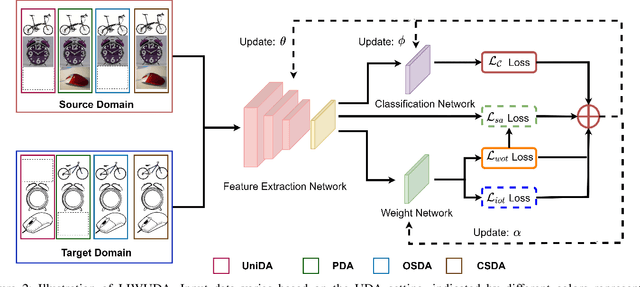
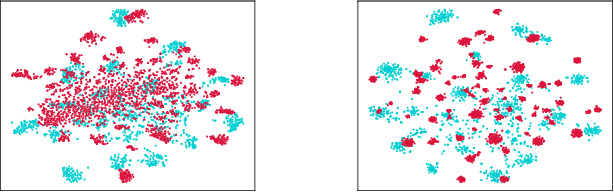
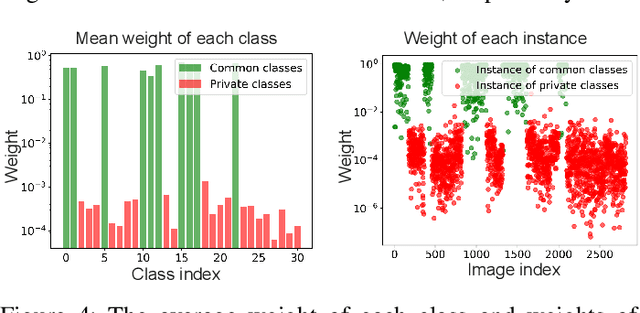
Despite the progress made in domain adaptation, solving Unsupervised Domain Adaptation (UDA) problems with a general method under complex conditions caused by label shifts between domains remains a formidable task. In this work, we comprehensively investigate four distinct UDA settings including closed set domain adaptation, partial domain adaptation, open set domain adaptation, and universal domain adaptation, where shared common classes between source and target domains coexist alongside domain-specific private classes. The prominent challenges inherent in diverse UDA settings center around the discrimination of common/private classes and the precise measurement of domain discrepancy. To surmount these challenges effectively, we propose a novel yet effective method called Learning Instance Weighting for Unsupervised Domain Adaptation (LIWUDA), which caters to various UDA settings. Specifically, the proposed LIWUDA method constructs a weight network to assign weights to each instance based on its probability of belonging to common classes, and designs Weighted Optimal Transport (WOT) for domain alignment by leveraging instance weights. Additionally, the proposed LIWUDA method devises a Separate and Align (SA) loss to separate instances with low similarities and align instances with high similarities. To guide the learning of the weight network, Intra-domain Optimal Transport (IOT) is proposed to enforce the weights of instances in common classes to follow a uniform distribution. Through the integration of those three components, the proposed LIWUDA method demonstrates its capability to address all four UDA settings in a unified manner. Experimental evaluations conducted on three benchmark datasets substantiate the effectiveness of the proposed LIWUDA method.