 Add to Chrome
 Add to Firefox
 Add to Edge
When Data Is Scarce: Scaling Sparse Language Models with Repeated Training
May 31, 2026
Scaling laws for dense LLMs under infinite data are well explored, but how sparsity interacts with limited data is not. In this work, we study sparse training in data-constrained regimes where limited unique tokens require multi-epoch training. Our experiments span models up to 1.92B parameters in the fitting set, sparsity up to 93.75%, unique data budgets up to 2.6B tokens, and total training tokens up to 41.6B over 16 epochs; we further validate extrapolation on held-out dense-equivalent models up to 7.68B parameters. We find that: 1. Sparse scaling in data-limited settings: We introduce a scaling law that models loss as a function of active parameters, unique tokens, data repetition, and sparsity, accurately predicting performance across compute and data budgets. 2. Delayed data saturation: sparse training postpones diminishing returns from repeated data, making multi-epoch training more effective. 3. Resource trade-offs: With fixed data, loss-optimal sparsity is moderate ~ 50%, while compute-optimal sparsity is higher and grows with data scale. Overall, sparsity is not just a tool for efficiency, but a mechanism for improving scaling trade-offs under data scarcity. Our code is available at: https://github.com/boqian333/sparse-dc-scaling.

Memory-Efficient LLM Training with Dynamic Sparsity: From Stability to Practical Scaling
May 30, 2026Dynamic Sparse Training (DST) offers a promising paradigm for improving the training and inference efficiency of deep neural networks; however, we find that in large language model training, DST can suffer from optimization instability, manifested as loss spikes after topology updates. In this work, we show that the naive use of standard Adam-based optimizers leads to a cold-start issue for newly regrown parameters, resulting in excessively large updates and disrupted training dynamics. To address this issue, we propose Sparse Memory-Efficient Training (SMET), which stabilizes DST with optimizer warm-up and improves training progress through density-aware learning-rate scaling. SMET further reduces memory consumption by storing gradients and optimizer states only for active parameters. We provide a theoretical analysis of the update behaviors under SMET, showing improved optimization stability. Extensive experiments demonstrate that SMET enables stable, scalable, and memory-efficient sparse pre-training of LLMs, paving the way for sparse training as a practical alternative to dense training. Our code is publicly available at: https://github.com/QiaoXiao7282/SMET.
Batch Matrix-form Equations and Implementation of Multilayer Perceptrons
Nov 14, 2025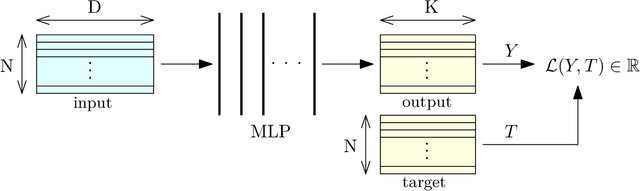
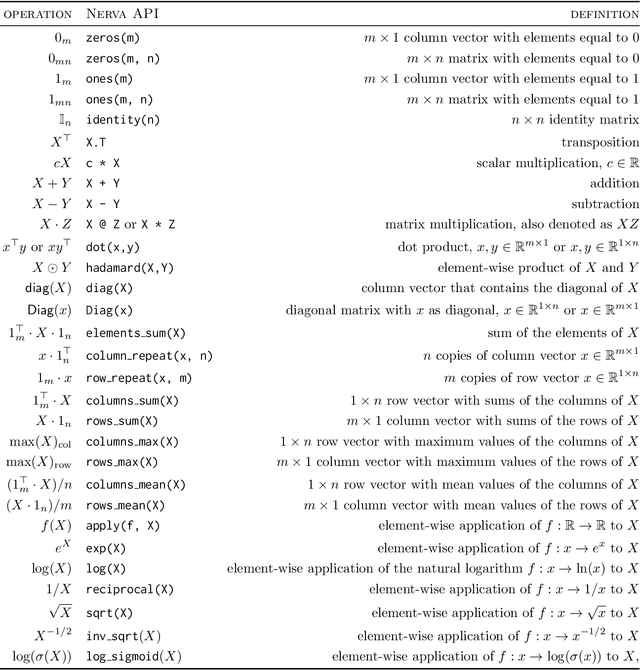
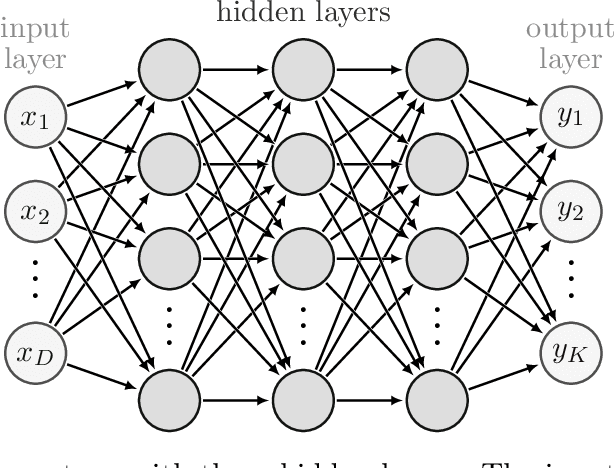
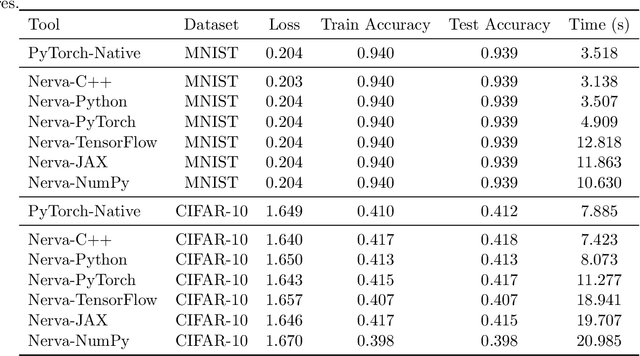
Multilayer perceptrons (MLPs) remain fundamental to modern deep learning, yet their algorithmic details are rarely presented in complete, explicit \emph{batch matrix-form}. Rather, most references express gradients per sample or rely on automatic differentiation. Although automatic differentiation can achieve equally high computational efficiency, the usage of batch matrix-form makes the computational structure explicit, which is essential for transparent, systematic analysis, and optimization in settings such as sparse neural networks. This paper fills that gap by providing a mathematically rigorous and implementation-ready specification of MLPs in batch matrix-form. We derive forward and backward equations for all standard and advanced layers, including batch normalization and softmax, and validate all equations using the symbolic mathematics library SymPy. From these specifications, we construct uniform reference implementations in NumPy, PyTorch, JAX, TensorFlow, and a high-performance C++ backend optimized for sparse operations. Our main contributions are: (1) a complete derivation of batch matrix-form backpropagation for MLPs, (2) symbolic validation of all gradient equations, (3) uniform Python and C++ reference implementations grounded in a small set of matrix primitives, and (4) demonstration of how explicit formulations enable efficient sparse computation. Together, these results establish a validated, extensible foundation for understanding, teaching, and researching neural network algorithms.
Leave it to the Specialist: Repair Sparse LLMs with Sparse Fine-Tuning via Sparsity Evolution
May 29, 2025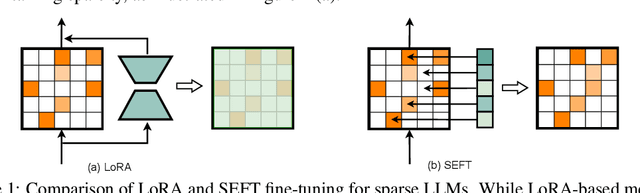
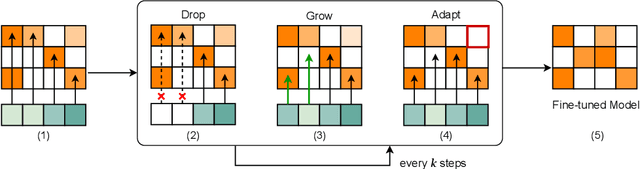
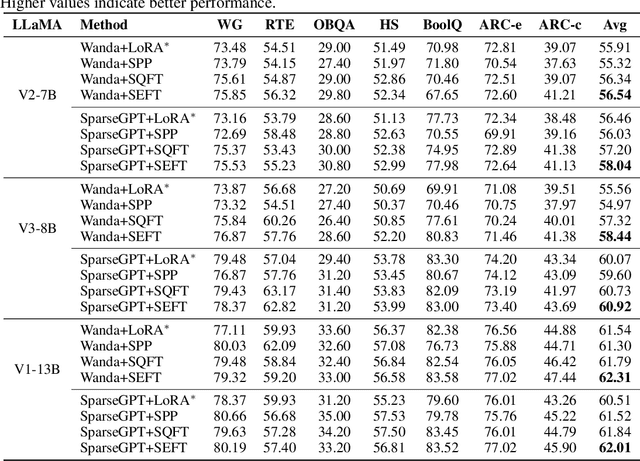
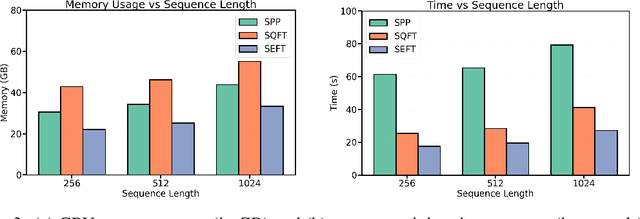
Large language models (LLMs) have achieved remarkable success across various tasks but face deployment challenges due to their massive computational demands. While post-training pruning methods like SparseGPT and Wanda can effectively reduce the model size, but struggle to maintain model performance at high sparsity levels, limiting their utility for downstream tasks. Existing fine-tuning methods, such as full fine-tuning and LoRA, fail to preserve sparsity as they require updating the whole dense metrics, not well-suited for sparse LLMs. In this paper, we propose Sparsity Evolution Fine-Tuning (SEFT), a novel method designed specifically for sparse LLMs. SEFT dynamically evolves the sparse topology of pruned models during fine-tuning, while preserving the overall sparsity throughout the process. The strengths of SEFT lie in its ability to perform task-specific adaptation through a weight drop-and-grow strategy, enabling the pruned model to self-adapt its sparse connectivity pattern based on the target dataset. Furthermore, a sensitivity-driven pruning criterion is employed to ensure that the desired sparsity level is consistently maintained throughout fine-tuning. Our experiments on various LLMs, including LLaMA families, DeepSeek, and Mistral, across a diverse set of benchmarks demonstrate that SEFT achieves stronger performance while offering superior memory and time efficiency compared to existing baselines. Our code is publicly available at: https://github.com/QiaoXiao7282/SEFT.
NeuroTrails: Training with Dynamic Sparse Heads as the Key to Effective Ensembling
May 23, 2025Model ensembles have long been a cornerstone for improving generalization and robustness in deep learning. However, their effectiveness often comes at the cost of substantial computational overhead. To address this issue, state-of-the-art methods aim to replicate ensemble-class performance without requiring multiple independently trained networks. Unfortunately, these algorithms often still demand considerable compute at inference. In response to these limitations, we introduce $\textbf{NeuroTrails}$, a sparse multi-head architecture with dynamically evolving topology. This unexplored model-agnostic training paradigm improves ensemble performance while reducing the required resources. We analyze the underlying reason for its effectiveness and observe that the various neural trails induced by dynamic sparsity attain a $\textit{Goldilocks zone}$ of prediction diversity. NeuroTrails displays efficacy with convolutional and transformer-based architectures on computer vision and language tasks. Experiments on ResNet-50/ImageNet, LLaMA-350M/C4, among many others, demonstrate increased accuracy and stronger robustness in zero-shot generalization, while requiring significantly fewer parameters.
Dynamic Sparse Training versus Dense Training: The Unexpected Winner in Image Corruption Robustness
Oct 03, 2024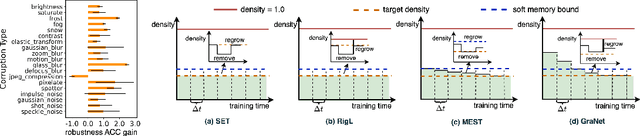
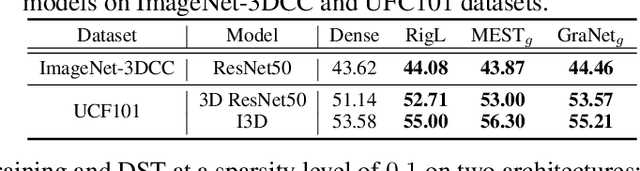
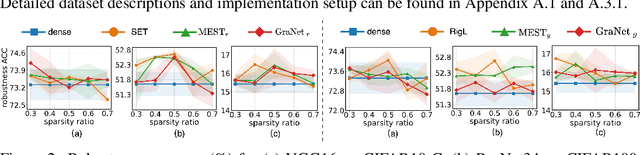

It is generally perceived that Dynamic Sparse Training opens the door to a new era of scalability and efficiency for artificial neural networks at, perhaps, some costs in accuracy performance for the classification task. At the same time, Dense Training is widely accepted as being the "de facto" approach to train artificial neural networks if one would like to maximize their robustness against image corruption. In this paper, we question this general practice. Consequently, we claim that, contrary to what is commonly thought, the Dynamic Sparse Training methods can consistently outperform Dense Training in terms of robustness accuracy, particularly if the efficiency aspect is not considered as a main objective (i.e., sparsity levels between 10% and up to 50%), without adding (or even reducing) resource cost. We validate our claim on two types of data, images and videos, using several traditional and modern deep learning architectures for computer vision and three widely studied Dynamic Sparse Training algorithms. Our findings reveal a new yet-unknown benefit of Dynamic Sparse Training and open new possibilities in improving deep learning robustness beyond the current state of the art.
Are Sparse Neural Networks Better Hard Sample Learners?
Sep 13, 2024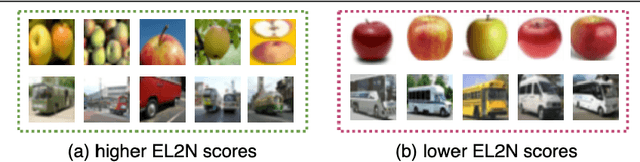
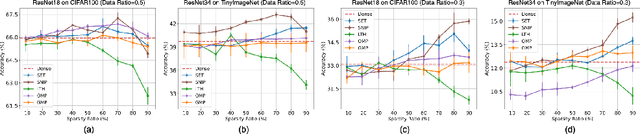
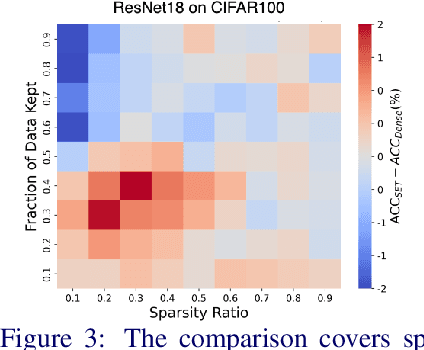
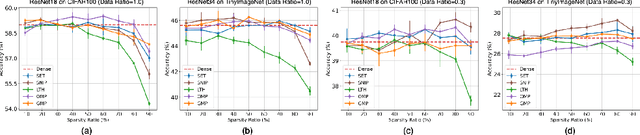
While deep learning has demonstrated impressive progress, it remains a daunting challenge to learn from hard samples as these samples are usually noisy and intricate. These hard samples play a crucial role in the optimal performance of deep neural networks. Most research on Sparse Neural Networks (SNNs) has focused on standard training data, leaving gaps in understanding their effectiveness on complex and challenging data. This paper's extensive investigation across scenarios reveals that most SNNs trained on challenging samples can often match or surpass dense models in accuracy at certain sparsity levels, especially with limited data. We observe that layer-wise density ratios tend to play an important role in SNN performance, particularly for methods that train from scratch without pre-trained initialization. These insights enhance our understanding of SNNs' behavior and potential for efficient learning approaches in data-centric AI. Our code is publicly available at: \url{https://github.com/QiaoXiao7282/hard_sample_learners}.
Nerva: a Truly Sparse Implementation of Neural Networks
Jul 24, 2024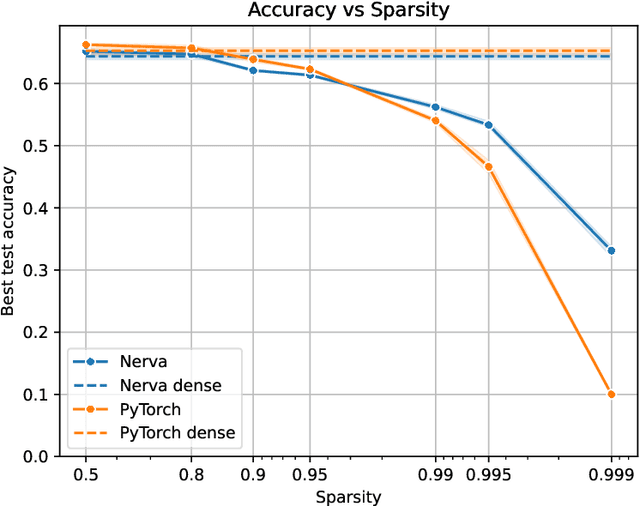
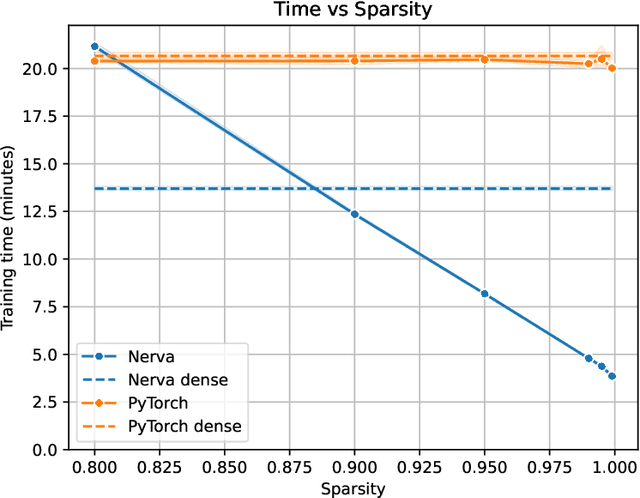
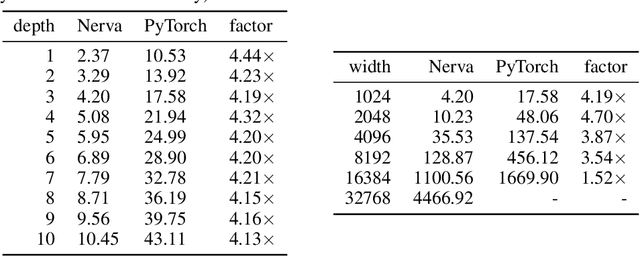
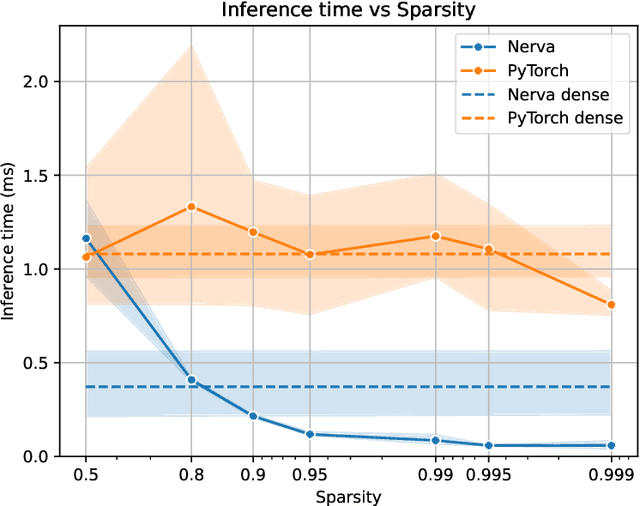
We introduce Nerva, a fast neural network library under development in C++. It supports sparsity by using the sparse matrix operations of Intel's Math Kernel Library (MKL), which eliminates the need for binary masks. We show that Nerva significantly decreases training time and memory usage while reaching equivalent accuracy to PyTorch. We run static sparse experiments with an MLP on CIFAR-10. On high sparsity levels like $99\%$, the runtime is reduced by a factor of $4\times$ compared to a PyTorch model using masks. Similar to other popular frameworks such as PyTorch and Keras, Nerva offers a Python interface for users to work with.
Dynamic Data Pruning for Automatic Speech Recognition
Jun 26, 2024
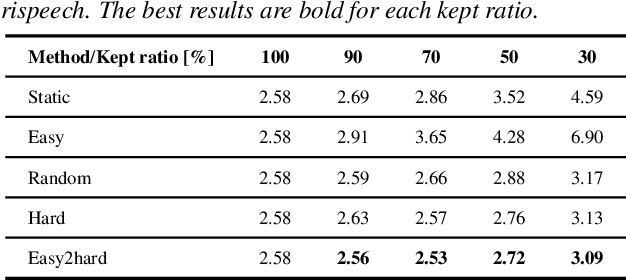
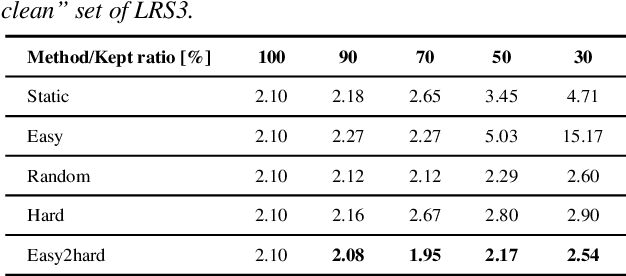
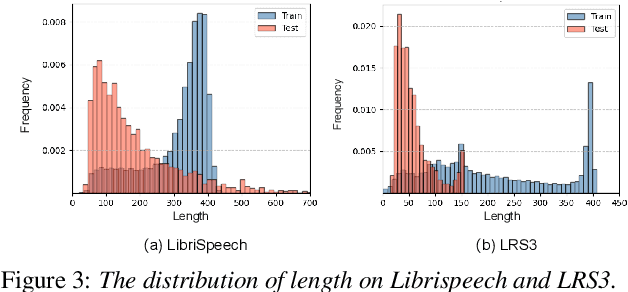
The recent success of Automatic Speech Recognition (ASR) is largely attributed to the ever-growing amount of training data. However, this trend has made model training prohibitively costly and imposed computational demands. While data pruning has been proposed to mitigate this issue by identifying a small subset of relevant data, its application in ASR has been barely explored, and existing works often entail significant overhead to achieve meaningful results. To fill this gap, this paper presents the first investigation of dynamic data pruning for ASR, finding that we can reach the full-data performance by dynamically selecting 70% of data. Furthermore, we introduce Dynamic Data Pruning for ASR (DDP-ASR), which offers several fine-grained pruning granularities specifically tailored for speech-related datasets, going beyond the conventional pruning of entire time sequences. Our intensive experiments show that DDP-ASR can save up to 1.6x training time with negligible performance loss.
MSRS: Training Multimodal Speech Recognition Models from Scratch with Sparse Mask Optimization
Jun 25, 2024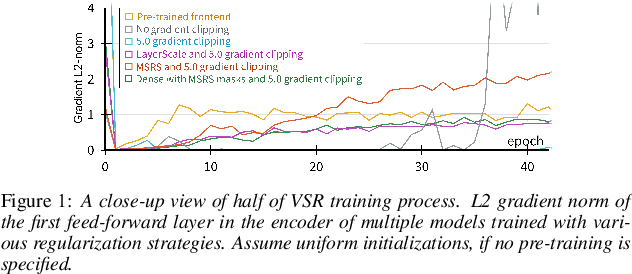
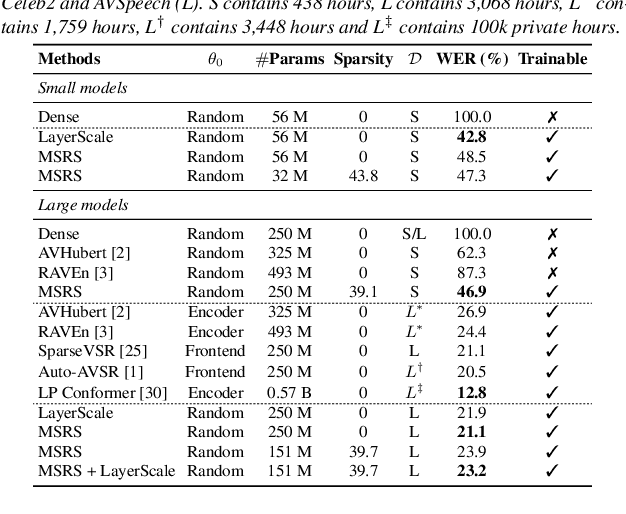
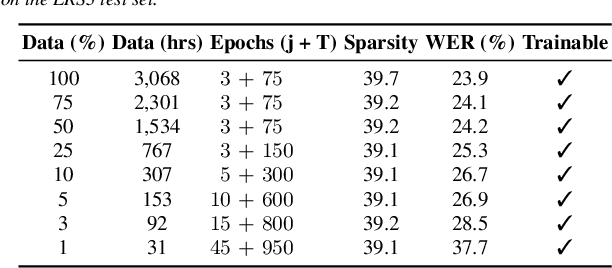

Pre-trained models have been a foundational approach in speech recognition, albeit with associated additional costs. In this study, we propose a regularization technique that facilitates the training of visual and audio-visual speech recognition models (VSR and AVSR) from scratch. This approach, abbreviated as \textbf{MSRS} (Multimodal Speech Recognition from Scratch), introduces a sparse regularization that rapidly learns sparse structures within the dense model at the very beginning of training, which receives healthier gradient flow than the dense equivalent. Once the sparse mask stabilizes, our method allows transitioning to a dense model or keeping a sparse model by updating non-zero values. MSRS achieves competitive results in VSR and AVSR with 21.1% and 0.9% WER on the LRS3 benchmark, while reducing training time by at least 2x. We explore other sparse approaches and show that only MSRS enables training from scratch by implicitly masking the weights affected by vanishing gradients.