 Add to Chrome
 Add to Firefox
 Add to Edge
Taming Pre-trained LLMs for Generalised Time Series Forecasting via Cross-modal Knowledge Distillation
Mar 12, 2024
Multivariate time series forecasting has recently gained great success with the rapid growth of deep learning models. However, existing approaches usually train models from scratch using limited temporal data, preventing their generalization. Recently, with the surge of the Large Language Models (LLMs), several works have attempted to introduce LLMs into time series forecasting. Despite promising results, these methods directly take time series as the input to LLMs, ignoring the inherent modality gap between temporal and text data. In this work, we propose a novel Large Language Models and time series alignment framework, dubbed LLaTA, to fully unleash the potentials of LLMs in the time series forecasting challenge. Based on cross-modal knowledge distillation, the proposed method exploits both input-agnostic static knowledge and input-dependent dynamic knowledge in pre-trained LLMs. In this way, it empowers the forecasting model with favorable performance as well as strong generalization abilities. Extensive experiments demonstrate the proposed method establishes a new state of the art for both long- and short-term forecasting. Code is available at \url{https://github.com/Hank0626/LLaTA}.

Improving Low-Resource Knowledge Tracing Tasks by Supervised Pre-training and Importance Mechanism Fine-tuning
Mar 11, 2024
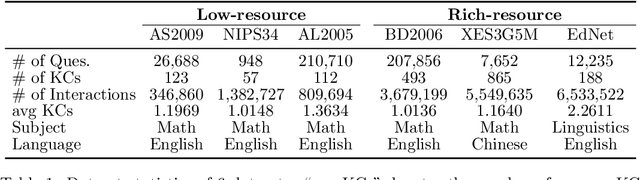
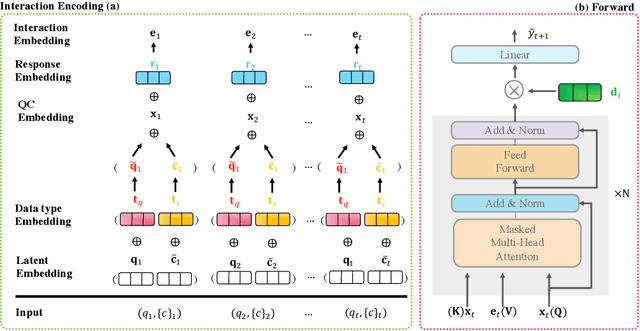
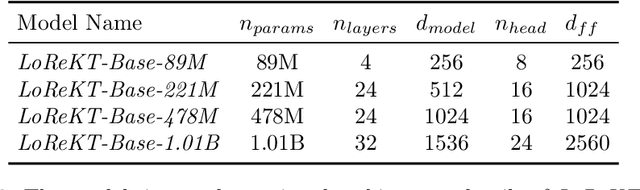
Knowledge tracing (KT) aims to estimate student's knowledge mastery based on their historical interactions. Recently, the deep learning based KT (DLKT) approaches have achieved impressive performance in the KT task. These DLKT models heavily rely on the large number of available student interactions. However, due to various reasons such as budget constraints and privacy concerns, observed interactions are very limited in many real-world scenarios, a.k.a, low-resource KT datasets. Directly training a DLKT model on a low-resource KT dataset may lead to overfitting and it is difficult to choose the appropriate deep neural architecture. Therefore, in this paper, we propose a low-resource KT framework called LoReKT to address above challenges. Inspired by the prevalent "pre-training and fine-tuning" paradigm, we aim to learn transferable parameters and representations from rich-resource KT datasets during the pre-training stage and subsequently facilitate effective adaptation to low-resource KT datasets. Specifically, we simplify existing sophisticated DLKT model architectures with purely a stack of transformer decoders. We design an encoding mechanism to incorporate student interactions from multiple KT data sources and develop an importance mechanism to prioritize updating parameters with high importance while constraining less important ones during the fine-tuning stage. We evaluate LoReKT on six public KT datasets and experimental results demonstrate the superiority of our approach in terms of AUC and Accuracy. To encourage reproducible research, we make our data and code publicly available at https://anonymous.4open.science/r/LoReKT-C619.
Let LLMs Take on the Latest Challenges! A Chinese Dynamic Question Answering Benchmark
Mar 02, 2024


How to better evaluate the capabilities of Large Language Models (LLMs) is the focal point and hot topic in current LLMs research. Previous work has noted that due to the extremely high cost of iterative updates of LLMs, they are often unable to answer the latest dynamic questions well. To promote the improvement of Chinese LLMs' ability to answer dynamic questions, in this paper, we introduce CDQA, a Chinese Dynamic QA benchmark containing question-answer pairs related to the latest news on the Chinese Internet. We obtain high-quality data through a pipeline that combines humans and models, and carefully classify the samples according to the frequency of answer changes to facilitate a more fine-grained observation of LLMs' capabilities. We have also evaluated and analyzed mainstream and advanced Chinese LLMs on CDQA. Extensive experiments and valuable insights suggest that our proposed CDQA is challenging and worthy of more further study. We believe that the benchmark we provide will become one of the key data resources for improving LLMs' Chinese question-answering ability in the future.
Quantized Side Tuning: Fast and Memory-Efficient Tuning of Quantized Large Language Models
Jan 13, 2024
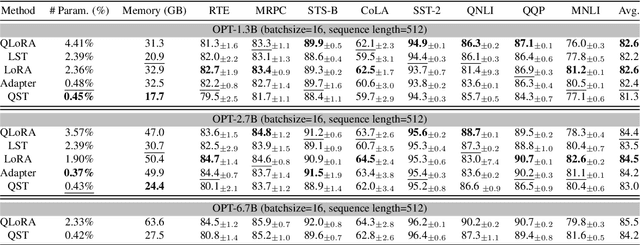


Finetuning large language models (LLMs) has been empirically effective on a variety of downstream tasks. Existing approaches to finetuning an LLM either focus on parameter-efficient finetuning, which only updates a small number of trainable parameters, or attempt to reduce the memory footprint during the training phase of the finetuning. Typically, the memory footprint during finetuning stems from three contributors: model weights, optimizer states, and intermediate activations. However, existing works still require considerable memory and none can simultaneously mitigate memory footprint for all three sources. In this paper, we present Quantized Side Tuing (QST), which enables memory-efficient and fast finetuning of LLMs by operating through a dual-stage process. First, QST quantizes an LLM's model weights into 4-bit to reduce the memory footprint of the LLM's original weights; QST also introduces a side network separated from the LLM, which utilizes the hidden states of the LLM to make task-specific predictions. Using a separate side network avoids performing backpropagation through the LLM, thus reducing the memory requirement of the intermediate activations. Furthermore, QST leverages several low-rank adaptors and gradient-free downsample modules to significantly reduce the trainable parameters, so as to save the memory footprint of the optimizer states. Experiments show that QST can reduce the total memory footprint by up to 2.3 $\times$ and speed up the finetuning process by up to 3 $\times$ while achieving competent performance compared with the state-of-the-art. When it comes to full finetuning, QST can reduce the total memory footprint up to 7 $\times$.
A Comprehensive Study of Knowledge Editing for Large Language Models
Jan 09, 2024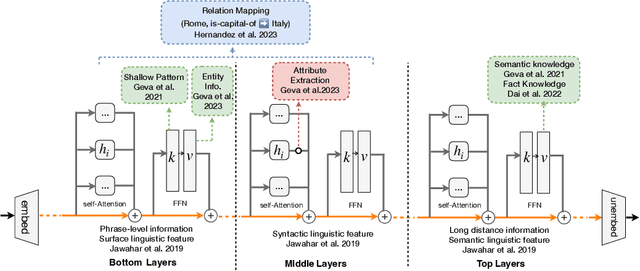
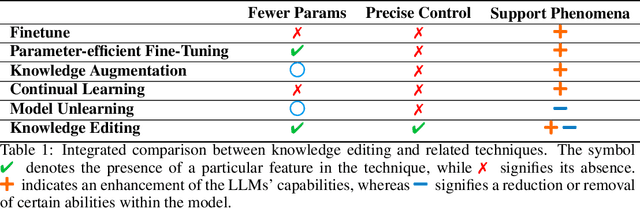
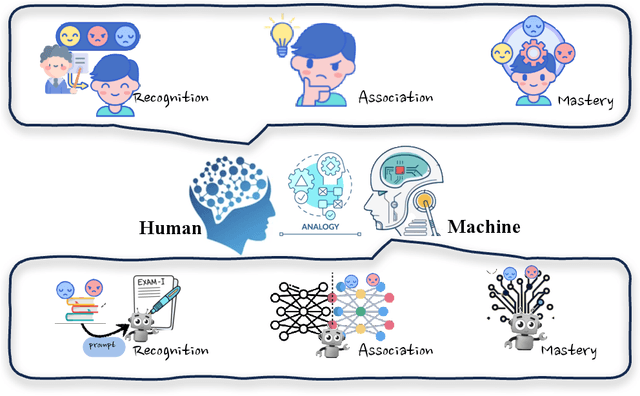
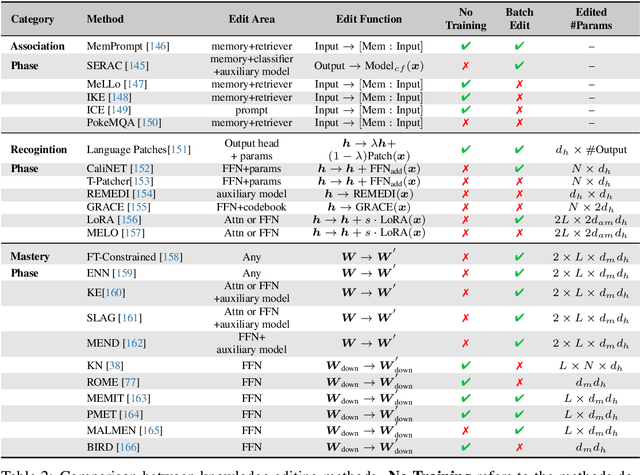
Large Language Models (LLMs) have shown extraordinary capabilities in understanding and generating text that closely mirrors human communication. However, a primary limitation lies in the significant computational demands during training, arising from their extensive parameterization. This challenge is further intensified by the dynamic nature of the world, necessitating frequent updates to LLMs to correct outdated information or integrate new knowledge, thereby ensuring their continued relevance. Note that many applications demand continual model adjustments post-training to address deficiencies or undesirable behaviors. There is an increasing interest in efficient, lightweight methods for on-the-fly model modifications. To this end, recent years have seen a burgeoning in the techniques of knowledge editing for LLMs, which aim to efficiently modify LLMs' behaviors within specific domains while preserving overall performance across various inputs. In this paper, we first define the knowledge editing problem and then provide a comprehensive review of cutting-edge approaches. Drawing inspiration from educational and cognitive research theories, we propose a unified categorization criterion that classifies knowledge editing methods into three groups: resorting to external knowledge, merging knowledge into the model, and editing intrinsic knowledge. Furthermore, we introduce a new benchmark, KnowEdit, for a comprehensive empirical evaluation of representative knowledge editing approaches. Additionally, we provide an in-depth analysis of knowledge location, which can give a deeper understanding of the knowledge structures inherent within LLMs. Finally, we discuss several potential applications of knowledge editing, outlining its broad and impactful implications.
What Makes Good Data for Alignment? A Comprehensive Study of Automatic Data Selection in Instruction Tuning
Dec 25, 2023Instruction tuning is a standard technique employed to align large language models to end tasks and user preferences after the initial pretraining phase. Recent research indicates the critical role of data engineering in instruction tuning -- when appropriately selected, only limited data is necessary to achieve superior performance. However, we still lack a principled understanding of what makes good instruction tuning data for alignment, and how we should select data automatically and effectively. In this work, we delve deeply into automatic data selection strategies for alignment. We start with controlled studies to measure data across three dimensions: complexity, quality, and diversity, along which we examine existing methods and introduce novel techniques for enhanced data measurement. Subsequently, we propose a simple strategy to select data samples based on the measurement. We present deita (short for Data-Efficient Instruction Tuning for Alignment), a series of models fine-tuned from LLaMA and Mistral models using data samples automatically selected with our proposed approach. Empirically, deita performs better or on par with the state-of-the-art open-source alignment models with only 6K SFT training data samples -- over 10x less than the data used in the baselines. When further trained with direct preference optimization (DPO), deita-Mistral-7B + DPO trained with 6K SFT and 10K DPO samples achieve 7.55 MT-Bench and 90.06% AlpacaEval scores. We anticipate this work to provide tools on automatic data selection, facilitating data-efficient alignment. We release our models as well as the selected datasets for future researches to effectively align models more efficiently.
EcomGPT-CT: Continual Pre-training of E-commerce Large Language Models with Semi-structured Data
Dec 25, 2023Large Language Models (LLMs) pre-trained on massive corpora have exhibited remarkable performance on various NLP tasks. However, applying these models to specific domains still poses significant challenges, such as lack of domain knowledge, limited capacity to leverage domain knowledge and inadequate adaptation to domain-specific data formats. Considering the exorbitant cost of training LLMs from scratch and the scarcity of annotated data within particular domains, in this work, we focus on domain-specific continual pre-training of LLMs using E-commerce domain as an exemplar. Specifically, we explore the impact of continual pre-training on LLMs employing unlabeled general and E-commercial corpora. Furthermore, we design a mixing strategy among different data sources to better leverage E-commercial semi-structured data. We construct multiple tasks to assess LLMs' few-shot In-context Learning ability and their zero-shot performance after instruction tuning in E-commerce domain. Experimental results demonstrate the effectiveness of continual pre-training of E-commerce LLMs and the efficacy of our devised data mixing strategy.
Towards Real-World Writing Assistance: A Chinese Character Checking Benchmark with Faked and Misspelled Characters
Nov 19, 2023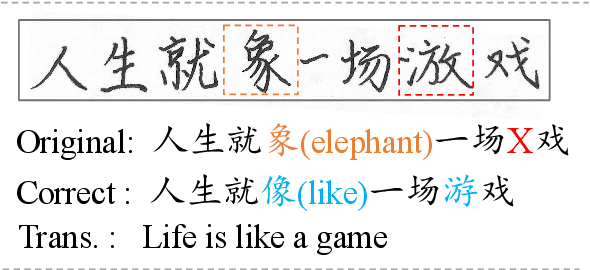

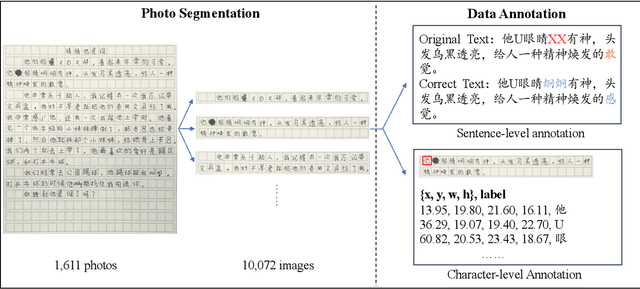

Writing assistance is an application closely related to human life and is also a fundamental Natural Language Processing (NLP) research field. Its aim is to improve the correctness and quality of input texts, with character checking being crucial in detecting and correcting wrong characters. From the perspective of the real world where handwriting occupies the vast majority, characters that humans get wrong include faked characters (i.e., untrue characters created due to writing errors) and misspelled characters (i.e., true characters used incorrectly due to spelling errors). However, existing datasets and related studies only focus on misspelled characters mainly caused by phonological or visual confusion, thereby ignoring faked characters which are more common and difficult. To break through this dilemma, we present Visual-C$^3$, a human-annotated Visual Chinese Character Checking dataset with faked and misspelled Chinese characters. To the best of our knowledge, Visual-C$^3$ is the first real-world visual and the largest human-crafted dataset for the Chinese character checking scenario. Additionally, we also propose and evaluate novel baseline methods on Visual-C$^3$. Extensive empirical results and analyses show that Visual-C$^3$ is high-quality yet challenging. The Visual-C$^3$ dataset and the baseline methods will be publicly available to facilitate further research in the community.
HierCas: Hierarchical Temporal Graph Attention Networks for Popularity Prediction in Information Cascades
Oct 20, 2023Information cascade popularity prediction is critical for many applications, including but not limited to identifying fake news and accurate recommendations. Traditional feature-based methods heavily rely on handcrafted features, which are domain-specific and lack generalizability to new domains. To address this problem, researchers have turned to neural network-based approaches. However, existing methods follow a sampling-based modeling approach, potentially losing continuous dynamic information and structural-temporal dependencies that emerge during the information diffusion process. In this paper, we propose a novel framework called Hierarchical Temporal Graph Attention Networks for cascade popularity prediction (HierCas). Unlike existing methods, HierCas operates on the entire cascade graph by a dynamic graph modeling approach, enabling it to capture the full range of continuous dynamic information and explicitly model the interplay between structural and temporal factors. By leveraging time-aware node embedding, graph attention mechanisms and hierarchical pooling structures, HierCas effectively captures the popularity trend implicit in the complex cascade. Extensive experiments conducted on two real-world datasets in different scenarios demonstrate that our HierCas significantly outperforms the state-of-the-art approaches.
Editing Personality for LLMs
Oct 03, 2023This paper introduces an innovative task focused on editing the personality traits of Large Language Models (LLMs). This task seeks to adjust the models' responses to opinion-related questions on specified topics since an individual's personality often manifests in the form of their expressed opinions, thereby showcasing different personality traits. Specifically, we construct a new benchmark dataset PersonalityEdit to address this task. Drawing on the theory in Social Psychology, we isolate three representative traits, namely Neuroticism, Extraversion, and Agreeableness, as the foundation for our benchmark. We then gather data using GPT-4, generating responses that not only align with a specified topic but also embody the targeted personality trait. We conduct comprehensive experiments involving various baselines and discuss the representation of personality behavior in LLMs. Our intriguing findings uncover potential challenges of the proposed task, illustrating several remaining issues. We anticipate that our work can provide the NLP community with insights. Code and datasets will be released at https://github.com/zjunlp/EasyEdit.