 Add to Chrome
 Add to Firefox
 Add to Edge
AgentHPOBench: A Benchmark For Evaluating LLM Agents as Sequential Hyperparameter Optimizers
Jul 31, 2026
As LLMs evolve from code completion systems into autonomous scientific agents, evaluating their ability to conduct experiments has become increasingly important. Existing benchmarks typically focus on static code generation, paper replication, or final answer correctness, but do not directly assess whether agents can interpret experimental evidence and use it to guide subsequent hyperparameter decisions. To address this gap, we introduce AgentHPOBench, a sequential benchmark comprising 30 executable machine learning tasks across seven research categories. Each task begins with a validated baseline run, after which an agent performs several sequential interventions. At each step, the agent observes the accumulated configurations, metrics, and logs before proposing the next valid configuration. We evaluate 12 widely used agents and conventional HPO baselines under a unified protocol. The results show that current agents exhibit measurable experimental optimization ability across domains, but still face clear limitations in sustained iterative refinement, complex log diagnosis, and consistent progress toward reported reference performance.

Rethinking Scientific Discovery in the Agentic Era
Jul 07, 2026Artificial intelligence has advanced scientific discovery, but most AI4Science systems remain fragmented tools that rely on humans to coordinate problem formulation, literature grounding, model use, simulation, validation, and knowledge reuse. This paper presents \textbf{SCION (Scientific Collaborative Innovation with Agentic Organizational Nexus)}, an agentic scientific operating system that acts as an \textbf{organizational nexus}. Through a Science Agent serving as a \textbf{Meta-Harness}, SCION connects scientific tasks, tools, agents, artifacts, and memory, transforming research into an executable, auditable, and reusable operational process. At its core is the \textbf{Research Execution Plan (REP)}, which compiles high-level scientific intent into staged objectives, dependencies, verification checkpoints, tool requirements, expected artifacts, and fallback conditions. SCION further integrates hierarchical multi-agent execution, profile-driven specialization, selective context construction, governed delegation, and layered epistemic memory to support long-horizon scientific work. We formulate discovery under SCION as \textbf{Target-conditioned Inverse Search} and extend it to hidden-target settings through batch active search under finite experimental budgets. Applications in materials analysis, molecule design, and protein or antibody screening, together with experiments on scientific reading, idea generation, molecule generation, and antibody screening, show that SCION outperforms existing autonomous research-agent baselines, especially in decomposition, verification, refinement, and memory reuse. Overall, SCION shifts AI from isolated tools toward a coordinated operational layer for traceable and reusable scientific innovation.
Rethinking Scientific Discovery in an Agentic Era
Jul 04, 2026Artificial intelligence has advanced scientific discovery, but most AI4Science systems remain fragmented tools that rely on humans to coordinate problem formulation, literature grounding, model use, simulation, validation, and knowledge reuse. This paper presents \textbf{SCION (Scientific Collaborative Innovation with Agentic Organizational Nexus)}, an agentic scientific operating system that acts as an \textbf{organizational nexus}. Through a Science Agent serving as a \textbf{Meta-Harness}, SCION connects scientific tasks, tools, agents, artifacts, and memory, transforming research into an executable, auditable, and reusable operational process. At its core is the \textbf{Research Execution Plan (REP)}, which compiles high-level scientific intent into staged objectives, dependencies, verification checkpoints, tool requirements, expected artifacts, and fallback conditions. SCION further integrates hierarchical multi-agent execution, profile-driven specialization, selective context construction, governed delegation, and layered epistemic memory to support long-horizon scientific work. We formulate discovery under SCION as \textbf{Target-conditioned Inverse Search} and extend it to hidden-target settings through batch active search under finite experimental budgets. Applications in materials analysis, molecule design, and protein or antibody screening, together with experiments on scientific reading, idea generation, molecule generation, and antibody screening, show that SCION outperforms existing autonomous research-agent baselines, especially in decomposition, verification, refinement, and memory reuse. Overall, SCION shifts AI from isolated tools toward a coordinated operational layer for traceable and reusable scientific innovation.
AdaptR1: Reinforcement Learning Based Adaptive Interleaved Thinking in Multi-hop Question Answering
May 29, 2026Large Language Models (LLMs) have achieved remarkable performance in complex reasoning tasks through Chain-of-Thought (CoT) prompting. However, this approach often leads to ``over-thinking,'' where models generate unnecessarily long reasoning traces for simple queries and incur avoidable inference cost. While recent work has explored adaptive reasoning, existing methods typically make a single query-level decision about whether to reason. This overlooks the dynamic nature of multi-step tasks, where the need for explicit reasoning varies across intermediate stages. To address this limitation, we introduce AdaptR1, a Reinforcement Learning (RL) based framework for adaptive interleaved thinking in multi-hop Question Answering (QA). Unlike previous approaches that require Supervised Fine-Tuning (SFT) for cold-start initialization, AdaptR1 uses a fully RL-based strategy with a quality-gated efficiency reward to dynamically allocate reasoning budgets at each step. Under the Graph-R1 setting, AdaptR1 reduces average think tokens by 69.71\%, with a 90.35\% reduction on HotpotQA, while maintaining performance comparable to or better than standard baselines. Furthermore, our analysis reveals that overthinking in multi-hop reasoning is not uniformly distributed but occurs predominantly during the initial planning stages, highlighting the effectiveness of step-wise adaptive budget allocation.
Beyond Rating: A Comprehensive Evaluation and Benchmark for AI Reviews
Apr 22, 2026The rapid adoption of Large Language Models (LLMs) has spurred interest in automated peer review; however, progress is currently stifled by benchmarks that treat reviewing primarily as a rating prediction task. We argue that the utility of a review lies in its textual justification--its arguments, questions, and critique--rather than a scalar score. To address this, we introduce Beyond Rating, a holistic evaluation framework that assesses AI reviewers across five dimensions: Content Faithfulness, Argumentative Alignment, Focus Consistency, Question Constructiveness, and AI-Likelihood. Notably, we propose a Max-Recall strategy to accommodate valid expert disagreement and introduce a curated dataset of paper with high-confidence reviews, rigorously filtered to remove procedural noise. Extensive experiments demonstrate that while traditional n-gram metrics fail to reflect human preferences, our proposed text-centric metrics--particularly the recall of weakness arguments--correlate strongly with rating accuracy. These findings establish that aligning AI critique focus with human experts is a prerequisite for reliable automated scoring, offering a robust standard for future research.
The Past Is Not Past: Memory-Enhanced Dynamic Reward Shaping
Apr 13, 2026Despite the success of reinforcement learning for large language models, a common failure mode is reduced sampling diversity, where the policy repeatedly generates similar erroneous behaviors. Classical entropy regularization encourages randomness under the current policy, but does not explicitly discourage recurrent failure patterns across rollouts. We propose MEDS, a Memory-Enhanced Dynamic reward Shaping framework that incorporates historical behavioral signals into reward design. By storing and leveraging intermediate model representations, we capture features of past rollouts and use density-based clustering to identify frequently recurring error patterns. Rollouts assigned to more prevalent error clusters are penalized more heavily, encouraging broader exploration while reducing repeated mistakes. Across five datasets and three base models, MEDS consistently improves average performance over existing baselines, achieving gains of up to 4.13 pass@1 points and 4.37 pass@128 points. Additional analyses using both LLM-based annotations and quantitative diversity metrics show that MEDS increases behavioral diversity during sampling.
AI Can Learn Scientific Taste
Mar 15, 2026Great scientists have strong judgement and foresight, closely tied to what we call scientific taste. Here, we use the term to refer to the capacity to judge and propose research ideas with high potential impact. However, most relative research focuses on improving an AI scientist's executive capability, while enhancing an AI's scientific taste remains underexplored. In this work, we propose Reinforcement Learning from Community Feedback (RLCF), a training paradigm that uses large-scale community signals as supervision, and formulate scientific taste learning as a preference modeling and alignment problem. For preference modeling, we train Scientific Judge on 700K field- and time-matched pairs of high- vs. low-citation papers to judge ideas. For preference alignment, using Scientific Judge as a reward model, we train a policy model, Scientific Thinker, to propose research ideas with high potential impact. Experiments show Scientific Judge outperforms SOTA LLMs (e.g., GPT-5.2, Gemini 3 Pro) and generalizes to future-year test, unseen fields, and peer-review preference. Furthermore, Scientific Thinker proposes research ideas with higher potential impact than baselines. Our findings show that AI can learn scientific taste, marking a key step toward reaching human-level AI scientists.
AgentLongBench: A Controllable Long Benchmark For Long-Contexts Agents via Environment Rollouts
Jan 29, 2026The evolution of Large Language Models (LLMs) into autonomous agents necessitates the management of extensive, dynamic contexts. Current benchmarks, however, remain largely static, relying on passive retrieval tasks that fail to simulate the complexities of agent-environment interaction, such as non-linear reasoning and iterative feedback. To address this, we introduce \textbf{AgentLongBench}, which evaluates agents through simulated environment rollouts based on Lateral Thinking Puzzles. This framework generates rigorous interaction trajectories across knowledge-intensive and knowledge-free scenarios. Experiments with state-of-the-art models and memory systems (32K to 4M tokens) expose a critical weakness: while adept at static retrieval, agents struggle with the dynamic information synthesis essential for workflows. Our analysis indicates that this degradation is driven by the minimum number of tokens required to resolve a query. This factor explains why the high information density inherent in massive tool responses poses a significantly greater challenge than the memory fragmentation typical of long-turn dialogues.
ABC-Bench: Benchmarking Agentic Backend Coding in Real-World Development
Jan 16, 2026The evolution of Large Language Models (LLMs) into autonomous agents has expanded the scope of AI coding from localized code generation to complex, repository-level, and execution-driven problem solving. However, current benchmarks predominantly evaluate code logic in static contexts, neglecting the dynamic, full-process requirements of real-world engineering, particularly in backend development which demands rigorous environment configuration and service deployment. To address this gap, we introduce ABC-Bench, a benchmark explicitly designed to evaluate agentic backend coding within a realistic, executable workflow. Using a scalable automated pipeline, we curated 224 practical tasks spanning 8 languages and 19 frameworks from open-source repositories. Distinct from previous evaluations, ABC-Bench require the agents to manage the entire development lifecycle from repository exploration to instantiating containerized services and pass the external end-to-end API tests. Our extensive evaluation reveals that even state-of-the-art models struggle to deliver reliable performance on these holistic tasks, highlighting a substantial disparity between current model capabilities and the demands of practical backend engineering. Our code is available at https://github.com/OpenMOSS/ABC-Bench.
Multi-hop Reasoning via Early Knowledge Alignment
Dec 23, 2025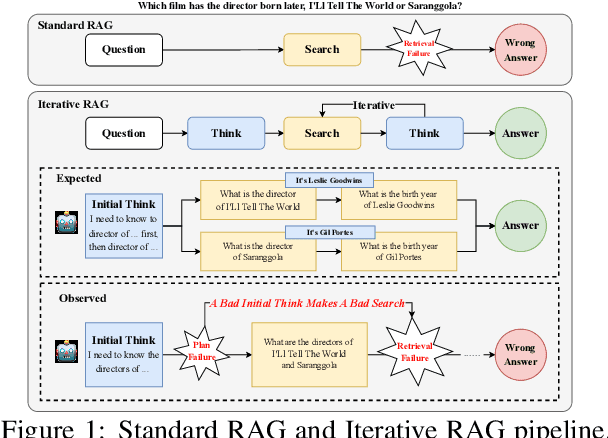
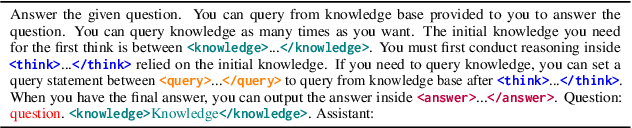
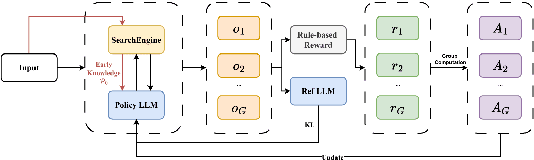
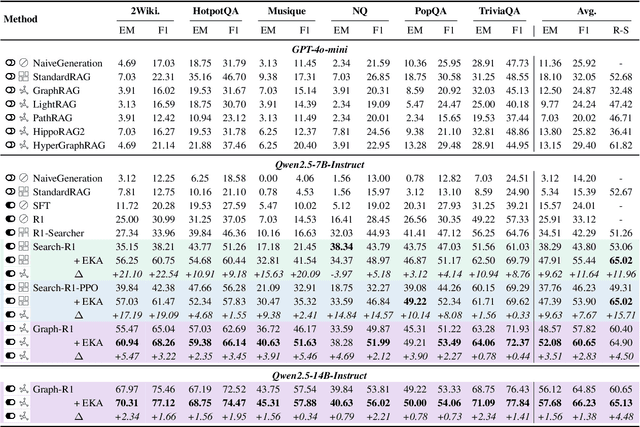
Retrieval-Augmented Generation (RAG) has emerged as a powerful paradigm for Large Language Models (LLMs) to address knowledge-intensive queries requiring domain-specific or up-to-date information. To handle complex multi-hop questions that are challenging for single-step retrieval, iterative RAG approaches incorporating reinforcement learning have been proposed. However, existing iterative RAG systems typically plan to decompose questions without leveraging information about the available retrieval corpus, leading to inefficient retrieval and reasoning chains that cascade into suboptimal performance. In this paper, we introduce Early Knowledge Alignment (EKA), a simple but effective module that aligns LLMs with retrieval set before planning in iterative RAG systems with contextually relevant retrieved knowledge. Extensive experiments on six standard RAG datasets demonstrate that by establishing a stronger reasoning foundation, EKA significantly improves retrieval precision, reduces cascading errors, and enhances both performance and efficiency. Our analysis from an entropy perspective demonstrate that incorporating early knowledge reduces unnecessary exploration during the reasoning process, enabling the model to focus more effectively on relevant information subsets. Moreover, EKA proves effective as a versatile, training-free inference strategy that scales seamlessly to large models. Generalization tests across diverse datasets and retrieval corpora confirm the robustness of our approach. Overall, EKA advances the state-of-the-art in iterative RAG systems while illuminating the critical interplay between structured reasoning and efficient exploration in reinforcement learning-augmented frameworks. The code is released at \href{https://github.com/yxzwang/EarlyKnowledgeAlignment}{Github}.