 Add to Chrome
 Add to Firefox
 Add to Edge
AI Can Learn Scientific Taste
Mar 15, 2026
Great scientists have strong judgement and foresight, closely tied to what we call scientific taste. Here, we use the term to refer to the capacity to judge and propose research ideas with high potential impact. However, most relative research focuses on improving an AI scientist's executive capability, while enhancing an AI's scientific taste remains underexplored. In this work, we propose Reinforcement Learning from Community Feedback (RLCF), a training paradigm that uses large-scale community signals as supervision, and formulate scientific taste learning as a preference modeling and alignment problem. For preference modeling, we train Scientific Judge on 700K field- and time-matched pairs of high- vs. low-citation papers to judge ideas. For preference alignment, using Scientific Judge as a reward model, we train a policy model, Scientific Thinker, to propose research ideas with high potential impact. Experiments show Scientific Judge outperforms SOTA LLMs (e.g., GPT-5.2, Gemini 3 Pro) and generalizes to future-year test, unseen fields, and peer-review preference. Furthermore, Scientific Thinker proposes research ideas with higher potential impact than baselines. Our findings show that AI can learn scientific taste, marking a key step toward reaching human-level AI scientists.

Unified Enhancement of the Generalization and Robustness of Language Models via Bi-Stage Optimization
Mar 19, 2025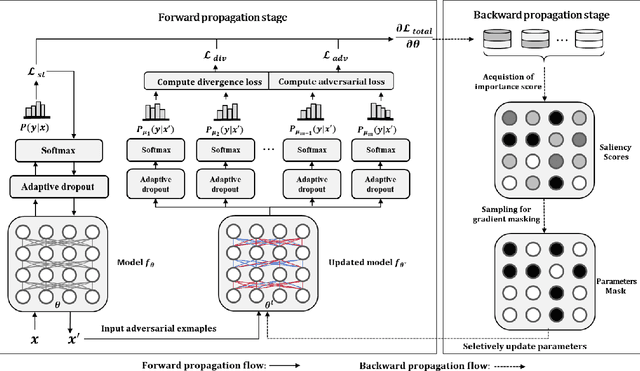
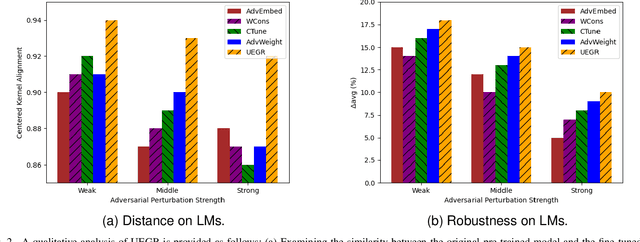
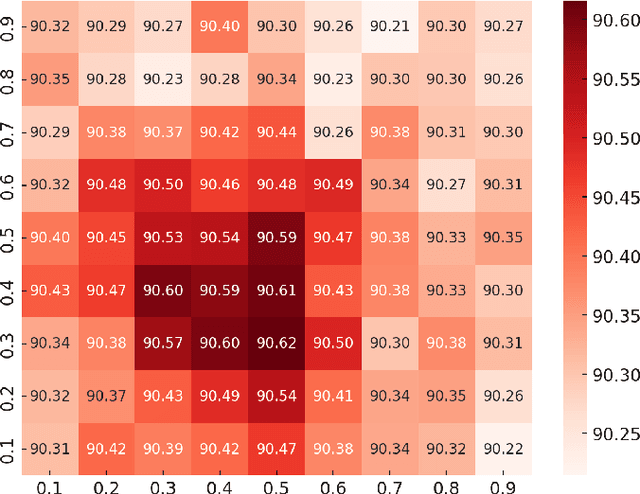
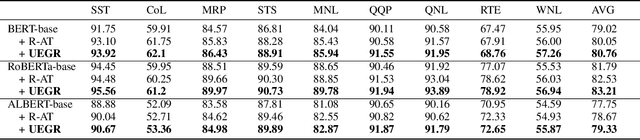
Neural network language models (LMs) are confronted with significant challenges in generalization and robustness. Currently, many studies focus on improving either generalization or robustness in isolation, without methods addressing both aspects simultaneously, which presents a significant challenge in developing LMs that are both robust and generalized. In this paper, we propose a bi-stage optimization framework to uniformly enhance both the generalization and robustness of LMs, termed UEGR. Specifically, during the forward propagation stage, we enrich the output probability distributions of adversarial samples by adaptive dropout to generate diverse sub models, and incorporate JS divergence and adversarial losses of these output distributions to reinforce output stability. During backward propagation stage, we compute parameter saliency scores and selectively update only the most critical parameters to minimize unnecessary deviations and consolidate the model's resilience. Theoretical analysis shows that our framework includes gradient regularization to limit the model's sensitivity to input perturbations and selective parameter updates to flatten the loss landscape, thus improving both generalization and robustness. The experimental results show that our method significantly improves the generalization and robustness of LMs compared to other existing methods across 13 publicly available language datasets, achieving state-of-the-art (SOTA) performance.