 Add to Chrome
 Add to Firefox
 Add to Edge
ContextWeave: A Real-World Workflow Benchmark
Aug 05, 2026
Memory is essential as language agents move from isolated tasks to long-horizon, stateful workflows, yet existing evaluations often reduce it to retrieval or question answering. We introduce ContextWeave, a longitudinal benchmark that evaluates whether recalled experience improves downstream agent performance in realistic office-work streams. ContextWeave reconstructs privacy-preserved, multi-month workflows of 14 participants into 1,005 executable tasks, including 568 core evaluation tasks, with instructions, containerized environments, trajectories, and task-specific rubrics. It measures workspace quality and alignment with participant-specific preferences, complemented by diagnostics of relevance, continuity, solvability, and robustness to misleading recall. Across six memory components under a fixed model, the strongest configuration raises Workspace Score from 68.08 to 78.20 and Preference Score from 41.50 to 70.60. With a fixed memory component, recall improves both outcomes for all five tested base models, although gains vary substantially. Our analysis shows that actionable, experience-rich memory supports workflow continuation and reduces redundant exploration more effectively than compact summaries, while it can also be more susceptible to misleading recall. These findings motivate memory systems that optimize not only retrieval relevance but also reliable use during execution.

HiMe: Hierarchical Embodied Memory for Long-Horizon Vision-Language-Action Control
Jul 03, 2026Current Vision-Language-Action (VLA) models excel at robotic manipulation but often struggle with non-Markovian tasks requiring long-term memory and reasoning due to their reliance on immediate observations. Existing solutions face a ''frequency-competence paradox,'' where stronger reasoning models are too slow for real-time control, while faster models lack sufficient reasoning capabilities. To resolve this architectural misalignment, we propose HiMe, a Hierarchical Embodied Memory framework that decouples embodied intelligence into a high-frequency Executor for execution, a Sentry for working memory, and a Planner for long-term strategy. We also introduce a dynamic knowledge system based on cross-modal semantic schemas and active management mechanisms, allowing robots to maintain memory plasticity through ''Add, Update, and Delete'' operations. This hierarchical design effectively balances the conflict between real-time execution and slow thinking planning, significantly improving success rates in long-horizon tasks. Experiments demonstrate that this approach not only outperforms flat memory baselines but also exhibits the novel ability to self-correct its internal knowledge based on human preferences.
Learning to Move Before Learning to Do: Task-Agnostic pretraining for VLAs
Jul 02, 2026Vision-Language-Action (VLA) models are fundamentally bottlenecked by the scarcity of expert demonstrations -- triplets of observations, instructions, and actions that are costly to collect at scale. We argue that this bottleneck stems from conflating two distinct learning objectives: acquiring physical competence (how to move) and acquiring semantic alignment (what to do). Crucially, only the latter requires language supervision. Building on this Decomposition Hypothesis, we propose Task-Agnostic Pretraining (TAP), a two-stage framework that first learns transferable motor priors from cheap, unlabeled interaction data -- including discarded off-task trajectories and autonomous robot play -- via a self-supervised Inverse Dynamics objective. A lightweight second stage then grounds these priors in language using minimal expert data. On the SIMPLER benchmark, TAP matches models trained on over 1M expert trajectories while using orders of magnitude less labeled data, yielding a 10% absolute gain over standard behavior cloning. On a real-world WidowX platform, TAP retains 25% success under camera perturbations where internet-scale baselines collapse to 0%, demonstrating that task-agnostic pretraining produces robust, transferable physical representations and offers a scalable path forward for Embodied AI.
In-Context World Modeling for Robotic Control
Jun 25, 2026Modern Vision-Language-Action (VLA) models often fail to generalize to novel setups, such as altered camera viewpoints or robot morphologies, because they are typically conditioned only on current observations and language instructions. By ignoring the underlying system configuration as a variable, these models implicitly assume a fixed execution context encountered during training, necessitating data-intensive fine-tuning for any new environment. In this work, we introduce In-Context World Modeling (ICWM), a framework that treats system identification as an in-context adaptation problem. ICWM enables robot policies to autonomously infer essential system variables from a short history of self-generated, task-agnostic interactions. Unlike traditional In-Context Learning that uses demonstrations to specify what task to perform, ICWM leverages the context window to understand how the system operates. By processing these interactions before task execution, the model implicitly captures the world dynamics of the current system, enabling adaptation to novel configurations without parameter updates. Extensive experiments in simulation and on real-world robot platforms demonstrate that ICWM significantly outperforms standard VLA baselines on novel camera viewpoints.
ABC-Bench: Benchmarking Agentic Backend Coding in Real-World Development
Jan 16, 2026The evolution of Large Language Models (LLMs) into autonomous agents has expanded the scope of AI coding from localized code generation to complex, repository-level, and execution-driven problem solving. However, current benchmarks predominantly evaluate code logic in static contexts, neglecting the dynamic, full-process requirements of real-world engineering, particularly in backend development which demands rigorous environment configuration and service deployment. To address this gap, we introduce ABC-Bench, a benchmark explicitly designed to evaluate agentic backend coding within a realistic, executable workflow. Using a scalable automated pipeline, we curated 224 practical tasks spanning 8 languages and 19 frameworks from open-source repositories. Distinct from previous evaluations, ABC-Bench require the agents to manage the entire development lifecycle from repository exploration to instantiating containerized services and pass the external end-to-end API tests. Our extensive evaluation reveals that even state-of-the-art models struggle to deliver reliable performance on these holistic tasks, highlighting a substantial disparity between current model capabilities and the demands of practical backend engineering. Our code is available at https://github.com/OpenMOSS/ABC-Bench.
SRPO: Self-Referential Policy Optimization for Vision-Language-Action Models
Nov 19, 2025Vision-Language-Action (VLA) models excel in robotic manipulation but are constrained by their heavy reliance on expert demonstrations, leading to demonstration bias and limiting performance. Reinforcement learning (RL) is a vital post-training strategy to overcome these limits, yet current VLA-RL methods, including group-based optimization approaches, are crippled by severe reward sparsity. Relying on binary success indicators wastes valuable information in failed trajectories, resulting in low training efficiency. To solve this, we propose Self-Referential Policy Optimization (SRPO), a novel VLA-RL framework. SRPO eliminates the need for external demonstrations or manual reward engineering by leveraging the model's own successful trajectories, generated within the current training batch, as a self-reference. This allows us to assign a progress-wise reward to failed attempts. A core innovation is the use of latent world representations to measure behavioral progress robustly. Instead of relying on raw pixels or requiring domain-specific fine-tuning, we utilize the compressed, transferable encodings from a world model's latent space. These representations naturally capture progress patterns across environments, enabling accurate, generalized trajectory comparison. Empirical evaluations on the LIBERO benchmark demonstrate SRPO's efficiency and effectiveness. Starting from a supervised baseline with 48.9% success, SRPO achieves a new state-of-the-art success rate of 99.2% in just 200 RL steps, representing a 103% relative improvement without any extra supervision. Furthermore, SRPO shows substantial robustness, achieving a 167% performance improvement on the LIBERO-Plus benchmark.
Anomaly Detection in Automated Fibre Placement: Learning with Data Limitations
Jul 15, 2023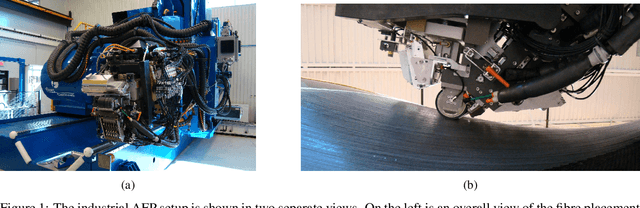
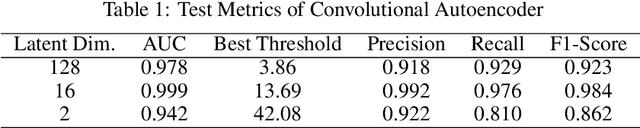
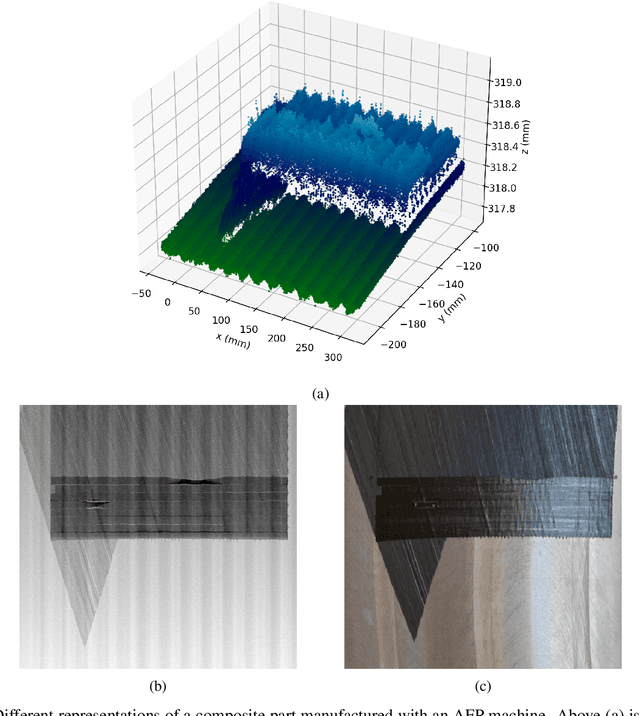
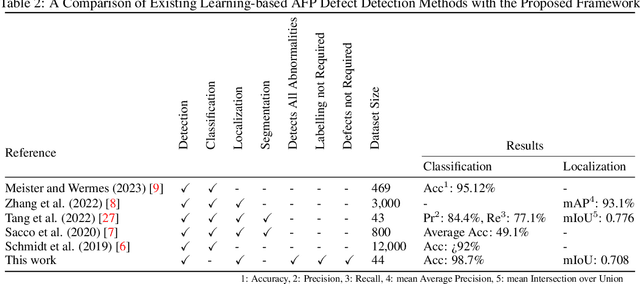
Current defect detection systems for Automated Fibre Placement (AFP) are mostly based on end-to-end supervised learning methods requiring abundant labelled defective samples, which are not easily generated in sufficient numbers. To address this data scarcity problem, we introduce an autoencoder-based approach compatible with small datasets. Fortunately, the problem from a foundational point of view can be simplified as a binary classification between normal and abnormal samples. The proposed approach uses a depth map of the fibre layup surface, split into small windows aligned to each composite strip (tow). A subset of these windows that do not contain anomalies is passed to an autoencoder to reconstruct the input. Because the autoencoder is trained with normal samples, it produces more accurate reconstructions for these samples than for abnormal ones. Therefore, the value of reconstruction error is used as a quantitative metric for whether there are potential anomalies. These values are combined to produce an anomaly map, which can localize the manufacturing defects in the depth map. The results show that although the autoencoder is trained with a very limited number of scans, the proposed approach can produce sufficient binary classification accuracy and specify the location of the defects.